Brahmos Supersonic Cruise Missile : News, Updates and Discussions

A naval missile deployed by Europeans in 2000s should have capability to intercept supersonic missiles given their primary enemy has Kh-32, Oniks.
98% kill probability by a single missile is just cope though.
Bro even Ukrainian CIC have admitted that their ADs have been only able to intercept 5% of Oniks fired at them by Russia..And here South block claims 98%.

This is an Ukrainian source btw, they inflate a lot even then they admitted they could only intercept 5%.

Among the hostile missiles that are best downed with modern anti-air systems are the Kh-22s and Kh-32s, which are launched from Tu-22M3 bombers. A total of 362 of them were launched and 2 were shot down, or 0.55%. The Russians used 211 Onyx anti-ship missiles, of which 12 were shot down, which is 5.7%.
 
Last edited:
No they are not.... America will be concentrating more on VLO based cruise missile like AGM-158C LRASM.

Only for combat mass. The USN only cancelled their hypersonic project because of budget issues. All of USAF next gen conventional standoff weapons are supersonic or above, SiAW, HACM, ARRW.

Storm shadow doesn't have more interception rate than oynx........ Take Russian claims with pinch of salt.... Storm shadow performance in Russian Ukrainian war has been spectacular just like in operation Sindoor & I never said about replacing just an alternative we can mass produce in numbers cheaply.
Storm Shadow has a very low success rate like most of western weapons thanks to the density of their ad systems. I don't know where are you getting your news from.

Over hyped in a sense it's trajectory is far easily predictable, it can't maneuver, sensor capabilities are limited because of speed, can't fly low over land & can't carry heavy warhead payload..... Speed is not some magic weapon...... Stealth is.... and that's where we need to concentrate more in future.

Stealth is not some magic weapon either. All these subsonic missiles can also be intercepted by MANPADS & guided rocket system like APWKS, something that can't work with supersonic missiles.
 
Last edited:
Bro even Ukrainian CIC have admitted that their ADs have been only able to intercept 5% of Oniks fired at them by Russia..And here South block claims 98%.

This is an Ukrainian source btw, they inflate a lot even then they admitted they could only intercept 5%.
Aster 30 has 98% chance of intercepting brahmos in it's kill zone..... Ukraine doesn't operate anything close
 
Aster 30 has 98% chance of intercepting brahmos in it's kill zone..... Ukraine doesn't operate anything close
Cite the source or link the technical paper that you are using to quote the intercept probability. If it is a news article that gave that figure, attach a link to the post so that folks can go over to check it out. Quwa had put something along the lines of PA trying to acquire the CAMM to provide defence installations with a chance at interceptions against Brahmos. However, many of their own Analysts on the panel were of the opinion that Block-III would present a challenging scenario for the PA. It is RUMINT that the IAF only used the earliest of its inventory during Sindoor. The latter lot that was provided remains in Inventory and will only be used when the confrontation turns from conflict to war.

Coming to interceptions, the Brahmos is not really a missile that was known in the west pre-Sindoor. The only case for export of the Brahmos remains the PH marines who are putting them along their shores in order to defend their EEZ and shore based facilities against PLAN. Now, the data available for most of the commercially available simulators uses the Oniks, the sister missile, for simulations. I do not beleve that such a scenario should be used to analyse the intercept probability.

I had presented an argument similar to yours when advocating for the Storm Shadow. I believe it has its uses when used in the urban environment. It is a capable missile for now. The Taurus is another case that I had studied earlier. Excellent performance against hardened urban targets. I do not know how it will fare against the Russian S-series as it was never provided by the Germans for the present Ru-Uk war. The VLO missiles provide a cheaper alternative that can be used in certain scenarios and have their own merits. I had listed how Storm Shadow costs 2.5X less compared to the ALCM Brahmos version that the IAF currently uses. However, to state the the Supersonics and Hypersonics have lost their utility when it comes to present land targeting air operations is a strech and is not supported by facts.

Two different concepts with their own merits and demerits.
 
Adding to the post above, the Storm Shadow is not a true VLO when it comes to the norms or checks. However, it is designed with certain LO/VLO features. I believe the next offering from MBDA should be quite interesting. It around the corner with the first batch coming out close to the end of the decade. Let's see what it ends up bringing to the table. Also, the intercept rates should indeed be taken with a pinch of salt by either party as most tend to lean towards higher end figures when talking to media outlets. The probability figures quoted almost never carry the parameters that the intercept took into account. No one will provide that kind of information to the public or the media. The rcs factor that are reported in OSINT are taken from declassified documents. Of course, there are also instances when there might be a leak.
 
Aster 30 has 98% chance of intercepting brahmos in it's kill zone..... Ukraine doesn't operate anything close
Perhaps you need to update your information. They do operate land based variant of it.

The SAMP/T system is designed around 4–6 launchers holding eight vertically-launched Aster 30 missiles each, one multi-function radar, and one engagement module for battery command and control. A crew of 14 is required per four-launcher battery. All components are designed to be mounted on 8x8 trucks, making the system fully air-transportable by C-130 or similar aircraft.
We are looking at a real warfare scenario here where Aster 30 has been there for almost 2years now. Yet Ukraine been able to intercept barely 5% of those Onyx. And we are talking about Onyx here, not Brahmos.
 
Last edited:
Real-time obstacle detection and avoidance capability or 'sense and avoid' tech is used mainly on drones like Reaper, esp when operating in civilian airspace.
Afaik, no current gen missile has it.

In any case, subsonic CMs including Scalp only use their IIR seeker in the terminal phase of flight and not for midcourse navigation. For the latter, it uses a radio altimeter for terrain mapping besides INS/GPS.

LRASM has onboard ESM to detect RF emissions from AD radars and can adapt its flight path in real time. It does have satellite datalink and onboard AI so it may be able to navigate around man-made obstacles.

For Brahmos, route planning is done on mission planning systems using GIS/cartographic data, taking into account geographical features, which are often used as landmarks for setting waypoints.

Also Brahmos has dual INS which can theoretically guide the missile all the way to the target without using the ARH seeker.
 
Bro even Ukrainian CIC have admitted that their ADs have been only able to intercept 5% of Oniks fired at them by Russia..And here South block claims 98%.

This is an Ukrainian source btw, they inflate a lot even then they admitted they could only intercept 5%.
In the wartime fog a lot of things will be claimed, and in case of the current conflict its entirely open game season for claims. In reality we will find many footage of subsonic class systems shot down by various means , from different range automated ad systems to manpads to even ad guns. Subsonic systems include geran like drones to kalibr class missiles , jets everything. Actual footage of being shot down with clarity.

You will not find many, if any, video of a confirmed supersonic vector being shot down with enough clarity. first of all this incoming vector will be very high up to even properly catch on camera, and then the redundancy built into the missile obc to defeat enemy ad. This is the reason why control guidance navigation was part of the Indian workshare in this JV. Russia did not bother with pin point accuracy because they use mostly as shore based system where the target ship is big enough. But when we turned this missile into multipurpose ie land attack version the need to get accuracy was vital otherwise how can you hit target hidden in a mountain valley with the speed regime you are working in? Brahmos can not loiter around in supersonic speed, go past by target point by mistake and turn back, even though such a feature is built into it actually.

Almost every Aster family interceptor has flight ceiling of 15-25km, its not possible for it to shot down an incoming vector like kh-22 class that cruise at 40km altitude. Entire batch of missiles can be fired in succession but to no avail. Western interceptors try to target either in ascent phase (via forward placed ad asset like ships) or in descent phase (via area point defence ad system). This is where the further movement in pitch roll & yaw make the incoming vector absolutely nightmare for any AD system. Smallest margin means the interceptor misses by >30m and the rpf fails to trigger. This is why we have seen ad missiles going up in Ukr cam video but then falling down a little later without aerial interception or explosion. It missed the target vector path and not enough proximity so the warhead goes off.
 
Perhaps you need to update your information. They do operate land based variant of it.


We are looking at a real warfare scenario here where Aster 30 has been there for almost 2years now. Yet Ukraine been able to intercept barely 5% of those Onyx. And we are talking about Onyx here, not Brahmos.
How many they have, where they are deployed & how do you know they were used for intercepting Onyx & failed ? Claims & more claims nothing more.
 
How many they have, where they are deployed & how do you know they were used for intercepting Onyx & failed ? Claims & more claims nothing more.
According to Italian media reports, Ukraine operated 2 batteries of SAMP/T. A third was apparently going to get delivered in October. If it was delivered, then 3 batteries. How would I know where those are deployed? Perhaps you should call Zelensky to get the locations.
 
Last edited:
Sea skimming over sea & over land is completely different thing..... ocean surface is relatively flat & predictable,.... allowing Brahmos radar altimeter & navigation system to maintain a constant altitude of 5 to 10 meters without risk of sudden terrain change.

Over land however terrain changes are abrupt, irregular & highly variable...... mountains, hills, valleys, buildings, tree lines, ridges, etc etc....... At Mach 3 brahmos covers one kilometer every 1 second..... meaning it has almost no reaction time to detect, process & maneuver around obstacles...... Terrain following over land requires, High resolution terrain contour matching sensors (TERCOM), Real time EO/IR terrain readers, High agility control surfaces, Lower flight speed to allow maneuvering.


BrahMos land attack variant does have TERCOM/DSMAC for mid course navigation & accurate position updates..... But it's not a real time obstacle avoidance tool & rely on pre- loaded terrain maps & image correlation, not instant detection of unexpected elevation or terrain changes.......... At Mach 3 even with TERCOM/DSMAC Brahmos has no time or maneuvering margin to avoid sudden terrain features & its control surfaces cannot generate high G turns needed for true terrain following at such high speeds........ Attempting ultra-low-altitude land flight would exceed its aerodynamic & guidance limits & risk terrain impact...... Reason why Brahmos land attack profile includes flying higher until the terminal dive........ which make it more susceptible for interception against a well defended enemy with a good Air defence system..... whereas over the sea, smooth & predictable surface conditions allow very low sea skimming even at Mach 3.

Now let's talk about its seeker...... It uses ARH based seeker & new phased array monopulse seeker which have limitations, it has no other option by the way because of its inherent design......... Active radar is excellent for detecting large metallic targets like ships but is less effective at identifying small, camouflaged or clutter masked land targets especially in environments with heavy electronic countermeasures or decoys....... Modern Subsonic VLO cruise missiles can integrate EO/IR, IIR, multispectral sensors & Automatic Target Recognition algorithms, which provide much higher target discrimination & can visually confirm or classify the target in real time....... This means missiles like JASSM ER, Storm Shadow can strike hardened relocatable or time sensitive land targets with greater autonomy & lower chances of misidentification.

Radar seekers are inherently more susceptible to jamming, deception & clutter spoofing......... whereas passive IR/IIR, high fidelity electro optical/TV seekers are immune to RF jamming & offer far better discrimination in difficult environments...... Brahmos inability to use passive optical seekers due to heating, shock, plasma interference & extremely short observation windows at Mach 3 reduces its effectiveness in deep strike, stealthy & complex terrain missions...... It's seeker is good for say speed driven naval strike roles but inferior for land attack precision, target classification, anti jamming resilience & multi sensor fusion, all of which subsonic stealthy cruise missiles can achieve far better with their more diverse seeker suites.
Let us be clear first and foremost. Brahmos was is and always have been an anti-ship missile. Over land, what brahmos can do, LoRA can too and for much cheaper. Anyhoo, if you have, drones are most cost effective tools for land attack missions.

Now as far as cruise missiles go, again better option is a large number of armed drones. Cheaper, reusable.

In the role that Brahmos was designed for : antiship missile, it is excellent. it is hard to stop. CIWS are useless against it (payload will still hit due to momentum even if your have sharded the missile.

Now coming to Radar seeker, NO, they are not inherently more susseptible to jamming. Otherwise anything trying to hit a moving target has issues with practically all missiles. Also IIRs are extremely vulnerable against laser blinders and thermal decoys.
 
  • Like
Reactions: South block
Let us be clear first and foremost. Brahmos was is and always have been an anti-ship missile. Over land, what brahmos can do, LoRA can too and for much cheaper. Anyhoo, if you have, drones are most cost effective tools for land attack missions.

Now as far as cruise missiles go, again better option is a large number of armed drones. Cheaper, reusable.

In the role that Brahmos was designed for : antiship missile, it is excellent. it is hard to stop. CIWS are useless against it (payload will still hit due to momentum even if your have sharded the missile.

Now coming to Radar seeker, NO, they are not inherently more susseptible to jamming. Otherwise anything trying to hit a moving target has issues with practically all missiles. Also IIRs are extremely vulnerable against laser blinders and thermal decoys.
It’s not that simple. Every missile system has a specific role on the battlefield, and its effectiveness depends heavily on the circumstances. In real operations you rarely rely on just one type, you need both subsonic and supersonic missiles to exploit their respective strengths.

A good example is the Russia–Ukraine war: Russia often saturates Ukrainian air-defense networks with cheaper subsonic cruise missiles or drones, and then follows up with high-speed weapons like the Kh-22 or Onyx to strike hardened or high-value targets. The same layered approach was visible during Operation Sindoor as well.

I’m simplifying a lot here, in practice it all comes down to mission requirements, target type, and the overall tactical environment.
 
  • Like
Reactions: Aniruddha
A lot of people forget that BrahMos uses a Ramjet engine, and might use a scramjet in future. These have no moving parts and hence have far lower chances of failure than gas turbine engines, especially when cruise missiles use low quality single-use jet engines. A jet engine is considered reliable if it has high MTBO and MTBF indicating high material quality used in the engine components, like the turbine blades or compressor. Meanwhile single use turbojets would remain susceptible to failures a lot more often. Biggest example being SCALPs which are expensive and have crashed a lot due to engine failures during conflicts, including one of ours outside Sargodha. BrahMos is very likely to never have a propulsion failure leading to wastage of the airframe unless intercepted.

And stealth/non-stealth subsonic cruise missiles, although cheaper than a brahmos also remain susceptible to being taken out by CIWS/C-RAM systems with airburst rounds and also lasers in future.

Now that doesn't mean they have no utility, but they have a separate place to be used in a degraded air defence environment, and we need both.
 
Brahmos' predecessor Onyx/Yakhont can apparently receive offboard targeting updates from Russian Kondor SAR satellites. Both are made by the same company NPO Mashinostroyenia.

No reason to think Brahmos doesn't pack something similar. I'd say our radar sats are superior to theirs.

Also, Onyx and other Russian ASCMs have always had a sort of intra flight datalink, allowing in-flight missiles to fly in pack hunting mode. The lead missile flies high, detects targets and allocates them to the rest before starting the attack run.

Brahmos CONOPS pics have always shown multiple missiles approaching from different directions so satellite datalinks (vs third-party OTHT) could well be a possibility. BMs don't offer this kind of mission planning flexibility.
 
Last edited:
.... and hence have far lower chances of failure .....
Yes true, missiles as a complex multi domain integrated systems are prone to failures, in today's digital checkout era plenty of in stock products fail during the 5 phase checkout. So imagine what was the case back during 1970s 80s when entire system were mechanical hydraulic based and each section had to be entirely disintegrated for checkout purpose then reintegrated again. I think many can remember even during the Karachi Port raid, out of 8-10 or 11 missiles fired in total, 1 failed and did not meet mission requirement. So this happens very often. In today info age, we are in no position to verify the claim just by hearsay or simply looking at a video. This is why such extensive panel is formed and based on test reports the cause is established.

Any claim that some weapon system is more or less reliable based on probable (imaginary) shortfalls related to subsystem units need to be substantiated with verified proof, otherwise its frankly bogus. A high speed supersonic system needs a suitable sensor package proven to work in speed regime upto 2.5-3 times of working environment ie it has to be proven for speed > = 2000m/sec before being cleared as part of bill of material. It will not use any off the shelf tv camera based guidance or IR seeker that is not suitable for the purpose. This is how ruggedization is achieved, a very specific mil-grade solution for a specific purpose because mil grade items need to have very high tolerance limit for its role.

A degree of stealth is always built into a smart system like Brahmos & speed is its one unique feature among many. There are at least 3-4 level of redundancy built into it that gives it such unique capability.

No reason to think Brahmos doesn't pack something similar. I'd say our radar sats are superior to theirs.
So this is basically how the armed forces wanted the missiles to be, right from the k15 prithvi days and gradually implemented in other systems. A tactical purpose missile should be fire and forget, user can control upto launch moment but after that the missile has to be smart, it should not depend on any external guidance/datalink/satcom or need any external source update to perform its mission.
This is because as user we can not control the target zone environment, it is assumed the missile will be subject to heavy EW environment which degrades its ability to operate if it is dependent on outside comm source (like gps, position & bearing update). So the missile is made very smart with own obc and a dead reckoning navigation scheme is used , which means it is resistant to every kind of jamming or ew attack the enemy has implemented.
This is what ECM/ECCM means and why Brahmos , K15 or every other indigenous missile system we use. No amount of enemy interference will have any effect on its ability because Brahmos Pralay etc are all self contained systems. You only initiate the ins , this initiation is vital because here the accuracy is needed, but this initiation is at the launch point, and you control from where you will launch your missile. Once you initiate its guidance package, the missile obc takes over fully automated from that point to target hit with top notch accuracy. No other support is needed.

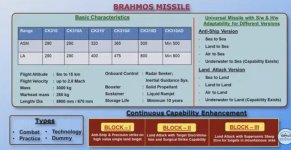
If we had used a mid course guidance update scheme, what would have happened? Suppose if the missile is flying thru a heavy EW environment during its midcourse and no link was possible between its obc and your satcom or other datalink, total comm blackout. Therefore no update was possible and your missile obc switched to INS again but in here the accuracy can be affected by 10s of meters due to that phase and target can be missed. Therefore both the mission time which is very short for Brahmos (300km within 5 mins vs 18-24 min for a subsonic cm) and no outside datalink/guidance dependency create the ultimate stealth effect. Your enemy will not be able to move or take precaution in enough time to avoid getting hit. That is why this missile is so deadly, if it had to depend on an external source for guidance, enemy could have detected that comm signature and still had enough time to take evasive action (because subsonic missile so longer flight time) and dodge the hit ie move their vital asset in time. But the complete silence and very quick action of Brahmos means enemy just do not get to react in time at all.

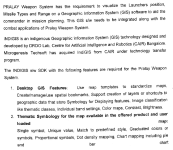
DRDO have a GIS linked with Pralay and other upcoming missile systems for good mission planning, which will help setting the location position (as opposed to pre surveyed) for better accurate INS initiation. The mission planning software also has a live map of every identified enemy ad and ew zones that is updated in real time , and the last update is stored in the missile obc memory. This helps in a way that the missile itself decides which areas to avoid and where to fly thru, all by itself. Pretty amazing.

1765035722933.png
 
Yes true, missiles as a complex multi domain integrated systems are prone to failures, in today's digital checkout era plenty of in stock products fail during the 5 phase checkout. So imagine what was the case back during 1970s 80s when entire system were mechanical hydraulic based and each section had to be entirely disintegrated for checkout purpose then reintegrated again. I think many can remember even during the Karachi Port raid, out of 8-10 or 11 missiles fired in total, 1 failed and did not meet mission requirement. So this happens very often. In today info age, we are in no position to verify the claim just by hearsay or simply looking at a video. This is why such extensive panel is formed and based on test reports the cause is established.

Any claim that some weapon system is more or less reliable based on probable (imaginary) shortfalls related to subsystem units need to be substantiated with verified proof, otherwise its frankly bogus. A high speed supersonic system needs a suitable sensor package proven to work in speed regime upto 2.5-3 times of working environment ie it has to be proven for speed > = 2000m/sec before being cleared as part of bill of material. It will not use any off the shelf tv camera based guidance or IR seeker that is not suitable for the purpose. This is how ruggedization is achieved, a very specific mil-grade solution for a specific purpose because mil grade items need to have very high tolerance limit for its role.

A degree of stealth is always built into a smart system like Brahmos & speed is its one unique feature among many. There are at least 3-4 level of redundancy built into it that gives it such unique capability.


So this is basically how the armed forces wanted the missiles to be, right from the k15 prithvi days and gradually implemented in other systems. A tactical purpose missile should be fire and forget, user can control upto launch moment but after that the missile has to be smart, it should not depend on any external guidance/datalink/satcom or need any external source update to perform its mission.
This is because as user we can not control the target zone environment, it is assumed the missile will be subject to heavy EW environment which degrades its ability to operate if it is dependent on outside comm source (like gps, position & bearing update). So the missile is made very smart with own obc and a dead reckoning navigation scheme is used , which means it is resistant to every kind of jamming or ew attack the enemy has implemented.
This is what ECM/ECCM means and why Brahmos , K15 or every other indigenous missile system we use. No amount of enemy interference will have any effect on its ability because Brahmos Pralay etc are all self contained systems. You only initiate the ins , this initiation is vital because here the accuracy is needed, but this initiation is at the launch point, and you control from where you will launch your missile. Once you initiate its guidance package, the missile obc takes over fully automated from that point to target hit with top notch accuracy. No other support is needed.

If we had used a mid course guidance update scheme, what would have happened? Suppose if the missile is flying thru a heavy EW environment during its midcourse and no link was possible between its obc and your satcom or other datalink, total comm blackout. Therefore no update was possible and your missile obc switched to INS again but in here the accuracy can be affected by 10s of meters due to that phase and target can be missed. Therefore both the mission time which is very short for Brahmos (300km within 5 mins vs 18-24 min for a subsonic cm) and no outside datalink/guidance dependency create the ultimate stealth effect. Your enemy will not be able to move or take precaution in enough time to avoid getting hit. That is why this missile is so deadly, if it had to depend on an external source for guidance, enemy could have detected that comm signature and still had enough time to take evasive action (because subsonic missile so longer flight time) and dodge the hit ie move their vital asset in time. But the complete silence and very quick action of Brahmos means enemy just do not get to react in time at all.

DRDO have a GIS linked with Pralay and other upcoming missile systems for good mission planning, which will help setting the location position (as opposed to pre surveyed) for better accurate INS initiation. The mission planning software also has a live map of every identified enemy ad and ew zones that is updated in real time , and the last update is stored in the missile obc memory. This helps in a way that the missile itself decides which areas to avoid and where to fly thru, all by itself. Pretty amazing.

View attachment 48181


That may be true of our BMs but not Brahmos. While there's a high degree of redundancy built into the Brahmos' guidance system via a dual INS, it is not entirely self contained - it uses GPS too.

Do you recall the 2009 Brahmos test that failed because of some GPS sats 'blinking' during the test window?


DRDO then introduced the G3OM chip that could accept Glonass and GAGAN updates too. Now IRNSS is available too.
 
That may be true of our BMs but not Brahmos. While there's a high degree of redundancy built into the Brahmos' guidance system via a dual INS, it is not entirely self contained - it uses GPS too.
All successful INS have to use a GPS or stellar augmentation to correct for INS wander error accumulation.
 
  • Like
Reactions: marich01
That may be true of our BMs but not Brahmos. While there's a high degree of redundancy built into the Brahmos' guidance system via a dual INS, it is not entirely self contained - it uses GPS too.

Do you recall the 2009 Brahmos test that failed because of some GPS sats 'blinking' during the test window?
This is why it is called dual-redundant guidance system. GPS/IRNSS/GLONASS is used for initialization part only. That is why the launch points are pre surveyed and location input is sent to the missile via telemetry antenna in the canister itself. This initialization is very very important, even a slight deviation will lead to 10s of meter of inaccuracy in the INS data, which is then filtered via various different algo in the OBC to arrive at the precise navigation. This is why our missiles are so much computation intensive and why so many tests are needed to prove the system because you are making this very smart flight vehicle fly like the way you want it to fly via computer generated command, with a pre programmed guidance scheme that provides the navigation data input via live sensor and map data all stored within the missile electronics bay to the missile; not the way this flight vehicle would have flown itself after launch. There is no need to rely on any outside data or command after launch. A self-sufficient smart system.

Major reason for using dual redundant guidance scheme ie pairing with sat data is to provide this initial launch point correct coordinate in INS terms, because INS is a dead reckoning system. It is not possible to jam the INS module, no matter how much anyone claims. But this module calculates by resonating/rotation wrt Earth magnetic field, which is why it is called tracking motion from a known start point. So obviously this start point co-ordinates are vital. It is also understandable this start point can be chosen by the user freely, even if there are widespread GPS denial you can still launch from a different suitable location, no one will be able to predict that except the user. Today enough sat coverage is available but still not enough accurate sat coverage is possible to get in our sub continent. Therefore multi constellation based accurate position determination & a GIS is now implemented across he board like you can see in case of Pralay above.

About the Brahmos test, during test they also use Beidou actively for data point, it is multi redundant, whichever coverage is found suitable is used. It is only for tests for drdo own data point collection, has no relation with how the missile works because for testing drdo has to use off the shelf instruments and sensors that work with existing mil grade connectivity. The actual missile guidance in wartime use only use multi constellation based position data for the correct initialization of the module then it is entirely the missile itself without any outside guidance.


DRDO then introduced the G3OM chip that could accept Glonass and GAGAN updates too. Now IRNSS is available too.
5 or more band based positioning data is used L1 to L5 and more, includes EU Galileo, our IRNSS too, Beidou and any available commercial satcom dataset. Test case use is harmless.
 
G80gFbkbcAA9et9