Indian Navy Inducts New Diving Support Vessel, To Serve As Mothership For DSRV
Published on 19/07/2025
By Adithya Krishna Menon
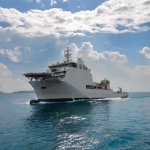 INS Nistar (Photo by Indian MoD).
INS Nistar, India’s first indigenously designed and constructed Diving Support Vessel, was commissioned into the Indian Navy on July 18, 2025.
INS
Nistar is the first of the two Diving Support Vessels (DSV) built by Hindustan Shipyard Limited (HSL), Visakhapatnam. These DSVs are designed to undertake deep sea saturation diving, salvage and rescue operations.
The order for DSVs was placed in September 2018. The keel of
Nistar was laid in December 2019. Delays occurred due to Covid pandemic, and both ships were launched in September 2022.
Nistar was delivered to the Indian Navy on July 8, 2025, at Visakhapatnam.
Nistar will be inducted into the Eastern Naval Command (ENC) headquartered in Visakhapatnam, which also hosts India’s nuclear-powered submarines.
The DSV design is over 118m long with a 23m beam and a displacement of over 10,000 tons. The cruise speed is 14 knots with an endurance of over 60 days at sea. Each DSV can accommodate 25 officers and 225 sailors.
To aid its primary mission set, INS
Nistar is installed with various equipment such as a Self-Propelled Hyperbaric Life Boat, Remotely Operated Underwater Vehicles of various types, chambers for compression management, side scan sonar, diving bell and a 15 ton class subsea crane. The propulsion setup is complex to ensure precise position keeping. The arrangement includes main engines, bow tunnel thrusters, a stern tunnel thruster and an azimuth retractable thruster. An NVG compliant front flight deck allows for helicopter operations. The ship has over 80% indigenous content according to HSL.
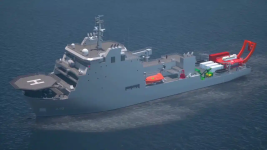 Various systems onboard the DSV (Screengrab from Indian Navy video showing port side)
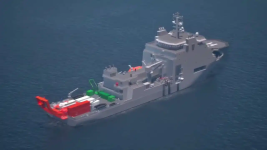 Various systems onboard the DSV (Screengrab from Indian Navy video showing starboard side)
The ship will also serve as the mothership for the Deep Submergence Rescue Vessel (DSRV) submarine rescue vehicle, to rescue and evacuate personnel, in case of an emergency in a submarine underwater. The DSRV forms the core component of the Submarine Rescue Intervention System onboard the DSVs. The DSVs can undertake diving and salvage operations up to
300m depth according to an Indian MoD press release, while an older release states
1000m.
The Indian Navy operates two DSRVs by JFD, ordered in 2016 under a £193m contract. According to JFD:
The contract included Deep Search and Rescue Vehicles (DSRV), Launch and Recovery Systems (LARS) equipment, Transfer Under Pressure (TUP) systems, and all logistics and support equipment required to operate the service. The contract also includes a 25-year all-encompassing maintenance support service.
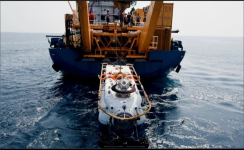 DSRV deployed from SCI Sabarmati (Photo by Indian Navy)
The
DSRVs were initially used without a proper mothership. SCI
Sabarmati was used as an interim mothership for one of the DSRVs. Both DSRVs were deployed by the Navy in 2021 after the Indonesian Navy Type-209 /1300 class submarine
KRI Nanggala (402) was reported missing on April 21, 2021 in waters north of Bali, Indonesia. SCI
Sabarmati with DSRV departed on April 21 while the 2nd DSRV was airlifted by April 23-24. However, the Indonesian submarine was declared
sunk with all hands lost before these DSRVs could be utilized for the search and rescue effort.
With the DSVs inducted to host the DSRVs, Indian Navy will have the ability to mount submarine rescue missions on both of its coasts. India also acquires the ability to assist nations in the Indian Ocean Region in case of any undersea mishap. For diving operations closer to the shore, the Navy had ordered five 300-ton class Diving Support Craft in 2021 from Titagarh.
Currently, the 3,500-ton diving support vessel
INS Nireekshak, commissioned in 1989, can also undertake submarine recuse missions. This ship was originally meant for commercial use and later retrofitted with diving equipment from the erstwhile Soviet origin INS
Nistar.
With various ROVs and other relevant equipment, the HSL DSVs can potentially enable
seabed warfare operations which is quickly turning out to be a major focus for global navies. The Indian Navy is yet to take major overt steps towards fielding such capabilities.
Indian Navy Inducts New Diving Support Vessel, To Serve As Mothership For DSRV - Naval News




 . Then there is HAL