Auxiliary Ships of Indian Navy : News and Discussions

Looks like she carries 02 30mm NSG and 02 12.7mm SRCG.
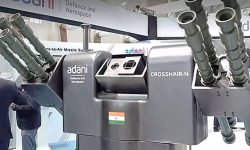
Near the helo deck & around that 30 mm turret, there are a bunch of small masts. I think those are VSHORAD launchers:
1750448169030.png
6 launchers at the rear, 8 missiles per launcher 48 missiles w/o reload. Could be higher if under-deck reloads are available. Foredeck &/or mid-deck could also have some launchers which may not be visible from this angle.

VSHORADS, 12.7mm RCWS & 30mm turrets can deal with drones, loitering munitions & other point defence duties. Medium & longer-range AD will be handled by other ships in its escort.
 
The Navy is looking for a dozen minesweepers, to be built in India and they are similar to modern international versions, at about 3,000 tons, versatile, with multiple functions including minelaying and anti-submarine warfare. With each minesweeper costing over Rs 3,500 crores, the entire package is likely to be Rs 43,000 crores. After clearance, an Indian shipyard will make them. While Goa Shipyards has the necessary infrastructure, sources said, the decision on the shipyard will be made on a "competitive basis."

Interesting, so its not just a minesweepers.

 
Interesting, so its not just a minesweepers.

I'd say wait for further details because we've seen several news agencies spread misinformation after some kind of defence developments, be it the F 35 after Trump meeting, Su 57 after Op Sindoor, etc.
 
Major boost to the shipping industry - Navy to bring a proposal for purchase of minesweepers worth 44,000 cr; QRSAM Systems also likely to be approved for Army worth 30,000 cr

The new MCMVs likely won't be GRP hulled. It carries USV/ROV to do the job from a standoff distance.

You'd recall that Korean and Italian cos refused ToT for GRP to GSL last time. Wonder what's so sensitive (wrt metallurgy) about torpedo tubes and GRP plates?
 
GvVyeQqXYAA2y1c

GvVyefBW8AADn0H

HSL today delivered the Diving Support Vessel, Nistar, to the Indian Navy.

 
  • Like
Reactions: Gautam and Chicu01

INDIAN NAVY TO COMMISSION THE FIRST INDIGENOUS DIVING SUPPORT VESSEL – ‘NISTAR’

Posted On: 10 JUL 2025 4:36PM by PIB Delhi

Indian Navy is all set to commission the first of the class Diving Support Vessel (DSV) Nistar at Naval Dockyard, Visakhapatnam on 18 Jul 2025 in the presence of the Hon'ble Raksha Mantri Shri Rajnath Singh. The event marks the formal induction of the ship which has been indigenously designed and constructed by M/s Hindustan Shipyard Limited, Visakhapatnam. On commissioning, the ship will join the Eastern Naval Command to support deep sea diving and submarine rescue operations.

⁠The ship is a testament to the GoI's resolute focus on nation building through self-reliance in defence production and unwavering focus on Aatmanirbharta. A total of 120 MSMEs have participated in the construction of this ambitious, unique and state-of-the-art vessel, achieving more than 80% indigenous content. The project is a step towards realising the Indian Navy's vision of designing and constructing complex indigenous platforms.

⁠In her earlier avatar ex-Nistar, was a submarine rescue vessel which was acquired by the Indian Navy from the erstwhile USSR in 1969 and commissioned in 1971. In two decades of service, she had significantly contributed towards the Indian Navy's diving and submarine rescue operations. With the commissioning of this ship, the legacy of ex-Nistar continues onwards, with her motto 'Surakshita Yatharthta Shauryam' translating to 'Deliverance with Precision and Bravery', aptly reflecting the main roles of the ship.

With a length of approx 120 meters and displacing of more than 10,000 tons, the DSV has the capacity to maintain its position with extreme accuracy, using Dynamic Positioning System. The expansive diving complex onboard which consists of both Air and Saturation Diving Systems, along with underwater Remotely Operated Vehicles (ROVs) and Side Scan SONAR, substantially enhances the operational envelope of the vessel. As the ‘Mother Ship’ for the Deep Submergence Rescue Vehicle (DRV), the induction of this platform would provide a major capability enhancement to Indian Navy's Submarine rescue preparedness.

The ship is also outfitted with an Operation Theatre, Intensive Care Unit, Eight Bedded Hospital and Hyperbaric Medical Facilities which are critical towards meeting her operational roles.

Endurance of over 60 days at sea, capacity to undertake stage through helicopter operations and a 15-ton subsea crane make the ship a very versatile platform.

⁠The commissioning of Nistar and its induction into the Indian Navy's Eastern Naval Command will not only enhance India's operational preparedness in the underwater domain, but will also reinforce its strategic maritime posture across the Indian Ocean Region.

 
Indian Navy Inducts New Diving Support Vessel, To Serve As Mothership For DSRV

Published on 19/07/2025
By Adithya Krishna Menon
1752931176513.png
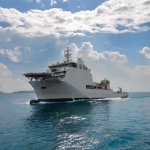
INS Nistar (Photo by Indian MoD).

INS Nistar, India’s first indigenously designed and constructed Diving Support Vessel, was commissioned into the Indian Navy on July 18, 2025.

INS Nistar is the first of the two Diving Support Vessels (DSV) built by Hindustan Shipyard Limited (HSL), Visakhapatnam. These DSVs are designed to undertake deep sea saturation diving, salvage and rescue operations.

The order for DSVs was placed in September 2018. The keel of Nistar was laid in December 2019. Delays occurred due to Covid pandemic, and both ships were launched in September 2022. Nistar was delivered to the Indian Navy on July 8, 2025, at Visakhapatnam. Nistar will be inducted into the Eastern Naval Command (ENC) headquartered in Visakhapatnam, which also hosts India’s nuclear-powered submarines.

The DSV design is over 118m long with a 23m beam and a displacement of over 10,000 tons. The cruise speed is 14 knots with an endurance of over 60 days at sea. Each DSV can accommodate 25 officers and 225 sailors.

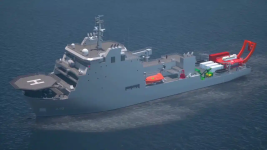
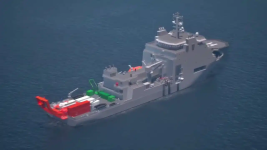
To aid its primary mission set, INS Nistar is installed with various equipment such as a Self-Propelled Hyperbaric Life Boat, Remotely Operated Underwater Vehicles of various types, chambers for compression management, side scan sonar, diving bell and a 15 ton class subsea crane. The propulsion setup is complex to ensure precise position keeping. The arrangement includes main engines, bow tunnel thrusters, a stern tunnel thruster and an azimuth retractable thruster. An NVG compliant front flight deck allows for helicopter operations. The ship has over 80% indigenous content according to HSL.
1752930996247.png
Various systems onboard the DSV (Screengrab from Indian Navy video showing port side)
1752931043120.png
Various systems onboard the DSV (Screengrab from Indian Navy video showing starboard side)

The ship will also serve as the mothership for the Deep Submergence Rescue Vessel (DSRV) submarine rescue vehicle, to rescue and evacuate personnel, in case of an emergency in a submarine underwater. The DSRV forms the core component of the Submarine Rescue Intervention System onboard the DSVs. The DSVs can undertake diving and salvage operations up to 300m depth according to an Indian MoD press release, while an older release states 1000m.

The Indian Navy operates two DSRVs by JFD, ordered in 2016 under a £193m contract. According to JFD:

The contract included Deep Search and Rescue Vehicles (DSRV), Launch and Recovery Systems (LARS) equipment, Transfer Under Pressure (TUP) systems, and all logistics and support equipment required to operate the service. The contract also includes a 25-year all-encompassing maintenance support service.
1752930845625.png
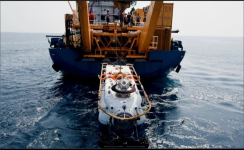
DSRV deployed from SCI Sabarmati (Photo by Indian Navy)

The DSRVs were initially used without a proper mothership. SCI Sabarmati was used as an interim mothership for one of the DSRVs. Both DSRVs were deployed by the Navy in 2021 after the Indonesian Navy Type-209 /1300 class submarine KRI Nanggala (402) was reported missing on April 21, 2021 in waters north of Bali, Indonesia. SCI Sabarmati with DSRV departed on April 21 while the 2nd DSRV was airlifted by April 23-24. However, the Indonesian submarine was declared sunk with all hands lost before these DSRVs could be utilized for the search and rescue effort.

With the DSVs inducted to host the DSRVs, Indian Navy will have the ability to mount submarine rescue missions on both of its coasts. India also acquires the ability to assist nations in the Indian Ocean Region in case of any undersea mishap. For diving operations closer to the shore, the Navy had ordered five 300-ton class Diving Support Craft in 2021 from Titagarh.

Currently, the 3,500-ton diving support vessel INS Nireekshak, commissioned in 1989, can also undertake submarine recuse missions. This ship was originally meant for commercial use and later retrofitted with diving equipment from the erstwhile Soviet origin INS Nistar.

With various ROVs and other relevant equipment, the HSL DSVs can potentially enable seabed warfare operations which is quickly turning out to be a major focus for global navies. The Indian Navy is yet to take major overt steps towards fielding such capabilities.

Indian Navy Inducts New Diving Support Vessel, To Serve As Mothership For DSRV - Naval News

 

Titagarh Rail Systems Limited (TRSL) marked a key milestone in its shipbuilding journey with the launch of the third indigenously built Diving Support Craft (DSC) for the Indian Navy. The vessel is part of a series of five DSCs being built by TRSL under the Make in India initiative of the Ministry of Defence.

The launch ceremony was graced by Mrs. Kangana Berry, wife of Vice Admiral Suraj Berry, AVSM, NM, VSM, Commander-in-Chief, who performed the traditional naming and launch of the vessel. The craft was side launched into the Hooghly River at 16:10 PM.

Diving Support Crafts are catamaran-type vessels, designed and built with advanced equipment sourced from indigenous manufacturers. They are equipped to support the Indian Navy’s Command Clearance Diving Teams (CCDTs) in critical operations such as underwater repair, maintenance, and salvage of ships inside and around harbours.

The Diving Support Crafts will also serve as advanced training platforms for the Navy’s diving cadre, enhancing operational readiness. With the successful launch of the third DSC, TRSL’s Shipbuilding and Maritime Systems (SMS) Division continues to demonstrate its ability to deliver complex, high-precision vessels for the armed forces.


As recently announced, the board of directors of TRSL has approved the creation of a new entity to which the SMS business will be transferred. This restructuring aims to optimise the growth of the business, while TRSL continues to focus on its core rail sector.

 
  • Like
Reactions: aditya g