Arihant-class SSBN - News & Discussions

The ATVP has already begun construction of the first two units of the S5 SSBNs, which at 13,500 tons are twice the size of the Arihant-class submarines. The first S5 will enter service in the early 2030s. A total of four S5 SSBNs will be acquired by the late 2030s.
With 04 S5 class subs being planned we might not see any SSGN conversion of Arihant class as previously expected.
 
With 04 S5 class subs being planned we might not see any SSGN conversion of Arihant class as previously expected.
Arihants are sort of moving deterrent against a CBG anyway, the original idea why such a small design iteration & weapon were conceived. We know our scientists make what they are told, in this case ATVP was started to have own capability of what he Rus ssbn offered. That is why there are 2 in each batch.

No one in their right mind would call k15 a BM to be used as a nuke delivery mechanism, it is simply not even though it can theoretically. The underwater booster design is retained for brahmos sub launch, another high priority project from the 90s. Given that one is conventional & the other is strategic & both got own roles, it is not too hard to imagine the intended role. A carrier sized target can not be damaged/sank easily with flurry of brahmos salvo, it needs very high payload used against and from a large distance.
 
BREAKING. India’s fourth SSBN S-4* sails out for sea trials.


Great news!

What's even more amazing is this bit in the report:

"The ATVP has already begun construction of the first two units of the S5 SSBNs"

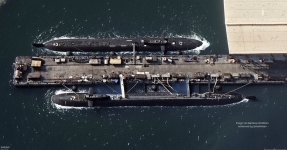
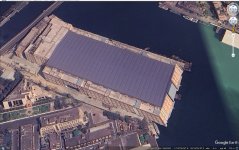
That means the S5 class will indeed be built in the existing dry dock at SBC Vizag (the same one that built the Arihant-class boats), whereas the new larger dry dock that's coming up beside it will exclusively cater to the Project-77 SSN program. While I estimate the new dry dock to be capable of comfortably accommodating up to at least 3 hulls side by side under various stages of outfitting at the same time, the Navy has only ordered 2 SSNs in the first tranche. So I don't expect the new dock's capacity to be fully utilized from the get-go.

GoAsvKCXkAAaLVj.jpeg
 
Arihants are sort of moving deterrent against a CBG anyway, the original idea why such a small design iteration & weapon were conceived. We know our scientists make what they are told, in this case ATVP was started to have own capability of what he Rus ssbn offered. That is why there are 2 in each batch.

No one in their right mind would call k15 a BM to be used as a nuke delivery mechanism, it is simply not even though it can theoretically. The underwater booster design is retained for brahmos sub launch, another high priority project from the 90s. Given that one is conventional & the other is strategic & both got own roles, it is not too hard to imagine the intended role. A carrier sized target can not be damaged/sank easily with flurry of brahmos salvo, it needs very high payload used against and from a large distance.
No other R&D agency would have attempted to do what DRDO has- converting an SSN into a SSBN given all the design constraints that would've entailed.

In the 90s, Sagarika was reported by Western intel (US ONI etc) as being a strategic cruise missile with ~300km range being developed with Russian help. A few years later, they said the Sagarika prog included both a BM and a CM. Until finally, India officially declared it was building an SSBN and that it would carry a hybrid missile.

K-15 is certainly n capable with a payload capacity of 800-1000kg. As a quasi-BM, it is survivable and keeps the Chinese on notice. Now K4 is taking us into credible minimum deterrent territory, even though compromises had to be made in its design. Pralay reportedly has a mmw radar seeker so it could concievably be used as a carrier killer but not the original K-15, I'd imagine.
 
Last edited:
  • Like
Reactions: PhotonVish
No other R&D agency would have attempted to do what DRDO has- converting an SSN into a SSBN given all the design constraints that would've entailed.
It is possibly due to us not being able to afford the needed huge tranches of such deterrent platforms like Rus/Soviet did, due to cost & manpower involved. Hence a jugaad sort of way, an ssbn that can act as ssn against a cbg, can act as ssbn against Pak+China due to compatible 2 types of missiles. In the land vector we have both A3 class and A4 class each playing different roles. Similar roles are created for the sea leg imo.

In the 90s, Sagarika was reported by Western intel (US ONI etc) as being a strategic cruise missile with ~300km range being developed with Russian help. A few years later, they said the Sagarika prog included both a BM and a CM.
Western intel has always had to rely on guesswork, so it is not surprising. No one knew the true nature so various theories were put up.
 
Great news!

What's even more amazing is this bit in the report:

"The ATVP has already begun construction of the first two units of the S5 SSBNs"

That means the S5 class will indeed be built in the existing dry dock at SBC Vizag (the same one that built the Arihant-class boats), whereas the new larger dry dock that's coming up beside it will exclusively cater to the Project-77 SSN program. While I estimate the new dry dock to be capable of comfortably accommodating up to at least 3 hulls side by side under various stages of outfitting at the same time, the Navy has only ordered 2 SSNs in the first tranche. So I don't expect the new dock's capacity to be fully utilized from the get-go.
my guess is it will be 2 concurrent hulls. Very hard to have all jigs tool set up for 3 separate lines, very costly too and have enough manpower available.
 
my guess is it will be 2 concurrent hulls. Very hard to have all jigs tool set up for 3 separate lines, very costly too and have enough manpower available.

Yea, I haven't measured the exact dimensions but I reckon the first drydock is long enough to accommodate two S5 hulls, one behind the other.

Or at least one full hull along with several joined sections of a second one, which will be finished once the first one is pushed into water.
 
Hence a jugaad sort of way, an ssbn that can act as ssn against a cbg, can act as ssbn against Pak+China due to compatible 2 types of missiles
Imo, not practical due to SSBNs being strategic assets (by definition) under the control of SFC. As an NFU state, doing this could result in catastrophic miscalculations by our adversaries. Besides, Arihant would be underpowered for the SSN role.
 
Great news!

What's even more amazing is this bit in the report:

"The ATVP has already begun construction of the first two units of the S5 SSBNs"

That means the S5 class will indeed be built in the existing dry dock at SBC Vizag (the same one that built the Arihant-class boats), whereas the new larger dry dock that's coming up beside it will exclusively cater to the Project-77 SSN program. While I estimate the new dry dock to be capable of comfortably accommodating up to at least 3 hulls side by side under various stages of outfitting at the same time, the Navy has only ordered 2 SSNs in the first tranche. So I don't expect the new dock's capacity to be fully utilized from the get-go.

View attachment 48686
For that you will have to assume 30 years back they had the foresight to build space for 12,000+ ton/140+ meter dry doc for a proper SSBN. I wouldn't count on that.
 
Now K4 is taking us into credible minimum deterrent territory, even though compromises had to be made in its design. Pralay reportedly has a mmw radar seeker so it could concievably be used as a carrier killer but not the original K-15, I'd imagine.
What compromises? Its a fantastic mechanism, core change that has gone thru is moving from maraging steel airframe era to composite airframe & equivalent compatible propellant class, better avionics, electronic packaging, way better on board software nav-control system, much improved multi channel link, from single controller based electrohydraulic actuation to quad/multi ema. Todays system is absolutely as state of the art as it goes, possibly dwarfs some western stuff.

Btw a land attack version missile can never be used successfully as a large naval ship killer without making major alteration to its entire programming. If you see how a subsonic cruise missile strike against a land target vs how it strikes a ship, you will understand.

[EDIT : 2 posts got merged, below is is not part of above reply]

Good program that Unnithan sir shared today

 
Imo, not practical due to SSBNs being strategic assets (by definition) under the control of SFC. As an NFU state, doing this could result in catastrophic miscalculations by our adversaries. Besides, Arihant would be underpowered for the SSN role.
Its not that impractical either. There are only a handful of countries that operate large carriers, and only 1 that regularly threatens countries with it and all/most of its carriers are nuclear powered. This means by our stated doctrine we are threatened with use of nuclear force, it can be interpreted in exact that way. No two other option , either stay away or try to engage with us with a nuke powered/strategic asset, zero sum game. In this circumstances I reserve the right to sink this asset that is threatening me by using my own strategic asset, that is INS Arihant.
 
  • Like
Reactions: Aniruddha
What compromises? Its a fantastic mechanism, core change that has gone thru is moving from maraging steel airframe era to composite airframe & equivalent compatible propellant class, better avionics, electronic packaging, way better on board software nav-control system, much improved multi channel link, from single controller based electrohydraulic actuation to quad/multi ema. Todays system is absolutely as state of the art as it goes, possibly dwarfs some western stuff.
No doubt it is a compact system with a massive 2t payload and respectable range. The compromises are more to do with the Arihant class than K4 itself. For example, the boat's VLS dimensions would have restricted the K4 dia to 1.4m. Secondly, as South Block pointed out the Arihant's gas ejection system must have been designed with K15 in mind with K-4 being an afterthought. This would've necessitated the nose tractor ejection system, adding weight and complexity.

Had gas ejection been possible for K4, perhaps the launch depth could've been higher (~15m), increasing the Arihant's indiscretion rate.
 
  • Like
Reactions: Rajput Lion
Its not that impractical either. There are only a handful of countries that operate large carriers, and only 1 that regularly threatens countries with it and all/most of its carriers are nuclear powered. This means by our stated doctrine we are threatened with use of nuclear force, it can be interpreted in exact that way. No two other option , either stay away or try to engage with us with a nuke powered/strategic asset, zero sum game. In this circumstances I reserve the right to sink this asset that is threatening me by using my own strategic asset, that is INS Arihant.
We are developing a comprehensive A2/AD network extending ~2000km around our coastline to deter this kind of scenario.

This includes everything from land-based ASBM (Agni-P/Pralay/future hypersonics), OTHR, SBS 3, P77, Brahmos-A, et all.

I don't think either party would be so cavalier about climbing the n escalation ladder.
 
Great news!

What's even more amazing is this bit in the report:

"The ATVP has already begun construction of the first two units of the S5 SSBNs"

That means the S5 class will indeed be built in the existing dry dock at SBC Vizag (the same one that built the Arihant-class boats), whereas the new larger dry dock that's coming up beside it will exclusively cater to the Project-77 SSN program. While I estimate the new dry dock to be capable of comfortably accommodating up to at least 3 hulls side by side under various stages of outfitting at the same time, the Navy has only ordered 2 SSNs in the first tranche. So I don't expect the new dock's capacity to be fully utilized from the get-go.

View attachment 48686
Sir they are producing 2 S5 class at the same time?
These are perhaps one of the only few weapons and capabilities we have that causes sleepless nights to those in Beijing.

For that you will have to assume 30 years back they had the foresight to build space for 12,000+ ton/140+ meter dry doc for a proper SSBN. I wouldn't count on that.
With all due respect, I would. Remember the snippets of the book "Weapons of Peace" by Raj Chengappa I shared some time back? Our SSBN programs had the highest support and funding from the highest political levels of the country from the very beginning, its not too unrealistic to assume they would have envisaged building such a capability a while ago. Even Chidambaram under UPA correctly understood that a SSBN carrying omly 4 long range SLBMs cannot justify the cost and ordered the addition of 4 more cubes which birthed the S4 and S4* program, this incident shows that this program certainly didnt lack foresight.
 
The 200MWe reactor design for S5 and P77 (likely based on Russia's OK-650B) is also ready. 10 year refueling cycle.

The Chinese apparently use 2 75 MWth for their Type 93 and it has only 10% or so enriched uranium which means currently our reactor tech for submarines is almost on par if not on par with Chinese and with the 200 MWth reactor we will perhaps surpass them in this domain.
 
No doubt it is a compact system with a massive 2t payload and respectable range. The compromises are more to do with the Arihant class than K4 itself. For example, the boat's VLS dimensions would have restricted the K4 dia to 1.4m. Secondly, as South Block pointed out the Arihant's gas ejection system must have been designed with K15 in mind with K-4 being an afterthought. This would've necessitated the nose tractor ejection system, adding weight and complexity.

Had gas ejection been possible for K4, perhaps the launch depth could've been higher (~15m), increasing the Arihant's indiscretion rate.
Arihant size does influence the article it can launch but the conscious choice for some IRBM class SLBM show it is planned rather than a forced decision. Not sure many, if any IRBM class slbm is in service by the nations that operate ssbn. Without knowing the arihant silo dia, we can not tell even why it was made that way. But it is likely how we have progressively built our capability. So a submarine purpose article was derived from the Agni 4 class first stage , both A1P and A4 have same dia 1.2m , that for submarine use evolved into a 1.4m stage booster-sustainer stage. Similarly the 2m dia class A3 A5 now get translated into 2.4m dia SLBM K5. We could easily have built K5 with same A5 characteristics for easier weapon system integration, but it did not happen.
Next up, we have the new shell being made to be proven, the 3m dia class massive slbm likely K6 with very large payload. If it is proven then S5 will also deploy its goodies in similar fashion like arihant did with k15 and k4.

K4 being very slim comparatively can not sustain deep underwater launch with a heavy payload on top, the transition from water to air would not be as smooth without that nose mounted tractor puller mechanism. After all we have to acknowledge the restriction it has, something A5 like article can survive pushing thru water from a deep position, but a slimmer K4 will have problem both unilaterally pushing thru from 30-40m deep or quick push thru like K15 similar to a brahmos underwater launch, esp with a 2 ton class payload. This is self imposed design choice. In this regard the ejectable nosecap use means K4 is able for both a high payload delivery and a depressed trajectory based flight profile, it can fly like k15 in similar fashion for a shorter haul.

The VLS dimension is not that severely restricted imo. You need to know the gas dynamics inside the tube, the tolerance limit of the seal and force on the end rings that hold vls upright in silo. These parts are needed to be very precision make with high shelf life, with zero error tolerance so the sub itself is not affected & able to absorb the shock & vibration via the shock absorber mechanism in place.

 
Arihant size does influence the article it can launch but the conscious choice for some IRBM class SLBM show it is planned rather than a forced decision. Not sure many, if any IRBM class slbm is in service by the nations that operate ssbn. Without knowing the arihant silo dia, we can not tell even why it was made that way. But it is likely how we have progressively built our capability. So a submarine purpose article was derived from the Agni 4 class first stage , both A1P and A4 have same dia 1.2m , that for submarine use evolved into a 1.4m stage booster-sustainer stage. Similarly the 2m dia class A3 A5 now get translated into 2.4m dia SLBM K5. We could easily have built K5 with same A5 characteristics for easier weapon system integration, but it did not happen.
Next up, we have the new shell being made to be proven, the 3m dia class massive slbm likely K6 with very large payload. If it is proven then S5 will also deploy its goodies in similar fashion like arihant did with k15 and k4.

K4 being very slim comparatively can not sustain deep underwater launch with a heavy payload on top, the transition from water to air would not be as smooth without that nose mounted tractor puller mechanism. After all we have to acknowledge the restriction it has, something A5 like article can survive pushing thru water from a deep position, but a slimmer K4 will have problem both unilaterally pushing thru from 30-40m deep or quick push thru like K15 similar to a brahmos underwater launch, esp with a 2 ton class payload. This is self imposed design choice. In this regard the ejectable nosecap use means K4 is able for both a high payload delivery and a depressed trajectory based flight profile, it can fly like k15 in similar fashion for a shorter haul.

The VLS dimension is not that severely restricted imo. You need to know the gas dynamics inside the tube, the tolerance limit of the seal and force on the end rings that hold vls upright in silo. These parts are needed to be very precision make with high shelf life, with zero error tolerance so the sub itself is not affected & able to absorb the shock & vibration via the shock absorber mechanism in place.

Post-1971, we set out to build a ssn fleet that could deter USN CBGs. The switch to SSBN was dictated by a strategic assessment of the Chinese n prog and its implications for India's security.

Because Arihant is a SSN design repurposed into SSBN, it could only accommodate 4 VLS tubes in a single row. This arrangement had never been done before and it couldn't have been a deliberate choice.

The IN wouldn't have settled for it unless there were severe technical risks. The dimensions of the reactor or the shielding/bulkheads required for the 1st gen 83MWe CLWR reactor too could have imposed space limitations, imo. The reactor was underpowered to begin with, precluding hull extension.

One can only speculate that the gas generator mechanism likely doesn't generate enough pressure to eject the much heavier K4 compared to the K15. This would've necessitated the tractor puller mechanism on the nose to ensure safe deployment.
 
Post-1971, we set out to build a ssn fleet that could deter USN CBGs. The switch to SSBN was dictated by a strategic assessment of the Chinese n prog and its implications for India's security.

Because Arihant is a SSN design repurposed into SSBN, it could only accommodate 4 VLS tubes in a single row. This arrangement had never been done before and it couldn't have been a deliberate choice.
Most likely it was not, a fine balance between the economic aspect (wrt financial situation in the 70s & 80s) of the country vs the strategic need , esp as this program was the sole way of building an underwater fleet.

the reason why ssbn program did not culminate into the ssn program up until now was again the political indecision, or lack of motivation. Our political leadership was happy with minimum credible deterrence doctrine. Hence neither the knowledge gained from Prithvi Agnis translated further into conventional war weapons like how China did , because GoI never intended for domestic proliferation into conventional war fighting instrument.

Why this is relevant wrt your 2nd para, we could easily have expanded arihant class 6k ton subs and built more as ssgn, just for pure nos like soviets did, or china do now. But the top chair occupying political leader would deny any such request even if the armed forces had presented one to them.
So if there is no go ahead from the leadership, or a strict denial to be more precise, how can the builders explore varied application except for building a stretched S4 class? We should have built at least 4 in each batch. Just this no along with our surface fleet would have deterred any chinese incursion that we are facing, even without being true ssn or ssbn.

The IN wouldn't have settled for it unless there were severe technical risks. The dimensions of the reactor or the shielding/bulkheads required for the 1st gen 83MWe CLWR reactor too could have imposed space limitations, imo. The reactor was underpowered to begin with, precluding hull extension.

One can only speculate that the gas generator mechanism likely doesn't generate enough pressure to eject the much heavier K4 compared to the K15. This would've necessitated the tractor puller mechanism on the nose to ensure safe deployment.
I can not tell about the reactor part, but on the slbm front most of the in service missiles are 2m dia or more huge sized right ? that means much higher powerful gas ejection method can be implemented in the 2.2m or more dia tubes. K-4 being much slimmer simply can not generate that level of release thrust obviously. Even if you try to use A5 GG for the canister launch, during transition from silo tube to water the missile would tumble & lose balance due to huge initial shock against the outside water layer beyond its tolerance imo. Therefore it is better to use a puller mechanism that clears the water surface then ignites the booster stage. Ejected nosecap means no need to carry this excess weight after job done.

Why this is imp wrt the point of not generating enough pressure, here we have to consider the well being & safety of the submarine too. Arihant batch is prob not built for very high powerful rocket launch lke trident class or our K5 batch (justified by your ssn to ssbn conversion point). So using a much powerful canister launch mechanism is out of question. So to keep safety of the boat as well as a clean launch method while being submerged, this current mechanism is very well suited and executed + proven. It is a compromise but a well suited one.