
Arihant-class SSBN - News & Discussions
- Thread starter Nick
- Start date
You are using an out of date browser. It may not display this or other websites correctly.
You should upgrade or use an alternative browser.
You should upgrade or use an alternative browser.




Arihant class nuclear-powered submarine S4* likely to be named INS Arisudan
The names of all Indian nuclear submarines —Arihant, Arighaat, Aridhaman, and now, Arisudan — mean destroyer of enemies.| India News
 www.hindustantimes.com

The ICS is the new generation submarine-based defence system vital for underwater warfare and anti-submarine operations.
It is a system of systems that gives unparalleled situational awareness by providing the threat picture to make tactical decisions and actions like weapon selection, launch and guidance.
The ICS is a collaborative effort from 8 DRDO laboratories with active involvement of about 150 major industry partners and MSMEs across
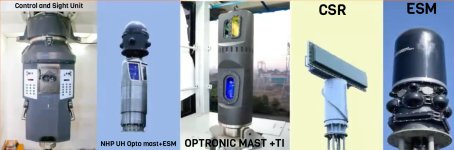
DRDO's new generation Cylindrical Array Sonar (CAS) and Intercept sonar:



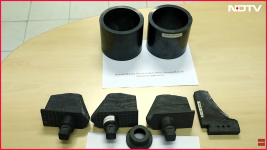
DMRL developed Reaction bonded SiC bearing bushings developed for submarines:



Arihant influenced by Russian design philosophy of double hull configuration does provides a large buoyancy reserve & certain survivability advantages...... However, for a nuclear submarine specially (SSBN), stealth and acoustic quieting are the most critical factors...... The common assumption that a double hull design is inherently quieter because it appears larger & wider is somewhat misleading. In reality, the diameter of the inner pressure hull where the reactor, machinery & acoustic isolation systems are installed largely determines the available space for sound dampening equipment. Despite their wider external beam, many double hull submarines have similar or even smaller inner pressure hull compared to single hull Western designs. For instance, the Borei-A class submarine, often claimed to be double quiet than Virginia class SSN has a beam of about 13.5 meters, yet its inner pressure hull diameter is roughly 11 meters, only about 1 meter wider than Virginia & still smaller than the pressure hulls of Ohio class submarine & the upcoming Columbia class submarine, which approaches 13 meters. Larger pressure hulls in these Western SSBNs allow more room for advanced acoustic isolation, raft mounted machinery & vibration dampening systems achieved with lower overall displacement & reduced hydrodynamic surface area both of which are beneficial for stealth....... Moreover, Western submarine programs typically emphasize extremely strict manufacturing tolerances, high precision construction & advanced noise reduction technologies. Arihant faces similar structural & acoustic constraints to Russian design but on a much larger scale..... Given the central importance of stealth in strategic deterrence, it may be worthwhile for future program to reconsider design philosophy & explore alternative approaches prioritizing larger single pressure hull design regards.
The outer hull can theoretically be layered with anaechoic tiles on either side for better silencing, imo.
In any case, the space between the inner and outer hulls is not dead weight (w/ballast tanks, et all).
It is used to house countermeasure dispensers, flank array sonars and in the future uuv launchers.
In any case, the space between the inner and outer hulls is not dead weight (w/ballast tanks, et all).
It is used to house countermeasure dispensers, flank array sonars and in the future uuv launchers.
More surface area of double hull means more noise propagation if isolation & dampening is not done properly & they don't use Anechoic tiles outside inner pressure hull because it effects are negligible.... Double hull increase displacement significantly affecting speed which is necessary specially for SSN.... More power would be required to achieve the desire results resulting in higher dB levels. You can house counter measures inside pressure hull like it is done in single hull subs & UUV can be mounted outside the hull without any space constraints.The outer hull can theoretically be layered with anaechoic tiles on either side for better silencing, imo.
In any case, the space between the inner and outer hulls is not dead weight (w/ballast tanks, et all).
It is used to house countermeasure dispensers, flank array sonars and in the future uuv launchers.
There is one more problem among many with Russian design philosophy but not to do with hull design but the type of enriched uranium used in their & ours naval reactors compared to the fuel approaches typically used by the United States and the United Kingdom,.
they don't use Anechoic tiles outside inner pressure hull because it effects are negligible...
No. I'm only talking about both sides (topside and underside) of the outer hull. Iirc, the upcoming UK Dreadnought class ssbn features such an arrangement. Although they seem to have chosen double/partial double hull construction mainly to allow angled shaping as seen on the Astute class ssn.
It's not double hull in true sense, the difference between outer & inner pressure hull in case of dreadnought is negligible. The beam of dreadnought is 12.8 meter with inner pressure hull being 12 meter. That's 0.4 meter difference on both sides which is negligible & is only there to provide slightly angular hull shape & nothing more. Compare this to massive 2.5 meter gap between Borie hulls which is a proper double hull submarine.No. I'm only talking about both sides (topside and underside) of the outer hull. Iirc, the upcoming UK Dreadnought class ssbn features such an arrangement. Although they seem to have chosen double/partial double hull construction mainly to allow angled shaping as seen on the Astute class ssn.
It's not double hull in true sense, the difference between outer & inner pressure hull in case of dreadnought is negligible. The beam of dreadnought is 12.8 meter with inner pressure hull being 12 meter. That's 0.4 meter difference on both sides which is negligible & is only there to provide slightly angular hull shape & nothing more. Compare this to massive 2.5 meter gap between Borie hulls which is a proper double hull submarine.
True. The outer hull on the Dreadnought is only there for stealth reasons. Here's an interesting article on the many tech innovations on that boat.

Dreadnought: Meet the UK's 'undersea Armageddon' - Asia Times
Now you hear it, now you don't. So how are you going to kill it, if you don't know where it is. There's a heckuva lot of deep, blue ocean out there, and
 asiatimes.com
Apparently, new gen Russian Yasen class boats are reportedly going the same route wrt hull construction.
Yasen is partial double hull SSGN. It's surfaced displacement is 8,600 tons while submerged is 13,800 tons. That's a massive 5,200 tons ( Suffren SSN when submerged level ) difference. You can't have such a different if the sub is only single hull. Dreadnought for most part being a single hull will have buoyancy reserve ranging between 10 to 15 % of submerged displacement like a typical western submarine. That will give a surface displacement around 14,600 to 15,500 tons surfaced & 17,200 submerged.True. The outer hull on the Dreadnought is only there for stealth reasons. Here's an interesting article on the many tech innovations on that boat.
Dreadnought: Meet the UK's 'undersea Armageddon' - Asia Times
Now you hear it, now you don't. So how are you going to kill it, if you don't know where it is. There's a heckuva lot of deep, blue ocean out there, and
Apparently, new gen Russian Yasen class boats are reportedly going the same route wrt hull construction.

Isn't the 5th SSBN the first boat of the S5 class.
Also work on the first 2 boats of the S5 class began simultaneously, so shouldn't the headline read 5th & 6th SSBN in the works?

Nobody knows except top level people. Rest everyone is gossiping!Isn't the 5th SSBN the first boat of the S5 class.
Also work on the first 2 boats of the S5 class began simultaneously, so shouldn't the headline read 5th & 6th SSBN in the works?