GTRE Kaveri Engine

Brace Yourself Here We Go GIF by MOODMAN


The low IQ retards of Indian defense strike again.
These idiots literally have no other job than yap garbage in front of the screen and their d*ckriders in the comments section praise them as if its some gospel truth
 
Jet Engine programmes running at this time under DRDO-
1. KDE
2. Kaveri after burner with 73 kn thrust to be paired with Tejas LSP
3. Kaveri afterburner with improve thrust for 85 kn thrust
4. Indegenous high thrust engine going for ground engine test bed with aim to achieve overall pressure ratio of 30 i.e. equavalent to F414
5. Two 5/6 gen engine negotiation with Snecma and Rolls Royal respectively.
6. Al 31 digital twin programme.
 
Is KDE using blisk and single crystal turbine blades, which generation ??

If yes then shouldn't its thrust should be more than what we got with previously versions ??

And whats it's MTBF ?
 
Last edited:
Jet Engine programmes running at this time under DRDO-
1. KDE
2. Kaveri after burner with 73 kn thrust to be paired with Tejas LSP
3. Kaveri afterburner with improve thrust for 85 kn thrust
4. Indegenous high thrust engine going for ground engine test bed with aim to achieve overall pressure ratio of 30 i.e. equavalent to F414
5. Two 5/6 gen engine negotiation with Snecma and Rolls Royal respectively.
6. Al 31 digital twin programme.
No other official Kaveri related program is active other than KDE. All the other things mentioned are either in the feasibility study phase or being funded internally, with few double-digit crores.
 
  • Informative
  • Like
Reactions: SammyBoi and Sathya
Jet Engine programmes running at this time under DRDO-
1. KDE
2. Kaveri after burner with 73 kn thrust to be paired with Tejas LSP
3. Kaveri afterburner with improve thrust for 85 kn thrust
4. Indegenous high thrust engine going for ground engine test bed with aim to achieve overall pressure ratio of 30 i.e. equavalent to F414
5. Two 5/6 gen engine negotiation with Snecma and Rolls Royal respectively.
6. Al 31 digital twin programme.
Succeeding in Point 3 (85 kN Kaveri Upgrade) and Point 6 (AL-31 Digital Twin) would solve so many problems of IAF, GE F404 engines replacement and MKI engine availability for extending total life.
 
Succeeding in Point 3 (85 kN Kaveri Upgrade) and Point 6 (AL-31 Digital Twin) would solve so many problems of IAF, GE F404 engines replacement and MKI engine availability for extending total life.
It is beyond to anybody reasoning why the Government is not funding for the development of Kaveri engine. Had they continued to fund it would have given better results. There must be some vested interest to sabotage the development of Kaveri engine.
 
Succeeding in Point 3 (85 kN Kaveri Upgrade) and Point 6 (AL-31 Digital Twin) would solve so many problems of IAF, GE F404 engines replacement and MKI engine availability for extending total life.
russian al-31fp is base of every future fighter jet engine they are developing. including al-51fp so we should reverse engineer just like china did and improve upon it with minor design tweaks
Is KDE using blisk and single crystal turbine blades, which generation ??

If yes then shouldn't its thrust should be more than what we got with previously versions ??

And whats it's MTBF ?
none of stages of kaveri is using blisk
 
russian al-31fp is base of every future fighter jet engine they are developing. including al-51fp so we should reverse engineer just like china did and improve upon it with minor design tweaks
I am not sure why people need to compare the AL-31FP's performance with European engines. We just need to increase performance by at least 15 to 20%, made completely out of indigenous components with same 1:1 layout including the afterburner with 3D thrust vectoring. If the 3D thrust vectoring is plug-and-play, that's fine—use the existing thrust vectoring nozzle, make a digital FADEC, and give it an Indian name.

There are so many HAL/GTRE scientists available to create this project, do some POC (Proof of Concept) for a 140 KN prototype, and burn some money in R&D. Also we need to create a high-altitude test facility :eek:; we need to start somewhere. We learned from the French Viking engine... now lets try with AL-31FP's
 
  • Like
Reactions: _Anonymous_
I am not sure why people need to compare the AL-31FP's performance with European engines. We just need to increase performance by at least 15 to 20%, made completely out of indigenous components with same 1:1 layout including the afterburner with 3D thrust vectoring. If the 3D thrust vectoring is plug-and-play, that's fine—use the existing thrust vectoring nozzle, make a digital FADEC, and give it an Indian name.

There are so many HAL/GTRE scientists available to create this project, do some POC (Proof of Concept) for a 140 KN prototype, and burn some money in R&D. Also we need to create a high-altitude test facility :eek:; we need to start somewhere. We learned from the French Viking engine... now lets try with AL-31FP's
and which Indian platform would be employ such an engine?
 
and which Indian platform would be employ such an engine?
If we build an engine with the same size and specifications using all indigenous components, we could increase the service life of the existing SU30 MKI fleet while also providing additional electrical power for EW equipment. This is just an idea. However, how we can build an existing MKI engine with completely indigenous components is something I have my doubts about. We may get stuck in afterburner sction section, similar to how we faced challenges with the Kaveri engine.
 
  • Like
Reactions: _Anonymous_
If we build an engine with the same size and specifications using all indigenous components, we could increase the service life of the existing SU30 MKI fleet while also providing additional electrical power for EW equipment. This is just an idea. However, how we can build an existing MKI engine with completely indigenous components is something I have my doubts about. We may get stuck in afterburner sction section, similar to how we faced challenges with the Kaveri engine.
I think it's better to work on the Kaveri 2.0 and buy the Izedeliye 177s engine which can be fitted on our current and future Russian platform and we can use the technology transfer from it to improve the kaveri as well if possible. Spending so much time on a new engine for a platform which doesn't have any engine shortage issues instead of a platform with severe shortage issues doesn't seem like a well planned idea.
 
  • Like
Reactions: Photon Vish
I think it's better to work on the Kaveri 2.0 and buy the Izedeliye 177s engine which can be fitted on our current and future Russian platform and we can use the technology transfer from it to improve the kaveri as well if possible. Spending so much time on a new engine for a platform which doesn't have any engine shortage issues instead of a platform with severe shortage issues doesn't seem like a well planned idea.
There should be multiple projects of different thrust ratings—90, 110, 140, and 180. If you work on multiple projects independently by at least two different teams, one from the government and the other a private consortium helped by GTRE, we will find some success, not just in any specific thrust engine. We need to open the wallet for R&D.
 
At present

Main bottelneck for Turbofan jet engine is modren testing facilities for components seperately and of whole system.

Now it is under construction and few are near completion.

Once testing facilities come online, there will be visible progress on many fronts.

AL 31 FP digital twin programme will be base for improved AL 31 FP varients both in term of thrust as well as life. That is why India outrightly reject Russian proposal for AL 41. As with currently metallurgy we can easily achieve that level provided availability of testing facilities and completion of digital twin programme.
 
  • Agree
Reactions: Photon Vish
There should be multiple projects of different thrust ratings—90, 110, 140, and 180. If you work on multiple projects independently by at least two different teams, one from the government and the other a private consortium helped by GTRE, we will find some success, not just in any specific thrust engine. We need to open the wallet for R&D.
90: Tejas mk1a MLU
110: Tejas Mk2
140: Amca
200+: 6th gen AHCA
 
  • Like
Reactions: TARGET

I am giving below an AI generated discussion:​

Safran M88 which material it uses for core:

The core of the Safran M88 engine (which powers the Dassault Rafale) relies on advanced nickel-based superalloys processed via powder metallurgy and single-crystal growth. [1, 2, 3]
Because the High-Pressure (HP) core of the M88 operates at extremely high turbine entry temperatures (exceeding 1,570°C), traditional metals or standard titanium alloys would instantly melt or deform. Safran uses a highly proprietary blend of materials specifically optimized for the hot-section core:

1. High-Pressure Turbine Blades & Vanes: AM1 Superalloy
  • The Material: The M88-2 engine uses AM1, a first-generation nickel-based single-crystal (SX) superalloy. It was developed jointly by Safran (formerly Snecma) and ONERA (the French aerospace lab). [1, 2]
  • Composition: AM1 is heavily alloyed with cobalt, chromium, molybdenum, tungsten, aluminum, and titanium, along with tantalum to give it extreme creep strength at high temperatures.
  • Structure: The blades are grown as a single, continuous crystal grain to eliminate internal boundaries where cracks form under immense centrifugal forces. [1]

2. Turbine Disks: Powder Metallurgy Alloys
  • The Material: The high-pressure compressor and turbine disks (which hold the spinning blades) are manufactured using powder-metallurgy nickel-based superalloys (specifically variants like N18). [1]
  • Why Powder? Standard ingot casting can result in chemical variations across large disks. Powder metallurgy allows Safran to fuse microscopic, completely uniform alloy particles under extreme pressure and heat, creating a flawless disk that can survive the punishing stress of the core.

3. Integrated Bladed Disks: Blisks
  • The Material: In the high-pressure compressor core, Safran uses titanium-based and nickel-based "Blisks" (integrally bladed disks).
  • The Design: Instead of slotting individual blades into a disk, the entire component is machined out of a single forged piece of alloy. This reduces weight by up to 30% and eliminates gaps where core air pressure could escape. [1, 2]

4. Thermal Barrier Coatings & Composites
  • Ceramic Matrix Coatings: The AM1 single-crystal blades are further insulated with advanced ceramic thermal barrier coatings (TBC). They are applied via electron-beam physical vapor deposition to create a heat shield. [1, 2, 3]
  • Thermostructural Composites: Parts of the inner core and exhaust mixers leverage Ceramic Matrix Composites (CMCs), which are significantly lighter than metal but have immense thermal resistance. [1]
Is it possible to compare all these with indegenous avialability and manufaturing?


Yes, it is possible to compare them directly. India has achieved near-complete parity with the metallurgical chemistry used in engines like the Safran M88, though gaps remain in large-scale commercial manufacturing capacity.
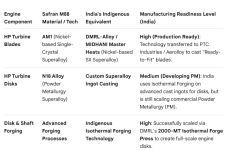
A direct comparison reveals how India’s indigenous materials and manufacturing capabilities (via labs like DMRL, PSUs like MIDHANI, and private firms like PTC Industries) map against the architecture of the Safran M88 core:


[TR]
[th]Engine Component[/th][th]Safran M88 Material / Tech[/th][th]India's Indigenous Equivalent[/th][th]Manufacturing Readiness Level (India)[/th]
[/TR]
[TR]
[td]HP Turbine Blades[/td][td]AM1 (Nickel-based Single-Crystal Superalloy)[/td][td]DMRL-Alloy / MIDHANI Master Heats (Nickel-based SX Superalloy)[/td][td]High (Production Ready): Technology transferred to PTC Industries / Aerolloy to cast "Ready-to-Fit" blades.[/td]
[/TR]
[TR]
[td]HP Turbine Disks[/td][td]N18 Alloy (Powder Metallurgy Superalloy)[/td][td]Custom Superalloy Ingot Casting[/td][td]Medium (Developing PM): India uses Isothermal Forging on advanced cast ingots for disks, but is still scaling commercial Powder Metallurgy (PM).[/td]
[/TR]
[TR]
[td]Disk & Shaft Forging[/td][td]Advanced Forging Processes[/td][td]Indigenous Isothermal Forging Technology[/td][td]High: Successfully scaled via DMRL's 2000-MT Isothermal Forge Press to create full-scale engine disks.[/td]
[/TR]
[TR]
[td]Compressor Blisks[/td][td]Titanium & Nickel Integrally Bladed Disks[/td][td]Five-Axis CNC Machined Blisks[/td][td]High: Companies like Godrej Aerospace and HAL routinely machine advanced titanium blisks.[/td]
[/TR]
[TR]
[td]Heat Insulation[/td][td]Ceramic Thermal Barrier Coatings (TBC)[/td][td]EB-PVD Ceramic Coatings[/td][td]High: Electron Beam Physical Vapor Deposition (EB-PVD) technology has been successfully indigenized by DRDO.[/td]
[/TR]


The Remaining Gaps vs. Safran's Capabilities
1. Ingot Casting vs. Powder Metallurgy (PM)
  • The Safran Standard: Safran uses Powder Metallurgy (PM) to create completely uniform, ultra-flawless turbine disks from microscopic alloy powder.
  • India's Status: India primarily relies on vacuum induction melting and ingot casting, followed by massive Isothermal Forging. While effective, powder metallurgy yields higher microstructural integrity for higher-thrust classes. India is actively developing commercial PM capabilities but has not fully mass-produced core disks with it yet. [1]
2. First-Generation vs. Next-Generation Single Crystals
  • The Safran Standard: While the baseline M88 used AM1 (1st generation), Safran has progressed to 2nd and 3rd-generation single-crystal superalloys containing Rhenium, which allows engines to run hundreds of degrees hotter.
  • India's Status: India's indigenously developed single-crystal alloy is comparable to 1st-generation standards. It is perfect for engines like the Dry Kaveri (KDE-2) or helicopter engines, but India will need to add Rhenium-based chemistry for heavy, fifth-generation fighter engines.
3. Scale and Yield Rate
  • The Safran Standard: Safran features a highly mature automated assembly line that can produce hundreds of flight-certified engines annually with exact repeatability.
  • India's Status: PTC Industries, MIDHANI, and HAL have established the foundry, material, and post-cast testing infrastructure. However, the current output is geared toward testing, prototyping, and low-volume production batches. Transitioning from "capable of making it" to "mass-producing 100 cores a year" is India's next industrial hurdle.
 
  • Like
Reactions: Sathya