People's Republic of China (PRC) : News & Discussions

When China, An Atheist State, Wants To Decide A Reincarnation

By Lobsang Wangyal & McLeod Ganj, Dharamshala, India
Published on : 28 July 2019
1564457830520.png

There is delicious irony when an officially atheist state gets involved in affairs of religion: the case in point is China and its concern over the Dalai Lama’s succession, meaning it wants to ensure its nominee succeeds the Dalai Lama. The problem here is the latter is in exile in India, which makes things difficult for the mandarins in Beijing.

Recently, a Chinese official told a group of visiting Indian journalists that his country would not accept any interference from India in the succession. Wang Nengsheng, the Information Officer of the “Tibet Autonomous Region” of China, said China alone would approve the next Dalai Lama after the current 14th Dalai Lama, now 84, passes away. Indirectly, Wang was telling India to stay out of the succession process, not to accept any “India born” Dalai Lama and accept Beijing’s choice of the Dalai Lama.

Wang then proceeded to reiterate the standard Chinese formulation on Tibet: that the Dalai Lamas have always been appointed by the central government in Beijing and that selection has always been through draw of lots from a golden urn.

Wang’s statement suggests an unspoken fear, that China’s choice may lack legitimacy. In fact Tibetans, the Himalayan people, Mongolians and others who have a stake in Tibetan affairs such as India, the U.S. are unlikely to be impressed if China comes up with a Dalai Lama. Dalai Lamas have always been chosen by the people of Tibet, not by Chinese claims of “established historical formalities”.

But why did China choose to speak up now, warning India to stay off Tibetan affairs and to back their candidate. First let’s take a quick look at what the Dalai Lama has been saying: he has been very clear that China has no business in matters related to reincarnation and should keep out of it. He is also implying that Communist China and its leaders, who are non-believers in religion, have no right to decide. If they are serious about reincarnation, they should first find the reincarnations of Mao Zedong and Deng Xiaoping.

As far back as 1969, the Dalai Lama has made it clear that it was for the Tibetan and Himalayan people, and the Mongol people to decide on the issue of reincarnation. He has also said that the institution of the Dalai Lama is a Buddhist institution and so Buddhists should decide, not China, which is an atheist regime that has been actively trying to destroy Tibetan Buddhism.

Reincarnation is a phenomenon which should take place through the voluntary choice of the person concerned. The person who reincarnates has the sole legitimate authority over where and how he or she takes rebirth and how that reincarnation is to be recognised. It is particularly inappropriate for Chinese communists, who explicitly reject even the idea of past and future lives, to meddle here. Such interference contradicts their own political ideology, it shows double standards.

If it is decided that the reincarnation of the Dalai Lama should continue and there is a need for the Fifteenth Dalai Lama to be recognised, responsibility for doing so will primarily rest with the officials of the Dalai Lama’s Gaden Phodrang Trust. They will have to consult the various heads of the Tibetan Buddhist tradition and the reliable oath-bound Dharma Protectors who are linked inseparably to the lineage of the Dalai Lamas. They should seek advice and direction from these masters and carry out the procedures of search and recognition in accordance with tradition. The Dalai Lama has even said that he will leave clear written instructions about this.

Chinese attempts to appropriate the traditions of Tibetan Buddhism will always come to nothing. The 11th Panchen Lama appointed by China, Gyaltsen Norbu, has only been a puppet and a tool for China, lacking any recognition or respect from Tibetans, their supporters or the free world.

For China to seek India’s cooperation in its handling of the reincarnation issue must have come as a puzzle for India’s minders of Tibetan affairs in Delhi. India under Modi has been trying to please Chinese interests in the hope of better business and peaceful borders but nothing has translated into India’s expectations. Knowing India has nothing to gain from obliging such a request, India will likely leave the reincarnation matter aside for the Tibetans to decide. The U.S. has a similar line, underscoring that the Dalai Lama’s succession should be decided by the Tibetan people and that the U.S. will not recognise a China-appointed Dalai Lama.

Although the next Dalai Lama may not come soon, considering the current Dalai Lama’s strong and sound health, it is obvious that there will be two Dalai Lamas—one chosen by the Gaden Phodrang Trust, which will be the real one, and the other by China, who will be described as the “Fake Dalai Lama”.

India should take a firm stand. Anything short of support for the Tibetan Dalai Lama, who will most likely be born in India, would only make India the loser as Tibetans, no matter what, will choose their Dalai Lama. This Dalai Lama will have popular support and could play an important role in the Tibetan cause (even though the Dalai Lama has relinquished all political powers). India supporting the Tibetan Dalai Lama will give it the upper hand, as it has in all these years.

(The author is the editor of Tibetsun, an online portal on Tibet affairs. Views are personal.)


When China, An Atheist State, Wants To Decide A Reincarnation - Sniwire News
 
Oh no, Ghazis in danger !! What are the Chini biraders doing ?:mad:

Beijing: China Orders Halal Restaurants In National Capital To Stop Displaying Arabic Signs And Islamic Symbols

by Swarajya Staff - Jul 31 2019, 3:31 pm
f59637c9_7c31_4abb_8461_c7218e261621.jpg
An Uyghur Muslim in China. (Kevin Frayer via Getty Images)

In a fresh crackdown on open displays of the Islamic faith, Chinese authorities have started directing restaurants and food joints in Beijing to remove signs in arabic reading ‘halal’, and symbols such as the crescent moon, reports Reuters.

“They said this is foreign culture and you should use more Chinese culture,” said a restaurant manager.

The Chinese capital is estimated to have at least 1,000 food outlet selling halal food, a number of shops have now already removed Islamic signs, or are in the process or removing them. Some shops have handled the directive by putting a Chinese sign ‘qing zhen’ meaning halal, instead of the Arabic sign.

The Chinese government, which has historically held a suspicious, or often outright antagonistic view of religions, has since 2016 massively increased its efforts to sinicise its Muslim minority, estimated to number around 20 million.

The emphasis on rapid integration of Muslims came following years of ethno-religious strife in the Western province of Xinjiang, where authorities even set up a number of ‘re-education camps’ to impart ideals of the Communist party to millions of people from the Uighur Muslim
minority.

Beijing: China Orders Halal Restaurants In National Capital To Stop Displaying Arabic Signs And Islamic Symbols
 
  • Like
Reactions: Ashwin and BMD
Multiculturalism doesn't go very far in China... or at all really.

While Europe decides how many million Arabs to adopt, China decides that one Arabic symbol is one too many.
 
Multiculturalism doesn't go very far in China... or at all really.

While Europe decides how many million Arabs to adopt, China decides that one Arabic symbol is one too many.
Chinese dont allow such shit to ruin their nation, they are proud of their culture and like to preserve it unlike the west and India
 
  • Agree
Reactions: vingensys and BMD
China bans individual permits to visit Taiwan

Reuters
Beijing,July 31, 2019 22:10 IST
Updated:July 31, 2019 22:10 IST

‘Travellers could consider group travel’

China will stop issuing individual travel permits for Taiwan to people in 47 mainland cities from August 1, its Culture and Tourism Ministry said on Wednesday, citing the state of ties with the self-ruled Island, but gave no details.

People from the mainland need permission to travel to what Beijing regards as a renegade province.

Only travellers from 47 cities, such as Beijing, Shanghai and Xiamen, were allowed to visit Taiwan independently.

China’s military held exercises this week in waters near Taiwan, following a warning last week that it was ready for war if there was any move towards independence by the Island for what Beijing regards as a renegade province.

“We're aware of the suspension,” said another operator, Shanghai Spring International Travel Service. “Today is the last day to apply for the permit as individuals.”

Travellers who had booked individual trips but had yet to obtain permits could consider group travel, travel agency Ctrip said.

Taiwan’s Mainland Affairs Council conveyed its stern protest and condemnation of the move to China. It comes ahead of Taiwan’s presidential elections in January.

“The mainland authorities unilaterally destroyed the agreement without communication with our side,” the panel said in a statement.

“We are not delighted to see the normal tourism and exchange across the Strait were disrupted by political factors.”

In recent years, China has stepped up military drills around Taiwan, including regularly flying what Beijing calls “island encirclement” exercises and sending warships into surrounding waters.

China bans individual permits to visit Taiwan
 
https://news.yahoo.com/taiwan-says-chinese-warship-slammed-182127919.html

Taiwan says a Chinese warship slammed into one of its cargo ships and then sailed off into the night


Ryan Pickrell

,
Business InsiderAugust 2, 2019

41e8ecbecd181b5977ed39c27ff3153f


The Taiwanese Yutai No. 1 cargo vessel is seen with damage in Kinmen, Taiwan.
Taiwan Coast Guard Administration via AP


  • Taiwan's coast guard has accused an unidentified Chinese military ship of ramming a Taiwanese cargo ship and fleeing the scene.
  • A ship, allegedly a Chinese warship that was unable to be properly identified in the dark, collided with the Yutai No. 1 in the Taiwan Strait.
  • It is unclear if the incident, which comes at a time of heightened tensions between mainland China and Taiwan, was an accident or an intentional act of aggression.
  • Visit Business Insider's homepage for more stories.
A mysterious Chinese warship collided with a Taiwanese cargo ship in the Taiwan Strait and fled the scene, the island's coast guard told local media.

The unidentified People's Liberation Army Navy (PLAN) warship slammed into the Yutai No. 1, a freighter registered in Kaohsiung, at around 8 pm on Wednesday about 20 miles from Liaoluo Port in Kinmen, Taiwan News reports, citing a press statement by the local coast guard.

The Chinese military vessel requested that the freighter sail to Xiamen, China for an investigation, Chen Jian-wen, a Taiwan coast guard official, told local media, explaining that the cargo ship "asked us to send patrol ships to the rescue." Two patrol boats were sent out in response, the South China Morning Post reports.

The freighter's hull was damaged, but the crew was unharmed, the coast guard confirmed when they arrived on scene at around 10 pm.

After escorting the cargo ship back to Liaoluo Port, the coast guard set out in search of the Chinese vessel, making contact right around midnight. " The military vessel said its hull was seriously damaged and its navigation was limited. It refused to stop as it immediately needed to return to Xiamen port for safety," Chen explained.

3d7a3d1d3f96840c24429f91e8193f39


Taiwanese Yutai No. 1 cargo vessel
Taiwan Coast Guard Administration via AP

The Taiwan coast guard said that it was unable to identify the hull number on the Chinese PLAN vessel in the dark. Taiwanese officials did not identify the type of vessel either.

The ship that collided with the freighter is believed to be one of two — a newly-commissioned Type 071 amphibious transport dock ship or a cruiser — that have been patrolling the Taiwan Strait, an unnamed source familiar with the incident told the China Times.
 
It's serious math involved, Paddy. I don't expect you or your Bumchum to understand it.
There's no serious maths at all, clown. The whole question is about critical thinking not maths. There clearly isn't enough data to solve the problem, yet 3/4 of French students tried to by manipulating the figures.

This guy in the comments summed it up:

I have one brother and 3 pencils, how many kilogram is my balls?
 
China tells Kyrgyzstan to punish mine attackers

China tells Kyrgyzstan to punish mine attackers


AFPAugust 6, 2019

d47ba0b9212e440d00642a476340cc809ed167de.jpg


Foreign mining companies have seen some pushback from Kyrgyzstan farmers (AFP Photo/VYACHESLAV OSELEDKO)

More
China's embassy in Kyrgyzstan Tuesday called on the Central Asian country to punish villagers it said attacked a Chinese-owned mine, leaving more than 20 workers injured.

The rare diplomatic rebuke from Beijing followed a skirmish between mine employees and villagers living close to the Solton Sary gold deposit which is licensed to China's Zhong Ji Mining.

The embassy said it had informed Kyrgyzstan of its "serious concern" over the incident.

China "firmly asks the government... to take effective measures to protect the legitimate rights and interests of Chinese companies, ensure the safety of (Chinese) citizens," the statement said, noting that guilty parties should be "strictly punished."

China rarely criticises its impoverished neighbour's investment climate despite a series of conflicts between Chinese companies and local communities in recent years.

A health ministry spokeswoman said that 28 Chinese employees of the company that operates the mine in the central province of Naryn had sought treatment after the confrontation began on Monday.

Police said around 300 villagers gathered at the mine to demand that the Chinese company cease work there.

"Both sides threw stones at each other" during the clashes that followed, the ministry said in a statement.

Kyrgyzstan's national security service issued a statement warning citizens against sharing videos of the incident, citing their potential to stir inter-ethnic hatred.

Zhong Ji Mining won a license for the Solton Sary gold field in 2012, shortly after a popular uprising that saw an uptick in conflicts between mining companies and local communities in the ex-Soviet country.

Pastoral farmers regularly accuse mining companies of causing ecological damage, accusations the companies deny.

Chinese companies have been particular targets for community ire.

Last year a Chinese investor in the southwestern Jalal Abad province saw its premises stormed by protesters opposed to the construction of a new gold refining plant.

Some of the biggest clashes in recent years have occurred in the eastern Issyk Kul province where a mine owned by Toronto-listed company Centerra Gold accounted for 8.5 percent of GDP in 2018.
 
China bans movies, actors from prominent Taiwan film awards

China bans movies, actors from prominent Taiwan film awards


CHRISTOPHER BODEEN

,
Associated PressAugust 7, 2019

edbed732a6375987f13fabf0638df594


FILE - In this Nov. 17, 2018, file photo, Chinese director Zhang Yimou holds his award for Best Director at the 55th Golden Horse Awards in Taipei, Taiwan. China said Wednesday, Aug. 7, 2019, that it was banning Chinese movies and actors from participating in Taiwan's Golden Horse Awards, one of the Asian film industry's most prestigious honors, as Beijing continues efforts to bring economic and political pressure to bear on the island it claims as its own territory. (AP Photo/Billy Dai, File)

More
BEIJING (AP) — China said Wednesday that it was banning Chinese movies and actors from participating in Taiwan's Golden Horse Awards, one of the Asian film industry's most prestigious honors, as Beijing ramps up economic and political pressure on the island it claims as its own territory.

The one-sentence announcement on the microblog of China Film News, a newspaper affiliated with the government film regulator, gave no reason for the suspension, but it comes amid rising tensions over Taiwan's refusal to recognize being part of Chinese territory to eventually be brought under Beijing's rule.

Even without the ban, Chinese artists might have found it difficult to make it to the Nov. 23 ceremony. Beijing recently issued a ban on solo travel to the island beginning Sept. 1 as part of measures to inflict an economic cost for its failure to obey.

Chinese participation was already in doubt following last year's ceremony, which was marked by Chinese displeasure over remarks in an acceptance speech by documentary director Fu Yue calling on the world to recognize Taiwan as an independent country, something only a handful of nations currently do.

Chinese participants refused to appear on stage, made pointed remarks about Taiwan and China being members of the same family, and then declined to attend the banquet reception following the show.

Asked about the announcement, the organizing committee said it was disappointed but the show would go on as scheduled.

"The Committee regrets to be informed of the news, if it is confirmed," it said in an emailed statement. "The jury process of Golden Horse Awards is ongoing and will continue as planned, and all Golden Horse events will take place as usual."

Chinese entrants have been big winners at the show since they were first invited to attend in 1996, with China's Xu Zheng winning best actor last year for his work in "Dying to Survive." Taiwan's Central News Agency said the festival was still in the process of choosing films and it wasn't immediately clear if any from China had already been withdrawn.

Presidential office spokesman Ernesto Ting Yun-kung said China's move "not only harmed exceptional members of the Chinese film industry but also positive exchanges between the sides."
 
‘China Trying To Destroy Tibetan Buddhism By Deciding The Next Dalai Lama’
By Parul Chandra
New Delhi
7 August 2019


To China’s propagandists pushing the line that atheist Beijing is the true arbiter of Tibetan Buddhism, here’s a counter from none other than Lobsang Sangay, the Sikyong or head of the Central Tibetan Administration in Dharmsala, India.

He told journalists in Delhi that “The Chinese government is trying to sell the propaganda that they have a role or that they will decide but the Dalai Lama’s reincarnation is the Dalai Lama’s business. It’s up to him to decide whether he comes back or not and if he comes back, what form he comes back in.”

Dr Sangay pointed out that “We’re talking about his consciousness. It’s his body, his soul and his consciousness. It’s his business. So the Chinese government with all its rituals and explanations has no role (to play) whatsoever.”

“Look at their track record. They have destroyed 98 per cent of the monasteries, hundreds and thousands of monks and nuns have been killed (in Tibet). Who will accept it?,” he asked adding: “The Communist Party of China destroyed our religion and continues to kill and destroy our monasteries even now. Even if they appoint a Dalai Lama, who will follow their Dalai Lama? Tibetans will follow their heart and will follow a Dalai Lama who they recognise.”

Asked about the possibility of two Dalai Lamas, Dr Sangay said this was the plan the Chinese have “but it won’t work because Tibetans won’t follow that Dalai Lama.”

Which brought him to another vital point, India’s failure to use Buddhism’s soft power. “India is the birthplace of Buddhism. All the sacred sites of the Buddha or Buddhism are in India but as far as Buddhism development is concerned, India is far, far, far behind China. Every year, China organises the World Buddhist Congress. Leaders from around the world are invited and the Chinese spend millions of dollars to entertain them, feed them well, take them around.”

China organised Buddhist conferences are attended by leaders from India’s own neighbourhood as well as Asean member states. To restate a point, China an officially atheist state headed by the Communist Party, has assumed the mantle of leader of the Buddhist world.

Sangay believes that Buddhism for India “is the low hanging fruit. All it (India) needs to do is send an e-mail to the leaders of these Buddhist nations and say: ‘Hey, we’re having an event in Bodh Gaya, just show up’. And all the leaders will come. Bodh Gaya is the land of enlightenment,” said Dr Sangay.

Unlike China, India doesn’t need to spend big money to woo the leaders of Buddhist nations given its deep connect with Buddhism, Sangay argues. “They don’t have to spend millions of dollars to put them up in five-star hotels, give them the best food, best cars, nothing. All you need is, do something,” he said.

China doesn’t have Sarnath, where the Buddha gave his first sermon, Sangay pointed out. Rather China’s links with Buddhism are largely a modern construct. “What they have is the tallest statues of Buddha, they have the biggest Buddhist monastery, they have the deepest Buddhist cave…All the Buddhist leaders all over the world are amazed by China’s development and investment. You go to the tallest, highest, biggest, deepest…you find in China.”

Comparatively, the Indian narrative on Buddhism is tragic. “From Patna you go to Bodh Gaya, my goodness, the highway takes four hours!…The taxi driver says I’ll take you via a short-cut and takes you through gullies (by-lanes)…Why not make a two-way highway and all the Buddhists will come here,” Sangay said.

Drawing attention to the significant population of Buddhists in the world, Dr Sangay said if tourism to Buddhist pilgrimage sites in India was promoted, the earnings would be in millions of dollars. “UP (Uttar Pradesh) and Bihar will prosper within 10 years…calculate, calculate, we’re talking about billions of dollars in the least developed areas like Gaya and Nalanda, where everybody wants to go. All you need is one billion in investment, you’ll have hundreds of billions in return,” he said.

Ruing the fact that India has been unable to promote Buddhism to its advantage, Dr Sangay remarked, “India’s largest, cheapest export has been Buddhism. Least investment, highest and longest return 2,500 years old–the dividends are still coming. What have you done? You send one tree to Sri Lanka, one scholar to….and look at the return.”

End result, India plays second fiddle to the Chinese in promoting a religion with deep roots in our country. Dr. Sangay is suggesting a way forward, but for that India needs to show political and administrative will. Faith is already on our side.


‘China Trying To Destroy Tibetan Buddhism By Deciding The Next Dalai Lama’ - Sniwire News
 
Future of India-China ties depends on mutual sensitivity: Jaishankar in Beijing

3 min read . Updated: 12 Aug 2019, 06:31 PM IST PTI
  • He underlined the need to 'exploit' the positive outcomes of the Wuhan Summit to take bilateral ties to a new level
  • With Chinese Vice President Wang Qishan, he said he discussed the evolving global situation and the larger re-balancing that reflects the rise of India and China as two large developing countries
20190812142L_1565614363807_1565614399407.jpg

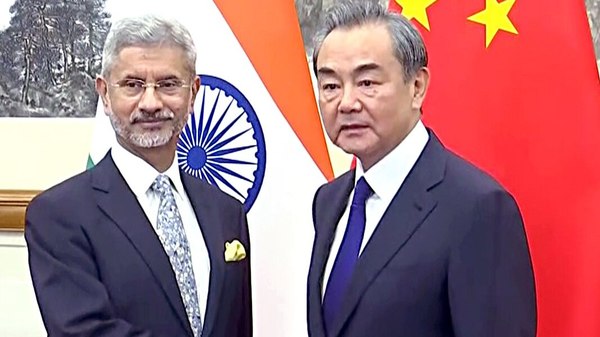
External Affairs Minister S. Jaishankar shakes hand with Foreign Affairs Minister of China Wang Yi during his visit, in Beijing on Monday (Photo: ANI)

Beijing: The future of the India-China relationship will depend on "mutual sensitivity" to each other's core concerns, External Affairs Minister S Jaishankar said on Monday as he underlined the need to "exploit" the positive outcomes of the Wuhan Summit to take bilateral ties to a new level and build strong public support in both societies.

Addressing the members of Indian and Chinese delegations for the 2nd meeting of the India-China High Level Mechanism on Cultural and People-to-People Exchanges here, Jaishankar said he positive meetings with the Chinese leadership on bilateral and international issues of common concern.

With Chinese Vice President Wang Qishan, he said he discussed the evolving global situation and the larger re-balancing that reflects the rise of India and China as two large developing countries.

He also said that he had detailed and productive discussions with Foreign Minister Wang Yi.

"We discussed the full gamut of issues relating to views on the international situation, regional aspects and our very important bilateral relations," Jaishankar, who is here on a three day official visit, said.

"Our discussions today were especially significant as we prepare for President Xi Jinping's visit to India for the 2nd Informal Summit later this year and celebrating the 70th Anniversary of establishment of diplomatic relations next year," Jaishankar, a former Indian ambassador to China, said at the meeting held at the Diaoyutai State Guest House.

He said the Wuhan Summit between Prime Minister Modi and President Xi in the Chinese city of Wuhan in April last year has opened up a world of new convergences. Prime Minister Modi has invited President Xi for the second informal summit in India.
2019-08-12T110457Z_466240535_RC1231208CB0_RTRMADP_3_CHINA-INDIA_1565614455814.JPG
Chinese Vice President Wang Qishan meets Indian Foreign Minister Subrahmanyam Jaishankar at the Zhongnanhai leadership compound in Beijing (Photo: Reuters)

"Exploiting this and taking our ties to a new level will require strong public support in both societies. The media can make a major contribution to that goal," he said.

He emphasised that the "future of the India-China relationship will obviously depend on mutual sensitivity to each other's core concerns."

"It is natural, both as neighbours and large developing economies that there would be issues in our ties. Properly managing differences is therefore vital," the minister said in the presence of his Chinese counterpart, Wang.

As the leaders agreed in Astana, Kazakhstan, differences between the two countries should not become disputes. That is how India-China relations can remain a factor of stability in an uncertain world, he said.

He said the first Informal Summit between Prime Minister Modi and President Xi was a historic meeting that has provided positive direction to India-China relations.

There is mutual agreement that as two of the largest and fastest growing developing countries, representing almost one third of the global population, stable and balanced development of our relations will not only be beneficial for our two peoples, but also a factor of stability in this uncertain global environment.

"Our two countries have similar goals in terms of providing better opportunities for our peoples," he said.

Since the Wuhan Summit, there has been progress in overall relationship. The two countries agree that maintenance of peace and tranquillity in border areas is essential for smooth development of our relations.

For this, the two armed forces have enhanced communication and are implementing various confidence building measures, he said. The two top leaders met after a 73-day standoff at Doklam between the militaries of the two countries in 2017.

India-China economic relationship too has seen "some progress," Jaishankar said. The bilateral trade has increased but so too has our deficit, which is a matter of some concern.

"We appreciate the steps taken in the last few months by the Chinese side to enhance imports from India. These efforts could expand to include measures to enable greater access for our pharmaceutical and IT products and services in the domestic Chinese market," he said.

This story has been published from a wire agency feed without modifications to the text. Only the headline has been changed.


Future of India-China ties depends on mutual sensitivity: Jaishankar in Beijing
 
  • Informative
Reactions: BMD
  • Agree
Reactions: Ashwin