India - United States Relations

Americans are weird people

Pakistan gets away with Killing US soldiers
In Afghanistan and they do nothing For
Themselves

But want India to dump Russia
They didn't get away with hiding Bin Laden though. Things are changing.

Russia is also the one arming your main adversary. Look at their planes and missiles, mostly Russian.
 
India, US close to inking industrial security pact

Once signed, the ISA will enable transfer of key high end technology pieces that are regulated under US law.
By Manu Pubby, ET Bureau | Jun 22, 2019, 07.38 AM IST
1561186829163.png

NEW DELHI: India and the US are inching towards inking an industrial security pact that will unlock access to key defence technologies for the Indian industry, with officials saying the agreement could be finalised within a couple of months.

The Industrial Security Annex (ISA) will add to existing agreements on protection of classified military information and is critical for any transfer of technology by a US firm to its Indian partners.
The draft of the annex has been circulated and is likely to get Cabinet clearances in the coming weeks, following which the bilateral agreement will be signed.

While several US companies including Lockheed Martin and Boeing are already working on defence products with Indian partners — mostly to meet offset obligations — the projects are primarily of the ‘build to print’ kind that do not involve transfer of key technology, officials explained.

Once signed, the ISA will enable transfer of key high end technology pieces that are regulated under US law. The pact is also expected to enable the floundering India US Defence Technology and Trade Initiative (DTTI) that was signed in 2012 but has not resulted in any major project on the ground yet.

Sources said that the ISA will involve Indian government assurances on the safety and security of technology against transfer and access to third parties. Once operational, US companies wishing to transfer technology to India will be able to do so through the government route. Sources explained that for critical technology, US companies will submit documentation to the US government that will share it with their Indian counterparts through diplomatic channels.

This technology piece will then be sent to the Indian industry by the government which will first satisfy itself that adequate safeguard mechanisms are in place for its protection. The ISA will be vital for US companies to participate in all upcoming Make in India projects like the 110 fighter jet deal and the requirement of 111 Naval Utility Helicopters that are currently being processed under the Strategic Partnership (SP) model.

While the ISA will require cabinet level clearances, it is an add on to the General Security Of Military Information Agreement (GSOMIA) that was signed in 2002. India and US have already signed the COMCASA


India, US close to inking industrial security pact, will unlock key defence technology sharing

Curious thing about the Americans, there is always that one agreement that we gotta sign and all the problems will be gone. First was the 123 nuclear agreement, then came the NSSP, then the DTTI, then the foundational agreements and now this. Agreements after agreements after agreements, yet none of these agreements live up to the hype.
 
This hypocrisy becomes clear when we consider that President Donald Trump dismissed a request by the United Nations for an inquiry by the Federal Bureau of Investigation into the murder of Saudi Arabian dissident and journalist Jamal Khashoggi because it may "jeopardise American weapons sales" to the Gulf nation. The American moral presumably moves differently when it comes to selling weapons to rogue states that send agents abroad to kill dissidents on foreign soil.​
That's why India should react by blocking any further weapon deal with the US.
 
  • Agree
Reactions: BlackOpsIndia
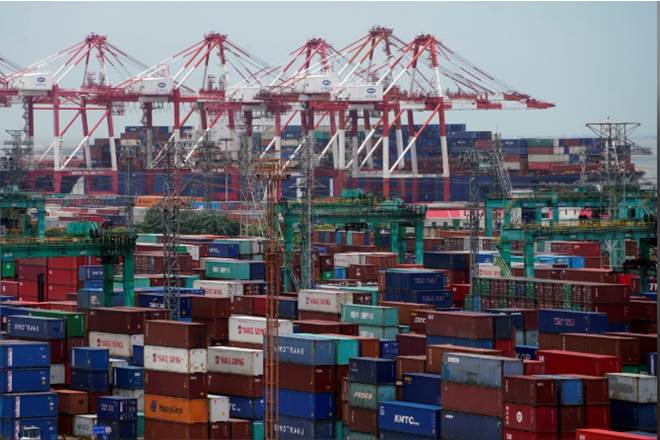
Barriers in trade have fallen due to Modi govt’s reforms: US corporate body

By: PTI | Published: June 25, 2019 11:19:47 AM
trade-reuters.jpg

The report ‘The Bay Area-Silicon Valley and India: Convergence and Alignment in the Innovation Age’, said that as with any relationship between major countries, there are complex issues. (Reuters photo)

Barriers in trade have fallen and many processes have been simplified as a result of the series of key reforms instituted by the Indian government, a top corporate body from Silicon Valley has said. The Bay Area Council, in its latest report on India, said that sustained economic growth and national strategies that push digitisation across a range of sectors and services are creating unique synergies with the Bay Area that open the door to new opportunities, as Bay Area companies expand their global footprint and diversify their market presence in Asia.

“India remains a complex place to do business, but with reforms instituted by the Modi government, barriers have fallen and many processes have been simplified. The re-election of Prime Minister Narendra Modi to a second term in May 2019 assures that these reforms will continue,” the Bay Area Council has said.

The report ‘The Bay Area-Silicon Valley and India: Convergence and Alignment in the Innovation Age’, said that as with any relationship between major countries, there are complex issues. Imposition of 25 per cent and 10 per cent steel and aluminum tariffs by the US in 2018 led India to impose retaliatory tariffs in 2019. The US withdrawal of Generalised System of Preferences (GSP) benefits has also exacerbated the trade relationship, it said.

“On the Indian side, government proposals to require data generated in India to be exclusively stored in India, and proposed data privacy regulations that are among the most stringent in the world, have drawn strong opposition from both Indian and US IT and financial services companies,” the report said.

Noting that India is a large untapped market for financial services, the report said that the Modi government sees mobility, fintech and a cashless society as keys to financial empowerment and business growth, providing access for ordinary Indians to credit, insurance, digital payments, and e-commerce.

“Fintech acceptance and adoption have grown rapidly, with the traditionally cash-driven Indian economy responding well to the fintech opportunity primarily triggered by the related surges in e-commerce and smartphone penetration,” it said. The shift to digital payments promises to revolutionise India’s economy and in the process transform the financial sector.

Credit Suisse forecasts that digital payments will become a USD 1 trillion market in India by 2023. Bay Area companies like Visa, PayPal, WhatsApp and Google have made inroads in financial services markets but face competition from local service providers as well as regulatory challenges, said the report, which was released in the presence of India’s Ambassador to the US Harsh Vardhan Shringla last week.

Observing that the potential for the India-US trade and economic relationship is huge, Shringla called upon the companies in the Bay area to become partners in the Indian growth story. “First, as a source of capital. In order to achieve the growth trajectory that we have set-out for ourselves, we need adequate funding to be channelised in all critical sectors of the economy – be it infrastructure, manufacturing, housing, health, education.

“Second, as a source of cutting-edge technology in the upcoming areas such as artificial intelligence, automation and robotics, semi-conductors, biotechnology, nanotechnology, Electric vehicles and battery storage technologies,” he said.

“US technology can also help in other areas that have economic value such as space exploration, space mining, renewable energy, healthcare and life sciences, aerospace and defence, agriculture, water through innovation. Third, as a source of employment generation and increasing trade for the mutual benefit of both the countries,” Shringla added.

Barriers in trade have fallen due to Modi govt’s reforms: US corporate body

 
They compromised on Iran though. So, no oil from Iran & Venezuela. Be prepared for petrol retailing at 110 - 120 / litre in the not so distant future.
India will have to procure oil from Iran. There is no way around it at least for now. Arabs cant meet the Indian needs all by themselves and the US can't really provide an alternative at the same price. It is in the US interest to keep India away from Iran for others to follow. The only way is to forcefully lower oil prices which they are trying to do by opening up their reserves.

India does have the capability to trade with Iran without entangling its banking systems in sanctions if they really want to.
 
  • Like
Reactions: rockstarIN
India will have to procure oil from Iran. There is no way around it at least for now. Arabs cant meet the Indian needs all by themselves and the US can't really provide an alternative at the same price. It is in the US interest to keep India away from Iran for others to follow. The only way is to forcefully lower oil prices which they are trying to do by opening up their reserves.
For the time being, Iran oil is out of question. Do you think all that lobbying done by the US with China on the MA listing by the UNSC was free of charge? This is the quid pro quo.
 
  • Agree
Reactions: BlackOpsIndia
For the time being, Iran oil is out of question. Do you think all that lobbying done by the US with China on the MA listing by the UNSC was free of charge? This is the quid pro quo.
You can't really compare MA listing with billions of economic trade. Yes, it was a favour that will be returned in another way for sure but India hasn't stooped so low to sacrifice its oil imports. Pak should have been on the blacklist by now at least if they wanted to equate oil imports to diplomacy.

Raising oil prices will send the countries economy back by at least 2 years. What the US is trying hard is to avoid China, Japan & India to form a buyers pack. This will happen eventually if the prices and demand aren't balanced. The way things are going within 2-3 months if India can't get the oil for the desired price, trade with Iran will open up again just like last time. Remember we just started taxing American imports very reluctantly after a long overdue.
 
Last edited:
  • Like
Reactions: screambowl
You can't really compare MA listing with billions of economic trade. Yes, it was a favour that will be returned in another way for sure but India hasn't stooped so low to sacrifice its oil imports. Pak should have been on the blacklist by now at least if they wanted to equate oil imports to diplomacy.
You're conflating two different but related issues. All these negotiations regarding give and take would have been broadly agreed upon before the UN listing was agreed to by China under US pressure. As far as Pakistan being listed under FATF blacklist goes, why hasn't either India or Afghanistan or even Iran declared Pakistan as a terrorist supporter and sanctioned it or even downgraded if not suspended diplomatic relations given that these three countries are directly affected by terrorism supported and abetted by Pakistan.

If India insists on US guaranteeing Pakistan be included in the FATF blacklist, what makes you think, the US won't turn around and ask India why didn't it take the lead in at least accomplishing this much which was well within its scope.

If Pakistan gets into the FATF blacklist, it's economy would enter freefall mode followed by its internal security and then it's anyone's guess what happens to it's NWP. The PA has calculated correctly that as long it has N weapons, Pakistan as a nation in whatever form and consequently the PA as an entity will survive. As of now that's how it's going to be. What the future portends will be answered in the future.

Raising oil prices will send the countries economy back by at least 2 years. What the US is trying hard is to avoid China, Japan & India to form a buyers pack. This will happen eventually if the prices and demand aren't balanced. The way things are going within 2-3 months if India can't get the oil for the desired price, trade with Iran will open up again just like last time. Remember we just started taxing American imports very reluctantly after a long overdue.


As far as oil prices hurting our economy goes, you're right, it will. Why do you think then that India is loathe to let outside intervention into the Kashmir issue and Indo Pakistan ties? This is the reason why. Every time Pakistan miscalculates, India has either to put up with it and the incumbent GoI face domestic opprobrium or India acts, cuts deals and even then pays a price which in this case happens to be Iran & Venezuelan oil and the hit we'd take on the growth in our economy.


Sometimes one has to go through the process knowing full well what the outcome is going to be in order to tell the world that - look, I told you so. What happens two years from now can't be predicted today. For all you know Trump may not return. This deal we've struck with the US is for a finite amount of time. Simultaneously, our efforts would be to team up with China and form a strong buyers Club. I won't add in Japan to it as Japan is too deeply entrenched in the US camp to defy it.
 
India, US close to inking industrial security pact

Once signed, the ISA will enable transfer of key high end technology pieces that are regulated under US law.
By Manu Pubby, ET Bureau | Jun 22, 2019, 07.38 AM IST
View attachment 7630

NEW DELHI: India and the US are inching towards inking an industrial security pact that will unlock access to key defence technologies for the Indian industry, with officials saying the agreement could be finalised within a couple of months.

The Industrial Security Annex (ISA) will add to existing agreements on protection of classified military information and is critical for any transfer of technology by a US firm to its Indian partners.
The draft of the annex has been circulated and is likely to get Cabinet clearances in the coming weeks, following which the bilateral agreement will be signed.

While several US companies including Lockheed Martin and Boeing are already working on defence products with Indian partners — mostly to meet offset obligations — the projects are primarily of the ‘build to print’ kind that do not involve transfer of key technology, officials explained.

Once signed, the ISA will enable transfer of key high end technology pieces that are regulated under US law. The pact is also expected to enable the floundering India US Defence Technology and Trade Initiative (DTTI) that was signed in 2012 but has not resulted in any major project on the ground yet.

Sources said that the ISA will involve Indian government assurances on the safety and security of technology against transfer and access to third parties. Once operational, US companies wishing to transfer technology to India will be able to do so through the government route. Sources explained that for critical technology, US companies will submit documentation to the US government that will share it with their Indian counterparts through diplomatic channels.

This technology piece will then be sent to the Indian industry by the government which will first satisfy itself that adequate safeguard mechanisms are in place for its protection. The ISA will be vital for US companies to participate in all upcoming Make in India projects like the 110 fighter jet deal and the requirement of 111 Naval Utility Helicopters that are currently being processed under the Strategic Partnership (SP) model.

While the ISA will require cabinet level clearances, it is an add on to the General Security Of Military Information Agreement (GSOMIA) that was signed in 2002. India and US have already signed the COMCASA


India, US close to inking industrial security pact, will unlock key defence technology sharing

Curious thing about the Americans, there is always that one agreement that we gotta sign and all the problems will be gone. First was the 123 nuclear agreement, then came the NSSP, then the DTTI, then the foundational agreements and now this. Agreements after agreements after agreements, yet none of these agreements live up to the hype.

WE need the tooling technology and not defence tech. we have/can do the designs the main issue is in making them. Equipment is only half the story the tooling design for weapons manufacturing is another, add production line management and manpower skills. thats our bottle neck. Not producing enough in required quantity, quality and and enough in time.
 
WE need the tooling technology and not defence tech. we have/can do the designs the main issue is in making them. Equipment is only half the story the tooling design for weapons manufacturing is another, add production line management and manpower skills. thats our bottle neck. Not producing enough in required quantity, quality and and enough in time.

My only problem was about the never ending agreements. Sign one there is another waiting. Also designations, get one someone somewhere is trying to get another one. Here's another one :

US moves bill to bring India on a par with Nato allies
1 min read . Updated: 18 Jun 2019, 12:22 AM IST, PTI
  • The move by Cornyn and Warner comes after India and the US signed the COMCASA last year
  • The two countries are also in advance discussion to sign another foundational agreement of the BECA
1561703075649.png
The development comes ahead of US President Donald Trump’s meeting with Prime Minister Narendra Modi on the sidelines of the G20 Summit in Japan next week. (Photo: AP)

WASHINGTON: Two top American lawmakers have moved a legislation in the Senate, seeking key amendment in the country’s Arms Control Export Act to bring India at par with the US’ Nato (North Atlantic Treaty Organization) allies— Israel, Australia, New Zealand and South Korea—when it comes to sale of high-tech military items.

The necessary amendment to the US Arms Control Act has been moved by Senators Mark Warner from the Democratic Party and John Cornyn from the Republican Party, which if enacted will further institutionalize the recent designation of India as a major defence partner of the US.

The move by Cornyn and Warner comes after India and the US signed the COMCASA (Communications, Compatibility and Security Agreement) last year.

The two countries are also in advance discussion to sign another foundational agreement of the BECA (Basic Exchange Cooperation Agreement).

The development also comes ahead of US President Donald Trump’s scheduled meeting with Prime Minister Narendra Modi on the sidelines of the G20 Summit in Osaka, Japan next week.

American Secretary of State Mike Pompeo is also scheduled to visit New Delhi next week.

“It is a significant development," said Mukesh Aghi, president of US India Strategic and Partnership Forum, the advocacy group, which along with other groups have been working on such legislative changes that would remove current legislative barriers to export of major high-tech defence equipment to India which is normally shared with only a few countries.

The passage of this amendment would help in removing such barriers, added Aghi.

“It’s an important signal of US political support for enhancing defence ties but is unlikely to have tangible impact on trade flows in the near term," said Benjamin Schwartz, from US India Business Council.

The amendment needs to be passed by both the Senate and the House of Representatives before it can be signed by the US president into law. People aware of the development said that the amendment moved as part of the National Defense Authorization Act 2020, would sail through the Congress, giving a big boost to India-US defence trade.


US moves bill to bring India on a par with Nato allies
 
Modi, Trump direct officials to resolve Indo-US trade issues

3 min read . Updated: 28 Jun 2019, 10:36 AM IST, by Elizabeth Roche
  • 'We have never been closer, I can say that with surety... will be discussing trade today,' says Donald Trump
  • Modi-Trump meeting assumes significance in the wake of strains in the bilateral relationship on a number of trade and economic issues

61755461fcad4f2ab6588037d8d8e49e-61755461fcad4f2ab6588037d8d8e49e-0_1561687382387_1561687404123.jpg

President Donald Trump shakes hands with Indian Prime Minister Narendra Modi during a meeting on the sidelines of the G-20 summit in Osaka. Photo: AP

US President Donald Trump and Indian Prime Minister Narendra Modi have directed their officials to meet in the coming days to resolve the thorny issues that have cropped up in trade ties between the two countries, an Indian official said Friday.

At a meeting on the sidelines of the G20 Summit in Osaka, the two leaders exchanged views on Iran and the tensions in the Gulf region and also discussed introduction of fifth generation or 5G technology for wireless communications, Indian foreign secretary Vijay Gokhale told reporters.

This is Modi’s first meeting with Trump after his re-election to office post the general elections. This was one of Modi’s first engagements on Friday with other meetings lined up with dignitaries like Mohammed bin Salman, the Crown prince of Saudi Arabia, and South Korea President Moon Jae-in.

In his opening remarks, Trump said India-US ties had never been closer, setting the stage for the interaction that was described as open, productive and warm.

Gokhale said, there were four issues on the table -- Iran, 5G, trade and defence relations.

On Iran, the two sides agreed to remain in touch to ensure that the situation in the region remained stable, Gokhale said.

Besides issues regarding peace and stability in the region, Modi outlined India’s energy concerns and said although Iran supplied as much as 11% of India’s energy needs, New Delhi had reduced oil imports from the West-Asian country even as it hurt the Indian economy.

Modi said a large number of Indians reside in the region and there were economic interests as well, and “therefore it’s in India’s fundamental interests to have peace and stability in the region". Gokhale said.

The prime minister also noted that India had despatched two of its naval ships to the region for the protection of Indian flagged vessels passing through the Strait of Hormuz, a point which President Trump appreciated. Trump on his part said he hoped that oil prices would remain stable and that the US was doing its best to ensure that stability was maintained.

On 5G, Modi told Trump that it was a new area in communication that provided opportunity for collaboration between India and the US. “The prime minister outlined that we are going to be a billion users of this technology and in that sense India is the second largest market in the world. The way India moves, whatever choices India makes essentially determine the way the global trend will go," Gokhale said adding that Modi pointed out the need to collaborate “to see how we can leverage this."

“The billion Indian users and India’s capacity in technology development and start-ups and design and Silicon Valley and its role in development of 5G technology for mutual benefit" was discussed in the meeting, Gokhale said, adding that Modi highlighted the “Make in India" flagship programme in this context.

Trump welcomed the idea and said relevant ministers of the two countries would meet to look at opportunities that the businesses of both sides can leverage and collaborate on.

It was also agreed that trade ministers of both countries would meet at an early date and sort out the contentious issues relating to market access, trade barriers and the trade imbalance.

According to Gokhale, the prime minister referred to the withdrawal of special export privileges accorded by the US to India and the retaliatory step taken by India to impose duties on 28 items the US exported to India as “something that had already happened and that we should now look forward and see how we can resolve some of the issues".

“President Trump welcomed this idea…so we expect now an early meeting – the level will be decided late," Gokhale said, adding it was a “very productive discussion" and a “very open discussion" and “we will take this forward."

The discussion on defence relations was cut short due to other engagements of the two leaders, the foreign secretary added.


Modi, Trump direct officials to resolve Indo-US trade issues