

India - United States Relations
- Thread starter Butter Chicken
- Start date
You are using an out of date browser. It may not display this or other websites correctly.
You should upgrade or use an alternative browser.
You should upgrade or use an alternative browser.

Opinion: Don't Let U.S.-India Trade Differences Escalate Into A Trade War
June 27, 20191:48 PM, ET, by Alyssa Ayres

President Trump, shown here with India's Prime Minister Narendra Modi at the Group of 20 meeting in Buenos Aires last November, will be meeting the Indian leader again at the Osaka G-20 on Friday, amid rising trade tensions. Pablo Martinez Monsivais/AP
Alyssa Ayres (@AyresAlyssa) is senior fellow for India, Pakistan, and South Asia at the Council on Foreign Relations. She served as U.S. deputy assistant secretary of state from 2010 to 2013. She is the author of Our Time Has Come: How India is Making Its Place in the World, published in 2018.
Secretary of State Mike Pompeo visited India this week as the Trump administration's first Cabinet-level envoy to the newly re-elected government of Prime Minister Narendra Modi. Pompeo's visit, ahead of Friday's Trump-Modi meeting at the G-20, occurred amidst tension: escalating trade differences threaten to overshadow recent progress in strategic ties.
It would be tragic if the Trump administration forgot why India matters to larger U.S. interests, and failed to reverse the slide into competitive trade grievances poisoning the atmosphere today.
India — the world's largest democracy — has just become the world's fifth-largest economy, per recent International Monetary Fund data, and is now an increasingly active security provider in the Indo-Pacific region. It is an open Internet economy, a demographically young and aspirational country, and one sensitive to and already battling the effects of climate change. India is a crucial part of every major issue of the global commons, due to its sheer scale.
India famously charts its own diplomatic course, eschewing alliances and always focused on its independence. But China's greater assertiveness over the larger Indian Ocean region has helped draw New Delhi and Washington closer over the years, with a shared sense of the need to preserve a rules-based international order across this vital region.

Secretary of State Mike Pompeo shakes hands with India's Prime Minister Narendra Modi during their meeting in New Delhi on June 26.
Jacquelyn Martin/AFP/Getty Images
Successive U.S. administrations, since Bill Clinton's visit to India in 2000, have worked to deepen strategic ties, given both countries' shared commitment to what is now termed a "free and open Indo-Pacific." In 2016, India was named a Major Defense Partner of the United States, a unique designation created to bridge the gap between India's independence and a U.S. system built around alliances.
Yet convergent views on, say, freedom of navigation have never been matched by convergence on market access. Ask any U.S. trade negotiator, current or former, about India and the response will be a lengthy list of problems.
The U.S. Trade Representative's annual National Trade Estimate on trade barriers illustrates the variety: high tariffs, price caps on medical devices, import bans, import quotas on things like peas, beans and lentils, food product approval problems, intellectual property rules, barriers to services industries and dozens of other specific issues.
Due to the complexity of some of these (don't ask about dairy), negotiators have worked for years to make incremental advances without notching complete successes. And in the past two years, the Modi government has shifted backward on market openness, with some increased tariffs on a few dozen goods, new regulations on e-commerce and a push for data localization in its growing digital economy.
The Trump administration, focused on "free, fair, and reciprocal trade," has been understandably frustrated by the difficulties improving access to one of the world's largest and fastest-growing markets. But the Trump focus on new things like bilateral trade deficits and the national security impact of steel and aluminum imports has escalated tensions without resolving old problems.
New U.S. tariffs on steel and aluminum imports imposed last year turned out to affect India; New Delhi delayed retaliation. Then, to express displeasure with India's market barriers, the Trump administration removed India from a duty-free trade program on June 5. India imposed retaliatory tariffs — for the steel and aluminum tariffs — on June 16. Trade media have reported that the administration is considering a separate investigation of India's trade practices.
Before he arrived in Osaka, Japan, on Thursday for the G-20, President Trump tweeted: "I look forward to speaking with Prime Minister Modi about the fact that India, for years having put very high Tariffs against the United States, just recently increased the Tariffs even further. This is unacceptable and the Tariffs must be withdrawn!"
It looks a lot like the trade war escalation that has already unfolded with China.
Meanwhile, from an Indian perspective, the United States is taking other kinds of steps that bleed into the trade-related category. High-skilled temporary workers, or "movement of persons," is a top Indian priority; New Delhi filed a trade dispute against the United States at the World Trade Organization in 2016 over visa fees. The Trump administration has taken steps to tighten up this program.
With the administration's withdrawal from the Iran deal, U.S. sanctions resumed. The U.S. weathered this with New Delhi earlier, but the Trump administration has ended the "significant reduction exemptions" that accounted for the difficulties unwinding large oil and gas procurements from Iran.
India spent years negotiating the acquisition of a major weapons system from Russia, the S-400, but now faces possible sanctions under the bipartisan Countering America's Adversaries Through Sanctions Act — from which only President Trump can offer relief.
Historically, India has not responded to sanctions (it withstood three decades of nuclear nonproliferation sanctions) and is unlikely to change its own decisions under threat of sanctions and tariff wars. So if the Trump administration now takes steps to sanction India due to its Iran procurements and its acquisition of the S-400 system from Russia, and then launches a special probe into India's market barriers, it will further escalate what has become an unnecessarily intensified trade spat.
Moreover, the trade-war tactic has failed to solve old problems, has layered on new ones, and worse, has created doubts in India about Washington's reliability as a partner.
In the past, Washington and New Delhi have found ways to quarantine tough trade differences in order to advance relations in other dimensions. That's how the U.S. and India reached the 2008 civil nuclear deal. That's how defense ties progressed from 2005 forward. And two-way goods and services trade continues to grow, despite the laundry list of complaints between governments.
So both sides should pause, and commit to preserving strategic cooperation. Trade experts should continue talking. Washington and New Delhi should agree to hold off on further trade escalations. But the Trump administration should recognize that incremental progress might be the best-case scenario for complex, longstanding economic differences. In other words, the trade war talk should stop — so the U.S. and India can keep strategic ties, and this bipartisan foreign policy success story, on track.
Opinion: Don't Let U.S.-India Trade Differences Escalate Into A Trade War
June 27, 20191:48 PM, ET, by Alyssa Ayres
President Trump, shown here with India's Prime Minister Narendra Modi at the Group of 20 meeting in Buenos Aires last November, will be meeting the Indian leader again at the Osaka G-20 on Friday, amid rising trade tensions. Pablo Martinez Monsivais/AP
Alyssa Ayres (@AyresAlyssa) is senior fellow for India, Pakistan, and South Asia at the Council on Foreign Relations. She served as U.S. deputy assistant secretary of state from 2010 to 2013. She is the author of Our Time Has Come: How India is Making Its Place in the World, published in 2018.
Secretary of State Mike Pompeo visited India this week as the Trump administration's first Cabinet-level envoy to the newly re-elected government of Prime Minister Narendra Modi. Pompeo's visit, ahead of Friday's Trump-Modi meeting at the G-20, occurred amidst tension: escalating trade differences threaten to overshadow recent progress in strategic ties.
It would be tragic if the Trump administration forgot why India matters to larger U.S. interests, and failed to reverse the slide into competitive trade grievances poisoning the atmosphere today.
India — the world's largest democracy — has just become the world's fifth-largest economy, per recent International Monetary Fund data, and is now an increasingly active security provider in the Indo-Pacific region. It is an open Internet economy, a demographically young and aspirational country, and one sensitive to and already battling the effects of climate change. India is a crucial part of every major issue of the global commons, due to its sheer scale.
India famously charts its own diplomatic course, eschewing alliances and always focused on its independence. But China's greater assertiveness over the larger Indian Ocean region has helped draw New Delhi and Washington closer over the years, with a shared sense of the need to preserve a rules-based international order across this vital region.
Secretary of State Mike Pompeo shakes hands with India's Prime Minister Narendra Modi during their meeting in New Delhi on June 26.
Jacquelyn Martin/AFP/Getty Images
Successive U.S. administrations, since Bill Clinton's visit to India in 2000, have worked to deepen strategic ties, given both countries' shared commitment to what is now termed a "free and open Indo-Pacific." In 2016, India was named a Major Defense Partner of the United States, a unique designation created to bridge the gap between India's independence and a U.S. system built around alliances.
Yet convergent views on, say, freedom of navigation have never been matched by convergence on market access. Ask any U.S. trade negotiator, current or former, about India and the response will be a lengthy list of problems.
The U.S. Trade Representative's annual National Trade Estimate on trade barriers illustrates the variety: high tariffs, price caps on medical devices, import bans, import quotas on things like peas, beans and lentils, food product approval problems, intellectual property rules, barriers to services industries and dozens of other specific issues.
Due to the complexity of some of these (don't ask about dairy), negotiators have worked for years to make incremental advances without notching complete successes. And in the past two years, the Modi government has shifted backward on market openness, with some increased tariffs on a few dozen goods, new regulations on e-commerce and a push for data localization in its growing digital economy.
The Trump administration, focused on "free, fair, and reciprocal trade," has been understandably frustrated by the difficulties improving access to one of the world's largest and fastest-growing markets. But the Trump focus on new things like bilateral trade deficits and the national security impact of steel and aluminum imports has escalated tensions without resolving old problems.
New U.S. tariffs on steel and aluminum imports imposed last year turned out to affect India; New Delhi delayed retaliation. Then, to express displeasure with India's market barriers, the Trump administration removed India from a duty-free trade program on June 5. India imposed retaliatory tariffs — for the steel and aluminum tariffs — on June 16. Trade media have reported that the administration is considering a separate investigation of India's trade practices.
Before he arrived in Osaka, Japan, on Thursday for the G-20, President Trump tweeted: "I look forward to speaking with Prime Minister Modi about the fact that India, for years having put very high Tariffs against the United States, just recently increased the Tariffs even further. This is unacceptable and the Tariffs must be withdrawn!"
It looks a lot like the trade war escalation that has already unfolded with China.
Meanwhile, from an Indian perspective, the United States is taking other kinds of steps that bleed into the trade-related category. High-skilled temporary workers, or "movement of persons," is a top Indian priority; New Delhi filed a trade dispute against the United States at the World Trade Organization in 2016 over visa fees. The Trump administration has taken steps to tighten up this program.
With the administration's withdrawal from the Iran deal, U.S. sanctions resumed. The U.S. weathered this with New Delhi earlier, but the Trump administration has ended the "significant reduction exemptions" that accounted for the difficulties unwinding large oil and gas procurements from Iran.
India spent years negotiating the acquisition of a major weapons system from Russia, the S-400, but now faces possible sanctions under the bipartisan Countering America's Adversaries Through Sanctions Act — from which only President Trump can offer relief.
Historically, India has not responded to sanctions (it withstood three decades of nuclear nonproliferation sanctions) and is unlikely to change its own decisions under threat of sanctions and tariff wars. So if the Trump administration now takes steps to sanction India due to its Iran procurements and its acquisition of the S-400 system from Russia, and then launches a special probe into India's market barriers, it will further escalate what has become an unnecessarily intensified trade spat.
Moreover, the trade-war tactic has failed to solve old problems, has layered on new ones, and worse, has created doubts in India about Washington's reliability as a partner.
In the past, Washington and New Delhi have found ways to quarantine tough trade differences in order to advance relations in other dimensions. That's how the U.S. and India reached the 2008 civil nuclear deal. That's how defense ties progressed from 2005 forward. And two-way goods and services trade continues to grow, despite the laundry list of complaints between governments.
So both sides should pause, and commit to preserving strategic cooperation. Trade experts should continue talking. Washington and New Delhi should agree to hold off on further trade escalations. But the Trump administration should recognize that incremental progress might be the best-case scenario for complex, longstanding economic differences. In other words, the trade war talk should stop — so the U.S. and India can keep strategic ties, and this bipartisan foreign policy success story, on track.
Opinion: Don't Let U.S.-India Trade Differences Escalate Into A Trade War
‘In India we trust’ would be good US policy
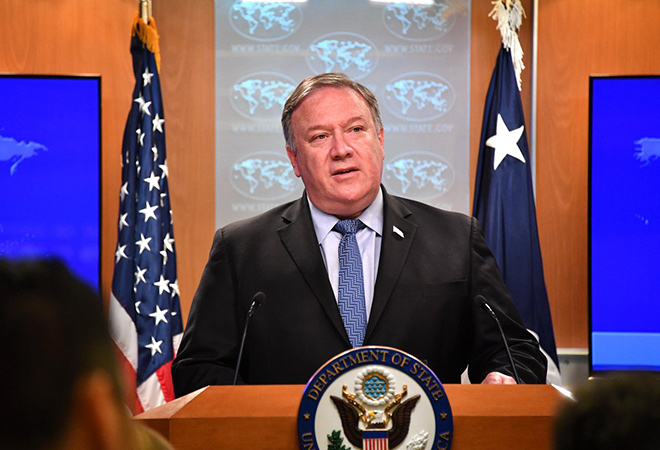
US Secretary of State Mike Pompeo is visiting New Delhi with a mission: to correct perceived economic and strategic inequities in bilateral relations between the world's oldest and largest democracies.
Three issues, in particular, stand out: India’s recent data localisation measures; the purchase of Russia’s S-400 missile defence system; and, oil trade with Iran. The Trump Administration's usual negotiating idiosyncrasies—unilateral economic measures and sanctions to use later as bargaining chips—have already preceded the visit.
Underlying these tactics, however, is a widely held consensus in Washington DC to support efforts that restore 'American leadership' over global affairs. While the American strategic community may argue over the Trump Administration's ham-handed methods, the end goal is the same. The thinking is born amidst the lengthening shadow of China’s rise, digital transformation of industrialisation and the global economy, and America's increasing self-doubt over the continued dominance of its global position and the resilience of the world order it has shaped between the fall of the Berlin Wall and the rise of the Great Wall of China.
India, it appears, is caught in the headwinds of America's geopolitical and geoeconomic reorientation. Unfortunately, the US is unwittingly undermining its relationship with India while trying to win the zero-sum race for ideological, economical, technological and military superiority.
At a sectoral level, the US is basing its strategy on two faulty premises. The first is economic. The US believes that Silicon Valley possesses the capacity and is vested with the legitimacy to underwrite India’s digital industrialisation.
This line of thinking ignores years of history in industrial development and American geoeconomic partnerships. A strong domestic industry and globally competitive corporations enabled American allies in Europe and East Asia to industrialise. The US, for its part, was a financier and a consumer market. With its recent policies on data governance and security, New Delhi is ensuring that Indian industry and governance propositions will dictate its development and growth during the Fourth Industrial Revolution.
Like with the electronic, automobile and aeronautical industries in Europe or Japan, India will design bias into its industrial policy to incubate its own domestic giants for the digital age. It will also protect its ability to provide security and guarantee the rights of its citizens in cyberspace—an area where American tech companies have certainly been found wanting. Rather than fight the inevitable, the US should partner with India to create an equitable, competitive and secure global regime for cyberspace—especially at a time when the risks of fragmentation are real.
The second faulty premise is strategic. The US is overestimating its long-term ability to dictate India’s relationship with its partners—especially Iran and Russia.
The US is being typically sanctimonious while seeking to dictate to India the terms of engagement with others. When Washington has maintained promiscuous defence relationships with several partners in West Asia and the extended Middle East, including with Pakistan, why expect India to act differently? India will maintain multiple defence and strategic partnerships based on its national security requirements.
More important, the US is ignoring the reorientation of geographies. The 21st century will be defined, in part, by the merger of Asia and Europe into the Eurasian supercontinent. India will be a crucial node in this arrangement, as it will in the Indo-Pacific maritime system.
In Eurasia, New Delhi must partner with Moscow and states like Iran to create order and opportunity for itself. This is India’s long-term prerogative and cannot be held hostage to America’s short-term impulses. It is arguably in the US’ interest to follow India’s lead in the governance of this region, given its integration with Eurasian actors and institutions.
The friction in both the economic and defence sectors is a product of faulty ‘big picture’ thinking about the India-US bilateral relationship. In the post-War period, America’s partners have all been dwarfed by its economic might and military capability. The Americans are keenly aware of this. For their own prosperity and security, they crave for a liberal order under American leadership. My friend Michael Fullilove of the Lowy Institute once paraphrased Winston Churchill to justify that “the US-led world order is the worst form of world order, except all those other forms that have been tried.”
This is not necessarily true for India.
A country of India’s size cannot emerge as a ‘leading power’ in a world order tailored to protect and promote the interests of one country. Think about the prospect in absolute quantitative terms. Should India try and ‘fit’ itself into the worldview of a country that has three times it's land and one-third its population?
What’s more, India’s economy may well surpass that of the US’ in size by the middle of this century. Look at it another way: America will, for the first time in over a century, be the smaller economic actor in a partnership. And unlike with Japan, Korea, Australia or the EU, the US will not be a guarantor of Indian security. Why, then, does Washington assume that its existing partnership templates will work with India?
Of course, there is a lesson in all of this for New Delhi. For too long, Indian policymakers have allowed ‘strategic ambiguity’ to guide foreign policy choices. In a rapidly fluctuating world order, this is bound to end in disaster. India must make clear what role it seeks in the international order and decide upon the means to achieve them.
The government of the day, arriving as it has on the back of a phenomenal election victory, must shape the imagination of Indians as to their place in the world. There are certainly many aspects of the world order that India will support, notably, liberal norms and rules-based trade and security. Nevertheless, it will not be hostage to a ‘US-led’ order. India will continue to push for a greater distribution and devolution of decision-making powers.
Rather than undermine India’s long-term ambitions, it is in America’s interest to recognise India as a co-sponsor and co-guarantor of the liberal order it incubated. This will necessarily involve trade-offs and compromises by both states. But that is expected of a relationship that carries the potential to define the course of the 21st century.
‘In India we trust’ would be good US policy | ORF
- Samir Saran
US Secretary of State Mike Pompeo is visiting New Delhi with a mission: to correct perceived economic and strategic inequities in bilateral relations between the world's oldest and largest democracies.
Three issues, in particular, stand out: India’s recent data localisation measures; the purchase of Russia’s S-400 missile defence system; and, oil trade with Iran. The Trump Administration's usual negotiating idiosyncrasies—unilateral economic measures and sanctions to use later as bargaining chips—have already preceded the visit.
Underlying these tactics, however, is a widely held consensus in Washington DC to support efforts that restore 'American leadership' over global affairs. While the American strategic community may argue over the Trump Administration's ham-handed methods, the end goal is the same. The thinking is born amidst the lengthening shadow of China’s rise, digital transformation of industrialisation and the global economy, and America's increasing self-doubt over the continued dominance of its global position and the resilience of the world order it has shaped between the fall of the Berlin Wall and the rise of the Great Wall of China.
India, it appears, is caught in the headwinds of America's geopolitical and geoeconomic reorientation. Unfortunately, the US is unwittingly undermining its relationship with India while trying to win the zero-sum race for ideological, economical, technological and military superiority.
At a sectoral level, the US is basing its strategy on two faulty premises. The first is economic. The US believes that Silicon Valley possesses the capacity and is vested with the legitimacy to underwrite India’s digital industrialisation.
This line of thinking ignores years of history in industrial development and American geoeconomic partnerships. A strong domestic industry and globally competitive corporations enabled American allies in Europe and East Asia to industrialise. The US, for its part, was a financier and a consumer market. With its recent policies on data governance and security, New Delhi is ensuring that Indian industry and governance propositions will dictate its development and growth during the Fourth Industrial Revolution.
Like with the electronic, automobile and aeronautical industries in Europe or Japan, India will design bias into its industrial policy to incubate its own domestic giants for the digital age. It will also protect its ability to provide security and guarantee the rights of its citizens in cyberspace—an area where American tech companies have certainly been found wanting. Rather than fight the inevitable, the US should partner with India to create an equitable, competitive and secure global regime for cyberspace—especially at a time when the risks of fragmentation are real.
The second faulty premise is strategic. The US is overestimating its long-term ability to dictate India’s relationship with its partners—especially Iran and Russia.
The US is being typically sanctimonious while seeking to dictate to India the terms of engagement with others. When Washington has maintained promiscuous defence relationships with several partners in West Asia and the extended Middle East, including with Pakistan, why expect India to act differently? India will maintain multiple defence and strategic partnerships based on its national security requirements.
More important, the US is ignoring the reorientation of geographies. The 21st century will be defined, in part, by the merger of Asia and Europe into the Eurasian supercontinent. India will be a crucial node in this arrangement, as it will in the Indo-Pacific maritime system.
In Eurasia, New Delhi must partner with Moscow and states like Iran to create order and opportunity for itself. This is India’s long-term prerogative and cannot be held hostage to America’s short-term impulses. It is arguably in the US’ interest to follow India’s lead in the governance of this region, given its integration with Eurasian actors and institutions.
The friction in both the economic and defence sectors is a product of faulty ‘big picture’ thinking about the India-US bilateral relationship. In the post-War period, America’s partners have all been dwarfed by its economic might and military capability. The Americans are keenly aware of this. For their own prosperity and security, they crave for a liberal order under American leadership. My friend Michael Fullilove of the Lowy Institute once paraphrased Winston Churchill to justify that “the US-led world order is the worst form of world order, except all those other forms that have been tried.”
This is not necessarily true for India.
A country of India’s size cannot emerge as a ‘leading power’ in a world order tailored to protect and promote the interests of one country. Think about the prospect in absolute quantitative terms. Should India try and ‘fit’ itself into the worldview of a country that has three times it's land and one-third its population?
What’s more, India’s economy may well surpass that of the US’ in size by the middle of this century. Look at it another way: America will, for the first time in over a century, be the smaller economic actor in a partnership. And unlike with Japan, Korea, Australia or the EU, the US will not be a guarantor of Indian security. Why, then, does Washington assume that its existing partnership templates will work with India?
Of course, there is a lesson in all of this for New Delhi. For too long, Indian policymakers have allowed ‘strategic ambiguity’ to guide foreign policy choices. In a rapidly fluctuating world order, this is bound to end in disaster. India must make clear what role it seeks in the international order and decide upon the means to achieve them.
The government of the day, arriving as it has on the back of a phenomenal election victory, must shape the imagination of Indians as to their place in the world. There are certainly many aspects of the world order that India will support, notably, liberal norms and rules-based trade and security. Nevertheless, it will not be hostage to a ‘US-led’ order. India will continue to push for a greater distribution and devolution of decision-making powers.
Rather than undermine India’s long-term ambitions, it is in America’s interest to recognise India as a co-sponsor and co-guarantor of the liberal order it incubated. This will necessarily involve trade-offs and compromises by both states. But that is expected of a relationship that carries the potential to define the course of the 21st century.
‘In India we trust’ would be good US policy | ORF
What ??
Modi and I will announce very big trade deal: Trump
IANS, Jun 28, 2019, 08:47 IST
Osaka, Japan :
US President Donald Trump on Friday said ahead of his meeting with Indian Prime Minister Narendra Modi that he thinks they will have a "very big trade deal to announce".
Speaking to the media before the trilateral talks between him, Modi and Japanese Prime Minister Shinzo Abe on the sidelines of the two-day G-20 Summit here, Trump said: "I think we are going to have some very big things to announce. Very big trade deal.
"We certainly work together on trade and we'll be discussing trade today... I think we will just continue to get along with India."
Modi said that the key topics they would discuss include Iran, 5G, bilateral and defence relations.
Modi said that US Secretary of State Mike Pompeo during his recent visit to New Delhi had delivered a "very warm letter" from Trump congratulating him on his recent re-election.
"The hottest country in the world right now is the US and everybody wants to be a part of it," Trump said.
"We're going to be discussing that and also how India fits in," Trump said when asked about Huawei, the Chinese telecommunications manufacturer that the US has placed restrictions because of its security considerations.
Trump has put sanctions on oil trade with Iran, an important energy source for India.
Asked about it, Trump said: "We have a lot of time, there's no rush they can take their time. There is absolutely no time pressure. Hopefully in the end, it's going to work out. If it does, great, if it doesn't, you all be hearing shut it."
When the three leaders were asked to shake hands for a photograph, Trump initiated a three-way fist bump.
Pompeo, Commerce Secretary Wilbur Ross, National Security Adviser John Bolton, Trump's son-in-law and adviser Jared Kushner were present at the start of the trilateral meeting.
The meeting began after Trump and Abe had bilateral talks. A bilateral meeting between Modi and Trump will take place later in the day.
Modi and I will announce very big trade deal: Trump
Modi and I will announce very big trade deal: Trump
IANS, Jun 28, 2019, 08:47 IST
Osaka, Japan :
US President Donald Trump on Friday said ahead of his meeting with Indian Prime Minister Narendra Modi that he thinks they will have a "very big trade deal to announce".
Speaking to the media before the trilateral talks between him, Modi and Japanese Prime Minister Shinzo Abe on the sidelines of the two-day G-20 Summit here, Trump said: "I think we are going to have some very big things to announce. Very big trade deal.
"We certainly work together on trade and we'll be discussing trade today... I think we will just continue to get along with India."
Modi said that the key topics they would discuss include Iran, 5G, bilateral and defence relations.
Modi said that US Secretary of State Mike Pompeo during his recent visit to New Delhi had delivered a "very warm letter" from Trump congratulating him on his recent re-election.
"The hottest country in the world right now is the US and everybody wants to be a part of it," Trump said.
"We're going to be discussing that and also how India fits in," Trump said when asked about Huawei, the Chinese telecommunications manufacturer that the US has placed restrictions because of its security considerations.
Trump has put sanctions on oil trade with Iran, an important energy source for India.
Asked about it, Trump said: "We have a lot of time, there's no rush they can take their time. There is absolutely no time pressure. Hopefully in the end, it's going to work out. If it does, great, if it doesn't, you all be hearing shut it."
When the three leaders were asked to shake hands for a photograph, Trump initiated a three-way fist bump.
Pompeo, Commerce Secretary Wilbur Ross, National Security Adviser John Bolton, Trump's son-in-law and adviser Jared Kushner were present at the start of the trilateral meeting.
The meeting began after Trump and Abe had bilateral talks. A bilateral meeting between Modi and Trump will take place later in the day.
Modi and I will announce very big trade deal: Trump
In Osaka, a mature Modi has emerged – one who didn’t make the mistake of hugging Trump
Modi assumed the quiet dignity of his office, which represents 1.3 billion people, and let Trump ramble on and on.
Jyoti Malhotra, Updated: 28 June, 2019 8:45 pm IST
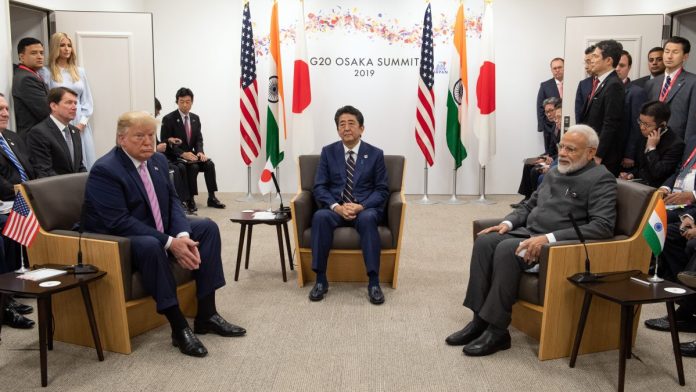
US President Donald Trump, left, Shinzo Abe, Japan's prime minister, center, and Narendra Modi at G-20 summit in Osaka, Friday| Photo: Carl Court | Bloomberg
It’s been a lot of fun, being with you, we’ve had some good talks already…” said US President Donald Trump to Prime Minister Narendra Modi Friday morning in Osaka on the margins of the G-20 summit.
If that sounded like Teacher Trump telling a recalcitrant student off, then you got it right. In the TV screen grab, Modi is quiet, as he turns his notes over in his hands, while Trump speaks nonstop sitting next to him.
“You deserve it (victory). You have done a great job in pulling together. I remember when you first took over, there were many factions and they were fighting with each other and now they get along…” Trump continued.
Even if you didn’t vote for Modi this election, he definitely had your sympathy.
Also read: Modi can’t forget trade war with US just because Trump called him a ‘great friend’ at G-20
Certainly, the real estate dealer-turned-powerful world leader didn’t seem to have realised that he was treating the Prime Minister of 1.3 billion people with a certain lack of grace. Trump redefines the meaning of the phrase, ‘The Ugly American,’ not because he is loud, boorish, cruel and unkind, but because he doesn’t even realise he is all of the above.
It’s probably why Modi reacted with a certain peevishness when he and Trump brushed up against each other the first two times they met – the first time in June 2017, in the White House, when Modi tried to hug him, as he is wont to do with world leaders, except Trump seemed totally uncomfortable with the idea of a male embrace.
The second time around, in November 2017, on the margins of an ASEAN summit in Manila, Modi and Trump got off the wrong foot because the PM felt Trump had treated him “like just another Asian leader.”
You can see why. Trump must have brushed off the obvious eagerness of the Indian Prime Minister, like so many other Third World leaders are wont to do in the presence of Powerful People.
Also read: India-Russia S-400 missile deal gets no mention during Modi-Trump talks at G-20 meeting
Except India isn’t just another Third World country – a lesson that Trump’s predecessor George Bush Jr (he didn’t know who India’s prime minister was when he was the Republic frontrunner in 1999 presidential elections) and Barack Obama (he was extremely tough on India’s nuclear weapons programme and wanted India to sign the NPT) learnt fairly quickly when they met India’s political leaders and diplomats. Both Bush and Obama came around over the years, both realising the value of partnering with a democratic country in a region littered with dictators.
To Modi’s credit, he didn’t let his emotions show this time around in Osaka. The Prime Minister has matured and he realises the world stage is actually a little bit like the hurly-burly of domestic politics.
The deal-making, the poison-tipped barb, the smiling sweetly but turning the knife within, the hard knuckles negotiation, the eye-to-eye stare. It’s what foreign policy is also made up of.
Also read: Faking Indian accent, bear hugs, public jibes & praises — how Modi-Trump ties have evolved
This time around, Modi didn’t make the mistake of hugging Trump. He assumed the quiet dignity of his office, which represents 1.3 billion people – even if you didn’t vote for him – and let Trump ramble on and on. The US president revealed his gracelessness in the manner in which he addressed PM Modi. Modi dealt with his loquaciousness by simply keeping quiet.
Both Modi and Trump know that their foreign office establishments have been working really hard to put together a meeting in Osaka, keeping some margin for error. Like the Mike Pompeo throwaway remark on Iran being “the world’s largest sponsor of terrorism” in his New Delhi press conference – remarks to his own audience back home rather than the one in front of him – or Trump’s irresponsible tweet on the eve of his meeting with Modi, telling Modi that he has to withdraw tariffs on American products, or else.
Well, some of that will happen. It’s bound to. But the stakes for India in the relationship with the US are far too important to be allowed to fray at the sight of an offensive tweet – and vice-versa. Trump may or may not know it, but India is doing far more than most countries in the world for the Americans, by just being there, a massive country in the Indian Ocean, right next to China.
In the next few weeks, the Indo-US relationship will stabilise. The US is working to send a delegation to Piyush Goyal’s commerce ministry to figure out how to reduce tariffs that have so irked the US president. It’s not a big deal. What you put on, you can easily take back.
Also read: Modi should strengthen ties with the US but not allow Trump to bully India
Osaka will be remembered for the manner in which Modi bit his tongue at Trump’s rude remarks and went on to calmly talk to the world’s most powerful leader. He vindicated the trust that India put in him, which was to separate the all-important relationship with the US from the personal careless disregard that Trump may or may not have for Modi.
Can the cat catch mice, Deng Xiaoping may have asked himself time and again, as he embarked upon the opening up of China in 1978. Modi faces several important struggles back home, including facing up to Right-wing ideologues like S. Gurumurthy on issues like data sovereignty, but he also realises that India is once again on the cusp of a big dilemma. Should it look ahead into the future or look back at its contested history?
Modi is keenly aware that the ability to answer that question also, partially, lies in his hands. On the eve of his Japan visit, he called for the punishment of those men lynching Muslims in Jharkhand. That statement was not only meant for the foreign audience that he was about to meet, but for his own people at home, those who have been fed on a relentless anti-Islam diet.
The weeks and months ahead will show the path that Modi and India chooses.
In Osaka, a mature Modi has emerged – one who didn’t make the mistake of hugging Trump
Modi assumed the quiet dignity of his office, which represents 1.3 billion people, and let Trump ramble on and on.
Jyoti Malhotra, Updated: 28 June, 2019 8:45 pm IST
US President Donald Trump, left, Shinzo Abe, Japan's prime minister, center, and Narendra Modi at G-20 summit in Osaka, Friday| Photo: Carl Court | Bloomberg
It’s been a lot of fun, being with you, we’ve had some good talks already…” said US President Donald Trump to Prime Minister Narendra Modi Friday morning in Osaka on the margins of the G-20 summit.
If that sounded like Teacher Trump telling a recalcitrant student off, then you got it right. In the TV screen grab, Modi is quiet, as he turns his notes over in his hands, while Trump speaks nonstop sitting next to him.
“You deserve it (victory). You have done a great job in pulling together. I remember when you first took over, there were many factions and they were fighting with each other and now they get along…” Trump continued.
Even if you didn’t vote for Modi this election, he definitely had your sympathy.
Also read: Modi can’t forget trade war with US just because Trump called him a ‘great friend’ at G-20
Certainly, the real estate dealer-turned-powerful world leader didn’t seem to have realised that he was treating the Prime Minister of 1.3 billion people with a certain lack of grace. Trump redefines the meaning of the phrase, ‘The Ugly American,’ not because he is loud, boorish, cruel and unkind, but because he doesn’t even realise he is all of the above.
It’s probably why Modi reacted with a certain peevishness when he and Trump brushed up against each other the first two times they met – the first time in June 2017, in the White House, when Modi tried to hug him, as he is wont to do with world leaders, except Trump seemed totally uncomfortable with the idea of a male embrace.
The second time around, in November 2017, on the margins of an ASEAN summit in Manila, Modi and Trump got off the wrong foot because the PM felt Trump had treated him “like just another Asian leader.”
You can see why. Trump must have brushed off the obvious eagerness of the Indian Prime Minister, like so many other Third World leaders are wont to do in the presence of Powerful People.
Also read: India-Russia S-400 missile deal gets no mention during Modi-Trump talks at G-20 meeting
Except India isn’t just another Third World country – a lesson that Trump’s predecessor George Bush Jr (he didn’t know who India’s prime minister was when he was the Republic frontrunner in 1999 presidential elections) and Barack Obama (he was extremely tough on India’s nuclear weapons programme and wanted India to sign the NPT) learnt fairly quickly when they met India’s political leaders and diplomats. Both Bush and Obama came around over the years, both realising the value of partnering with a democratic country in a region littered with dictators.
To Modi’s credit, he didn’t let his emotions show this time around in Osaka. The Prime Minister has matured and he realises the world stage is actually a little bit like the hurly-burly of domestic politics.
The deal-making, the poison-tipped barb, the smiling sweetly but turning the knife within, the hard knuckles negotiation, the eye-to-eye stare. It’s what foreign policy is also made up of.
Also read: Faking Indian accent, bear hugs, public jibes & praises — how Modi-Trump ties have evolved
This time around, Modi didn’t make the mistake of hugging Trump. He assumed the quiet dignity of his office, which represents 1.3 billion people – even if you didn’t vote for him – and let Trump ramble on and on. The US president revealed his gracelessness in the manner in which he addressed PM Modi. Modi dealt with his loquaciousness by simply keeping quiet.
Both Modi and Trump know that their foreign office establishments have been working really hard to put together a meeting in Osaka, keeping some margin for error. Like the Mike Pompeo throwaway remark on Iran being “the world’s largest sponsor of terrorism” in his New Delhi press conference – remarks to his own audience back home rather than the one in front of him – or Trump’s irresponsible tweet on the eve of his meeting with Modi, telling Modi that he has to withdraw tariffs on American products, or else.
Well, some of that will happen. It’s bound to. But the stakes for India in the relationship with the US are far too important to be allowed to fray at the sight of an offensive tweet – and vice-versa. Trump may or may not know it, but India is doing far more than most countries in the world for the Americans, by just being there, a massive country in the Indian Ocean, right next to China.
In the next few weeks, the Indo-US relationship will stabilise. The US is working to send a delegation to Piyush Goyal’s commerce ministry to figure out how to reduce tariffs that have so irked the US president. It’s not a big deal. What you put on, you can easily take back.
Also read: Modi should strengthen ties with the US but not allow Trump to bully India
Osaka will be remembered for the manner in which Modi bit his tongue at Trump’s rude remarks and went on to calmly talk to the world’s most powerful leader. He vindicated the trust that India put in him, which was to separate the all-important relationship with the US from the personal careless disregard that Trump may or may not have for Modi.
Can the cat catch mice, Deng Xiaoping may have asked himself time and again, as he embarked upon the opening up of China in 1978. Modi faces several important struggles back home, including facing up to Right-wing ideologues like S. Gurumurthy on issues like data sovereignty, but he also realises that India is once again on the cusp of a big dilemma. Should it look ahead into the future or look back at its contested history?
Modi is keenly aware that the ability to answer that question also, partially, lies in his hands. On the eve of his Japan visit, he called for the punishment of those men lynching Muslims in Jharkhand. That statement was not only meant for the foreign audience that he was about to meet, but for his own people at home, those who have been fed on a relentless anti-Islam diet.
The weeks and months ahead will show the path that Modi and India chooses.
In Osaka, a mature Modi has emerged – one who didn’t make the mistake of hugging Trump
This woman is to journalistic analysis what @Guynextdoor is to this forum.In Osaka, a mature Modi has emerged – one who didn’t make the mistake of hugging Trump
Modi assumed the quiet dignity of his office, which represents 1.3 billion people, and let Trump ramble on and on.
Jyoti Malhotra, Updated: 28 June, 2019 8:45 pm IST
US President Donald Trump, left, Shinzo Abe, Japan's prime minister, center, and Narendra Modi at G-20 summit in Osaka, Friday| Photo: Carl Court | Bloomberg
It’s been a lot of fun, being with you, we’ve had some good talks already…” said US President Donald Trump to Prime Minister Narendra Modi Friday morning in Osaka on the margins of the G-20 summit.
If that sounded like Teacher Trump telling a recalcitrant student off, then you got it right. In the TV screen grab, Modi is quiet, as he turns his notes over in his hands, while Trump speaks nonstop sitting next to him.
“You deserve it (victory). You have done a great job in pulling together. I remember when you first took over, there were many factions and they were fighting with each other and now they get along…” Trump continued.
Even if you didn’t vote for Modi this election, he definitely had your sympathy.
Also read: Modi can’t forget trade war with US just because Trump called him a ‘great friend’ at G-20
Certainly, the real estate dealer-turned-powerful world leader didn’t seem to have realised that he was treating the Prime Minister of 1.3 billion people with a certain lack of grace. Trump redefines the meaning of the phrase, ‘The Ugly American,’ not because he is loud, boorish, cruel and unkind, but because he doesn’t even realise he is all of the above.
It’s probably why Modi reacted with a certain peevishness when he and Trump brushed up against each other the first two times they met – the first time in June 2017, in the White House, when Modi tried to hug him, as he is wont to do with world leaders, except Trump seemed totally uncomfortable with the idea of a male embrace.
The second time around, in November 2017, on the margins of an ASEAN summit in Manila, Modi and Trump got off the wrong foot because the PM felt Trump had treated him “like just another Asian leader.”
You can see why. Trump must have brushed off the obvious eagerness of the Indian Prime Minister, like so many other Third World leaders are wont to do in the presence of Powerful People.
Also read: India-Russia S-400 missile deal gets no mention during Modi-Trump talks at G-20 meeting
Except India isn’t just another Third World country – a lesson that Trump’s predecessor George Bush Jr (he didn’t know who India’s prime minister was when he was the Republic frontrunner in 1999 presidential elections) and Barack Obama (he was extremely tough on India’s nuclear weapons programme and wanted India to sign the NPT) learnt fairly quickly when they met India’s political leaders and diplomats. Both Bush and Obama came around over the years, both realising the value of partnering with a democratic country in a region littered with dictators.
To Modi’s credit, he didn’t let his emotions show this time around in Osaka. The Prime Minister has matured and he realises the world stage is actually a little bit like the hurly-burly of domestic politics.
The deal-making, the poison-tipped barb, the smiling sweetly but turning the knife within, the hard knuckles negotiation, the eye-to-eye stare. It’s what foreign policy is also made up of.
Also read: Faking Indian accent, bear hugs, public jibes & praises — how Modi-Trump ties have evolved
This time around, Modi didn’t make the mistake of hugging Trump. He assumed the quiet dignity of his office, which represents 1.3 billion people – even if you didn’t vote for him – and let Trump ramble on and on. The US president revealed his gracelessness in the manner in which he addressed PM Modi. Modi dealt with his loquaciousness by simply keeping quiet.
Both Modi and Trump know that their foreign office establishments have been working really hard to put together a meeting in Osaka, keeping some margin for error. Like the Mike Pompeo throwaway remark on Iran being “the world’s largest sponsor of terrorism” in his New Delhi press conference – remarks to his own audience back home rather than the one in front of him – or Trump’s irresponsible tweet on the eve of his meeting with Modi, telling Modi that he has to withdraw tariffs on American products, or else.
Well, some of that will happen. It’s bound to. But the stakes for India in the relationship with the US are far too important to be allowed to fray at the sight of an offensive tweet – and vice-versa. Trump may or may not know it, but India is doing far more than most countries in the world for the Americans, by just being there, a massive country in the Indian Ocean, right next to China.
In the next few weeks, the Indo-US relationship will stabilise. The US is working to send a delegation to Piyush Goyal’s commerce ministry to figure out how to reduce tariffs that have so irked the US president. It’s not a big deal. What you put on, you can easily take back.
Also read: Modi should strengthen ties with the US but not allow Trump to bully India
Osaka will be remembered for the manner in which Modi bit his tongue at Trump’s rude remarks and went on to calmly talk to the world’s most powerful leader. He vindicated the trust that India put in him, which was to separate the all-important relationship with the US from the personal careless disregard that Trump may or may not have for Modi.
Can the cat catch mice, Deng Xiaoping may have asked himself time and again, as he embarked upon the opening up of China in 1978. Modi faces several important struggles back home, including facing up to Right-wing ideologues like S. Gurumurthy on issues like data sovereignty, but he also realises that India is once again on the cusp of a big dilemma. Should it look ahead into the future or look back at its contested history?
Modi is keenly aware that the ability to answer that question also, partially, lies in his hands. On the eve of his Japan visit, he called for the punishment of those men lynching Muslims in Jharkhand. That statement was not only meant for the foreign audience that he was about to meet, but for his own people at home, those who have been fed on a relentless anti-Islam diet.
The weeks and months ahead will show the path that Modi and India chooses.
In Osaka, a mature Modi has emerged – one who didn’t make the mistake of hugging Trump
This woman is to journalistic analysis what @Guynextdoor is to this forum.
how is the brain fog bro? You made up with Basanti yet?
Not interested in your mom, Ponthan.how is the brain fog bro? You made up with Basanti yet?
Not interested in your mom, Ponthan.
basanti is young and virile bro. She ain't anybody's mom. She's so virile she kicked you in the balls and plays football too....
Not into your sister too.basanti is young and virile bro. She ain't anybody's mom. She's so virile she kicked you in the balls and plays football too....
Google the meaning of virile and why doesn't one associate it with females unless your sister is a male, which makes perfect sense if one is @Guynextdoor .
Not into your sister too.
Google the meaning of virile and why doesn't one associate it with females unless your sister is a male, which makes perfect sense if one is @Guynextdoor .
You seem to think cows give birth to human beings. This could be because....
a) Personal experience- your mommmy is gaumata
b) Personal experience- you sister is also gaumata
c) You attended your biology lessons at the local shaka
I'd say even odds for all the choices above.
Basanti is virile because she is the one screwing you.....
Think tank paper on India-US relations.
https://www.isas.nus.edu.sg/wp-content/uploads/2019/06/isas-trump-modi-pdf-june2019.pdf
https://www.isas.nus.edu.sg/wp-content/uploads/2019/06/isas-trump-modi-pdf-june2019.pdf

Faux-patriots want India to repeat Nehru’s 1960 mega-mistake - The Sunday Guardian Live
Madhav Nalapat enjoying his day - Sunday Kerala style while penning the article.
Madhav Nalapat enjoying his day - Sunday Kerala style while penning the article.
Personally speaking we should have delayed this meet after Trump s remark and F16 assistance program. We should recaliberate our foreign policy now. All the visits of Modi have come to naught just by few visits of Im the Dim to Middle East and now US. We should keep some distance from US. And most importantly somebody should do something to bring our economy back on track. Foreign policy draws strength from Economic performance.
Modi should make the mistake of Nehru who ran India s foreign policy with no economic and military strength. He weaken our military n destroyed the economy but wrong policies. End result was no body took us seriously. Modi appears to be overlooking our military n economic frailties