

Take it with a huge lump of salt. It looks like an elaborate hit job.
US-China conflict opens door to Sino-Indian border settlement
 Madhav Nalapat, Published : May 18, 2019, 7:20 pm | Updated : May 19, 2019, 8:10 AM
Unlike his predecessors Jiang Zemin and Hu Jintao, who believed that the boundary dispute was best left to be settled at a much later date, key policymakers say that Xi Jinping is looking to strengthen his historical legacy by coming to a boundary settlement with India during his term.
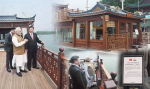
East Lake Guest House, Wuhan: Far from anticipating a speedy end to the trade war formally launched last year by US President Donald Trump against China, the leadership of the Chinese Communist Party (CCP) is preparing for a prolonged struggle. The CCP considers the hostile measures serially introduced by Trump as an effort by the United States to slow down and if possible snuff out economic growth in China in order to create chaos that would generate Arab Spring or Colour Revolution conditions.
In the CCP core’s view, several of the conditions insisted upon by US trade negotiators “at the point of a gun” have little to do with commerce but relate to demands designed to significantly dilute the influence and authority of the Communist Party over the country, a control over policy that is regarded as having been a necessary pre-condition for the rapid growth of China since the mid-1980s.
Those around President Xi Jinping look to the experience of Japan, which during 1985-87 accepted (as a consequence of Washington’s pressure) several one-sided conditions related to the economy, such as excessive levels of investment in US-based assets, and artificially boosting the value of the Japanese currency. That surrender to US dictates by Tokyo created the conditions for the relative stagnation of the Japanese economy since the 1990s as compared to the previous period.
The policy group around the core leadership of the CCP has equally intensively gone through the numerous concessions made by the Communist Party of the Soviet Union (CPSU) to US demands since the death of Stalin, including Khruschev’s climbdown in Cuba in 1962 and Brezhnev agreeing to the 1975 Helsinki accords, which opened the way for large-scale US interference through the non-formal sector in sensitive internal matters concerning the CPSU. They point out that none of the concessions made by Moscow yielded any of the economic and financial returns that they were expected to generate. CCP policymakers have also studied the aftershocks of numerous other Soviet concessions “given on the basis of post-dated cheques by western powers that were never honoured”, not to mention the unprecedented concessions made by Mikhail Gorbachev in the latter half of the 1980s, which in their view resulted in the meltdown of the USSR.
Instead of heading down the “Soviet Road”, the CCP is instead fashioning a raft of measures designed to ensure eventual success in what is expected to be a long struggle with the US over the economy and polity of China “without the illusions that the CPSU had that an honourable accommodation could be reached with a power intent on its destruction”.
Such a situation has created an opportunity for India, a country whose importance in the geopolitical calculus of China has risen substantially in view of what are anticipated to be long-term, multiple and significant tensions between Beijing and Washington.
THE CHINESE ARE STANDING TALL
In discussions concerning strategy, a favoured retreat for officials looking for a quiet locale conducive to intensive deliberations is the East Lake Guest House on the outskirts of Wuhan, the capital of Hubei province. This was the venue for the Wuhan Summit that took place last year between Xi Jinping and Narendra Modi, two individuals who together manage the destinies of 2.6 billion of the earth’s human inhabitants.
Apart from the comfortable 7-star quarters and the leafy grounds of the estate, some of their discussions took place on the lake itself, inside a large craft outfitted with two rows of white single-seater sofas. On Modi’s part, the sofas on his side were occupied by the IAS, IFS and IPS officers that the Prime Minister relies on to formulate policy and implement decisions.
The large seacraft where the two leaders met has now become something of a tourist attraction, although visitors are not permitted inside. Indicating the importance the Chinese side attaches to the Xi-Modi meeting, there are numerous locations around the lake with plaques commemorating the 2018 Wuhan Summit.
Not coincidentally, the East Lake Guest House is a short walk away from what was from 1955 to 1974 the favourite residence of Mao Zedong, who on October 1, 1949 declared that “the Chinese people have stood up”. Given what has taken place since then, it can now be asserted that the Chinese people are now not just standing up but standing tall. The Peoples Republic of China has become an economic and geopolitical powerhouse next only to the US. From the start of his term in 2012 as the General Secretary of the Chinese Communist Party, the most consequential of his titles (others include the President of the Peoples Republic of China (PRC) and Chairman of the Central Military Commission) Xi Jinping has made no secret of his determination to place China once again where the country had been for at least two millennia, at the very top.
During the earlier period of its glory, China was followed closely by the Indian subcontinent, which at the time was the world’s second largest economy. Both were brought to their knees by European colonial powers and denuded of their wealth. However, by 2011, it was clear to US policymakers that the PRC was well on the way towards achieving the goal of being the world’s biggest economy within at most a couple of decades. This led, in the view from Beijing, to the implementation of plans for the US to try and indefinitely delay the day when Washington’s post-1945 primacy over global geopolitics ended would end. This included slowing down and limiting the reach of the Chinese economic juggernaut, a policy initiative made by Barack Obama during his term, although in a far quieter manner than his successor, Donald J Trump, who tweets almost hourly nuggets of information on US policy objectives. Trump has filled the topmost layers of his administration with those who not only wish to ensure that the 21st century remains the American Century, just as the 20th has been, but are willing to take enormous risks in order to ensure such a result. Such a casual attitude towards risk is much the way Trump acted during the days he ran his business interests.
As a consequence, Xi Jinping has collected around him a group of individuals chosen for their skills in identifying the problems facing the PRC and finding out solutions for them. Meeting not just in Beijing but in other places having historical significance for the CCP, his policy advisors are aware that the Trade War begun by President Trump in the opening weeks of 2018 is not so much about commerce as it is about Washington seeking to retain its global primacy in the face of the challenge from China. President Xi knows that the battle will be hard and long, which is perhaps why a slim text, “On Protracted War”, a collection of lectures given by Mao from 16 May to 1 June 1938 at the Yenan Association for the Study of Resistance is being read and re-read these troubled days by several within the most consequential echelons of the CCP.
A PROTRACTED WAR
In the book, which details Mao’s strategy for winning what the CCP Chairman warned would be a long and cruel war with Japan, Mao correctly identified then British Prime Minister Neville Chamberlain as being blind to the threat posed by Germany to Great Britain, and forecast that Hitler (with help from Japan) would soon launch a war against the US and Britain. Among Mao’s forecasts in the book was that this global war would inevitably end in the destruction of the feudal governance system of Japan. This did happen in 1945, but not because of the Japanese people revolting against the leaders who had taken them into a disastrous conflict. It took place because of the victory of the US and consequent reforms imposed on Japan by General Douglas MacArthur.
Key officials say that Beijing’s refusal to accept the “one-sided and harmful” conditions that the US side had demanded of China were the reason for Trump’s additional tariffs in May 2019 on a further $ 200 billion of imports from China. It was claimed that negotiators from Washington unilaterally included the contentious conditions and one-sided commitments in its own draft, despite the Chinese side not having agreed to them. The US side insisted that the Chinese side should accept the US draft rather than seek a mutually acceptable compromise. Policymakers spoken to said that several of these conditions were quasi-political rather than wholly economic in their effects, and if conceded, could have affected the governance system in China in branches that have little to do with trade.
It was therefore not a surprise (except to the US side) that the fresh tariffs imposed by Trump saw an almost immediate retaliation from Beijing, which imposed tariffs on a further $ 60 billon of imports from the US. During the initial weeks of the US Trade War with China, public opinion in the latter country was largely in favour of an accommodative stance, the perception being that all that the US President was looking for was to get some more money for his country’s companies out of doing business with China. However, subsequently opinion within the populace hardened as a consequence of the harsher and harsher rhetoric, as well as additional punitive measures from the US side. The perception is spreading within the general public that the conflict between Beijing and Washington is much bigger than merely the size of the trade surplus. There has begun a conscious effort to eliminate from public acceptance two toxic theories pointed out by Mao in his lectures, which was to “either believe that China was doomed to lose the battle, or that victory over the adversary will be quick”.
Through his very public and not very polite efforts at getting China to make concessions, President Trump has ensured that more and more of the Chinese population are moving in the direction of favouring a hard line rather than Beijing making concessions that would satisfy the US side, even if this means pain for what could be an extended period of time. Memories are reviving of an earlier period when China accumulated huge specie surpluses with western powers (then led by Britain), but which were clawed back by western powers through gunboat diplomacy and “unequal treaties” imposed by force.
The 120 years from 1820 onwards saw the decline of China from being for millennia the world’s largest economy to a nation in free fall, and this period of shame and weakness has been burnt into the minds of the Chinese people. Today, once again, the view of many is that because China has become the world’s biggest economy ( in Purchasing Power Parity terms) and has accumulated large surpluses with the US, the latter is seeking to get back, once again through “unequal treaties”, the moneys earned by China. The revival of such memories has ensured that public opinion remains behind the firm line being adopted by President Xi Jinping.
‘U.S. OVERREACH’
There may be an underlying rationale for the numerous geopolitical fires that have been lit in different regions by National Security Advisor John Bolton and Secretary of State Mike Pompeo on behalf of the 45th President of the United States. However, to minds less evolved than theirs, the crises that have been created by Trump across continents since 2017 seem a textbook example of overreach.
Some carry the risk of outright war, such as in the actions concerning Iran and Venezuela. In several of these militarised and tension-filled situations, the Sino-Russian alliance is the beneficiary. For example, the US has put China in the driver’s seat so far as two large oil producing states are concerned, Venezuela and Iran, through forcing countries such as Japan and India to snap oil trade with Teheran.
The Modi government seems to have decided to prioritize the goodwill of Bolton and Pompeo over the possibility that the consequence would be that Iran transfer India’s rights and access in Chabahar to China as a consequence of oil imports by India from Iran being brought to zero since the beginning of May 2019. The reason given by Delhi is that a decision on continuing or stopping imports from Iran needs to await the results of the current Lok Sabha polls, a reason that seems somewhat at variance with the stance expected of a country that showcases itself as a global heavyweight with a mind of its own.
Should China decide to boost oil imports from Venezuela and Iran, it is likely to do so at prices far below those India will need to pay to access alternative supplies. Across the world, pressure both public and otherwise that is being brought to bear on different countries by the Trump administration, often on behalf of individual US companies, is leading policymakers in these capitals to look towards Beijing for a closer association, given that the Chinese are entirely tolerant of what they term the “internal affairs” of the countries they are dealing with.
Even within the European Union, the divide has deepened between Germany, France and the UK, who consider themselves the First Tier of the EU, relegating others to a less exalted status. Countries such as Italy and Greece, which have been pushed and pulled by the EU Big Three to alter their policies for the benefit of Frankfurt, London and Paris, are now openly moving closer to the Sino-Russian alliance. They are likely to be followed by several more EU member-states interested in the potential for investment from China, especially on projects within the Belt and Road Initiative (BRI) framework. The ongoing effort by Beijing to persuade countries in Asia, Africa and South America to move away from their longstanding tilt towards the US to a posture of neutrality will get intensified as a consequence of the US-China trade war masterminded by President Trump.
Technology is a key battleground. Alarmed that Huawei has developed what is at present globally the most cost-effective 5G system, the Trump administration is seeking to use administrative methods, including emergency powers, to limit its market access. However, policymakers in Beijing are confident that more and more countries will prefer the 5G and other advanced products of the company, in view of time and cost advantages over the competition. Trump’s move to block select Chinese products from accessing the US market is having an impact on the minds of citizens in the PRC.
In times past, US franchise operations such as McDonalds or KFC used to be crowded, but more and more, locals are giving them a miss in favour of other outlets. Whether it be food, aircraft, automobiles or mobile telephones, US brands are likely to face a backlash from Chinese consumers made hostile by trade tensions. Apart from Chinese consumers increasingly looking askance at US-made items, Chinese companies that are being denied access to the US market are gearing up to compete more fiercely with US brands across the world, seeking to make up the loss of the world’s biggest market by denying market share in third countries to companies from the US, “not though administrative fiat but through price and quality standards”.
ONE FALLOUT
A fallout of the trade war has been a change in the approach of the CCP leadership core towards private industry in China. Across Southeast Asia, ethnic Chinese are the most successful in business, creating commercial empires that reach across the globe. However, in the PRC, private industry has long been treated in a step-motherly fashion, with funds and policy advantages instead getting lavished on the state sector, whose top ranks are filled with the CCP elite. Recent statements by Xi Jinping indicate that the leadership core of the CCP has accepted that the private sector in China needs to be trusted and given freedom to develop rather than remain held back by bureaucratic excess. This shift in policy is likely to boost the economy in coming years, and give China more legroom to overcome the blockages created by the US on Chinese exports.
DOOR OPENS FOR INDIA
US-China tensions have opened the door for India, and not only in business deals. Each turn of the screw by Washington on China demonstrates to the CCP core the importance of a stable and cordial relationship with India. The barrier standing in the way of this is the border dispute.
Senior policymakers for the first time admit in private conversation that it is time to seek a resolution of the boundary dispute rather than push the issue away towards a future leadership. Ideally, the matter should get resolved on the lines suggested by Zhou Enlai in 1960. Unlike his predecessors Jiang Zemin and Hu Jintao, who believed that the boundary dispute was best left to be settled at a much later date, key policymakers say that Xi Jinping is looking to strengthen his historical legacy by coming to a boundary settlement with India during his term. This would remove a major shadow on relations between Delhi and Beijing.
The illusion has ended in Beijing that the US and China could reach what Clinton staffers termed a cosy G2 relationship with each other. This has created a window for diplomacy for India to ensure an equitable outcome. During the Modi years the Special Representative dealing with the boundary question is the former IPS officer Ajit Doval, whose expertise is legendary in spy craft. Prime Minister Modi has immense confidence in the IPS, just as he has in the IAS and the IFS.
However, despite heavy-duty official involvement through officers trusted 100% by Prime Minister Modi, Sino-Indian boundary talks have hardly made any progress since 2014, despite the personal chemistry between Narendra Modi and Xi Jinping. The bureaucracy in India, on which Prime Minister Modi relies, is known for its propensity to “lose no opportunity to lose an opportunity”, as has been said by the Israelis about the Palestinians in the past.
Prime Minister Narendra Modi decided two years ago to set up two industrial parks for Chinese companies, in Maharashtra and Gujarat, but actual implementation of these projects have yet to take begin. This despite the fact that numerous Chinese companies are looking to invest in India, especially after Prime Minister Modi personally intervened to ensure that the Bank of China was allowed to set up a branch in India for the first time since the 1962 war. Modi’s gesture of refusing to target Chinese companies even during the 73-day Doklam standoff in 2017 has ensured appreciation for the Prime Minister within the leadership core in China, which is looking to whether he will return to office or get replaced as a consequence of the 2019 Lok Sabha election results.
Telecom giant Huawei is looking to India to set up 5G facilities, and till now, the Government of India has resisted efforts from abroad to get India to ban the company. A compromise solution could be to give access to Huawei 5G systems in all except those fields that are core to security-related operations. A speedy rollout of 5G would be immensely beneficial to India, in much the same way as the proliferation of low-cost smartphones has empowered tens of millions of users across small towns and villages in India.
Following on from the Green Revolution begun under Lal Bahadur Shastri, India needs a Digital Revolution that could alleviate some of the problems faced by the low quality of infrastructure across most of India, and an early spread of 5G usage (the way it is taking place in South Korea and China) would help such a result. Enhancement of rail and road infra through Chinese collaboration would also be game changers, and these would form part of the mix of an overall resolution of Sino-Indian tensions, including a time-bound path towards a settlement of the boundary dispute.
Such moves need not be at the cost of building close security and defence ties with the US. If China could, in the 1960s and beyond, live comfortably with its relationship with a Pakistan that was a formal member of CENTO and SEATO, it can do so with India even after this country establishes a close working relationship with the US on matters such as jointly ensuring primacy in the Indo-Pacific and battling extremist terror to reverse the instability created by such forces in South, Central and West Asia.
INDIA-CHINA SUMMITS A MUST
It may be a good idea for the East Lake Guest House in Wuhan to be the permanent location for the annual India-China summit, just as a backwaters resort in Kerala may provide a restful setting for summit talks in India. Ideally, there should be two summits each year, one in China and the other in India.
President Xi Jinping is firming up plans to visit India for a return summit with the Prime Minister of India, possibly by October 2019. Hopefully, both sides will be more ambitious in their aims than has been the case so far, so that substantial outcomes that benefit both sides get agreed upon. In particular, a border settlement within a clear time frame is vital to the establishment of comprehensive trust between both sides. Given innovative handling, international circumstances have made the border dispute between India and China a matter that could get settled during the term in office of President Xi Jinping and his interlocutor, the Prime Minister of India.
US-China conflict opens door to Sino-Indian border settlement - The Sunday Guardian Live
My take :
Well the article starts with the common theme from Chinese media : "Yankee bad, China good"
Then follows up by how the US action hurts everybody(might be true) and we should gang up against the US(don't know about that). Indirect admission that they can't handle it alone.
Then it uncovers a sinister Western plot to harm China like they did a hundred years ago. Huawei is just an excuse actual goal is hegemony. No mention of stealing trade secrets, getting CCP funds, spying charges, links with PLA etc.
Then we get to how India is being respected by China, they see it(trade war with US) a massive opening for improving ties.
Then we get to how India desperately needs China, but can do without the West. Talks about what we can import from China, nothing on exports.
Then we get to solving border issues and it can be solved, no mention of how/what/when. Nudging mentions of comproises India must make for border issues to be resolved, no mention of concessions China must make, if any.
Then we get to how India showed restraint in the Doklam incident and how that restraint can help build better relationship. No mention of how/why Doklam started in the first place.
Typical hit job piece. Might as well be posted by the "Global Times". The pattern is getting easier and easier to spot, maybe they should change things up a bit.
US-China conflict opens door to Sino-Indian border settlement
Madhav Nalapat, Published : May 18, 2019, 7:20 pm | Updated : May 19, 2019, 8:10 AMUnlike his predecessors Jiang Zemin and Hu Jintao, who believed that the boundary dispute was best left to be settled at a much later date, key policymakers say that Xi Jinping is looking to strengthen his historical legacy by coming to a boundary settlement with India during his term.
East Lake Guest House, Wuhan: Far from anticipating a speedy end to the trade war formally launched last year by US President Donald Trump against China, the leadership of the Chinese Communist Party (CCP) is preparing for a prolonged struggle. The CCP considers the hostile measures serially introduced by Trump as an effort by the United States to slow down and if possible snuff out economic growth in China in order to create chaos that would generate Arab Spring or Colour Revolution conditions.
In the CCP core’s view, several of the conditions insisted upon by US trade negotiators “at the point of a gun” have little to do with commerce but relate to demands designed to significantly dilute the influence and authority of the Communist Party over the country, a control over policy that is regarded as having been a necessary pre-condition for the rapid growth of China since the mid-1980s.
Those around President Xi Jinping look to the experience of Japan, which during 1985-87 accepted (as a consequence of Washington’s pressure) several one-sided conditions related to the economy, such as excessive levels of investment in US-based assets, and artificially boosting the value of the Japanese currency. That surrender to US dictates by Tokyo created the conditions for the relative stagnation of the Japanese economy since the 1990s as compared to the previous period.
The policy group around the core leadership of the CCP has equally intensively gone through the numerous concessions made by the Communist Party of the Soviet Union (CPSU) to US demands since the death of Stalin, including Khruschev’s climbdown in Cuba in 1962 and Brezhnev agreeing to the 1975 Helsinki accords, which opened the way for large-scale US interference through the non-formal sector in sensitive internal matters concerning the CPSU. They point out that none of the concessions made by Moscow yielded any of the economic and financial returns that they were expected to generate. CCP policymakers have also studied the aftershocks of numerous other Soviet concessions “given on the basis of post-dated cheques by western powers that were never honoured”, not to mention the unprecedented concessions made by Mikhail Gorbachev in the latter half of the 1980s, which in their view resulted in the meltdown of the USSR.
Instead of heading down the “Soviet Road”, the CCP is instead fashioning a raft of measures designed to ensure eventual success in what is expected to be a long struggle with the US over the economy and polity of China “without the illusions that the CPSU had that an honourable accommodation could be reached with a power intent on its destruction”.
Such a situation has created an opportunity for India, a country whose importance in the geopolitical calculus of China has risen substantially in view of what are anticipated to be long-term, multiple and significant tensions between Beijing and Washington.
THE CHINESE ARE STANDING TALL
In discussions concerning strategy, a favoured retreat for officials looking for a quiet locale conducive to intensive deliberations is the East Lake Guest House on the outskirts of Wuhan, the capital of Hubei province. This was the venue for the Wuhan Summit that took place last year between Xi Jinping and Narendra Modi, two individuals who together manage the destinies of 2.6 billion of the earth’s human inhabitants.
Apart from the comfortable 7-star quarters and the leafy grounds of the estate, some of their discussions took place on the lake itself, inside a large craft outfitted with two rows of white single-seater sofas. On Modi’s part, the sofas on his side were occupied by the IAS, IFS and IPS officers that the Prime Minister relies on to formulate policy and implement decisions.
The large seacraft where the two leaders met has now become something of a tourist attraction, although visitors are not permitted inside. Indicating the importance the Chinese side attaches to the Xi-Modi meeting, there are numerous locations around the lake with plaques commemorating the 2018 Wuhan Summit.
Not coincidentally, the East Lake Guest House is a short walk away from what was from 1955 to 1974 the favourite residence of Mao Zedong, who on October 1, 1949 declared that “the Chinese people have stood up”. Given what has taken place since then, it can now be asserted that the Chinese people are now not just standing up but standing tall. The Peoples Republic of China has become an economic and geopolitical powerhouse next only to the US. From the start of his term in 2012 as the General Secretary of the Chinese Communist Party, the most consequential of his titles (others include the President of the Peoples Republic of China (PRC) and Chairman of the Central Military Commission) Xi Jinping has made no secret of his determination to place China once again where the country had been for at least two millennia, at the very top.
During the earlier period of its glory, China was followed closely by the Indian subcontinent, which at the time was the world’s second largest economy. Both were brought to their knees by European colonial powers and denuded of their wealth. However, by 2011, it was clear to US policymakers that the PRC was well on the way towards achieving the goal of being the world’s biggest economy within at most a couple of decades. This led, in the view from Beijing, to the implementation of plans for the US to try and indefinitely delay the day when Washington’s post-1945 primacy over global geopolitics ended would end. This included slowing down and limiting the reach of the Chinese economic juggernaut, a policy initiative made by Barack Obama during his term, although in a far quieter manner than his successor, Donald J Trump, who tweets almost hourly nuggets of information on US policy objectives. Trump has filled the topmost layers of his administration with those who not only wish to ensure that the 21st century remains the American Century, just as the 20th has been, but are willing to take enormous risks in order to ensure such a result. Such a casual attitude towards risk is much the way Trump acted during the days he ran his business interests.
As a consequence, Xi Jinping has collected around him a group of individuals chosen for their skills in identifying the problems facing the PRC and finding out solutions for them. Meeting not just in Beijing but in other places having historical significance for the CCP, his policy advisors are aware that the Trade War begun by President Trump in the opening weeks of 2018 is not so much about commerce as it is about Washington seeking to retain its global primacy in the face of the challenge from China. President Xi knows that the battle will be hard and long, which is perhaps why a slim text, “On Protracted War”, a collection of lectures given by Mao from 16 May to 1 June 1938 at the Yenan Association for the Study of Resistance is being read and re-read these troubled days by several within the most consequential echelons of the CCP.
A PROTRACTED WAR
In the book, which details Mao’s strategy for winning what the CCP Chairman warned would be a long and cruel war with Japan, Mao correctly identified then British Prime Minister Neville Chamberlain as being blind to the threat posed by Germany to Great Britain, and forecast that Hitler (with help from Japan) would soon launch a war against the US and Britain. Among Mao’s forecasts in the book was that this global war would inevitably end in the destruction of the feudal governance system of Japan. This did happen in 1945, but not because of the Japanese people revolting against the leaders who had taken them into a disastrous conflict. It took place because of the victory of the US and consequent reforms imposed on Japan by General Douglas MacArthur.
Key officials say that Beijing’s refusal to accept the “one-sided and harmful” conditions that the US side had demanded of China were the reason for Trump’s additional tariffs in May 2019 on a further $ 200 billion of imports from China. It was claimed that negotiators from Washington unilaterally included the contentious conditions and one-sided commitments in its own draft, despite the Chinese side not having agreed to them. The US side insisted that the Chinese side should accept the US draft rather than seek a mutually acceptable compromise. Policymakers spoken to said that several of these conditions were quasi-political rather than wholly economic in their effects, and if conceded, could have affected the governance system in China in branches that have little to do with trade.
It was therefore not a surprise (except to the US side) that the fresh tariffs imposed by Trump saw an almost immediate retaliation from Beijing, which imposed tariffs on a further $ 60 billon of imports from the US. During the initial weeks of the US Trade War with China, public opinion in the latter country was largely in favour of an accommodative stance, the perception being that all that the US President was looking for was to get some more money for his country’s companies out of doing business with China. However, subsequently opinion within the populace hardened as a consequence of the harsher and harsher rhetoric, as well as additional punitive measures from the US side. The perception is spreading within the general public that the conflict between Beijing and Washington is much bigger than merely the size of the trade surplus. There has begun a conscious effort to eliminate from public acceptance two toxic theories pointed out by Mao in his lectures, which was to “either believe that China was doomed to lose the battle, or that victory over the adversary will be quick”.
Through his very public and not very polite efforts at getting China to make concessions, President Trump has ensured that more and more of the Chinese population are moving in the direction of favouring a hard line rather than Beijing making concessions that would satisfy the US side, even if this means pain for what could be an extended period of time. Memories are reviving of an earlier period when China accumulated huge specie surpluses with western powers (then led by Britain), but which were clawed back by western powers through gunboat diplomacy and “unequal treaties” imposed by force.
The 120 years from 1820 onwards saw the decline of China from being for millennia the world’s largest economy to a nation in free fall, and this period of shame and weakness has been burnt into the minds of the Chinese people. Today, once again, the view of many is that because China has become the world’s biggest economy ( in Purchasing Power Parity terms) and has accumulated large surpluses with the US, the latter is seeking to get back, once again through “unequal treaties”, the moneys earned by China. The revival of such memories has ensured that public opinion remains behind the firm line being adopted by President Xi Jinping.
‘U.S. OVERREACH’
There may be an underlying rationale for the numerous geopolitical fires that have been lit in different regions by National Security Advisor John Bolton and Secretary of State Mike Pompeo on behalf of the 45th President of the United States. However, to minds less evolved than theirs, the crises that have been created by Trump across continents since 2017 seem a textbook example of overreach.
Some carry the risk of outright war, such as in the actions concerning Iran and Venezuela. In several of these militarised and tension-filled situations, the Sino-Russian alliance is the beneficiary. For example, the US has put China in the driver’s seat so far as two large oil producing states are concerned, Venezuela and Iran, through forcing countries such as Japan and India to snap oil trade with Teheran.
The Modi government seems to have decided to prioritize the goodwill of Bolton and Pompeo over the possibility that the consequence would be that Iran transfer India’s rights and access in Chabahar to China as a consequence of oil imports by India from Iran being brought to zero since the beginning of May 2019. The reason given by Delhi is that a decision on continuing or stopping imports from Iran needs to await the results of the current Lok Sabha polls, a reason that seems somewhat at variance with the stance expected of a country that showcases itself as a global heavyweight with a mind of its own.
Should China decide to boost oil imports from Venezuela and Iran, it is likely to do so at prices far below those India will need to pay to access alternative supplies. Across the world, pressure both public and otherwise that is being brought to bear on different countries by the Trump administration, often on behalf of individual US companies, is leading policymakers in these capitals to look towards Beijing for a closer association, given that the Chinese are entirely tolerant of what they term the “internal affairs” of the countries they are dealing with.
Even within the European Union, the divide has deepened between Germany, France and the UK, who consider themselves the First Tier of the EU, relegating others to a less exalted status. Countries such as Italy and Greece, which have been pushed and pulled by the EU Big Three to alter their policies for the benefit of Frankfurt, London and Paris, are now openly moving closer to the Sino-Russian alliance. They are likely to be followed by several more EU member-states interested in the potential for investment from China, especially on projects within the Belt and Road Initiative (BRI) framework. The ongoing effort by Beijing to persuade countries in Asia, Africa and South America to move away from their longstanding tilt towards the US to a posture of neutrality will get intensified as a consequence of the US-China trade war masterminded by President Trump.
Technology is a key battleground. Alarmed that Huawei has developed what is at present globally the most cost-effective 5G system, the Trump administration is seeking to use administrative methods, including emergency powers, to limit its market access. However, policymakers in Beijing are confident that more and more countries will prefer the 5G and other advanced products of the company, in view of time and cost advantages over the competition. Trump’s move to block select Chinese products from accessing the US market is having an impact on the minds of citizens in the PRC.
In times past, US franchise operations such as McDonalds or KFC used to be crowded, but more and more, locals are giving them a miss in favour of other outlets. Whether it be food, aircraft, automobiles or mobile telephones, US brands are likely to face a backlash from Chinese consumers made hostile by trade tensions. Apart from Chinese consumers increasingly looking askance at US-made items, Chinese companies that are being denied access to the US market are gearing up to compete more fiercely with US brands across the world, seeking to make up the loss of the world’s biggest market by denying market share in third countries to companies from the US, “not though administrative fiat but through price and quality standards”.
ONE FALLOUT
A fallout of the trade war has been a change in the approach of the CCP leadership core towards private industry in China. Across Southeast Asia, ethnic Chinese are the most successful in business, creating commercial empires that reach across the globe. However, in the PRC, private industry has long been treated in a step-motherly fashion, with funds and policy advantages instead getting lavished on the state sector, whose top ranks are filled with the CCP elite. Recent statements by Xi Jinping indicate that the leadership core of the CCP has accepted that the private sector in China needs to be trusted and given freedom to develop rather than remain held back by bureaucratic excess. This shift in policy is likely to boost the economy in coming years, and give China more legroom to overcome the blockages created by the US on Chinese exports.
DOOR OPENS FOR INDIA
US-China tensions have opened the door for India, and not only in business deals. Each turn of the screw by Washington on China demonstrates to the CCP core the importance of a stable and cordial relationship with India. The barrier standing in the way of this is the border dispute.
Senior policymakers for the first time admit in private conversation that it is time to seek a resolution of the boundary dispute rather than push the issue away towards a future leadership. Ideally, the matter should get resolved on the lines suggested by Zhou Enlai in 1960. Unlike his predecessors Jiang Zemin and Hu Jintao, who believed that the boundary dispute was best left to be settled at a much later date, key policymakers say that Xi Jinping is looking to strengthen his historical legacy by coming to a boundary settlement with India during his term. This would remove a major shadow on relations between Delhi and Beijing.
The illusion has ended in Beijing that the US and China could reach what Clinton staffers termed a cosy G2 relationship with each other. This has created a window for diplomacy for India to ensure an equitable outcome. During the Modi years the Special Representative dealing with the boundary question is the former IPS officer Ajit Doval, whose expertise is legendary in spy craft. Prime Minister Modi has immense confidence in the IPS, just as he has in the IAS and the IFS.
However, despite heavy-duty official involvement through officers trusted 100% by Prime Minister Modi, Sino-Indian boundary talks have hardly made any progress since 2014, despite the personal chemistry between Narendra Modi and Xi Jinping. The bureaucracy in India, on which Prime Minister Modi relies, is known for its propensity to “lose no opportunity to lose an opportunity”, as has been said by the Israelis about the Palestinians in the past.
Prime Minister Narendra Modi decided two years ago to set up two industrial parks for Chinese companies, in Maharashtra and Gujarat, but actual implementation of these projects have yet to take begin. This despite the fact that numerous Chinese companies are looking to invest in India, especially after Prime Minister Modi personally intervened to ensure that the Bank of China was allowed to set up a branch in India for the first time since the 1962 war. Modi’s gesture of refusing to target Chinese companies even during the 73-day Doklam standoff in 2017 has ensured appreciation for the Prime Minister within the leadership core in China, which is looking to whether he will return to office or get replaced as a consequence of the 2019 Lok Sabha election results.
Telecom giant Huawei is looking to India to set up 5G facilities, and till now, the Government of India has resisted efforts from abroad to get India to ban the company. A compromise solution could be to give access to Huawei 5G systems in all except those fields that are core to security-related operations. A speedy rollout of 5G would be immensely beneficial to India, in much the same way as the proliferation of low-cost smartphones has empowered tens of millions of users across small towns and villages in India.
Following on from the Green Revolution begun under Lal Bahadur Shastri, India needs a Digital Revolution that could alleviate some of the problems faced by the low quality of infrastructure across most of India, and an early spread of 5G usage (the way it is taking place in South Korea and China) would help such a result. Enhancement of rail and road infra through Chinese collaboration would also be game changers, and these would form part of the mix of an overall resolution of Sino-Indian tensions, including a time-bound path towards a settlement of the boundary dispute.
Such moves need not be at the cost of building close security and defence ties with the US. If China could, in the 1960s and beyond, live comfortably with its relationship with a Pakistan that was a formal member of CENTO and SEATO, it can do so with India even after this country establishes a close working relationship with the US on matters such as jointly ensuring primacy in the Indo-Pacific and battling extremist terror to reverse the instability created by such forces in South, Central and West Asia.
INDIA-CHINA SUMMITS A MUST
It may be a good idea for the East Lake Guest House in Wuhan to be the permanent location for the annual India-China summit, just as a backwaters resort in Kerala may provide a restful setting for summit talks in India. Ideally, there should be two summits each year, one in China and the other in India.
President Xi Jinping is firming up plans to visit India for a return summit with the Prime Minister of India, possibly by October 2019. Hopefully, both sides will be more ambitious in their aims than has been the case so far, so that substantial outcomes that benefit both sides get agreed upon. In particular, a border settlement within a clear time frame is vital to the establishment of comprehensive trust between both sides. Given innovative handling, international circumstances have made the border dispute between India and China a matter that could get settled during the term in office of President Xi Jinping and his interlocutor, the Prime Minister of India.
US-China conflict opens door to Sino-Indian border settlement - The Sunday Guardian Live
My take :
Well the article starts with the common theme from Chinese media : "Yankee bad, China good"
Then follows up by how the US action hurts everybody(might be true) and we should gang up against the US(don't know about that). Indirect admission that they can't handle it alone.
Then it uncovers a sinister Western plot to harm China like they did a hundred years ago. Huawei is just an excuse actual goal is hegemony. No mention of stealing trade secrets, getting CCP funds, spying charges, links with PLA etc.
Then we get to how India is being respected by China, they see it(trade war with US) a massive opening for improving ties.
Then we get to how India desperately needs China, but can do without the West. Talks about what we can import from China, nothing on exports.
Then we get to solving border issues and it can be solved, no mention of how/what/when. Nudging mentions of comproises India must make for border issues to be resolved, no mention of concessions China must make, if any.
Then we get to how India showed restraint in the Doklam incident and how that restraint can help build better relationship. No mention of how/why Doklam started in the first place.
Typical hit job piece. Might as well be posted by the "Global Times". The pattern is getting easier and easier to spot, maybe they should change things up a bit.


