

Project Kusha / Programme LRSAM / PGLRSAM
- Thread starter Fatalis
- Start date
You are using an out of date browser. It may not display this or other websites correctly.
You should upgrade or use an alternative browser.
You should upgrade or use an alternative browser.


India Builds ‘Sky Sentinel’: Unmanned Airship to Watch Enemies from 60,000 Feet
India is developing a High Altitude Pseudo Satellite (HAPS) airship for surveillance, capable of flying between 45,000 to 60,000 feet, beyond the range of many air-defense missiles. , India News, Times Now
The first development trials of Project Kusha, the long-range indigenously developed air-defence system, is complete. The DRDO and Bharat Electronics are involved in the project and it will have a range of 100-150 km. Subsequently, the range can be extended to over 350 km.
This seems to be the source for all the images/articles pertaining to a test/dev trial completion that have been floating around recently.
Crux of the whole process in a supposed 150 km interceptor is to prove the KV body performance. Now this KV part, which is obviously derived off akash NG & barak 8 like proven system except the kinematics differ (working in mach 2-3 range vs mach 5.5 range). So for a 150km class interceptor or more, the booster will propel the KV to a desired state of kinetic impulse threshold while covering certain distance that is what was needed to be proven in any development trial.
In this regard scientists already have data on hand from LRSAM/MRSAM tests, akash Ng tests, now it goes a notch up both in terms of distance covered (100km LRSAM to 150 km Kusha) while working at a higher kinetic zone (mach 3 to Mach 5.5) aka the relative velocity of the interceptor wrt to the incoming target would be in max zone of Mach 12 ie about 4-4.5km/sec sort of velocity. BMDs work in higher zone like ASAT dealt with 11km/sec sort of relative velocity.
So the challenge in each of these cases is how do you design the autopilot program which handle the automated flight & trajectory/course correction part as its an interceptor. Here the interception happens within the atmosphere so the drag is more, this need to be considered in the mathematical program of the software as one of the constraints. Similarly design of the sheer aerodynamic stress tolerant guidance & seeker system is major task because in such speed regime the stress & heating factor is huge. Normal gyros, accelerometers used might get faulty. High precision stabilising system so the seeker can correctly acquire its target without mechanical failure while flying at close to mach 6 speed is vital. The seeker should also be capable of doing its job at speed > 2000 meter per sec (which is the max used in most mil gears worldwide at present, every western & Israeli system). It means RCI had to make a built to spec custom solution for this application.
Once these building block challenges are solved, proving the integrated system follow much less delay even if its challenging in terms of getting telemetry & tracking data which should match with your theoretical data within an acceptable limit of tolerance. Naturally we are seeing the first dev trials are complete. This is why post test flight it takes time to analyse the gathered data , and why it is vital to test repeatedly year after year. The systems we are making, many are first of its kind fully automated precision guided weapon systems.
In this regard scientists already have data on hand from LRSAM/MRSAM tests, akash Ng tests, now it goes a notch up both in terms of distance covered (100km LRSAM to 150 km Kusha) while working at a higher kinetic zone (mach 3 to Mach 5.5) aka the relative velocity of the interceptor wrt to the incoming target would be in max zone of Mach 12 ie about 4-4.5km/sec sort of velocity. BMDs work in higher zone like ASAT dealt with 11km/sec sort of relative velocity.
So the challenge in each of these cases is how do you design the autopilot program which handle the automated flight & trajectory/course correction part as its an interceptor. Here the interception happens within the atmosphere so the drag is more, this need to be considered in the mathematical program of the software as one of the constraints. Similarly design of the sheer aerodynamic stress tolerant guidance & seeker system is major task because in such speed regime the stress & heating factor is huge. Normal gyros, accelerometers used might get faulty. High precision stabilising system so the seeker can correctly acquire its target without mechanical failure while flying at close to mach 6 speed is vital. The seeker should also be capable of doing its job at speed > 2000 meter per sec (which is the max used in most mil gears worldwide at present, every western & Israeli system). It means RCI had to make a built to spec custom solution for this application.
Once these building block challenges are solved, proving the integrated system follow much less delay even if its challenging in terms of getting telemetry & tracking data which should match with your theoretical data within an acceptable limit of tolerance. Naturally we are seeing the first dev trials are complete. This is why post test flight it takes time to analyse the gathered data , and why it is vital to test repeatedly year after year. The systems we are making, many are first of its kind fully automated precision guided weapon systems.

Yes as we know the RRM , forgot his name, mentioned it first about the initial development trials being complete. So there is authentic confirmation of the same (whether slip of tongue or mistaken with another program). Plus we also know its mission mode program , so it is fast tracked. Initial order will come soon. Aaksh NG also very close roughly 3000cr intial order from IAF likely. Early version need a lot of software hardware customisation which people do not consider important, but this is the most vital the FOPM is full of lot of rough edges that need correction. What happens now is that each of such big programs start off with a lot of indi % IC from the off instead of improving by constant change in the bill of materials. So that is a positive.
India Builds ‘Sky Sentinel’: Unmanned Airship to Watch Enemies from 60,000 Feet
India is developing a High Altitude Pseudo Satellite (HAPS) airship for surveillance, capable of flying between 45,000 to 60,000 feet, beyond the range of many air-defense missiles. , India News, Times Nowwww.timesnownews.com
This seems to be the source for all the images/articles pertaining to a test/dev trial completion that have been floating around recently.


Looks like M3 interceptor has a variant or a new improved version.
Name of Tender / Work: Fabrication of M2M3B Igniter Canister with Liners
Name / Description of item(s) / Service(s)
Fabrication of M2M3B Igniter Canister with Liners consisting of:
l. LS M2M3B Igniter Canister with CP Liner Nos 75
2. LS M2M3B Primary Charge Container Nos 75
Delivery Period: 04 Months
Name of Tender / Work: Fabrication of M2M3B Igniter Canister with Liners
Name / Description of item(s) / Service(s)
Fabrication of M2M3B Igniter Canister with Liners consisting of:
l. LS M2M3B Igniter Canister with CP Liner Nos 75
2. LS M2M3B Primary Charge Container Nos 75
Delivery Period: 04 Months
Attachments

Why would it be a slower booster when the M3 version is specifically being designed for mach 8+ interception?


Maiden Flight Test of Project Kusha Successfully Conducted by DRDO !

CongratulationsMaiden Flight Test of Project Kusha Successfully Conducted by DRDO !
 In my opinion this is THE BIGGEST NEWS IN DEFENCE SECTOR OF INDIA in this year. Jai Hind.
Nope, this is M1 only. The pic which you shared is probably of old configuration.This is M2 ? because M1 does not have a booster
View attachment 53127

Defence Research & Development Organisation (DRDO) successfully conducted the maiden flight-test of ‘Kusha’ Long-Range Surface-to-Air Missile from the APJ Abdul Kalam Island off the coast of Odisha on July 23, 2026. This maiden test was conducted against an electronic target simulating high-speed and high-altitude aerial threat which was successfully intercepted by the missile system.
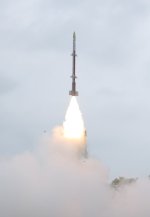 The ‘Kusha’ missile system is capable of neutralising a wide variety of aerial threats including fighter jets, missiles, unmanned aerial vehicles and large enemy aircraft within a wide range & altitude envelope. All weapon system elements, including the missiles, radars, command and control centre, have been developed by various DRDO laboratories and Industry partners.
The ‘Kusha’ missile system is capable of neutralising a wide variety of aerial threats including fighter jets, missiles, unmanned aerial vehicles and large enemy aircraft within a wide range & altitude envelope. All weapon system elements, including the missiles, radars, command and control centre, have been developed by various DRDO laboratories and Industry partners.
I wonder how much capacity is Solar going to be investing for Kusha ERADS/XR-SAM production given these are bigger missiles/boosters to produce and integrate. They haven't announced any plans for dedicated missile integration lines as this is the first missile whose DcPP they are.

This is probably the M2 missile. Very interesting set of control surfaces:
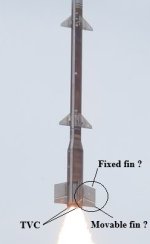
4x Jet vane thrust vector control.
The rear set of fins are interesting. The large size helps with lift. This missile is said to optimized for high-speed targets like fighters. I think the rear most fin is movable; I could be wrong.
The rear fins remind me of the Rudram M3. I don't think those are movable.
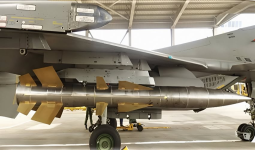
The launcher is interesting. Hot launch cannisters. How will this fit in with Navy's cold launch UVLMs. May be there will be two different configurations for the UVLMs. One hot launched VLM for SAMs, one cold launched VLM for strike missiles like Brahmos & ET-LDHCM.
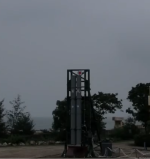
4x Jet vane thrust vector control.
The rear set of fins are interesting. The large size helps with lift. This missile is said to optimized for high-speed targets like fighters. I think the rear most fin is movable; I could be wrong.
The rear fins remind me of the Rudram M3. I don't think those are movable.
The launcher is interesting. Hot launch cannisters. How will this fit in with Navy's cold launch UVLMs. May be there will be two different configurations for the UVLMs. One hot launched VLM for SAMs, one cold launched VLM for strike missiles like Brahmos & ET-LDHCM.
I think this is the M1 Missile with 150 + km range under KUSHA Air Defence System. In initial images/ renders of Kusha the M1 Missile was not having a Booster, but the later changes suggests there is a small booster for M1 Missile too. Even if you look at the NOTAM length (180 km) for this test , suggests that this is M1 Missile and not the M2 Missile.This is probably the M2 missile. Very interesting set of control surfaces:
View attachment 53138
4x Jet vane thrust vector control.
The rear set of fins are interesting. The large size helps with lift. This missile is said to optimized for high-speed targets like fighters. I think the rear most fin is movable; I could be wrong.
The rear fins remind me of the Rudram M3. I don't think those are movable.
View attachment 53139
The launcher is interesting. Hot launch cannisters. How will this fit in with Navy's cold launch UVLMs. May be there will be two different configurations for the UVLMs. One hot launched VLM for SAMs, one cold launched VLM for strike missiles like Brahmos & ET-LDHCM.
View attachment 53140
Can you elaborate on this part?In initial images/ renders of Kusha the M1 Missile was not having a Booster, but the later changes suggests there is a small booster for M1 Missile too.