
It didn't collide, they briefly fired stage-4 booster to put some distance between the two after separation. Then, they powered down the S4 and let it coast for while. That's the gap in the telemetry.To be specific, IMO, it happened during Stage 3 separation and the initial coasting phase of 4th Stage , when the 3rd stage followed the trajectory that caused it to collide with the separated rocket stage. Maybe they missed the instant ignition of Stage 4 after the third-stage separation, which would have kept the vehicle's speed higher than that of the separated third stage but later they corrected it by using 4th stage burn. The first launch went well, so they would have learned a lot from it.
Indian Space Industry : Updates & Discussions
- Thread starter Ashwin
- Start date
You are using an out of date browser. It may not display this or other websites correctly.
You should upgrade or use an alternative browser.
You should upgrade or use an alternative browser.


Spectrum isn't like patents that if you ignore you may be subjected to sanctions/isolation. It's a global shared resource and if you F around, let's just say countries have gone to war over lesser things -- spectrum coordination is serious business.Dumb question but whats exactly stopping a third country from not giving 2 hoots about this international satellite filing process?
In anyways even though China has recently succeeded in testing re usable rockets it is still nowhere near the launch cadence of SpaceX. As if the Americans will allow this to happen especially when they can launch way more satellites than China now and for the near future.
Where are they getting the tech from to build these satellites?
Speaking about rockets @Hyperactive ADD Russia has had great achievements in space but now they are still flying the ancient but reliable R7, whereas China and the US already achieved reusable capability. But ig somehow you are now going to say Russia is ahead of both in launch capability now?
we still live in license raj where govt thinks they can control innovation or R&D based on their whims and fancies. Instead of finding the root cause and fixing it ,govt is arrogantly exercising their absolute Kafkaesque powers. This is not leadership in action but bunch of gorillas showcasing their bureaucratic might.

Couldn't have put it better.
And case in point: Huge congratulations to Skyroot and India on the major achievement today.
Just surprised Jitendra didn't show up on the podium at the end to take credit.
Last edited:





Unless you continue to count Rocket Lab as a New Zealand company (which may not be factual at least anymore), Skyroot Aerospace is the FIRST non-American/non-Chinese private company to have made it to orbit. Several others (European, Australian) have tried, but none outside the US/China have succeeded so far.
 Orbital Sciences SpaceX Rocket Lab
 i-Space Galactic Energy Virgin Orbit Astra Firefly Aerospace Space Pioneer LandSpace Orienspace Blue Origin
 Skyroot Aerospace

Rocket Lab's first successful test was from New Zealand but it was officially a US company by then.
Unless you continue to count Rocket Lab as a New Zealand company (which may not be factual at least anymore), Skyroot Aerospace is the FIRST non-American/non-Chinese private company to have made it to orbit. Several others (European, Australian) have tried, but none outside the US/China have succeeded so far.

Brazilian civil aviation industry started after ours and yet they're much ahead of us with the kinda stuff Embraer builds and we buy from them. Gotta humble down.
Actually it is a covert for an ICBM test... (lol)


Btw, posting here for the record as for some reason, the Gross Lift-off Mass (GLoM) figure of Vikram-1 is not mentioned in most brochures/press kits:

Despite 35 minute delay Vikram-1 keeps date with Indian space history with Mission Aagaman success
SRIHARIKOTA: After some anxious moments when the automatic launch sequence of Vikram-1 was halted midway at just five minutes before lift-off, Skyroot Aerospace finally created history after it successfully placed India’s first privately developed orbital-class rocket into space.
 timesofindia.indiatimes.com
"...The seven-storey tall Vikram-1 rocket, with a lift-off weight of 45,000 kg, blasted off at 12.05 pm..."
I've heard that same figure being stated by Skyroot's own media guys during the launch stream so can confirm the 45 tons figure as accurate. It's comparable to the old ISRO ASLV's 41 tons. But Vikram-1 can carry more than twice as much payload (350kg vs 150kg) to LEO. Well, that's what ~40 years of advancements in solid propulsion gets you I guess.
That said, here's some background on the two co-founders of Skyroot, Pawan Kumar Chandana & Naga Bharath Daka:

Meet the Rocket Boys behind Mission Aagaman
Hyderabad: When Vikram-1 thundered into orbit from ISRO’s First Launch Pad at Sriharikota on Saturday under Mission Aagaman, it carried more than satellites and technology payloads. It marked the arrival of India’s private launch industry on the global stage and crowned a journey that began with...
timesofindia.indiatimes.com
The page has copy-protection so I'm summarizing it:
>> Pawan worked on the LVM3's S200 solid booster and was later the Deputy Project Manager of ISRO's SSLV program.
>> Bharath worked on hardware & firmware for ISRO's avionics systems at VSSC, and later also worked in IC/FPGA-maker Xilinx (which was later acquired by AMD).
Solid credentials between the two.
P.S.
Skyroot is aiming for at least one more launch this year. Unclear if the 2nd launch will be with the Vikram-1U variant with strap-on boosters (~550kg to LEO), but it does seem to be the case.
They want Vikram-2 (with the Dhawan-1 cryogenic engine powering the upper kickstage) to fly next near, that will have a 900kg-1 ton capacity to LEO and additionally will have multi-orbit placement capability.
Agnikul's re-usable launch vehicle to be launched next year apparently.
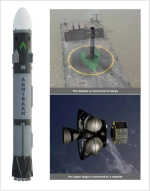
How dogshit is ISRO SSLV is then at 120-Tons Liftoff Mass. Its purely a waste of time now for govt to invest in that.Btw, posting here for the record as for some reason, the Gross Lift-off Mass (GLoM) figure of Vikram-1 is not mentioned in most brochures/press kits:
Despite 35 minute delay Vikram-1 keeps date with Indian space history with Mission Aagaman success
SRIHARIKOTA: After some anxious moments when the automatic launch sequence of Vikram-1 was halted midway at just five minutes before lift-off, Skyroot Aerospace finally created history after it successfully placed India’s first privately developed orbital-class rocket into space.
"...The seven-storey tall Vikram-1 rocket, with a lift-off weight of 45,000 kg, blasted off at 12.05 pm..."
I've heard that same figure being stated by Skyroot's own media guys during the launch stream so can confirm the 45 tons figure as accurate. It's comparable to the old ISRO ASLV's 41 tons. But Vikram-1 can carry more than twice as much payload (350kg vs 150kg) to LEO. Well, that's what ~40 years of advancements in solid propulsion gets you I guess.
That said, here's some background on the two co-founders of Skyroot, Pawan Kumar Chandana & Naga Bharath Daka:
Meet the Rocket Boys behind Mission Aagaman
Hyderabad: When Vikram-1 thundered into orbit from ISRO’s First Launch Pad at Sriharikota on Saturday under Mission Aagaman, it carried more than satellites and technology payloads. It marked the arrival of India’s private launch industry on the global stage and crowned a journey that began with...
The page has copy-protection so I'm summarizing it:
>> Pawan worked on the LVM3's S200 solid booster and was later the Deputy Project Manager of ISRO's SSLV program.
>> Bharath worked on hardware & firmware for ISRO's avionics systems at VSSC, and later also worked in IC/FPGA-maker Xilinx (which was later acquired by AMD).
Solid credentials between the two.
P.S.
Skyroot is aiming for at least one more launch this year. Unclear if the 2nd launch will be with the Vikram-1U variant with strap-on boosters (~550kg to LEO), but it does seem to be the case.
They want Vikram-2 (with the Dhawan-1 cryogenic engine powering the upper kickstage) to fly next near, that will have a 900kg-1 ton capacity to LEO and additionally will have multi-orbit placement capability.
Btw, Solar Industries invested early in Skyroot and even provided their facility for sold stage static testing. Thats how an ecosystem gets build.Btw, posting here for the record as for some reason, the Gross Lift-off Mass (GLoM) figure of Vikram-1 is not mentioned in most brochures/press kits:
Despite 35 minute delay Vikram-1 keeps date with Indian space history with Mission Aagaman success
SRIHARIKOTA: After some anxious moments when the automatic launch sequence of Vikram-1 was halted midway at just five minutes before lift-off, Skyroot Aerospace finally created history after it successfully placed India’s first privately developed orbital-class rocket into space.
"...The seven-storey tall Vikram-1 rocket, with a lift-off weight of 45,000 kg, blasted off at 12.05 pm..."
I've heard that same figure being stated by Skyroot's own media guys during the launch stream so can confirm the 45 tons figure as accurate. It's comparable to the old ISRO ASLV's 41 tons. But Vikram-1 can carry more than twice as much payload (350kg vs 150kg) to LEO. Well, that's what ~40 years of advancements in solid propulsion gets you I guess.
That said, here's some background on the two co-founders of Skyroot, Pawan Kumar Chandana & Naga Bharath Daka:
Meet the Rocket Boys behind Mission Aagaman
Hyderabad: When Vikram-1 thundered into orbit from ISRO’s First Launch Pad at Sriharikota on Saturday under Mission Aagaman, it carried more than satellites and technology payloads. It marked the arrival of India’s private launch industry on the global stage and crowned a journey that began with...
The page has copy-protection so I'm summarizing it:
>> Pawan worked on the LVM3's S200 solid booster and was later the Deputy Project Manager of ISRO's SSLV program.
>> Bharath worked on hardware & firmware for ISRO's avionics systems at VSSC, and later also worked in IC/FPGA-maker Xilinx (which was later acquired by AMD).
Solid credentials between the two.
P.S.
Skyroot is aiming for at least one more launch this year. Unclear if the 2nd launch will be with the Vikram-1U variant with strap-on boosters (~550kg to LEO), but it does seem to be the case.
They want Vikram-2 (with the Dhawan-1 cryogenic engine powering the upper kickstage) to fly next near, that will have a 900kg-1 ton capacity to LEO and additionally will have multi-orbit placement capability.

Send more SS of these crashouts. A delight to see ngl
And soon Agnikul comsos Insha Shiva.
Unless you continue to count Rocket Lab as a New Zealand company (which may not be factual at least anymore), Skyroot Aerospace is the FIRST non-American/non-Chinese private company to have made it to orbit. Several others (European, Australian) have tried, but none outside the US/China have succeeded so far.
It's the 4th liquid stage on Vikram-1 that burns for a long duration. It pretty much does the same work as a CUS in GSLVs, that final long kick.How dogshit is ISRO SSLV is then at 120-Tons Liftoff Mass. Its purely a waste of time now for govt to invest in that.
These guys have built an ICBM.
Send more SS of these crashouts. A delight to see ngl
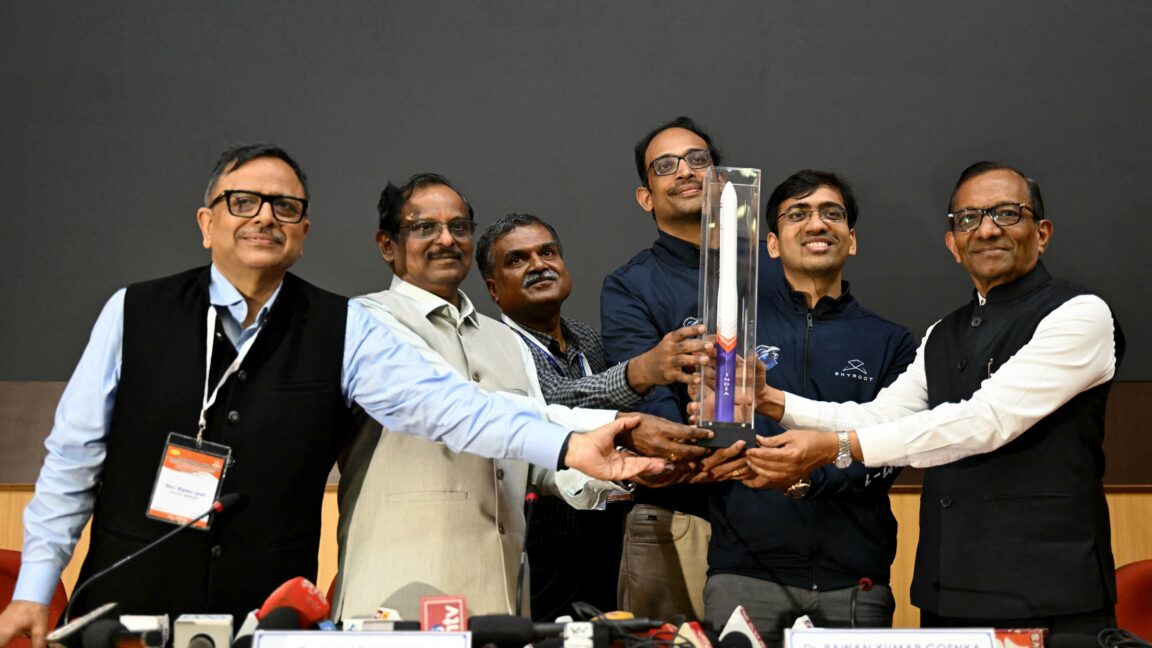
India's first privately developed rocket reaches orbit on dramatic debut launch
On the first attempt, reaching orbit, I never thought it was possible."
 arstechnica.com
Few comments:
A very big congratulations to Skyroot. India has long space launch history.
On that note. How is it that India and China private space launch companies managed to reach orbit before the European? I get that India first attempt is a simpler solid fueled one but Europe has that kind of private rocket too. And China even already attempted landings by their private rocket. How much further will Europe get left behind?
Three replies to above comment
European scleroticism as usual. Arianespace and by extension ESA/Euro politicians denied SpaceX for years, and still haven't really accepted it. Any private activity has to raise funds in Europe which is very difficult, and has limited governmental support compared to the Franco-Italian national champions.
Having worked with EADS, I've got a pretty good idea; but even setting that aside, if I were holding capital in Europe right now and looking for investment opportunities I would be thinking "look, even the Indians are doing it - maybe it's too late to turn a profit off local launch unless you can show pending military contracts and they can launch on ESA or SpaceX"
According to my assessment, European launch Startups like PLD Space,Isar Aerospace, Maia Space and RFA are ahead of Indian startups, both in terms of sophistication as well as scale although trailing Chinese ones.
I'm pretty confident of European startups especially PLD Space.
I think there is some underestimation here of the state of European launch (not saying it's good as opposed to the US and China, but it is good as opposed to the rest of the world) . And it's interesting to read here people cheering for a solid fuel rocket while in this forum it's a constant litany of complaints about European launch companies not being innovative and ambitous enough to develop reusable vehicles.
I guess it's just a different bar people are holding Indian and European launch to. Which is fine by me. Let's see in 5 years where things stand.
There is also a big comment about India's geographical advantage. Most of the comments are positive.
NSIL has outsourced production of that to HALHow dogshit is ISRO SSLV is then at 120-Tons Liftoff Mass. Its purely a waste of time now for govt to invest in that.


HAL wins ₹511-crore deal to build, own and commercialise SSLV launches
HAL wins bid for ISRO's SSLV technology transfer, to independently build and commercialize rockets, strengthening India's space capabilities.
I wonder with PSLV and SSLV outsourced to L&T and HAL, and LVM3 getting outsourced too, will ISRO maintain launch vehicle production capacity or shut them down completely like I presume NASA did?