

Just try rereading @Hyperactive ADD points, I currently don't have the mental to explain to you and hyperActive guy was more than willing to teach you some things which you wont listen.Looks like you missed-
Based on what points?
Stealth & sensor fusion are the 1st things in 5+gen. If the jet is largely visible & cant survive BVR then what kinematics & other features willit use?
- Please don't throw my own words at me. I try to be technical with points, pic, diagrams, graphs, calculations.
- Please speak for yourself rather seeing opportunity to join hands with others to ambush & pressurize others.
- The reality & facts & some speculation have been put in the table.
- You can give your own version of the table.
- Some people wanna accept points of Su-57 but not F-22 even after red-marking in pics & diagrams.
- Please avoid personal philosophical comment & focus on your technical inputs.
Thanks & regards.
PAK-FA / Sukhoi Su-57 - Updates and Discussions
- Thread starter Ashwin
- Start date
You are using an out of date browser. It may not display this or other websites correctly.
You should upgrade or use an alternative browser.
You should upgrade or use an alternative browser.


Sure, it can be seen what kind of pics & analogy have been shared by us.Just try rereading @Hyperactive ADD points,
Except on RCS, i've also supported Su-57 but you guys wanna put down F-22 like hell like it doesn't exist.
What more do you wan't?> If we remove RCS from focus, then Su-57 is certainly better overall in most aspects - agility, weapons, multiple radars, countermeasure, HMDS, etc.
Please speak for yourself & focus on your inputs.I currently don't have the mental to explain to you and hyperActive guy was more than willing to teach you some things which you wont listen.
Thnks & regards.

“Stealth & sensor fusion are the 1st things in 5+gen.”Based on what points?
Stealth & sensor fusion are the 1st things in 5+gen. If the jet is largely visible & cant survive BVR then what kinematics & other features willit use?
Well, the key issue is that you said stealth capability ranks number one... This comes from the objective document guiding the design of the U.S. 4-generation fighter ATF (F-22/YF-23).
In Russia's 5-generation frontline fighter (Su-57), this ranks only third.
And sensor fusion is not mentioned at all in the objective document guiding the design of the U.S. 4-generation fighter ATF (F-22/YF-23) (which is why it's so terrible, penalized when it comes to low-observable detection means, infrared detection means, L-band radars, side-mounted phased arrays, and the messy multi-level target data sharing function that the MiG-31 already had).
And this indicator ranks fifth in Russia's 5-generation frontline fighter (Su-57)...
So in general, your judgment orientation is based on American standards and your own fantasies...
Since American standards are so perfect, then please let the Americans continue to justify themselves using 4-generation fighter methods from now on.
We can't even indigenise our Tejas in time let alone the 4th gen Su30MKI to modern standards with indian hardware and we wanna do something similar to a much more advanced 5th gen platform.Indian EW + Radar combo comes later though. This is currently between Israeli radar and the 8222SB pod.
Here is why this is gonna cause plenty of issues down the line based on what I've come across online.
See the core reason why the Su-30MKI cannot serve as an inspiration for modifying a Su-57 is cause of the evolution of avionics computing.
SU30 like jets utilize a Federated Avionics Architecture built around a standard multiplex data bus (typically MIL-STD-1553B)... In this, the radar, EW suite, and targeting pods each possess an independent processing computer...+++
subsystems only talk to each other via finalized data products feeded so we can intercept the data bus, place an open-architecture interface like our mission computer we put and cleanly swap a Russian box for an Israeli or Indian sensor.
Su-57 uses a Integrated Modular Avionics (IMA) framework which uses a centralized processor called the IUS-57
Instead of individual computers for every sensor, raw data from all over the airframe is routed via fiber optic buses directly into a central core.
The centralized IUS-57 executes the processing tasks, radar waveform generation, and electronic counter-countermeasures (ECCM) simultaneously within a unified software...
According to Tikhomirov Scientific Research Institute of Instrument Design the radar functions as unified under the the Sh121 Multifunctional Integrated Radio Electronic System (MIRES).
Not as a single entity
The system consists of five radars
N036-1-01: The main forward-looking X-band
N036B-1-01 (Left and Right): Two side-looking X-band cheek arrays (404 T/R)
N036L-1-01 (Left and Right): Two L-band AESA arrays mounted used for (IFF) and counter-stealth target
software processing of the X and L signals is executed entirely within a shared computing inside the IUS-57.... So if Indian GaN radar (like Virupaksha) replaces the main radar it creates disconnect. Our radar operates on its own software logic, processing code, and profile.
Also modern jet have integrated ECM/ECCM suites so they need shared use of apertures between the radar and the EW suite. On the Su-57, the L402 Himalayas ECM suite uses just use its own dedicated antennas; it can do jamming signals through the N036 Byelka radar... ++
This requires complex Waveform Interleaving. The central computer must mathematically time the transmission of radar pulses and EW jamming signals down to prevent the aircraft from blinding its own sensors or burning out its hardware components...(SENSOR DECONFLICTATION) ++
Inserting a foreign radar into the nose we will need source code of the L402 Himalayas suite and the IUS-57 kernel, else Indian radar would be completely unsynchronized....
The Su-30MKI has EW and extra sensors, but they are treated like independent add-ons:
The EW is in a Pod: If India wants heavy jamming on the Su-30, they hang an Israeli Elta or a Russian SAP-518 pod on the wingtips.
The IRST is a Standalone Eye: The OLS-30 Infra-Red Search
SU57 has a 101KS Atoll electro-optical suite and the L402 Himalayas EW suite integrated into the whole system itself
101KS-V: The main Infra-red search and track (IRST) right in front of the cockpit.
101KS-U: missile approach warning sensors ++
101KS-O (DIRCM)
3 X Band + 2 L Band radars
See like If MAWS detects the flash of an incoming missile from the side,It tells the DIRCM laser to and blind the missile.
It can tell the N036 AESA radar (nose or cheek arrays) to instantly track
Modern jets have a locked architecture... Mutiple radars... Different band... EW suite integrated+... Passive and active sensors all feed data to one thing... All work on 1 architecture... You can't place your architecture at one point...
SU30 gen was much simpler
To put Indian Radar and avionics as many demand it means stripping out the central IUS-57 computer, all five radar arrays, and the entire L402 EW architecture, and rebuilding a new, unified ecosystem from scratch.
This is a military exchange forum, not an IT exchange forum. I don't understand why you're emphasizing IT engineers—what are you even trying to do?
I know you're agonizing over what profession the people who've made you suffer in reality have—what's that even for? You could simply think of me as unemployed. If that makes you happy, so be it.
I tried to appreciate you initially but if you keep offending passing personal provocative comments, then others'll defend & let you know that they also have some credibility based on their qualification, industrial experience, while you can't give a basic intro.
Look at what i said -
You've shared some good tech data so far
- No matter how loud the voice, heavier the propaganda, how big the wealth, nobody's putting a gun to head of any forum member or to professionals of any civillian & military domain to search, think, analyze, perceive, decide.


- We all are fans, enthusiasts, so everybody can have their perception where data is missing.
- It's ok if you or me or any member don't have idea of something. Who is aero-pro here? And many things about these military products are meant to be secret while people can guess endlessly. So let me make my guess & you can make yours.
Now look at your personal & useless comments -
other people aren't like you—many of them might actually know a thing or two about this field. But in my nearly 30 years of surfing the internet, you are genuinely the first person to equate the F‑22's 1–2 GHz radio comms gear with Russian L‑band radars, and then proceed to compare them with a straight face—truly, a stroke of genius.
Your American daddy
you keep babbling about.
how spectacularly filial of you, still fantasizing
Don't know if IT engineers are really all that hot stuff these days, but the level of confidence is certainly extraordinary.
Or is it that people in your line of work reckon
are you gambling on me, betting that I'm just another "ordinary enthusiast" like you? Betting that I can't do anything more than Google(the same to you)?
"IT engineer" is more accurately dubbed a "network migrant worker" (code monkey).
When it comes to military matters, you guys are nothing but rank amateurs.
You'd be better off just sticking to your own industry and grinding out some basic C++. Why even bother debating military aviation?
IT engineers live in such a hopelessly narrow bubble.
=========================================================================================================
J-20
Trash: The only one using canards.
Trash: One of only two lacking an internal gun.
Trash: One of only two lacking thrust-vectoring nozzles.
Trash: Powered by a knock-off F110.
Trash: Features a weapon bay too thin and cramped.
J-35
Trash: Broader than a Su-33.
Trash: One of only two lacking an internal gun.
Trash: One of only two lacking thrust-vectoring nozzles.
Trash: Powered by a knock-off RD-33.
Trash: Features a weapon bay too thin and cramped.
J-36
A stunning 3-engine piece of trash.
A stunning 3-engine piece of trash.
A stunning 3-engine piece of trash.
(Three engines, so it deserves three repeats).
Still a piece of trash with no thrust-vectoring.
J-50
When the Su-57 debuted, J-20 fanboys called its RCS trash because of the seam on its underbelly. Now that the J-50 copied that exact same underbelly seam, following the old tradition, it's officially just more trash.
……This logic seems to manifest itself within you as well
...That's what I said. I don't know what you're trying to express. Are you implying that because my IP is Chinese, I have to think this is good?
- What can we do if you being Chinese don't like your own jets? You can put these things in Chinese thread to discuss.
- Perhaps you can share a drawing how you envision a good jet & put it in Chinese thread.
- I've always said that stealth = RAM+RAS+geometry+EW+tactics, but it's a fact that round surface is worst RF reflector, hence planform shaping.
- I shared a CAD by an artist with angular belly from front to back which looks much better.
Yes they're spending huge tax money & after that we can see the pace of R&D of all jets & when a particular feature got implemented in the inducted jet.Everything has objective distinctions of quality; the inferior is generally called garbage, particularly in life‑and‑death battles,They are all spending vast amounts of taxpayer money
In life & death battle the entity more visible on the outside gets seen & attacked 1st, no matter how good inside.
===========================================================================================
Before proceeding keep in mind what i said -
.> If we remove RCS from focus, then Su-57 is certainly better overall in most aspects - agility, weapons, multiple radars, countermeasure, HMDS, etc.
.
.
Su-57 could be a better gunfighter with superior TVC, 50-50 chance with CCMs, but in BVR, like i said above " the entity more visible on the outside gets seen & attacked 1st, no matter how good inside."F-22 and Su-57 combat performance?
Air superiority combat: Su-57 wins
F-22 is qouted M 1.8 SuCr while Su-57 quoted M1.3-1.6Interception: Su-57 wins
Today CAS doesn't mean diving with gun like A-10 Thunderbolt.Close air support against soft targets: neither is suitable
They can drop GPS guided bombs like JDAM & small smart bombs like SDB.
Ground strike against hard targets: Su-57 wins
Ok.Anti-ship warfare: Su-57 wins
Not blocked, but Su-57 cannot carry even 1 R-100 internally, while F-22 will carry 6x AIM-260 internally.Has information on the R-100/Ks-172 been blocked here?
R-100 under wings'll expose Su-57.
And look at metrics - size, weight, range, etc -
- R-100 has 300-400 Km range, weighs 750 Kg. Range/Kg = 400/750 = 0.53 Km/Kg
- While AIM-260 under testing is speculated to reach 200-300 Kms, expected to weight 150-220 Kg. Range/kg = 300/220 = 1.36 Kms/kg
- PL-17 weighs 500 Kg, with range 300-500 Km. Range/Kg = 500/500 = 1 Km/kg
And to fire a weapon it should have a direct lock or indirect guidance & with much lower RCS a jet would have much better chance to break the lock.
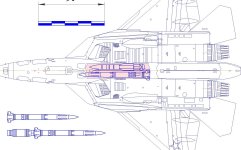
- I did mark the side radar aspect in the table as "may be in MLU" in RED, then why're you raising this point again & again?Having these technologies is certainly better than not having them. For example, the side-looking phased array radar—the F-22 was originally planned to have it installed during its design phase, but it later fell through. This fully demonstrates that the F-22's designers considered it to be very useful
For example, on Chinese forums, fans of the J-20 all criticize the Su-57 for being loaded with a bunch of useless junk—after all, the American F-22 and the Chinese J-20 don't have them, so that proves it's junk. But then when the J-36 started having them installed, they suddenly went silent and played dead
- And bcoz it was originally planned but not implemented, hence i speculated may be for MLU. What's the big fuss in it?
- It's not about just 1 or few chips but a complete system which is very costly to R&D. These are way beyond even the costly servers in datacenters.Currently, the chips used in fighter jets—whether in the F-22 or the Su-57—cost far less than a bag of cat food.
There is no difficulty in acquiring them and no performance bottleneck. I don't understand why this is even being discussed.
- CPU, cache memory, PCB, etc are among most expensive components in any computer system.
- Ultimately their computing capabilities are different, 3 BIPS Vs 10.5 BIPS as per current search.
- We've been doing performance analysis in datacenter since 20 years & it's the toughest & most tricky task. Many times the bottlenecks occur in the most unexpected parts, even after the manufacturers did so much R&D to make the components & setup.
- There are computing & network architecture & topologies, efficiency of OS, protocols, etc to be considered.
- YF-22 & many jets so far crashed due to system glitch.
- A lagger country with limited money, R&D, perhaps dependent on import, has to remain satisfied with whatever it can arrange.
- The leader country with highest R&D will enjoy better quality, capability, at more cost bcoz quality comes with price, but it's still affordable to the leader nation even in less numbers as they sell& generate revenue but not equally to lagger nations.
> Like i said above, to lead, huge investment is needed & ultimately 1 day by trial & error success is achieved & customers line up generating revenue, what we call ROI or Return On Investment.The kind Westerners invest huge amounts of money, and then the Chinese, Indians, Russians, and North Koreans get to enjoy it all happily.
> IDK about China, but non-computer manufacturing nations, dependent on West, don't seem to be happy at all. They fear their IT industry can collapse if West does arm twisting.
The most advanced server chips and AI graphics cards that are subject to restrictions are only products that are new within the past 3 to 5 years. With Moore's Law scaling, these things become obsolete quickly. It does affect the profits of IT companies, but it is of little consequence to the military industry—for military equipment, 650 nanometers is still considered good.Micron-scale chips are still mainstream
> This is contradiction bcoz -
- if things get obsolete quickly then already older, higher NM, less capable CPUs may suffice for few years but with lesser performance & will need upgrade.
- Military equipment is very generic term, with numerous size, scale, need, performace, etc, needing variety of chips, custom to the platform.
- Lesser the nanometer, more dense the CPU becomes, more the MIPS/BIPS, more avionics can be accomodated, better the radar/sensor performance, more targets can be simultaneously scanned, tracked, locked, better the sensor fusion, better the data sharing.
> The idea is that higher capable system takes advantage over lesser capable one.
“Stealth & sensor fusion are the 1st things in 5+gen.”
Well, the key issue is that you said stealth capability ranks number one... This comes from the objective document guiding the design of the U.S. 4-generation fighter ATF (F-22/YF-23).
In Russia's 5-generation frontline fighter (Su-57), this ranks only third.
And sensor fusion is not mentioned at all in the objective document guiding the design of the U.S. 4-generation fighter ATF (F-22/YF-23) (which is why it's so terrible, penalized when it comes to low-observable detection means, infrared detection means, L-band radars, side-mounted phased arrays, and the messy multi-level target data sharing function that the MiG-31 already had).
And this indicator ranks fifth in Russia's 5-generation frontline fighter (Su-57)...
So in general, your judgment orientation is based on American standards and your own fantasies...
Since American standards are so perfect, then please let the Americans continue to justify themselves using 4-generation fighter methods from now on.
Again going in circle. We all are judging & giving opinion based on something. So it's your misunderstanding that i'm supporting USA, while i'm simply focussing on tech aspects & R&D state. So there's no need to get entangled in gen #, standard & document, bcoz that doesn't change RCS, IRS.
- I already said that except RCS, Su-57 seems better.
- However, a good jet needs to be good both in & out. More visible outside means 1st to be seen & attacked.
- Also, detecting a faint object is 1 thing & confirming a genuine target & getting a lock for firing solution is another thing.
- Both Su-57 & F-22 have wing mounted sensors, the paint patch for sensors are grey color, which your eyes want to intentionally ignore & deny.
- Su-57 radar being newer could have higher detection range than F-22 for same RCS object, but with F-22's RCS as target that range reduces a lot.
- Su-57's IRST range is qouted 50 Kms against non-afterburning head-on targets, far less than radar ranges.
- So F-22 needs to detect, lock, fire on Su-57 b/w 50-150 Kms range. It can win BVR in this range otherwise it'ld loose mostly within 50 Kms.
- Under-wing stealth IRST pod & AN-AAR-56 replaced by TacIRST will tilt overall chances in F-22's favor.
- Also, round IRST worse than angled one, hence F-22's under-wing IRST are angled. There's speculation that Su-57 might have EOTS like cover for IRST.


We can't even indigenise our Tejas in time let alone the 4th gen Su30MKI to modern standards with indian hardware and we wanna do something similar to a much more advanced 5th gen platform.
Here is why this is gonna cause plenty of issues down the line based on what I've come across online.
See the core reason why the Su-30MKI cannot serve as an inspiration for modifying a Su-57 is cause of the evolution of avionics computing.
SU30 like jets utilize a Federated Avionics Architecture built around a standard multiplex data bus (typically MIL-STD-1553B)... In this, the radar, EW suite, and targeting pods each possess an independent processing computer...+++
subsystems only talk to each other via finalized data products feeded so we can intercept the data bus, place an open-architecture interface like our mission computer we put and cleanly swap a Russian box for an Israeli or Indian sensor.
Su-57 uses a Integrated Modular Avionics (IMA) framework which uses a centralized processor called the IUS-57
Instead of individual computers for every sensor, raw data from all over the airframe is routed via fiber optic buses directly into a central core.
The centralized IUS-57 executes the processing tasks, radar waveform generation, and electronic counter-countermeasures (ECCM) simultaneously within a unified software...
According to Tikhomirov Scientific Research Institute of Instrument Design the radar functions as unified under the the Sh121 Multifunctional Integrated Radio Electronic System (MIRES).
Not as a single entity
The system consists of five radars
N036-1-01: The main forward-looking X-band
N036B-1-01 (Left and Right): Two side-looking X-band cheek arrays (404 T/R)
N036L-1-01 (Left and Right): Two L-band AESA arrays mounted used for (IFF) and counter-stealth target
software processing of the X and L signals is executed entirely within a shared computing inside the IUS-57.... So if Indian GaN radar (like Virupaksha) replaces the main radar it creates disconnect. Our radar operates on its own software logic, processing code, and profile.
Also modern jet have integrated ECM/ECCM suites so they need shared use of apertures between the radar and the EW suite. On the Su-57, the L402 Himalayas ECM suite uses just use its own dedicated antennas; it can do jamming signals through the N036 Byelka radar... ++
This requires complex Waveform Interleaving. The central computer must mathematically time the transmission of radar pulses and EW jamming signals down to prevent the aircraft from blinding its own sensors or burning out its hardware components...(SENSOR DECONFLICTATION) ++
Inserting a foreign radar into the nose we will need source code of the L402 Himalayas suite and the IUS-57 kernel, else Indian radar would be completely unsynchronized....
The Su-30MKI has EW and extra sensors, but they are treated like independent add-ons:
The EW is in a Pod: If India wants heavy jamming on the Su-30, they hang an Israeli Elta or a Russian SAP-518 pod on the wingtips.
The IRST is a Standalone Eye: The OLS-30 Infra-Red Search
SU57 has a 101KS Atoll electro-optical suite and the L402 Himalayas EW suite integrated into the whole system itself
101KS-V: The main Infra-red search and track (IRST) right in front of the cockpit.
101KS-U: missile approach warning sensors ++
101KS-O (DIRCM)
3 X Band + 2 L Band radars
See like If MAWS detects the flash of an incoming missile from the side,It tells the DIRCM laser to and blind the missile.
It can tell the N036 AESA radar (nose or cheek arrays) to instantly track
Modern jets have a locked architecture... Mutiple radars... Different band... EW suite integrated+... Passive and active sensors all feed data to one thing... All work on 1 architecture... You can't place your architecture at one point...
SU30 gen was much simpler
To put Indian Radar and avionics as many demand it means stripping out the central IUS-57 computer, all five radar arrays, and the entire L402 EW architecture, and rebuilding a new, unified ecosystem from scratch.
If Su-57 is MKIzed, DRDO can deliver all that themselves using all Indian avionics. Indian radar with side arrays and L band, EW suite, nav, comm etc, all fused into one computer using a new NATO std bus system using fiber optics. It will take roughly 6 years to develop and test them. Maybe 8 years if we decide to configure it to AMCA's standards. The flight controls will have to be Russian though, to save on time, but it uses 1553B as well.
But as I said before, it will take 8-10 years to have FOC jets operational from contract, and can only be done after the Su-57 has achieved FOC in Russia, so that way we have a fully developed airframe to work on.
So MKIzation is out of the picture now. It was possible only if Su-57 was ready by 2020, not 2030. The only possibility is direct imports with full Russian kit + ISE... Rafale GTG style... if it happens.
But this is the kinda tech the IAF is looking to import after Rafale.
At last, a shape-morphing aircraft wing is here - ASM International
The long-sought elusive goal of practical, seamless control surface technologies to reduce drag and improve aircraft fuel efficiency—chased by the defense and commercial aviation industries and researchers for several decades—was finally realized with the introduction of a variable geometry...
 www.asminternational.org
And that's not possible on the Su-57 right now.

Let me say something as a student of geopolitics.
Buying Su-57 will be the worst decision we will make for our economy, our industries and our jobs.
Russia is not a economic power house, there are only 3 economic powerhouse, USA, China, EU.
China is our enemy, we sre china's enemy, she will never let us progress or develope.
EU hates russia to the core, they are so anti russia that they have visibly became russo-phobic.
Democrats in USA for sure are winning next election, they hate Russia more than wrst european, their hatered for russia is comparable to those of eastern european countries like Poland.
Democrats know that trump has harmed
Indo-USA relationship but they also hate india for buying oil.
If we want to be neutral and actually care for our interest which is economy, industries, jobs, IT, then we need USA and europe at any cost !!
We bought oil from Russia angering Democrats alot as well as EU, buying Su-57 means directly funding Russian MIC, which is red line for both EU and USA, the line even China cross very carefully and publicly denies it.
If people here are fine with India turning into pakistan with less than 5% of real GDP growth rate with being extremly dependent on china for almost everything of high tech with no other option then its fine to buy Su-57 , but in that case we will never ever able to deter china even if we got Nepolean as Indian General.
I would rather say that, Democrats will be willing to improve relation with India, we too need USA.
Hemce we shouod buy over 100 F-35 off the shelf with demand to integrate astra series(specially Gandiva) and Rudram 1 with F-35 and obv integration with IACCS.
And we should not buy more S-400. Russia is a sinking ship, the faster we move out, the better we will be.
If we have USA support then pakistan will face huge pressure from both USA and Saudi Arabia in case of conflict.
We have to be realistic, USA is still the superpower, and challenger is China which is iur enemy, we need USA support.
And in return we have to give them something, USA is not our slave, we can not expect that they only favor us while we keep buying oil and equipments from Russia.
Buying Su-57 will be the worst decision we will make for our economy, our industries and our jobs.
Russia is not a economic power house, there are only 3 economic powerhouse, USA, China, EU.
China is our enemy, we sre china's enemy, she will never let us progress or develope.
EU hates russia to the core, they are so anti russia that they have visibly became russo-phobic.
Democrats in USA for sure are winning next election, they hate Russia more than wrst european, their hatered for russia is comparable to those of eastern european countries like Poland.
Democrats know that trump has harmed
Indo-USA relationship but they also hate india for buying oil.
If we want to be neutral and actually care for our interest which is economy, industries, jobs, IT, then we need USA and europe at any cost !!
We bought oil from Russia angering Democrats alot as well as EU, buying Su-57 means directly funding Russian MIC, which is red line for both EU and USA, the line even China cross very carefully and publicly denies it.
If people here are fine with India turning into pakistan with less than 5% of real GDP growth rate with being extremly dependent on china for almost everything of high tech with no other option then its fine to buy Su-57 , but in that case we will never ever able to deter china even if we got Nepolean as Indian General.
I would rather say that, Democrats will be willing to improve relation with India, we too need USA.
Hemce we shouod buy over 100 F-35 off the shelf with demand to integrate astra series(specially Gandiva) and Rudram 1 with F-35 and obv integration with IACCS.
And we should not buy more S-400. Russia is a sinking ship, the faster we move out, the better we will be.
If we have USA support then pakistan will face huge pressure from both USA and Saudi Arabia in case of conflict.
We have to be realistic, USA is still the superpower, and challenger is China which is iur enemy, we need USA support.
And in return we have to give them something, USA is not our slave, we can not expect that they only favor us while we keep buying oil and equipments from Russia.

We need to became allies with USA, that will counter both China and pak and unrestricted access to western tech and oil.Let me say something as a student of geopolitics.
Buying Su-57 will be the worst decision we will make for our economy, our industries and our jobs.
Russia is not a economic power house, there are only 3 economic powerhouse, USA, China, EU.
China is our enemy, we sre china's enemy, she will never let us progress or develope.
EU hates russia to the core, they are so anti russia that they have visibly became russo-phobic.
Democrats in USA for sure are winning next election, they hate Russia more than wrst european, their hatered for russia is comparable to those of eastern european countries like Poland.
Democrats know that trump has harmed
Indo-USA relationship but they also hate india for buying oil.
If we want to be neutral and actually care for our interest which is economy, industries, jobs, IT, then we need USA and europe at any cost !!
We bought oil from Russia angering Democrats alot as well as EU, buying Su-57 means directly funding Russian MIC, which is red line for both EU and USA, the line even China cross very carefully and publicly denies it.
If people here are fine with India turning into pakistan with less than 5% of real GDP growth rate with being extremly dependent on china for almost everything of high tech with no other option then its fine to buy Su-57 , but in that case we will never ever able to deter china even if we got Nepolean as Indian General.
I would rather say that, Democrats will be willing to improve relation with India, we too need USA.
Hemce we shouod buy over 100 F-35 off the shelf with demand to integrate astra series(specially Gandiva) and Rudram 1 with F-35 and obv integration with IACCS.
And we should not buy more S-400. Russia is a sinking ship, the faster we move out, the better we will be.
If we have USA support then pakistan will face huge pressure from both USA and Saudi Arabia in case of conflict.
We have to be realistic, USA is still the superpower, and challenger is China which is iur enemy, we need USA support.
And in return we have to give them something, USA is not our slave, we can not expect that they only favor us while we keep buying oil and equipments from Russia.
With USA hand on your head, you will never face oil problem for long as USA control majority of oil supplies and not China Russia or Iran.
And Russia will never choose india over china sow hy should we choose Russia over our development.
And our national interest in development and not becoming North Korea or pakistan hence USA is needed , USA and EU is our nationa interest.
People here thinks that "USSR helped India against USA", thats pure lie.
USSR supported its policy to defeat USA in 1971.
Ever wonder why POK issues did not resolved in 1971 war when we had such massive victory ?
Its because USSR withdrew its support, it never wanted to help us. It wanted to defeat USA which it need.
(One more post )
And you people know ? Let me introduced some bitter historical facts to you people:We need to became allies with USA, that will counter both China and pak and unrestricted access to western tech and oil.
With USA hand on your head, you will never face oil problem for long as USA control majority of oil supplies and not China Russia or Iran.
And Russia will never choose india over china sow hy should we choose Russia over our development.
And our national interest in development and not becoming North Korea or pakistan hence USA is needed , USA and EU is our nationa interest.
People here thinks that "USSR helped India against USA", thats pure lie.
USSR supported its policy to defeat USA in 1971.
Ever wonder why POK issues did not resolved in 1971 war when we had such massive victory ?
Its because USSR withdrew its support, it never wanted to help us. It wanted to defeat USA which it need.
(One more post )
1) USA supplied wepapons to india in 1962 war far better than USSR
2) USA put arms embargo on pakistan in 1965 war despite pakistan being a USA allies while we were clearly have community policy inside india while tilting toward USSR in geopolitics despite being self proclaimed "neutral".
We too did lots of mistake, you can not expect others to have self less love for you even in real life and expecting this in geopolitics is foolish.
Partnership is always about taking and giving, we need to give something in order to get something.
USA for sure will supply weapons to india in sino-india war iff ( and a big iff) we stop being "neutral" and start aligning with USA.
And obv we can make use of America wrapons during war only when we already using them or familiar with them
Again, our national interest, that is economy, development, jobs, all needs USA and Russia can never ever gave this to us.
Heck, even USSR was not able to give economy, development or jobs to india, Russia is just a shadow of USSR, so expecting it it stupid.
I know which part offended you, but I have no intention of pleasing anyone, and I plan to keep going like this…I tried to appreciate you initially but if you keep offending passing personal provocative comments, then others'll defend & let you know that they also have some credibility based on their qualification, industrial experience, while you can't give a basic intro.
Look at what i said -
Now look at your personal & useless comments -
This comment is objective and neutral, without adding any personal feelings. Besides, you’re not my girlfriend, so why should I add personal feelings?
It's just the internet; who knows, I might not even be Chinese, I might be from Zimbabwe.
- What can we do if you being Chinese don't like your own jets? You can put these things in Chinese thread to discuss.
- Perhaps you can share a drawing how you envision a good jet & put it in Chinese thread.
“own jets” — no aircraft factory in China has ever paid my salary, so how did it become “mine”? Or maybe I should go check my bank card.
Just believing it doesn’t make it true. And that CG you cited is by a well-known “wumao” on the Chinese internet. They firmly believe the J-20 is far superior to the F-22.- I've always said that stealth = RAM+RAS+geometry+EW+tactics, but it's a fact that round surface is worst RF reflector, hence planform shaping.
- I shared a CAD by an artist with angular belly from front to back which looks much better.
Oh, so when this Chinese person posts a CG, it gets cited on foreign networks,
but my CG is only allowed on domestic networks.
------------------Yet another display of double standards.
The Chinese are obsessed with scapegoating the Bolsheviks—including the Soviets and Russians—for every single problem they encounter.
For instance, when developing nuclear weapons, they harbored bitter resentment over the Soviet withdrawal of experts, as if that assistance was somehow their god-given right.
Another example: the Soviet Union practically gifted China the Northeast provinces, Inner Mongolia, Xinjiang, Tibet, and Qinghai—vast territories making up half of modern China, lands that no Chinese regime in 3,000 years had ever effectively controlled. Yet, the Chinese still feel entitled to more, grumbling about being 'owed' Mongolia, Vladivostok, Sakhalin, and Komsomolsk-on-Amur, acting as though they had conquered the Japanese with their own two hands.
In the 1950s, the Chinese aviation industry was handed complete blueprints and entire production lines for the MiG-15, MiG-21, and Tu-16 on a silver platter. Yet, by 1990, they were still manufacturing the MiG-21 and Tu-16 (with the latter production stretching all the way into 2026). Then, they turned around and blamed the Soviets for 'teaching them wrong,' using it as an excuse for their own decades of stagnation. It’s an utter joke.
Consequently, after the 1991 collapse of the USSR, the entire nation, from top to bottom, began propagandizing that the American social structure was the ultimate truth. They celebrated finally breaking free from the 'Russian Overlord,' benchmarked everything against the US. Take the Type 99 tank—never mind why the turret was designed with a retro 1950s sloped armor and a hydrocephalic rear bustle, or how much it inflated the hit probability; as long as it looked American, it was deemed a success.
Regarding tank engines, because they couldn't break through their domestic technology bottlenecks, their V-2 derivatives remained stuck at 780 horsepower (with a fuel consumption rate roughly 15% higher than the Russian 1,100-hp counterparts). Consequently, they sourced a locomotive engine from Germany, frankensteined it into a tank engine bay, and loudly proclaimed a grand victory—simply because it matched their 'American Daddy's' nominal 1,500-hp benchmark.The "1500 Horsepower Club"—a term they invented specifically to describe the superior tank designs of their Western counterparts, even excluding the Mitsubishi Type 10—is a classic example of Chinese technology triumphing over Japan.
Of course, we all know how that turned out. Aside from Japan's Type 10 and South Korea's K2, the actual battlefield mobility of all other Western junk tanks suffers from a massive deficit compared to even a vintage Soviet T-64.Even regarding anti-ship missiles, they parroted that 'subsonic is best' and that only Soviet trash relied on supersonic speed—conveniently masking their own failure to master low-altitude sea-skimming guidance electronics because their 'American Daddy' only had the Harpoon.
It's the exact same story with these fighter jets. Just the other day when that F-35 was shot down by Iran, Chinese netizens completely lost their minds, unable to cope with the failure of their American savior.
Your CG art suffers from the exact same pathology. It’s a very familiar recipe.
Like the US = Correct
Unlike the US = Garbage
It's really that simple a principle.
(Honestly, my personal take on sixth-gen is 80 to 100 tons, four D30F6, dorsal inlets plus rough-field takeoff capability, lobbing free-fall bombs 300 kilometers out------Preferably four FAB-3000/5000 — to hell with stealth.)
- I've always said that stealth = RAM+RAS+geometry+EW+tactics, but it's a fact that round surface is worst RF reflector, hence planform shaping.
- I shared a CAD by an artist with angular belly from front to back which looks much better.
On the Chinese internet, we call this way of thinking “dog-eye RCS,” and a similar concept includes “dog-eye wind tunnel.”、"dog-eye rangefinder" and "dog-eye weighing scale"
Based on my observations, when it comes to high or low RCS,
they actually have only one real standard: if it looks like their 'American Daddy,' then the RCS is low;
-----if it doesn't look like their American Daddy, then the RCS is high.
The most textbook example of this bias is the endless whining over the 'exposed fan blades of the Su-57.' Yet, the X-32, YF-23, and B-2 all featured 'exposed fan blades' to some degree. In fact, the US Air Force themselves conceded that the YF-23's stealth performance was actually superior to that of the F-22.
This is the ultimate death-blow to their logic.
Based on this, I always drop this question on them: 'The MiG-29 and Yak-130 can completely close off their main air intakes. Wouldn't that mean their RCS is even lower? After all, even if the F-22 hides its fan blades, it still leaves a gaping hole. The Yak-130, when its intakes are sealed shut, presents a perfectly flush surface. It must have a lower RCS than the F-22, right?'
And without fail, every single one of them just plays dead.
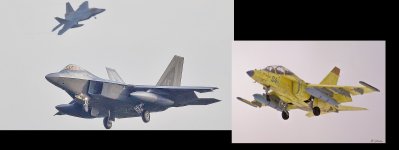
you could give me an answer to that?
Following that exact trajectory:
seeing fan blades > hiding fan blades > having no intakes at all.
By that textbook definition,
I have every reason to conclude that missiles are inherently more invisible than the actual jets carrying them.
SO:
And to fire a weapon it should have a direct lock or indirect guidance & with much lower RCS a jet would have much better chance to break the lock.
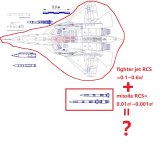
A “stealth” aircraft alone = stealthy.
A standalone air-to-air missile with a physical size under 0.1 square meters = stealthy.
A “stealth” fighter + A standalone air-to-air missile with a physical size under 0.1 square meters = not stealthy.
What a marvelous equation. This equation is very common,
but every time I ask the people who created it to explain it, they are completely at a loss. Are you one of them?
Clearly you've realized this too ——— so if it were up to me, of course I'd send 4 assault aircraft in the front group with no external stores, and a rear support group of 4 to 8 aircraft all fully loaded with KS-172s.
—————————— Of course, the ultimate solution can be abstracted as directly using data links to guide long-range surface-to-air missiles to engage — like the 40N6.
This is a capability the Su-57 has from the very beginning, while the F-22 is still far from it.
Su-57 could be a better gunfighter with superior TVC, 50-50 chance with CCMs, but in BVR, like i said above " the entity more visible on the outside gets seen & attacked 1st, no matter how good inside."

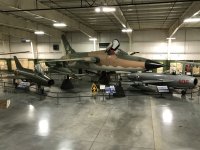
How come I’ve never seen anyone say that the MiG-21, with an RCS of only 3 square meters, had any first-look, first-detect advantage against the F-4 with an RCS of over 20 square meters?
The F-15’s RCS is also larger than that of the Su-27, MiG-29, F-16, and Mirage 2000.
But I’ve never heard anyone claim that the F-15 would be detected first and therefore get attacked.
Just like gravity as a physical phenomenon suddenly appeared overnight after Newton got hit by the apple — before the F-22, how come no one ever gave a damn about the impact of RCS in air combat?
——— Double standards.
Therefore, your scale is flawed.
RCS = Armor;
Radar, L-band radar, infrared detectors = Swords.
Perhaps the F-22 has higher armor, but the Su-57's sword-like advantage is greater.
F-22 is qouted M 1.8 SuCr while Su-57 quoted M1.3-1.6
The Su-57 has long-range air-to-air missiles and data-link sharing with the S-400.
The Su-57 has higher inlet efficiency than the F-22.
Because, literally speaking, the F-22 has been in service for 20 years- I did mark the side radar aspect in the table as "may be in MLU" in RED, then why're you raising this point again & again?
- And bcoz it was originally planned but not implemented, hence i speculated may be for MLU. What's the big fuss in it?
MLU ×
ELU ✓
E=End-of-life
- It's not about just 1 or few chips but a complete system which is very costly to R&D. These are way beyond even the costly servers in datacenters.
- CPU, cache memory, PCB, etc are among most expensive components in any computer system.
- Ultimately their computing capabilities are different, 3 BIPS Vs 10.5 BIPS as per current search.
- We've been doing performance analysis in datacenter since 20 years & it's the toughest & most tricky task. Many times the bottlenecks occur in the most unexpected parts, even after the manufacturers did so much R&D to make the components & setup.
- There are computing & network architecture & topologies, efficiency of OS, protocols, etc to be considered.
- YF-22 & many jets so far crashed due to system glitch.
- A lagger country with limited money, R&D, perhaps dependent on import, has to remain satisfied with whatever it can arrange.
- The leader country with highest R&D will enjoy better quality, capability, at more cost bcoz quality comes with price, but it's still affordable to the leader nation even in less numbers as they sell& generate revenue but not equally to lagger nations.
> Like i said above, to lead, huge investment is needed & ultimately 1 day by trial & error success is achieved & customers line up generating revenue, what we call ROI or Return On Investment.
> IDK about China, but non-computer manufacturing nations, dependent on West, don't seem to be happy at all. They fear their IT industry can collapse if West does arm twisting.
> This is contradiction bcoz -
- if things get obsolete quickly then already older, higher NM, less capable CPUs may suffice for few years but with lesser performance & will need upgrade.
- Military equipment is very generic term, with numerous size, scale, need, performace, etc, needing variety of chips, custom to the platform.
- Lesser the nanometer, more dense the CPU becomes, more the MIPS/BIPS, more avionics can be accomodated, better the radar/sensor performance, more targets can be simultaneously scanned, tracked, locked, better the sensor fusion, better the data sharing.
> The idea is that higher capable system takes advantage over lesser capable one.
The ultra-high-speed, disorderly development of hardware has already led to extreme performance overkill. Bitcoin is a prime example of this ——— along with the new industry spawned by Bitcoin speculators pivoting into it: the AI bubble. Both make this reality abundantly clear. My main workstation runs dual 2687W v2; my TV PC has an E3-1230 V2 (swapped in a 2800X a week ago — purely for the transparent RGB case — and also fitted a Radeon VII, but the TV itself is only 60Hz); my home gaming rig is a 3940MX-XP/7; my office machine is a 7800X3D (so I can sneak in some gaming); my meeting laptop is a 10810U; and I also have a 4K-screen 4940MX and an H365 laptop as well as a 5800HX notebook that I barely use.Back then I even shelled out a lot of money for a 6900 XT Liquid-Cooled Toxic — and the fans never even spun up. Now it's worth just one-seventh of what I paid. The most demanding game I ever played on it was GTA5, but it was never as fun as Heroes of Might and Magic III or SimCity 4 — I have zero interest in it. ———In fact, even the performance of a More than ten years ago‘s 3940MX is enough to satisfy over 90% of the office user base,The 1060/1070 level still accounts for half of the gaming user base. — let alone military equipment. And the defining trait of advanced-process chips: they're delicate.
Again going in circle. We all are judging & giving opinion based on something. So it's your misunderstanding that i'm supporting USA, while i'm simply focussing on tech aspects & R&D state. So there's no need to get entangled in gen #, standard & document, bcoz that doesn't change RCS, IRS.
- I already said that except RCS, Su-57 seems better.
- However, a good jet needs to be good both in & out. More visible outside means 1st to be seen & attacked.
- Also, detecting a faint object is 1 thing & confirming a genuine target & getting a lock for firing solution is another thing.
- Both Su-57 & F-22 have wing mounted sensors, the paint patch for sensors are grey color, which your eyes want to intentionally ignore & deny.
- Su-57 radar being newer could have higher detection range than F-22 for same RCS object, but with F-22's RCS as target that range reduces a lot.
- Su-57's IRST range is qouted 50 Kms against non-afterburning head-on targets, far less than radar ranges.
- So F-22 needs to detect, lock, fire on Su-57 b/w 50-150 Kms range. It can win BVR in this range otherwise it'ld loose mostly within 50 Kms.
- Under-wing stealth IRST pod & AN-AAR-56 replaced by TacIRST will tilt overall chances in F-22's favor.
- Also, round IRST worse than angled one, hence F-22's under-wing IRST are angled. There's speculation that Su-57 might have EOTS like cover for IRST.
In my view, fifth-gen is all a product of failure. The Su-57 is the relatively better one among them. should skip fifth-gen entirely and go straight for sixth-gen.
Chances are, manned fighter jets won't even live to see seventh-gen before being completely replaced by ground-based firepower, data-linked surface-to-air missiles, and suicide drones — or reduced to nothing more than an anti-drone platform.
The U.S. supported Japan's military buildup and its southward push to attack China, then pulled the rug out from under Japan halfway through, cooked it, and dropped two atomic bombs on it.Then, with a flick of a wrist, they reinvented themselves as the benevolent benefactors of the Chinese anti-Japanese war, expecting everyone to kiss their feetAnd you people know ? Let me introduced some bitter historical facts to you people:
1) USA supplied wepapons to india in 1962 war far better than USSR
2) USA put arms embargo on pakistan in 1965 war despite pakistan being a USA allies while we were clearly have community policy inside india while tilting toward USSR in geopolitics despite being self proclaimed "neutral".
We too did lots of mistake, you can not expect others to have self less love for you even in real life and expecting this in geopolitics is foolish.
Partnership is always about taking and giving, we need to give something in order to get something.
USA for sure will supply weapons to india in sino-india war iff ( and a big iff) we stop being "neutral" and start aligning with USA.
And obv we can make use of America wrapons during war only when we already using them or familiar with them
Again, our national interest, that is economy, development, jobs, all needs USA and Russia can never ever gave this to us.
Heck, even USSR was not able to give economy, development or jobs to india, Russia is just a shadow of USSR, so expecting it it stupid.
The U.S. helped Germany 'rebuild' after WWI, then Germany couldn't repay the Wall Street loans, its economy teetered on the brink, and Hitler came to power.Then the U.S. turned around and loaned money to the Soviet Union and Britain to go fight Germany.
The Soviets got off relatively easy — a few crappy Shermans and P-39s, and they still had to get on their knees and thank the Americans for it. They just had to hold their noses and put up with it. But the British? They couldn't afford to pay back those American loans.The U.S. 'helped' Britain win WWII, then seized the British Empire's colonies for itself and tore it to pieces.
Saddam got the green light from his American daddy to go after Kuwait, and what happened? He got served 'Desert Storm.'
Oh right, and to please their 'American Daddy,' Deng Xiaoping scurried over to the White House to After licking Carter's anus. Right after, China launched the invasion of Vietnam as a blood tribute to prove their loyalty to their American master. They spent ten years grinding on the border, only to be rewarded in the end by three Tomahawk missiles penetrating the Chinese Embassy in Serbia right through the roof.
Oh, and you might want to ask Yeltsin and Putin how hard they used to lick America's boots — in exchange for shock therapy and two rounds of NATO eastward expansion.
You make it seem like there's anyone in the whole world who doesn't want to be on good terms with the Americans. But the American daddy gets to pick and choose too.
Whether you get to be America's friend or enemy — is that even up to you to decide?
Last edited:
Let me say something as a student of geopolitics.
Buying Su-57 will be the worst decision we will make for our economy, our industries and our jobs.
Russia is not a economic power house, there are only 3 economic powerhouse, USA, China, EU.
China is our enemy, we sre china's enemy, she will never let us progress or develope.
EU hates russia to the core, they are so anti russia that they have visibly became russo-phobic.
Democrats in USA for sure are winning next election, they hate Russia more than wrst european, their hatered for russia is comparable to those of eastern european countries like Poland.
Democrats know that trump has harmed
Indo-USA relationship but they also hate india for buying oil.
If we want to be neutral and actually care for our interest which is economy, industries, jobs, IT, then we need USA and europe at any cost !!
We bought oil from Russia angering Democrats alot as well as EU, buying Su-57 means directly funding Russian MIC, which is red line for both EU and USA, the line even China cross very carefully and publicly denies it.
If people here are fine with India turning into pakistan with less than 5% of real GDP growth rate with being extremly dependent on china for almost everything of high tech with no other option then its fine to buy Su-57 , but in that case we will never ever able to deter china even if we got Nepolean as Indian General.
I would rather say that, Democrats will be willing to improve relation with India, we too need USA.
Hemce we shouod buy over 100 F-35 off the shelf with demand to integrate astra series(specially Gandiva) and Rudram 1 with F-35 and obv integration with IACCS.
And we should not buy more S-400. Russia is a sinking ship, the faster we move out, the better we will be.
If we have USA support then pakistan will face huge pressure from both USA and Saudi Arabia in case of conflict.
We have to be realistic, USA is still the superpower, and challenger is China which is iur enemy, we need USA support.
And in return we have to give them something, USA is not our slave, we can not expect that they only favor us while we keep buying oil and equipments from Russia.
Russia's nuclear arsenal and undersea capabilities make them the second most powerful nation on the planet. They have some conventional holes to fill, but once done, they will become an all-round military superpower.
While they cannot become an economic superpower, their control of energy and natural resources alongside their presence in the Arctic and Pacific while the ice is melting gives them some measure of power over other economies.
Our lack of interest in Su-57 is only due to AMCA being a higher-specc'd duplicate of it. It has little to do with geopolitics.
The S-400s are very good, and Russia's not sinking. As mentioned, they are headed towards achieving military parity with NATO over the coming years. We need to produce the missiles and radar parts in India for the next batch alongside some indigenization.
American "anger" towards India buying Russian oil is just an opportunistic play at keeping Russia away from India. It hasn't worked, and since the Americans know they failed, they will just move on from there. The long term relations between India and US will still stay strong, at least for a few decades. Plus, due to Russia and China, US will avoid becoming a military threat to India and vice versa.
In any case, India and US relations shouldn't be seen from the lens of smaller powers and their relationship with the US. India will only accept a relationship of equals, and has already proven that position since 2022. Economic relations will stay predictable and strong.
I tried to appreciate you initially but if you keep offending passing personal provocative comments, then others'll defend & let you know that they also have some credibility based on their qualification, industrial experience, while you can't give a basic intro.
Look at what i said -
And one more thing — your assessment of my posts might have been affected by the translation software. I typed in Chinese... because I'm lazy.
Literally nobody cares what America thinks, the whole world is moving away from America. Russia is the only veto power who is our genuine ally, aside from being a military superpower, they hold vast amounts of natural resources which will benefit our economy, sure America is an economic powerhouse but they are too much of an unreliable partner and we would need to compromise far too many times to appease them, even with the GE414 deal and trade surplus, they have a decent control over us and is trying to dictate us on policies. They know what they are doing. Russia is also no slouch economically, they are the largest European country in terms of GDP in PPP. Russia also won't try to dictate how we run our country and we should also show a certain degree of loyalty to the country and people who have aided us for so long instead of trying to overestimate our current value and overplay our hand and turn our one true ally against us.Let me say something as a student of geopolitics.
Buying Su-57 will be the worst decision we will make for our economy, our industries and our jobs.
Russia is not a economic power house, there are only 3 economic powerhouse, USA, China, EU.
China is our enemy, we sre china's enemy, she will never let us progress or develope.
EU hates russia to the core, they are so anti russia that they have visibly became russo-phobic.
Democrats in USA for sure are winning next election, they hate Russia more than wrst european, their hatered for russia is comparable to those of eastern european countries like Poland.
Democrats know that trump has harmed
Indo-USA relationship but they also hate india for buying oil.
If we want to be neutral and actually care for our interest which is economy, industries, jobs, IT, then we need USA and europe at any cost !!
We bought oil from Russia angering Democrats alot as well as EU, buying Su-57 means directly funding Russian MIC, which is red line for both EU and USA, the line even China cross very carefully and publicly denies it.
If people here are fine with India turning into pakistan with less than 5% of real GDP growth rate with being extremly dependent on china for almost everything of high tech with no other option then its fine to buy Su-57 , but in that case we will never ever able to deter china even if we got Nepolean as Indian General.
I would rather say that, Democrats will be willing to improve relation with India, we too need USA.
Hemce we shouod buy over 100 F-35 off the shelf with demand to integrate astra series(specially Gandiva) and Rudram 1 with F-35 and obv integration with IACCS.
And we should not buy more S-400. Russia is a sinking ship, the faster we move out, the better we will be.
If we have USA support then pakistan will face huge pressure from both USA and Saudi Arabia in case of conflict.
We have to be realistic, USA is still the superpower, and challenger is China which is iur enemy, we need USA support.
And in return we have to give them something, USA is not our slave, we can not expect that they only favor us while we keep buying oil and equipments from Russia.

USA is our covert enemy no. 1. Su-57/60s are coming in huge numbers(100+). The deal is nearing completion.We need to became allies with USA, that will counter both China and pak and unrestricted access to western tech and oil.
With USA hand on your head, you will never face oil problem for long as USA control majority of oil supplies and not China Russia or Iran.
And Russia will never choose india over china sow hy should we choose Russia over our development.
And our national interest in development and not becoming North Korea or pakistan hence USA is needed , USA and EU is our nationa interest.
People here thinks that "USSR helped India against USA", thats pure lie.
USSR supported its policy to defeat USA in 1971.
Ever wonder why POK issues did not resolved in 1971 war when we had such massive victory ?
Its because USSR withdrew its support, it never wanted to help us. It wanted to defeat USA which it need.
(One more post )
Last night it was too late. I spent two hours editing the post before last, only to realize that the argument in that post was never finished.The U.S. supported Japan's military buildup and its southward push to attack China, then pulled the rug out from under Japan halfway through, cooked it, and dropped two atomic bombs on it.Then, with a flick of a wrist, they reinvented themselves as the benevolent benefactors of the Chinese anti-Japanese war, expecting everyone to kiss their feet
The U.S. helped Germany 'rebuild' after WWI, then Germany couldn't repay the Wall Street loans, its economy teetered on the brink, and Hitler came to power.Then the U.S. turned around and loaned money to the Soviet Union and Britain to go fight Germany.
The Soviets got off relatively easy — a few crappy Shermans and P-39s, and they still had to get on their knees and thank the Americans for it. They just had to hold their noses and put up with it. But the British? They couldn't afford to pay back those American loans.The U.S. 'helped' Britain win WWII, then seized the British Empire's colonies for itself and tore it to pieces.
Saddam got the green light from his American daddy to go after Kuwait, and what happened? He got served 'Desert Storm.'
Oh right, and to please their 'American Daddy,' Deng Xiaoping scurried over to the White House to After licking Carter's anus. Right after, China launched the invasion of Vietnam as a blood tribute to prove their loyalty to their American master. They spent ten years grinding on the border, only to be rewarded in the end by three Tomahawk missiles penetrating the Chinese Embassy in Serbia right through the roof.
Oh, and you might want to ask Yeltsin and Putin how hard they used to lick America's boots — in exchange for shock therapy and two rounds of NATO eastward expansion.
You make it seem like there's anyone in the whole world who doesn't want to be on good terms with the Americans. But the American daddy gets to pick and choose too.
Whether you get to be America's friend or enemy — is that even up to you to decide?
The U.S. supported Japan's military buildup and its southward push to attack China, then pulled the rug out from under Japan halfway through, cooked it, and dropped two atomic bombs on it.Then, with a flick of a wrist, they reinvented themselves as the benevolent benefactors of the Chinese anti-Japanese war, expecting everyone to kiss their feet
The U.S. helped Germany 'rebuild' after WWI, then Germany couldn't repay the Wall Street loans, its economy teetered on the brink, and Hitler came to power.Then the U.S. turned around and loaned money to the Soviet Union and Britain to go fight Germany.
The Soviets got off relatively easy — a few crappy Shermans and P-39s, and they still had to get on their knees and thank the Americans for it. They just had to hold their noses and put up with it. But the British? They couldn't afford to pay back those American loans.The U.S. 'helped' Britain win WWII, then seized the British Empire's colonies for itself and tore it to pieces.
Saddam got the green light from his American daddy to go after Kuwait, and what happened? He got served 'Desert Storm.'
Everybody knows that Saddam was taken out not because he invaded Kuwait, but because he actually had the nerve to discuss settling oil in euros with the newly formed EU. Then the European lackeys still had to help their American daddy go and invade Iraq. Something regrettable is happening right now in Ukraine. The American daddy wants to screw up an integrated Europe. Two rounds of NATO eastward expansion, plus Ukraine, made Putin feel the very real danger of getting his *censored* Anus, so he fought back. Europe — especially garbage countries like Germany — has prosperity that depends on cheap fuel supplied by Russia. The Ukrainians blew up the Nord Stream pipeline and hammered the German economy, yet in order to carry out the will of their American daddy, they'd rather commit suicide, just like with Iraq back then, and help fight Ukraine all the way down to the very last Ukrainian. Then the Americans turn around and ask them for Greenland. Europeans are this pathetically stupid, so it's only right and natural that they get abandoned and overtaken by the entire world. (In the European political system, even the lowliest political hacks have bought massive amounts of property in the United States, and the Jew daddy is holding countless pieces of dirt over them as leverage — this is also the result of the so-called democratic system completely collapsing.)
Oh right, and to please their 'American Daddy,' Deng Xiaoping scurried over to the White House to Then licking Carter's anus. Right after, China launched the invasion of Vietnam as a blood tribute to prove their loyalty to their American master. They spent ten years grinding on the border, only to be rewarded in the end by three Tomahawk missiles penetrating the Chinese Embassy in Serbia right through the roof.
Back when I was growing up, the official narrative was practically obsessed with kissing America's *censored*. The government lectured us daily on Sino-US ties, produced films romanticizing the American dream, and politicians in every meeting ordered low-level cadres to swallow American doctrines hook, line, and sinker. They trashed the Soviets as stupid, backward losers who failed because they rejected market capitalism. CCTV literally spammed us with tear-jerkers about Chinese immigrants making it big in America. And now? All that hardcore bootlicking has magically evaporated into what they now call 'incorrect historical memories.'
Heck, even Ren Zhengfei and Huawei, who got blasted by US chip sanctions, are doing backflips to cope and explain: 'I love America! Our whole setup is literally modeled after the US. Since I was young, I've been pro-American to the marrow of my bones (and back then, he was basically a brigadier-general in the military). Even today, I’m still a hardcore fan of the US. Uncle Sam just got his wires crossed, and that's the only reason we're getting squeezed.'
This is a direct, verbatim quote from the man himself—zero exaggeration on my part
【任正非:我是亲美的,华为内部的指导文件都是美国精神-哔哩哔哩】 任正非:我是亲美的,华为内部的指导文件都是美国精神_哔哩哔哩_bilibili
【【任正非】:我从年轻时就是很亲美的,直到今天仍然是亲美的-哔哩哔哩】 【任正非】:我从年轻时就是很亲美的,直到今天仍然是亲美的_哔哩哔哩_bilibili
Oh, and you might want to ask Yeltsin and Putin how hard they used to lick America's boots — in exchange for shock therapy and two rounds of NATO eastward expansion.
You make it seem like there's anyone in the whole world who doesn't want to be on good terms with the Americans. But the American daddy gets to pick and choose too.
Whether you get to be America's friend or enemy — is that even up to you to decide?
Last edited:

And you people know ? Let me introduced some bitter historical facts to you people:
1) USA supplied wepapons to india in 1962 war far better than USSR
2) USA put arms embargo on pakistan in 1965 war despite pakistan being a USA allies while we were clearly have community policy inside india while tilting toward USSR in geopolitics despite being self proclaimed "neutral".
We too did lots of mistake, you can not expect others to have self less love for you even in real life and expecting this in geopolitics is foolish.
Partnership is always about taking and giving, we need to give something in order to get something.
USA for sure will supply weapons to india in sino-india war iff ( and a big iff) we stop being "neutral" and start aligning with USA.
And obv we can make use of America wrapons during war only when we already using them or familiar with them
Again, our national interest, that is economy, development, jobs, all needs USA and Russia can never ever gave this to us.
Heck, even USSR was not able to give economy, development or jobs to india, Russia is just a shadow of USSR, so expecting it it stupid.
We are doing what should be done..
We are lessening the import of Russian weapons .. Increasing from reliable partners like France.
We are indeed increasing US weapons purchase..
Russia won't have much to offer .. only few items hereafter.. Su 57 which was rejected got the interest again because of clauses and restrictions other sellers have..and Pakistan is set to receive J35 sooner that we imagined.
Otherwise it's only AMCA .
Ah, the 'reliable' French ally.We are doing what should be done..
We are lessening the import of Russian weapons .. Increasing from reliable partners like France.
We are indeed increasing US weapons purchase..
Russia won't have much to offer .. only few items hereafter.. Su 57 which was rejected got the interest again because of clauses and restrictions other sellers have..and Pakistan is set to receive J35 sooner that we imagined.
Otherwise it's only AMCA .
Look at the Mistral-class ships now in Egyptian hands—half of those hulls were literally manufactured by Russia, and their original names were Sevastopol and Petropavlovsk before France backed out.
Let's also laugh at that French engine disaster on the SSJ-100.
Seriously, in what era of human history did France and 'reliable' ever belong in the same sentence? Unless you mean reliably fast at hoisting a white flag?
Radar detection follows this exact rule: for the same radar, the detection range and the target's RCS exhibit a 4th-root relationship.
RCS 100 = 400 km (Benchmark)
RCS 20 = 267.5 km
RCS 10 = 224.9 km
RCS 5 = 189.1 km
RCS 3 = 166.5 km
RCS 1 = 126.5 km
RCS 0.51 = 106.9 km
RCS 0.5 = 106.4 km
RCS 0.1 = 71.1 km
RCS 0.01 = 40.0 km
This means that for every 10-fold reduction in RCS, the actual reduction in radar detection range is a meager 44%.
Russian engineers have noted that an RCS below 1.0 can meet all beam requirements,
Therefore, designers recognize that an equivalent RCS of 0.5 represents the optimal, balanced sweet spot. Pushing for lower signatures beyond this threshold triggers a massive overflow of diminishing returns, severely compromising the aircraft's kinematic and kinematic performance.
Incidentally, the theory of low-RCS aircraft design was invented by the Russians.
Yet the Americans have taken this theory as gospel and gone to extremes with it; the most typical example of low‑RCS aerodynamic junk is the F‑117.
……From the Russian perspective, both the Su‑57 and the F‑22 lie in the optimal solution interval of 0.3 to 1.
Furthermore, shifting from 0.5 to 0.51 (by adding an external pylon) causes absolutely no qualitative change, and the same goes for four pylons. In reality, the primary purpose of an internal weapons bay is to reduce aerodynamic drag—a concept that originated with bombers and torpedo planes. The reduction in RCS was merely a happy accident.
> I guess you're using this formula -

So like i said that frequency/band also matters. And there're other variables of X'mit power, recieved power, Gain.
> I'm aware of Pyotr Yakovlevich Ufimtsev, a maths physicist who revolutionized electromagnetics and modern aviation through his pioneering work on the Physical Theory of Diffraction (PTD) and edge wave diffraction, and Americans noticed it & continued on it.
> You're continiously ignoring that stealth is not just physical size. Pushing RCS below 1m2, 0.1m2 also depends on RAS, RAM, EW, so it won't compromise kinematics. It's just that diferent nations' RAM, RAS, EW have different efficiency.
> West is trying to stall Russian R&D in every way, otherwise Russians could have achieved very low RCS too.
> NON-STEALTHY pylon RCS not 0.01 but 0.1 to 1 m2. NON-STEALTHY big AAM RCS 0.1m2 +/-. So a broad range of 1-5 m2.
Last edited by a moderator:
It wasn't the Su57 but Pak FA which was rejected, I don't know why people in 2026 still don't understand this simple difference and the deal was rejected for various reasons related to ToT, workshare, politics etc it didn't have much to do with the capabilities of the older design as far as I remember.We are doing what should be done..
We are lessening the import of Russian weapons .. Increasing from reliable partners like France.
We are indeed increasing US weapons purchase..
Russia won't have much to offer .. only few items hereafter.. Su 57 which was rejected got the interest again because of clauses and restrictions other sellers have..and Pakistan is set to receive J35 sooner that we imagined.
Otherwise it's only AMCA .