Arjun Main Battle Tank (Mk-1 & Mk-2)

  • Thread starter Thread starter Tarun
  • Start date Start date
Reflecting on MTU’s unilateral cessation of supply chain commitments to the Russian Federation—which severely disrupted both locomotive manufacturing and frigate propulsion programs—it is evident that Germany remains structurally unreliable in the delivery of sovereign strategic assets. Berlin functions essentially as an absolute geopolitical instrument and vassal of Washington's strategic mandates.
Yup, they denied engines for zorawar light tank hence we have to look for cummins.

We are in process of developing a 750-800 horsepower engine too but its unknown, what is the current progress
 
Yup, they denied engines for zorawar light tank hence we have to look for cummins.

We are in process of developing a 750-800 horsepower engine too but its unknown, what is the current progress
Although China possesses a comprehensive suite of licensed technologies from Cummins—specifically centering on the 13-liter displacement platforms—the defense establishment has strategically averted integrating these powerplants into light tanks or armored fighting vehicles (AFVs). This restriction is enforced to mitigate severe vulnerabilities should Washington unilaterally terminate bilateral commercial and technical compliance.
Regarding armored propulsion history, China’s early tank designs relied exclusively on derivatives of the Soviet V-2 diesel engine. However, following the Sino-Soviet geopolitical rupture, later-stage domestic research and development suffered profound stagnation, stranding their heavy propulsion capabilities at the 700-horsepower threshold for an extended period.
Subsequently, during a Western-oriented paradigm of indigenous development, China initiated the 150HB engine program. This architecture was hybridized by modifying the stroke and cylinder bank angle of the legacy Soviet V-2 block, while incorporating select subsystem components acquired from the German MTU 6-cylinder 833 series. In operational reality, the early iterations of this design manifested severe technical immaturity. Despite nominal ratings of 1,200 horsepower (later uprated to 1,500 horsepower) for the 12-cylinder variant and 1,000 horsepower for the 8-cylinder variant, its baseline performance—particularly regarding thermal management and mean time between failures (MTBF)—fell drastically short of the V-84 engines localized by India. Consequently, the defense industry ultimately defaulted to utilizing the Deutz 1015 series, a propulsion technology suite previously acquired via complete licensing transfers, as their primary operational power plant.
 
Last edited:
  • Like
Reactions: PhotonVish
China possesses the complete licensed technology suite for Cummins 13-liter displacement diesel engines; however, they deliberately abstain from integrating these powerplants into light tanks or armored fighting vehicles (AFVs) to preclude critical exposure to sudden geopolitical supply chain disruptions from the United States.
In terms of armored vehicle propulsion, the earlier domestic reliance was placed on the indigenous 150HB engine series—a hybrid architecture derived from modifying the stroke and bank angle of the legacy Soviet V-2 cylinder block, combined with reverse-engineered elements of the MTU 6-cylinder 833 system. This powerplant suffered from systemic design maturity deficits; while it boasted a nominal rating of 1,500 horsepower for the 12-cylinder variant and 1,000 horsepower for the 8-cylinder version, its actual operational metrics across all parameters fell significantly short of India's localized V84 propulsion system.
Consequently, China ultimately transitioned to utilizing the Deutz 1015 engine series as its primary armored vehicle powerplant, leveraging the comprehensive technology transfer and production rights acquired in prior decades
Nice, in india, govt is very stingy and spinless, they fear taking risk. Thats why till its available from foreign, we hardly develope any advanced things on time.

Infact i wish that all foreign nations including russia, israel and france sanctions india for militry equipment

You will see how india sprint to surpass all of them, may not be as good as them , but its fine, quality can be improved, but we will surely have all type of wepaons within 2 decade just like china
 
Nice, in india, govt is very stingy and spinless, they fear taking risk. Thats why till its available from foreign, we hardly develope any advanced things on time.

Infact i wish that all foreign nations including russia, israel and france sanctions india for militry equipment

You will see how india sprint to surpass all of them, may not be as good as them , but its fine, quality can be improved, but we will surely have all type of wepaons within 2 decade just like china
The ultimate metric of an effective armaments doctrine resides in the immediate operational utility of its hardware, rather than the uncoordinated proliferation of superfluous and operationally redundant models.
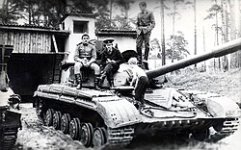
Had China possessed the systemic industrial capacity to manufacture and field a platform equivalent to the Soviet T-64B during that specific era, its defense establishment would never have initiated the chaotic proliferation of intermediate armored platforms that followed—a trajectory defined by a fragmented continuum of designations, including the Type 85-III, Type 90, Type 96, Type 99, Type 15, and Type 100 series
T-64_der_GSSD_in_Perleberg_(1980er-Jahre).jpgAOeaILNHW-B3HP7NCPV8drd6agkYxUO6W8MkN_BXDhxdXz2ZQVJEWOVKGu7rHLPeB6ceKzec7M5so0ZrTPHpLw.webp

Admittedly, the Soviet Union's concurrent mass production of the T-64, T-72, and T-80 platforms was itself symptomatic of a systemic logistical pathology—an institutional malady demanding immediate, structural remediation.
 
  • Like
Reactions: PhotonVish
I don’t get it — why buy an MTU engine just to give yourself a headache?
Headache lol? You're talking about an establishment that had never previously developed a tank engine attempting to jump straight into something as exotic as a 1,500 hp air-cooled VCR (Variable Compression Ratio) engine on its very first try. Unsurprisingly, that effort didn't go anywhere. As far as I know, it could only develop around 1,000 hp on the dynamometer.

At the time of Arjun's development, West Germany was regarded as a key strategic partner and provided important consultancy services, along with several critical subsystems such as the gun control system, tracks, suspension seals, and, of course, the powerpack. That is why the decision was made to import the engine. However, it's worth noting that the Germans were not willing to provide the MB 873. The MB 838 used in the Arjun was essentially a custom-built variant tailored to Indian requirements.

That said, CVRDE did have a backup option in mind in the form of the Cummins QST-30, a civilian engine adapted for Arjun requirements through the reconfiguration of its peripheral systems. It was paired with the RK 304S transmission and underwent limited trials around 2007–08. Very little information about this effort is publicly available.

At present, CVRDE is reportedly working on a T-shaped powerpack configuration derived from the NGMBT's 1,500 hp engine. This spin-off derivative is referred to as the CV1500A.

 
  • Like
Reactions: YoungWolf
Headache lol? You're talking about an establishment that had never previously developed a tank engine attempting to jump straight into something as exotic as a 1,500 hp air-cooled VCR (Variable Compression Ratio) engine on its very first try. Unsurprisingly, that effort didn't go anywhere. As far as I know, it could only develop around 1,000 hp on the dynamometer.

At the time of Arjun's development, West Germany was regarded as a key strategic partner and provided important consultancy services, along with several critical subsystems such as the gun control system, tracks, suspension seals, and, of course, the powerpack. That is why the decision was made to import the engine. However, it's worth noting that the Germans were not willing to provide the MTU 873. The MTU 838 used in the Arjun was essentially a custom-built variant tailored to Indian requirements.

That said, CVRDE did have a backup option in mind in the form of the Cummins QST-30, a civilian engine adapted for Arjun requirements through the reconfiguration of its peripheral systems. It was paired with the RK 304S transmission and underwent limited trials around 2007–08. Very little information about this effort is publicly available.

At present, CVRDE is reportedly working on a T-shaped powerpack configuration derived from the NGMBT's 1,500 hp engine. This spin-off derivative is referred to as the CV1500A.
Would it not have been entirely viable to execute a propulsion and transmission reconfiguration for the Arjun MBT, integrating a localized derivative of the Soviet V-2 engine alongside a dual-flow planetary transmission architecture? Under this framework, tactical retraining for armored crews would remain virtually indistinguishable from their existing baseline on the T-72, maximizing combat readiness through systemic standardization.

It seems that Indian bureaucrats and Chinese bureaucrats are quite similar — long live Russian goods on Mondays, Wednesdays, and Fridays; Western goods are better on Tuesdays, Thursdays, and Saturdays; and on Sundays, it’s time to rely on oneself...
 
Would it not have been entirely viable to execute a propulsion and transmission reconfiguration for the Arjun MBT, integrating a localized derivative of the Soviet V-2 engine alongside a dual-flow planetary transmission architecture? Under this framework, tactical retraining for armored crews would remain virtually indistinguishable from their existing baseline on the T-72, maximizing combat readiness through systemic standardization.

It is not exactly known what they had in mind. Arjun documentation is hilariously bad but no I don't think what you are suggesting was sensible.
 
It is not exactly known what they had in mind. Arjun documentation is hilariously bad but no I don't think what you are suggesting was sensible.
Alternatively, coupling the V-2 engine series with an electro-hydraulically assisted semi-automatic transmission architecture represents a highly pragmatic configuration—a paradigm previously operationalized by Eastern European defense industries through successful legacy retrofits.