PAK-FA / Sukhoi Su-57 - Updates and Discussions

.....sure mate. The su57 has its own advantages but it was designed to fight under friendly AD protection hence the relatively poor IR stealth from the back. It might get better if the flat nozzles are introduced but even the Its basic RCS shape is not as optimal. the J20 idk but the F22 and F35 are vastly better in terms of pure stealth via airframe.
I've said it in other threads — I consider all fifth-generation fighters to be failures. The Su-57 is merely the best among a bad lot. Ever since the Cold War ended, this whole Western-liberal school of design thinking has been one fundamental logical fallacy after another.

Let's start with "first-detect, first-engage." If that's the idea, then you're definitely switching on your radar to search for targets. And switching on your radar to search for a target is like turning on a flashlight in the dark to find a cat — the first thing that lights up is you.

Then there's the issue of downward stealth. Downward stealth matters when you're deep behind enemy lines, in an environment where the adversary holds the advantage in air defense. The entire air defense system of Europe, combined, is less dense than the organic air defense assets of a single Russian combined-arms army. If your aircraft design is purpose-built to take on the Russian military, giving extra weight to this aspect does make sense — and the same goes for Taiwan, South Korea, Saudi Arabia, and Israel, which are among the rare pockets of high-density air defense networks anywhere on the planet. But when it comes to other countries, whose air defense systems are barely worth mentioning, what's the point of optimizing in that direction? And in an age of 100-plus-kilometer glide missiles — especially considering the Su-57's massive internal bays designed to carry four cruise missiles — what exactly is the value of penetrating an enemy's air defense envelope in the first place?

Finally, there's the rear-aspect stealth you mentioned. Rear-aspect stealth has always been about the infrared spectrum — things like serrated nozzles, designed to dissipate heat. But engines are getting more and more powerful, with temperatures climbing from around 1,300 degrees in the previous generation to 1,800 degrees in the latest engines. No matter how you tweak the back end, the infrared signature is only going to get more and more pronounced. So just how much absolute value does any of that really have?
even when it comes to radar-band stealth, the return echoes generated by the tail section are positively modest compared to the returns bouncing off the nose cone and the cockpit — and for radar waves, that nose radome might as well be a pane of clear glass. When you're already crawling with lice, you stop caring about a few more. That marginal sliver of stealth improvement at the rear is nothing but a psychological comfort blanket, barely worth the bother.
 
Appreciate the raw, no-BS take on European suppliers and the hard truths about tech transfers. That "fangs at the weak, knees at the strong" line is sharp, it really captures how political reliability often overrides specs in this game. And yeah, pointing to the USSR-to-China model as the rare genuine full-chain precedent makes sense historically. It wasn't just crates of hardware; it was experts on the ground, training, standards, and systemic know-how through those "156 Projects" in the 1950s. Studies (like Giorcelli & Li) show the plants that got both machinery and deep training saw productivity gains compounding for decades, up to 50% cumulative after 40 years, with real spillovers. Hardware alone faded fast after the split. That's the absorption + iteration playbook China rode into broader industrial muscle, including aviation lineages from Su-27s onward.

Your advice for India to lean into Sukhois/MiGs with serious reverse-engineering tracks with patterns that worked before. Russia's Su-57 offers to India have moved into pretty advanced technical talks, joint production at HAL lines (building on Su-30MKI), significant localization, source code access, engines, avionics, stealth elements, and integration of Indian stuff like BrahMos/Astra. Putin himself pitched co-development recently. It's not the full 1950s blank-check model, but it's closer to meaningful transfer than most Western deals come with.

On India's side, Atmanirbhar isn't just talk. Defense production hit a record ₹1.54 lakh crore in FY 2024-25, with indigenous output around ₹1.27 lakh crore (huge jump from 2014 levels). Exports are climbing fast too (tens of thousands of crore, to 100+ countries). Tejas indigenous content is rising, DRDO/private sector ecosystem is expanding, and policies are pushing private/MSME involvement. Full fighter self-reliance (engines, materials, timelines) is still a grind, AMCA and Tejas Mk2 are progressing but not there yet. So the hybrid bridge via Russian platforms + domestic R&D makes pragmatic sense, exactly as the Chinese experience showed.

Serbia's hedging is a live case study for your point: Rafale buy came with restrictions (MICA instead of full Meteor due to Western sensitivities), while they've integrated Chinese CM-400 supersonic missiles on upgraded MiG-29s. Diversification in action.

Russian systems have held up in Ukraine's grind, mass fires, EW, glide bombs, adaptations without full general mobilization, validating resilience in protracted attrition. But it's come at steep costs (high losses, slow gains), and both sides have innovated hard with cheap drones/FPVs. PLA analysts have pored over this: pushing attritable swarms, EW cat-and-mouse, resilient logistics, info dominance, and accepting long fights over quick wins. It builds on that Soviet foundation into today's J-20, Type 055, hypersonics, and mass output. The "East Wind" shift feels real in multipolarity, but it depends on execution speed in the drone/EW/artillery age.

European examples (Mistral cancellation, AUKUS killing the French sub deal, Rafale strings) do expose the dependency risks you called out. Secondary-tier options often stay stopgaps unless you extract full lines/tech.

With Russia's Su-57 pitch offering decent absorption potential for India, and China evolving that old Soviet base while digesting Ukraine realities, what do you see as the real game-changers today for climbing tiers, depth of initial transfer, scaling domestic R&D + ecosystem (India's DRDO + private talent pool + diaspora), mass/asymmetric doctrines, or something else? India's manufacturing base and innovation push might tweak the classic Chinese script in interesting ways in the 2020s.

This kind of straight comparative analysis is gold for the forum. Keeps things grounded instead of the usual echo chambers. Drop the next one whenever, always good to chew on.
Ah, alright — thank you so much for your support, and for taking the time to write so much in reply. I've taken note of everything. But it's already quite late now, and I have to head over to my mother-in-law's place tomorrow. So I'll come back and respond tomorrow.
 
I've said it in other threads — I consider all fifth-generation fighters to be failures. The Su-57 is merely the best among a bad lot. Ever since the Cold War ended, this whole Western-liberal school of design thinking has been one fundamental logical fallacy after another.

Let's start with "first-detect, first-engage." If that's the idea, then you're definitely switching on your radar to search for targets. And switching on your radar to search for a target is like turning on a flashlight in the dark to find a cat — the first thing that lights up is you.

Then there's the issue of downward stealth. Downward stealth matters when you're deep behind enemy lines, in an environment where the adversary holds the advantage in air defense. The entire air defense system of Europe, combined, is less dense than the organic air defense assets of a single Russian combined-arms army. If your aircraft design is purpose-built to take on the Russian military, giving extra weight to this aspect does make sense — and the same goes for Taiwan, South Korea, Saudi Arabia, and Israel, which are among the rare pockets of high-density air defense networks anywhere on the planet. But when it comes to other countries, whose air defense systems are barely worth mentioning, what's the point of optimizing in that direction? And in an age of 100-plus-kilometer glide missiles — especially considering the Su-57's massive internal bays designed to carry four cruise missiles — what exactly is the value of penetrating an enemy's air defense envelope in the first place?

Finally, there's the rear-aspect stealth you mentioned. Rear-aspect stealth has always been about the infrared spectrum — things like serrated nozzles, designed to dissipate heat. But engines are getting more and more powerful, with temperatures climbing from around 1,300 degrees in the previous generation to 1,800 degrees in the latest engines. No matter how you tweak the back end, the infrared signature is only going to get more and more pronounced. So just how much absolute value does any of that really have?
even when it comes to radar-band stealth, the return echoes generated by the tail section are positively modest compared to the returns bouncing off the nose cone and the cockpit — and for radar waves, that nose radome might as well be a pane of clear glass. When you're already crawling with lice, you stop caring about a few more. That marginal sliver of stealth improvement at the rear is nothing but a psychological comfort blanket, barely worth the bother.
1. A stealth aircraft engaging hostile aircraft will not be alone, it will use other assets like 4th gen fighters with massive radars or AWACS or Ground based radars and AD to cue missiles. Its not going to be a solo 1v1. Stealth helps here because it makes sure YOU are not detectable while your allies who are are far enough for it to barely matter.

2. Downward stealth is important if your going to fly over a country but the vast majority of the time while facing an actual airforce your going to stay in friendly lines. This allows you a first look and first shoot advantage that doesnt require downward stealth.

3. Rear aspect is important here because you need to shoot and egress and rear aspect stealth increases your chances by a significant amount vs Dual mode seeker missiles. any small increase in stealth drastically increases survival chances. We also have to take into account IRSTs and theyre increasing effectiveness and range.

It looks like you and I have fundamental disagreements about this topic. lets just agree to disagree and move on.
 
  • Like
Reactions: batman
1. A stealth aircraft engaging hostile aircraft will not be alone, it will use other assets like 4th gen fighters with massive radars or AWACS or Ground based radars and AD to cue missiles. Its not going to be a solo 1v1. Stealth helps here because it makes sure YOU are not detectable while your allies who are are far enough for it to barely matter.

2. Downward stealth is important if your going to fly over a country but the vast majority of the time while facing an actual airforce your going to stay in friendly lines. This allows you a first look and first shoot advantage that doesnt require downward stealth.

3. Rear aspect is important here because you need to shoot and egress and rear aspect stealth increases your chances by a significant amount vs Dual mode seeker missiles. any small increase in stealth drastically increases survival chances. We also have to take into account IRSTs and theyre increasing effectiveness and range.

It looks like you and I have fundamental disagreements about this topic. lets just agree to disagree and move on.
Our Su-57/60MKI variant would be far better in-terms of stealth from all-aspects, especially rear than current Su-57S/E. Rest assured about that.
 
OMG, this thread expanded so fast.🤪

DoD/security plans & deals're supposed to appear tricky, so that enemies can't adapt prematurely.
> IM🧅 In short,
- Looking at USA's arm twisting, no F-35 or any future jet &/or engine. After 80% F414 ToT also be mentally prepared for 20% arm twisting.​
- Few squads of Su-57 50-50 chance. Although Su-57 has many cool stuff but we should not see Su-57 as true 5gen but 4.5-5gen gap filler better than any 4.5gen jet. Hence getting it or not, i'm neutral.​
- We can take 1 of the new Russian engines & inflate AMCA like LCA to MWF, similar to Kaan. Ultimately our own domestic/JV engines matter.​
.
.
.
Expanding the short lines -

- USA makes good quality products but in return expects world submission/domination.
- Jets remain for 40-60 years but Regimes can change every few years, so to avoid further arm-twisting & delays, we should limit our purchases from them to auxilliary systems & products like helicopters, cargo planes, equipments, etc for which alternatives are there globally & locally. That would be enough for international trade & diplomacy. So we shouldn't even dream of F-35 or even export variant of NGAD, F/A-XX, their CCAs.

> Action speak more than words, for US & us too. World is already pointing to most populous nation's bureaucratic management & delays.
- Indians succeed abroad but struggle locally & with AI/ML there'll be global impact & forcing priority on local employment, so many NRIs will have to return to India.​
- Expanded DoD employement & PPP need to absorb the talent. It's not good to keep going to shopping abroad even to friendliest nations like Russia, France, israel, etc.​
- AMCA plan A with F414 along with inflated plan-B. Citizens are already in shock after 15 years thinking earlier that the prototype is half way under construction until this PPP news disclosed the real state of progress.​
- Bcoz new airframe & engine design take 10-15 years at least hence just like GTRE's effort & JV engine, we also need our own heavy class 5+gen airframe along with appropriate engine to be officially started immediately, later upgraded to 6gen when DRDO making RAM, RAS, DEW, TVC, etc. We don't need a complete capitalistic GCAP, FCAS system, just some of their components & technology which EU'll agree or not is tentative. If ADA can't design new airframe then PPP should do it.​

> We've to be carefull with products of EU & Russia too bcoz friendly politicians can't remain in power indeinitely & every nation's defence products' export variant is supposed to be inferior to its domestic variant, to maintain a leading strategic & industrial advantage & business continuity.
- Although Su-57 has many +ve points like flatter fuselage, DIRCM, levcons, TVC, IRST, multi-band DAS-MAWS, side & rear looking radars, multi-band RF antennas, new HMDS, glass cockpit, etc, but its RCS is not satisfactory from 5gen PoV, contributed by many aspects like round engine bays, round IRST, IFRP, canopy arc, etc.
- Regular citizens/enthusiasts are not historians, journalists, so as per internet search & chatter on other foreign forums, Russians don't seem to claim Su-57 front RCS lower than 0.1m2, that's just 1 decimal place lower than the Western MLUed 4.5gen jets with 1m2 RCS in clean config.​
- So for public understanding -​
F-22 - 0.0001m2​
Domestic F-35 - 0.001m2 or b/w 0.001 & 0.0001 m2.​
Exported F-35 - <=0.001m2​
Domestic Su-57 - <=0.1m2​
Exported Su-57 - ??​
MLUed 4.5gen clean config - 1-5m2​
Initial 4gen - 5-25m2​
- So <=0.1m2 RCS Su-57 can kill 1+m2 RCS 4.5gen jets, but even if world's best avionics is put inside a fuselage which's still visible 1st could be vulnerable to enemy 5gen jet & SAM, then the incoming BVR-AAM/SAM has to be decisively jammed to survive. Some missiles have HoJ (Home on Jam) capability so that has to be countered by ECCM.​
- In next few years when AMCA full scale RAM+RAS+EW model will be tested in anechoic chamber & RCS range, then DoD'll know its RCS which'll be desired to be at most 0.001m2 like F-35.
- If we intend to use networked fusion then enemy can also use it.
- LR-AAMs/SAMs R&D or import also seen on both sides.

> Some points on engine performance -
- It does vary as per weather, geography, giving 5-10% more dry thrust in cold/dense sea level areas & 5-20% less dry thrust in hot/thin air sea level areas. There'll be some trade-offs.​
- Russia is cold region, Europe is also very cool. USA has diversified geography & climate. Their jets & engines have been used globally,​
- Engines thrust're quoted as per testing in chamber with conditions of sea level STP, also tested in heated & cold air to simulate real world, keeping a cap or flat-rating limit to avoid damage.​
- In hot areas bcoz the air is pushed up, as altitude rises the performance differences decrease. Hence the hurdle is the initial takeoff at higher runway &/or hot climate.​
- Important IAF bases like Gwalior, Ambala, Bikaner, etc used in Op-Sindoor for example, in summer can have 10-20% loss of air density, dry thrust & lift compared to STP.​
- In lower air density, by rule of conservation of mass, the velocity(volume) needs to increase to compensate for lower air density, means higher T/o & flight speeds, means longer runways.​
- And lift also needs sufficient air density.​
- So when enough runway, Afterburner can be lit when jet is stationary bcoz it's direct fuel injection & fuel's calorific value is very high giving big KE to air molecules compensating for dry thrust loss, provided the engine thermal materials are good & a jet can still t/o with full MTOW.​
- But if runway is limited then any jet can t/o with 80% of MTOW, more payload, less fuel then do mid-air-refuelling.​
- But if airfield is higher like in Tibet then it's bigger problem bcoz air density drops by 35-40%, dry thrust drop by 40%, T/o speed increases by 30%, the runway length to like 5 Kms.​
- IDK exactly how much AB's wet thrust can compensate this loss of dry thrust but internet search shows J-20 or any jet can still t/o with around 70-80% of MTOW with AB, 46% empty, remaining 24-34% weapons+internal fuel.​

- So if 18.4 tons empty Su-30MKI carrying Brahmos & many AAMs with AL-31FP engine is manageable with longer T/o distance, then 18.5 tons empty Su-57 with any higher thrust engine'll also be manageable.
- If Russia allows airframe modification then we can use it for 6gen TD.

The larger point was about whether Su-57 could be ordered without a formal RfI/RfP process. Lately, the IAF has been doing market surveys via RfIs for items like AWACS (2 so far) for which we already have a proven local tech base.

To give you an example, nobody had any doubt that the IN would choose Rafale overSH B3 for MRCBF. Yet, MoD went the whole 9 yards. I suspect that was done, atleast partly, to deflect US pressure.

In case of Su-57, the Russians could also sucker us on upfront acquisition and lifecycle costs without a proper competition. Gorshov/Vikram redux?
 
Last edited:
It bares its fangs at weak nations, forcing them to buy second-hand, low-spec junk, still acting as if it were a colonial overlord.

When it meets a slightly stronger country, it says, "Don't you worry. We don't care what the Americans think, and we don't care what the Russians think. Go ahead and use it with confidence — whatever happens, we'll take the blame."

But when it actually runs into the Americans, it instantly snaps to attention and hollers, "Daddy, we'll do exactly as you say!"

And at the sight of Jews, its legs start trembling so hard it looks ready to drop to its knees.

--------------------------That's European goods.

picture this — it's M1A2s, Leclercs, Rafales, Marders, and a whole rainbow brigade of LGBT infantry rolling into the Donetsk four oblasts. By now, they'd probably be defending Moscow itself.
I mean, come on — Europe tagged along with America messing around in Afghanistan for over a decade, and in the end, didn't they all get politely, ever-so-dignifiedly escorted out by the Taliban right at Kabul Airport?


What is the "best" choice for the Indian government?
—Self-reliance, independent production — there is simply no other way. Security cannot be bought, and core technologies are things others will never sell to you. Historically speaking, the only truly wholehearted, full-chain technology transfers since World War II have been from the Soviet Union to China, and, in a few specific fields, from the United States to Japan. In other words, if you're talking about a "credit score" in this game, only those two countries have any real credibility. No other nation has set such a precedent. You'd be lucky if they didn't fleece you dry and strip you bare — and you're hoping to dig up blueprints from Europe's shallow little bookshelf?

Play it straight — just buy the Sukhois and MiGs. If push comes to shove, reverse-engineer the damn things, bolt for bolt. That's how you shave decades off the detour.
— That's the Chinese experience,
Of course, you can pay to negotiate; it can be sold to Chinese people, but it's impossible that it won't be sold to Indians.

Specifically regarding India, they could simply replicate the F-15 or F-16.
plain and simple.You want to politely ask others to sit tight and wait obediently while you overtake them — that's about as real as dreaming with your eyes open.Especially Americans
I think there is one point where I agree with you completely: security cannot simply be bought.

A serious country cannot remain forever dependent on foreign suppliers for its critical defence capabilities. India must develop its own industrial base, its own weapons, its own software interfaces, its own maintenance ecosystem, and ultimately its own design capabilities. On that point, I think there is no disagreement.

But I do not think your conclusion follows from that premise.

You seem to suggest that India should simply buy Sukhois and MiGs, reverse-engineer them, and follow the Chinese path. But the problem is that your own previous description of the Chinese aerospace experience actually proves the opposite.

You explained at length how China absorbed Soviet and Russian technologies, bought blueprints, recruited engineers, reverse-engineered engines and aircraft, and built its own programmes from that base. But you also described the consequences: long delays in engines, persistent dependence on foreign design inputs, difficulties with WS-10 and WS-15, compromised aircraft designs, factional struggles between Chengdu and Shenyang, corruption issues, and platforms whose real performance may be far below propaganda claims.

So if China’s experience shows anything, it is not that reverse engineering is a magic shortcut. It shows that reverse engineering can help a country start faster, but it does not automatically give maturity.

Reverse engineering can copy shapes, dimensions, components and sometimes manufacturing methods. It does not automatically copy metallurgy, engine hot-section mastery, software architecture, electronic warfare libraries, sensor fusion, certification discipline, maintenance philosophy, sortie generation, pilot training standards, or decades of operational refinement.

That is precisely why India should not simply repeat the Chinese path.

India already has Russian-origin platforms. It has Su-30MKI, MiG-29, and decades of experience with Soviet/Russian systems. These aircraft remain useful and should be upgraded. Nobody is saying otherwise. But the question is not whether Russian systems can still be dangerous. Of course they can. The question is whether they provide India with the best future ecosystem.

The Ukraine war is instructive here. Russia entered the war with the largest stockpile of Soviet and Russian legacy systems in the world. If that alone guaranteed operational superiority, Russia should have achieved a decisive victory very quickly. It did not. Russia has shown resilience, adaptation and mass. It has not shown decisive superiority. After years of war, it has still not achieved its initial objectives, its aviation has been heavily constrained, its Black Sea Fleet has suffered severe losses, and its rear-area infrastructure is increasingly vulnerable.

So the lesson of Ukraine is not “old Soviet systems are useless.” That would be wrong. The lesson is that stockpiles and rugged legacy designs are not enough. Modern combat power depends on ISR, EW, logistics, maintenance, precision weapons, secure communications, software, training, industrial replacement capacity and operational doctrine.

That is exactly where the Rafale becomes important for India.

The Rafale is not merely an aircraft purchase. If India were simply buying 114 Rafales off the shelf, your criticism would be stronger. But that is not what is happening. India is demanding local production, deep MRO, Indian weapons integration, ICDs, industrial workshare, and a long-term domestic support ecosystem. That is not dependency. That is controlled appropriation.

India is not buying the Rafale in order to remain French-dependent forever. India is buying the Rafale because it offers a mature combat system that can be progressively Indianised.

There is a major difference between passive import and strategic absorption.

Passive import means buying aircraft, spare parts and weapons forever from abroad.

Strategic absorption means using a mature foreign platform to build domestic skills: precision manufacturing, systems integration, quality control, maintenance, avionics support, weapons integration, software interfaces, engine MRO, and eventually design competence for future Indian programmes.

That is what the Rafale programme can do if managed properly.

It gives India immediate combat capability against Pakistan and China, while also building the industrial base needed for future Indian systems such as AMCA, TEDBF, Ghatak and indigenous weapons. It is not a substitute for Indian self-reliance. It is a bridge toward it.

The “just copy the F-15 or F-16” argument is also not realistic. A modern fighter is not only an airframe. Copying an external shape is the easiest part. The hard part is the engine, radar, EW suite, mission computer, sensor fusion, data links, weapons integration, software validation, maintainability, production quality and operational doctrine. If this were easy, every major country would already have a world-class fighter industry.

India should learn from China, but not blindly imitate it.

China’s path produced impressive achievements, but also long delays, hidden dependencies, engine problems and uncertain real-world maturity. India has the opportunity to take a different path: combine selective foreign partnerships with domestic integration and production, rather than relying only on reverse engineering.

That is why the Rafale makes sense.

Not because France is perfect. Not because Europe is fully autonomous. Not because India should trust any foreign supplier blindly.

It makes sense because, compared with the alternatives, it gives India a strong combination of combat capability, availability, survivability, upgrade path, political flexibility, weapons integration, and industrial learning.

The Su-30MKI should be upgraded. The Tejas should continue. AMCA should continue. Indigenous missiles should be integrated. But the Rafale fills the high-end gap now and creates an industrial ecosystem that India can use later.

In short: India does not need to choose between “buying foreign” and “being self-reliant.” The real strategy is to buy selectively, absorb deeply, integrate nationally, and then build independently.

That is exactly why the Rafale deal is important.
 
  • Like
Reactions: batman and Ironhide
The Su-57 is the most powerful fifth-generation fighter — and it's not even close.

Its air-to-air missile range is 170% that of the F-22, or 200% that of the J-20.
Its air-to-ground and anti-ship missiles leave the J-35 in the dust, never mind any other aircraft.
Its agility is supreme — no need to elaborate.
As for this "RCS" issue you bring up — the F-35's underside is just as bad, and one just got shot down, by the way. And the J-20 is the worst of them all, with those ridiculous ventral fins. It's laughable. And when it comes to facing the Su-57, the F-22 is also missing an L-band radar and side-mounted blind-spot radars.

Whoa! Your replies're superfast.🤖 Do you use voice to text tool?

- Yes like i already said highlighted in blue color that Su-57 has many cool stuff which others don't. I also believe it's best gun-fighter. It has many AGMs for IWB.

1780769353270.jpeg

- But a jet needs to be good both in & out. Even the best stuff inside but still visible 1st on outside could be dangerous.
The RCS is a tricky combo of geometry, RAM, RAS, EW & the final RCS return matters.
F-22 with huge rudders has lowest RCS. F-35 sure has bumpy belly & other things increasing its RCS. Su-57 also has round engine bays, surface discontinuities, etc which i wrote in red color.
IDK what Russians & Chinese quote front RCS of Su-57, J-20, J-35.

- But USA also trying to level with AIM-260 JATM & AGMs like MAKO, AGM-88G-AARGM-ER, JSM/NSM, etc.
China would also develop AGMs for IWB like LD-8A ARM, etc.

- Time'll tell soon what USA is doing more to F-22 with 10+Bn$ upgrade apart from IRST pod, stealthy EFT, TacIRST replacing AN/AAR-56 DAS-MLD, etc.

1780768741031.png

- Every jet has +/- points bcoz their design was intentional like that. So F-22 & F-35 don't have certain eachother's features.
- Moreover their come back is their 6gen NGAD, not just side radar, AAM, AGM, etc. Whatever F-22 & F-35 are missing they'll put in F-47.

- F-22 does have multi band antennas in its wings, rudders, fuselage, what they refer as Band-2, Band-3, Band-4, etc. It does seems to have L-band on spine, belly & elsewhere as needed.

1780768917918.jpeg
 
The larger point was about whether Su-57 could be ordered without a formal RfI/RfP process. Lately, the IAF has been doing market surveys via RfIs for items like AWACS (2 so far) for which we already have a proven local tech base.

To give you an example, nobody had any doubt that the IN would choose Rafale overSH B3 for MRCBF. Yet, MoD went the whole 9 yards. I suspect that was done, atleast partly, to deflect US pressure.

In case of Su-57, the Russians could also sucker us on upfront acquisition and lifecycle costs without a proper competition. Gorshov/Vikram redux?

Well, some things only GoI/MoD/IAF themselves will tell. It's up to them if they wanna get sucked for few squads considering emergency or stopgap. Our discussion won't matter to them.
Technically IMO we should get mix of Rafale & Su-57. They'll try to pitch Su-75 also.
But IDK how the cost would work out. We made delays & mistakes which the world would love to exploit, it's business.
So when USA has exploited us with its engines, going forward we have to set expectations, T&C, compensation for delays, etc for Russia & EU.
 
Our Su-57/60MKI variant would be far better in-terms of stealth from all-aspects, especially rear than current Su-57S/E. Rest assured about that.
Ah yes somehow Mr Rajput lion is very sure about things that are not even confirmed yet let alone modification to said thing. I mean.........

Lets just agree to disagree that the su57MKI if ever produced would be drastically ahead of the su57 base.
su75 fulfills the same requirements as the AMCA. doesnt make sense to buy any if India actually wants to do something about its industry.
Well, some things only GoI/MoD/IAF themselves will tell. It's up to them if they wanna get sucked for few squads considering emergency or stopgap. Our discussion won't matter to them.
Technically IMO we should get mix of Rafale & Su-57. They'll try to pitch Su-75 also.
But IDK how the cost would work out. We made delays & mistakes which the world would love to exploit, it's business.
So when USA has exploited us with its engines, going forward we have to set expectations, T&C, compensation for delays, etc for Russia & EU.
 
Well, some things only GoI/MoD/IAF themselves will tell. It's up to them if they wanna get sucked for few squads considering emergency or stopgap. Our discussion won't matter to them.
Technically IMO we should get mix of Rafale & Su-57. They'll try to pitch Su-75 also.
But IDK how the cost would work out. We made delays & mistakes which the world would love to exploit, it's business.
So when USA has exploited us with its engines, going forward we have to set expectations, T&C, compensation for delays, etc for Russia & EU.

First we have to make sure Su-57 works as advertised. Atleast Rafale's issues (lack of ARM, etc) are out in the open. Felon is bound to have teething issues as a jet just entering scale production. Don't need another lemon like MiG-29K which is set to retire early.

I'm not a shill for US gear, either. Just saying we shouldn't get carried away by shiny brochures and propoganda.
 
Ah yes somehow Mr Rajput lion is very sure about things that are not even confirmed yet let alone modification to said thing. I mean.........

Lets just agree to disagree that the su57MKI if ever produced would be drastically ahead of the su57 base.
su75 fulfills the same requirements as the AMCA. doesnt make sense to buy any if India actually wants to do something about its industry.
There won't be much difference between the su-57E/M/M1 and su-57mki. The only difference might be in the mission computer at best and its ability to fire the astra MK2/3, Gandiv and maybe the Brahmos 2/NG(if they ever become real)
Integrating Virupaksha to the su-57 seems highly difficult and unlikely.
It won't be much different to our mki's at best Israeli and French munition integration may happen and stealth might be improved using the AMCA RAM and materials in future batches but rest I don't think there might a huge jump. The su-30mkis are infact a more evolved version of the su-30sm(not including the sm2) than I assume the su-57 will be.
 
You seem to suggest that India should simply buy Sukhois and MiGs, reverse-engineer them, and follow the Chinese path. But the problem is that your own previous description of the Chinese aerospace experience actually proves the opposite.

You explained at length how China absorbed Soviet and Russian technologies, bought blueprints, recruited engineers, reverse-engineered engines and aircraft, and built its own programmes from that base. But you also described the consequences: long delays in engines, persistent dependence on foreign design inputs, difficulties with WS-10 and WS-15, compromised aircraft designs, factional struggles between Chengdu and Shenyang, corruption issues, and platforms whose real performance may be far below propaganda claims.

So if China’s experience shows anything, it is not that reverse engineering is a magic shortcut. It shows that reverse engineering can help a country start faster, but it does not automatically give maturity.

Reverse engineering can copy shapes, dimensions, components and sometimes manufacturing methods. It does not automatically copy metallurgy, engine hot-section mastery, software architecture, electronic warfare libraries, sensor fusion, certification discipline, maintenance philosophy, sortie generation, pilot training standards, or decades of operational refinement.

That is precisely why India should not simply repeat the Chinese path.
This isn't some uniquely Chinese path. Both American and Soviet jet aviation started out as copies of German designs — same goes for rocketry, right down to the V-2. The reason they eventually got the MiG-15 and the F-86, the Atlas and the R-7, was that they built up their own capabilities and invested heavily.

The reason China's copies are garbage is because China itself was weak. Of course a copy is garbage — but that garbage is irreplaceable. You've got to use what you've got. When the shooting starts, it's not going to be a case of three knock-offs somehow losing to two originals. This isn't like picking a wife — it doesn't have to be perfect, and there's no need for it to be.

The J-20, J-11, J-16 — they may be garbage, but they're still a damn sight better than the J-10.
Was the F-16A garbage? Ukraine keeps them tucked away in the rear, using them carefully, and they've survived a good long while.
The T-62 has been absolutely brilliant in Ukraine — light (something the M1A2 doesn't have), packing high-explosive shells (again, the M1A2 doesn't have that), and capable of lobbing shells out to 10 kilometers (the M1A2 doesn't do that either). Electronics a bit lacking? No problem — just correct with an FPV drone.

Is the WS-10 garbage? Absolute garbage. Two of them don't give enough thrust? Fine — stuff three of them into the JH-36. No one's going to pull a Cobra maneuver in that thing anyway. The common folk see it up there and cheer.

All industrial products — cars, motorcycles, phones, robot vacuums — technology is built on copying. We're all the same.

The Ukraine war is instructive here. Russia entered the war with the largest stockpile of Soviet and Russian legacy systems in the world. If that alone guaranteed operational superiority, Russia should have achieved a decisive victory very quickly. It did not. Russia has shown resilience, adaptation and mass. It has not shown decisive superiority. After years of war, it has still not achieved its initial objectives, its aviation has been heavily constrained, its Black Sea Fleet has suffered severe losses, and its rear-area infrastructure is increasingly vulnerable.

The Ukrainian liberation operations (the Dnieper crossing operation, the Cherkasy Pocket, Right-Bank Ukraine offensive) — casualties: 1.69 million (420,000 killed).
The Belarusian counter-offensive — casualties: 770,000 (180,000 killed).
East Prussia — casualties: 580,000 (130,000 killed).
The Battle of Berlin — casualties: 360,000 (80,000 killed).
From 1945 to 1955, the post-war suppression of bandits in Ukraine — 40,000 Soviet troops, police, and Party members sacrificed.
All of the above were sacrifices sustained under conditions of overwhelming and victorious momentum.

The Soviet military, and the current Russian military high command, clearly understand the intensity of war and the price of victory far better than the Western world does. By comparison, of course, the scale and impact of the current Russia-Ukraine war amount to little more than the intensity of playing house.

The political propaganda from the West, distorting the Russian General Staff's assessments of actual military force commitment, loss projections, and the war's duration — all to hype Russia up only to cut it down — is especially ludicrous. After all, from start to finish, there has been no announcement from the Russian side of a "quick victory," nor any declaration of an intention to "occupy Kyiv." It would seem as though fabricating a non-existent objective for Russia and then refuting it is somehow supposed to weaken Russia.
As for Russian aviation forces being severely restricted in Ukraine — I have seen no signs of this. Almost half the year has passed, and according to statistics compiled through Gemini:
On January 4th and 9th, one Su-30SM2 each suffered a single-engine malfunction and made emergency landings.
On January 12th, one Mi-8 crashed near the Arctic Circle.
On January 28th, one Su-34/30 was shot down by Ukraine.
On January 28th, one Su-34 crashed due to mechanical failure in Kursk.
On March 31st, one An-26 flew into a mountain.
On March 31st, one Su-34 was shot down.
On May 14th, one Mi-8 made an emergency landing in the Caucasus.
(I'm not sure how to count the incident from a couple of days ago, where a Ukrainian spy group attacked two decommissioned Tu-142 anti-submarine aircraft at a Russian aircraft repair plant — aircraft that originally belonged to Ukraine and were being used for spare parts stripping.)

Meanwhile, in 2025 alone, at least 14 Su-34s have been delivered, and Russia is simultaneously continuing to fulfill orders supplying aircraft, including the Su-57E, to other countries.
At Ukraine's pace, it would take several years to destroy just one year's worth of Russian aircraft production.
Take 2020 as an example: Russia produced 10 MiG-29Ms delivered to Egypt, 4 MiG-35s for its own use, 4 Su-30SMs for Belarus and 8 for Kazakhstan, and, additionally, equipped itself with 4 Su-34s and 10 Su-35S. It also manufactured 22 Su-35s destined for an Egyptian order (which were retained for domestic use and are now being prepared for transfer to Iran).
—And all of this was merely "peacetime production volume."

Whoa! Your replies're superfast.🤖 Do you use voice to text tool?

Like This
↓↓↓↓
BaiduShurufa_2026-6-7_4-13-18.png


- Time'll tell soon what USA is doing more to F-22 with 10+Bn$ upgrade apart from IRST pod, stealthy EFT, TacIRST replacing AN/AAR-56 DAS-MLD, etc.

View attachment 52063
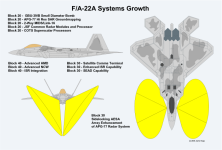
The side-looking cheek active electronically scanned arrays (AESA) for the F-22 Raptor were fully conceptualized during the initial design phase; however, they were ultimately descoped and omitted from the actual production airframes due to fiscal constraints

First we have to make sure Su-57 works as advertised. Atleast Rafale's issues (lack of ARM, etc) are out in the open. Felon is bound to have teething issues as a jet just entering scale production. Don't need another lemon like MiG-29K which is set to retire early.

I'm not a shill for US gear, either. Just saying we shouldn't get carried away by shiny brochures and propoganda.

45 MiG-29Ks (twin-seat variants included) — covering everything from R&D to production — plus the Vikramaditya, all for $2.2 billion.
26 Rafale Ms — $7.5 billion.
IAC-2 aircraft carrier — $5billion.
 
- Yes like i already said highlighted in blue color that Su-57 has many cool stuff which others don't. I also believe it's best gun-fighter. It has many AGMs for IWB.
This directly exposes yet another foundational operational paradox within fifth-generation fighter doctrine.
On one hand, the premise dictates that universal low-observability (stealth) design significantly compresses mutual detection ranges. On the other hand, it asserts that supercruise capabilities drastically reduce the temporal window required to close the vector into the battle space. When synthesized, the mathematically inevitable outcome of these two coexisting parameters is that peer-level engagements between opposing fifth-generation platforms will see a massive escalation in the probability of close-quarters dogfights and visual-range kinetic combat.
Or are we to assume that fifth-generation platforms are structurally immune to mutual peer-level conflict—that their operational paradigm is akin to early modern musketeers conducting colonial expeditions in Africa, operating under the assumption that every sortie is merely an asymmetric turkey shoot?
Evidently, this is a simulated fantasy scenario reliant on mutually contradictory unilateral projections. It simultaneously presupposes that one's own offensive spear is universally irresistible, while assuming that one's own defensive shield is completely impenetrable. Yet, within the rigorous framework of military operational analysis, when an irresistible spear encounters an impenetrable shield, the entire conceptual architecture collapses into a systemic paradox
No one dares to subject this to empirical scrutiny. Consequently, the singular, underlying explanation becomes distinctly clear: because the foundational tenets of these doctrines are systemically amplified by the hegemonic media apparatus of the primary Western patron, they remain structurally immune to critical skepticism
 
Ah yes somehow Mr Rajput lion is very sure about things that are not even confirmed yet let alone modification to said thing. I mean.........
It has been confirmed last year itself when Russian UAC team "officially" visited Nashik plant.
Lets just agree to disagree that the su57MKI if ever produced would be drastically ahead of the su57 base.
su75 fulfills the same requirements as the AMCA. doesnt make sense to buy any if India actually wants to do something about its industry.
Su-57 is required in 140-200 numbers till 2040 because that is where AMCA would be ready for an actual war.
 
It has been confirmed last year itself when Russian UAC team "officially" visited Nashik plant.

Su-57 is required in 140-200 numbers till 2040 because that is where AMCA would be ready for an actual war.

Not just that, India is lagging behind a lot, this machine is required to defend skies and as stop gap. Stuck with 4th gen engine development and just entering 5th gen avionics, when in China US and Russia, infact even in Europe the research has began on quantum models in aviation. Gen 6th will be complete autonomous capable with a lot of ML and AI and Gen 7th will be quantum fused with AI ( so quantum AI) .

If India needs to have research on such technologies, first it requires its skies to be safe from 5.5th gen technologies.

it was India who failed and walked away from the Su-57E program

It was a different project with some no stealth engine. India wanted this with a real stealth engine like Izdeliye 30 which can be compared with F119 of F22. India on other hand is also not very happy with GE414 on AMCA. Just like Chinese are not happy with their WS15 engines due to lack of stealth characteristics. Even thought Chinese did get the stealth engine technology from the Russians

Take the Rafales, for instance—what was even the point of buying those? If they had just stuck to upgrading the Su-30MKI, they would have saved themselves a mountain of trouble.

Rafales are good 4.5 gen fighters and is a subtitute of Mig 21, Mirage 2000 and Mig 29, Jaguar. One aircraft multiple roles. There is a reason why total 176 are being ordered. If LCA Mk2 is dealyed they may order more.

Su30 will also be upgraded along with that. Su 30MKI is the back bone and Su57 will be the next backbone. India has very well integrated Su30MKI with defence network and made it extremely lethal. India can't let go Su30 so easily for another 20 years.

Indian technology will take 2 decades to mature where India can produce a fighter aircraft like Rafale, and LCA Mk2 on it's own with indegenous or codeveloped engine. But this will be just to increase the quantity of SQN and for export.


At the end of the day, whether it's highly integrated warships like the Project 22350, next-generation tanks with radical architectures like the T-14, or formidable light tank destroyers like the 2S25—countries are eventually forced to swallow their pride and fall back on buying them. This applies to everyone, China included: they possess ambitions as high as the heavens, but a destiny as thin as paper.

Only handful of countries can have the luxury of discussing stealth technology rest will remain at 4 and 4.5 gen. For another 30 years at least. There'll be still market for 4th and 4.5 gen aircrafts because stealth is too costly top operate and the cost will rise only.


This exact Indian phenomenon is now being faithfully replicated in China. If you line up the Type 99, 99A, Type 15, and Type 100, all of their gimmicks combined cannot match a single T-64B upgraded with a new main gun and some modern electronics.
The entire evolutionary lineage of the Type 051B, 052C, 052D, and Type 055 destroyer combined still falls short of a Project 22350 frigate stretched by 10 meters to carry an extra 300 tons of fuel.

That is what Rafale does in IAF, it subsititutes all the upgrades required on jaguar, mig 21, mig 29, mirage2000. But the Mig 29s are still lethal since they are adjusted for Indian scenario with lethal upgradations. But soon they are coming close to retirement due to old air frame.


The J-20 and JH-XX combined are inferior to the Su-57.
And the entire progression of service rifles—from the Type 81 to the Type 03, the Type 95, and now the QBZ-191—all lumped together, cannot hold a candle to the AK-74M

J20 and JHXX are inferior because of the ideology behind Su57. It is a highly upgradable aircraft, keeping in mind the 6th gen technology. It will also be the the test bed of most of the 6th gen technology apart from fuselage.
doesnt make sense to buy any if India actually wants to do something about its industry.

So how is the 5th gen engine technology will be made in India? I totally fail to understand why there is iota of doubt that without engine technology even after 500 years Indian aviation is going no where.
 
  • Like
Reactions: Rajput Lion
Our Su-57/60MKI variant would be far better in-terms of stealth from all-aspects, especially rear than current Su-57S/E. Rest assured about that.
Bigger canopy, more reflecting surface, may be we wont gate al51. Yet still su57mki will be more stealthy.

I wonder Why people loves to say something which seems illogical to normal mind yet they dont explain their logic.
 
This isn't some uniquely Chinese path. Both American and Soviet jet aviation started out as copies of German designs — same goes for rocketry, right down to the V-2. The reason they eventually got the MiG-15 and the F-86, the Atlas and the R-7, was that they built up their own capabilities and invested heavily.

The reason China's copies are garbage is because China itself was weak. Of course a copy is garbage — but that garbage is irreplaceable. You've got to use what you've got. When the shooting starts, it's not going to be a case of three knock-offs somehow losing to two originals. This isn't like picking a wife — it doesn't have to be perfect, and there's no need for it to be.

The J-20, J-11, J-16 — they may be garbage, but they're still a damn sight better than the J-10.
Was the F-16A garbage? Ukraine keeps them tucked away in the rear, using them carefully, and they've survived a good long while.
The T-62 has been absolutely brilliant in Ukraine — light (something the M1A2 doesn't have), packing high-explosive shells (again, the M1A2 doesn't have that), and capable of lobbing shells out to 10 kilometers (the M1A2 doesn't do that either). Electronics a bit lacking? No problem — just correct with an FPV drone.

Is the WS-10 garbage? Absolute garbage. Two of them don't give enough thrust? Fine — stuff three of them into the JH-36. No one's going to pull a Cobra maneuver in that thing anyway. The common folk see it up there and cheer.

All industrial products — cars, motorcycles, phones, robot vacuums — technology is built on copying. We're all the same.


The Ukrainian liberation operations (the Dnieper crossing operation, the Cherkasy Pocket, Right-Bank Ukraine offensive) — casualties: 1.69 million (420,000 killed).
The Belarusian counter-offensive — casualties: 770,000 (180,000 killed).
East Prussia — casualties: 580,000 (130,000 killed).
The Battle of Berlin — casualties: 360,000 (80,000 killed).
From 1945 to 1955, the post-war suppression of bandits in Ukraine — 40,000 Soviet troops, police, and Party members sacrificed.
All of the above were sacrifices sustained under conditions of overwhelming and victorious momentum.

The Soviet military, and the current Russian military high command, clearly understand the intensity of war and the price of victory far better than the Western world does. By comparison, of course, the scale and impact of the current Russia-Ukraine war amount to little more than the intensity of playing house.

The political propaganda from the West, distorting the Russian General Staff's assessments of actual military force commitment, loss projections, and the war's duration — all to hype Russia up only to cut it down — is especially ludicrous. After all, from start to finish, there has been no announcement from the Russian side of a "quick victory," nor any declaration of an intention to "occupy Kyiv." It would seem as though fabricating a non-existent objective for Russia and then refuting it is somehow supposed to weaken Russia.
As for Russian aviation forces being severely restricted in Ukraine — I have seen no signs of this. Almost half the year has passed, and according to statistics compiled through Gemini:
On January 4th and 9th, one Su-30SM2 each suffered a single-engine malfunction and made emergency landings.
On January 12th, one Mi-8 crashed near the Arctic Circle.
On January 28th, one Su-34/30 was shot down by Ukraine.
On January 28th, one Su-34 crashed due to mechanical failure in Kursk.
On March 31st, one An-26 flew into a mountain.
On March 31st, one Su-34 was shot down.
On May 14th, one Mi-8 made an emergency landing in the Caucasus.
(I'm not sure how to count the incident from a couple of days ago, where a Ukrainian spy group attacked two decommissioned Tu-142 anti-submarine aircraft at a Russian aircraft repair plant — aircraft that originally belonged to Ukraine and were being used for spare parts stripping.)

Meanwhile, in 2025 alone, at least 14 Su-34s have been delivered, and Russia is simultaneously continuing to fulfill orders supplying aircraft, including the Su-57E, to other countries.
At Ukraine's pace, it would take several years to destroy just one year's worth of Russian aircraft production.
Take 2020 as an example: Russia produced 10 MiG-29Ms delivered to Egypt, 4 MiG-35s for its own use, 4 Su-30SMs for Belarus and 8 for Kazakhstan, and, additionally, equipped itself with 4 Su-34s and 10 Su-35S. It also manufactured 22 Su-35s destined for an Egyptian order (which were retained for domestic use and are now being prepared for transfer to Iran).
—And all of this was merely "peacetime production volume."


Like This
↓↓↓↓
View attachment 52066


The side-looking cheek active electronically scanned arrays (AESA) for the F-22 Raptor were fully conceptualized during the initial design phase; however, they were ultimately descoped and omitted from the actual production airframes due to fiscal constraints


45 MiG-29Ks (twin-seat variants included) — covering everything from R&D to production — plus the Vikramaditya, all for $2.2 billion.
26 Rafale Ms — $7.5 billion.
IAC-2 aircraft carrier — $5billion.

Add lifecycle/sustainment costs for a 40 yr old refurbished hull (with dated sensors and combat mgmt systems no less) and the picture won't look as lopsided. Unlike your Liaoning, Vikram spends most of her time in port, despite sharing the same/similar boiler based propulsion system.

I'd credit the Chinese for buying out the blueprints and locally refitting the Liaoning. Russia is no longer a carrier navy with the retirement of Kuznetsov. So we are now literally at Sevmash SY's mercy for spares and support.

In any case, the cost of refit for Vikram was $2.35bn + another $2.4bn for the airwing. Not cheap by any means.


IAC-2 would build on the tech base established for INS Vikrant. I'd say cost overruns for homegrown platforms, esp first time ones, are justified since most of the money stays within the country.
 
Last edited:
Add lifecycle/sustainment costs for a 40 yr old refurbished hull (with dated sensors and combat mgmt systems no less) and the picture won't look as lopsided. Unlike your Liaoning, Vikram spends most of her time in port, despite sharing the same/similar boiler based propulsion system.

I'd credit the Chinese for buying out the blueprints and locally refitting the Liaoning. Russia is no longer a carrier navy with the retirement of Kuznetsov. So we are now literally at Sevmash SY's mercy for spares and support.

In any case, the cost of refit for Vikram was $2.35bn + another $2.4bn for the airwing. Not cheap by any means.


IAC-2 would build on the tech base established for INS Vikrant. I'd say cost overruns for homegrown platforms, esp first time ones, are justified since most of the money stays within the country.
An aircraft carrier is nothing but a floating tin can, and all those sensors on board are just a convenient excuse. The carrier itself is an utterly obsolete piece of equipment—honestly, you're shelling out 5 billion just for 20 planes, and that's only the initial contract price. Who knows how much the final bill will actually run?

On the other hand, you take MiG fighters plus a carrier, throw in the modification costs and the follow-up secondary retrofits, and the total comes in under 2.5 billion. Now that's an incredible bargain—a deal so good you couldn't find another one if you searched with a lantern.

Furthermore, I consider the purchase of the LiaoNing to be a total waste of junk—something destined to sink on day one of a war. I honestly can't fathom what the point of such a thing is. The recent disastrous American failure in Iran is the perfect footnote to everything I've been saying.

No matter how hard the Chinese and Indian carriers try, compared to a Nimitz-class they are complete and utter garbage, through and through. A mission that three Nimitzes plus a Charles de Gaulle couldn't accomplish, China and India certainly have no chance of pulling off.

An aircraft carrier is simply a platform for enforcing dominion over fragile Third World colonies. In this day and age, it can't even defeat the Third World anymore.
 
Last edited:
An aircraft carrier is nothing but a floating tin can, and all those sensors on board are just a convenient excuse. The carrier itself is an utterly obsolete piece of equipment—honestly, you're shelling out 5 billion just for 20 planes, and that's only the initial contract price. Who knows how much the final bill will actually run?

On the other hand, you take MiG fighters plus a carrier, throw in the modification costs and the follow-up secondary retrofits, and the total comes in under 2.5 billion. Now that's an incredible bargain—a deal so good you couldn't find another one if you searched with a lantern.

Furthermore, I consider the purchase of the LiaoNing to be a total waste of junk—something destined to sink on day one of a war. I honestly can't fathom what the point of such a thing is. The recent disastrous American failure in Iran is the perfect footnote to everything I've been saying.

No matter how hard the Chinese and Indian carriers try, compared to a Nimitz-class they are complete and utter garbage, through and through. A mission that three Nimitzes plus a Charles de Gaulle couldn't accomplish, China and India certainly have no chance of pulling off.

An aircraft carrier is simply a platform for enforcing dominion over fragile Third World colonies. In this day and age, it can't even defeat the Third World anymore.

Screenshot_20260607-125730(1).png
↑↑
BTW,
The bureaucratic, compliance-driven AI software developed in China absurdly refused to execute my translation parameters, simply because my analytical evaluation charactered the Liaoning aircraft carrier as a strategically non-viable asset
Furthermore, the system went so far as to subject my inputs to adversarial counter-interrogation, accompanied by ideological censuring and patronizing, moralistic lecturing
 
Not just that, India is lagging behind a lot, this machine is required to defend skies and as stop gap. Stuck with 4th gen engine development and just entering 5th gen avionics, when in China US and Russia, infact even in Europe the research has began on quantum models in aviation. Gen 6th will be complete autonomous capable with a lot of ML and AI and Gen 7th will be quantum fused with AI ( so quantum AI) .

If India needs to have research on such technologies, first it requires its skies to be safe from 5.5th gen technologies.


It was a different project with some no stealth engine. India wanted this with a real stealth engine like Izdeliye 30 which can be compared with F119 of F22. India on other hand is also not very happy with GE414 on AMCA. Just like Chinese are not happy with their WS15 engines due to lack of stealth characteristics. Even thought Chinese did get the stealth engine technology from the Russians


Rafales are good 4.5 gen fighters and is a subtitute of Mig 21, Mirage 2000 and Mig 29, Jaguar. One aircraft multiple roles. There is a reason why total 176 are being ordered. If LCA Mk2 is dealyed they may order more.

Su30 will also be upgraded along with that. Su 30MKI is the back bone and Su57 will be the next backbone. India has very well integrated Su30MKI with defence network and made it extremely lethal. India can't let go Su30 so easily for another 20 years.

Indian technology will take 2 decades to mature where India can produce a fighter aircraft like Rafale, and LCA Mk2 on it's own with indegenous or codeveloped engine. But this will be just to increase the quantity of SQN and for export.


Only handful of countries can have the luxury of discussing stealth technology rest will remain at 4 and 4.5 gen. For another 30 years at least. There'll be still market for 4th and 4.5 gen aircrafts because stealth is too costly top operate and the cost will rise only.


That is what Rafale does in IAF, it subsititutes all the upgrades required on jaguar, mig 21, mig 29, mirage2000. But the Mig 29s are still lethal since they are adjusted for Indian scenario with lethal upgradations. But soon they are coming close to retirement due to old air frame.


J20 and JHXX are inferior because of the ideology behind Su57. It is a highly upgradable aircraft, keeping in mind the 6th gen technology. It will also be the the test bed of most of the 6th gen technology apart from fuselage.


So how is the 5th gen engine technology will be made in India? I totally fail to understand why there is iota of doubt that without engine technology even after 500 years Indian aviation is going no where.
The Chinese development model possesses inherent structural limitations, yet it also shares certain commonalities with the Indian context.

The primary limitation resides in China’s nature as a unified party-state apparatus. To illustrate this through its most fundamental governance mechanism, the official title of the current paramount leader is structured as 'General Secretary of the Communist Party of China (CPC) Central Committee, President of the State, and Chairman of the Central Military Commission (CMC).' Historically, these three distinct constitutional roles were not always consolidated within a single individual.

These roles represent three distinct pillars of authority. The first two—General Secretary (the head of the ruling party) and State President (the Head of State)—are easily understood within comparative politics, functioning roughly analogously to the Congress Party leader and the President of India, respectively. However, the third identity, 'Chairman of the Central Military Commission,' requires closer structural analysis. This role extends far beyond that of a nominal 'Commander-in-Chief'; it exercises absolute, centralized control over the promotion, vetting, and appointment of all military flag officers.

Furthermore, China’s defense industrial enterprises operate parallel to the civilian state government, reporting directly to the Central Military Commission—and, by extension, to the Chairman of the CMC personally. These state-owned entities are characterized by a highly pronounced non-profit orientation, with organizational frameworks and cadre structures that mirror the regular armed forces, defined by rigid, top-down vertical integration. Unlike the institutional landscape in India, private enterprises are entirely non-existent within this ecosystem, save for a few isolated suppliers of low-tier subsystems or peripheral small arms components.

From a market perspective, such a highly centralized command structure inherently produces lower allocative efficiency and demands immense fiscal expenditure. Crucially, the true economic cost of this apparatus defies conventional measurement via modern economic methodologies, and its internal financial data is entirely withheld from public disclosure.

The second point is what China and India have in common.

I know very little about India's current political system and its actual circumstances, so I'll only comment on the surface-level phenomena I can observe.

It's that both the Chinese and Indian military-industrial establishments absolutely love launching new projects — churning out stacks of PowerPoint slides, painting magnificent blueprints, especially the kind of stuff the Americans are into. Both countries are wildly enthusiastic about this.

Take China, for example — chasing after the Americans with electromagnetic railguns (so dumb), electromagnetic catapult aircraft carriers (really dumb), the division-to-brigade reform (stupid beyond belief), mid-course missile defense (what the hell is that even supposed to mean), and all those bizarrely shaped stealth aircraft (I'm in tears). And now they're messing around with "reusable rockets" — no idea what's going through their heads. It's painfully obvious from the start that none of these things were ever going to work out. Then a few years down the line, they either vanish without a trace or turn into zombies. And then it's on to the next PowerPoint. Who knows how many people got rich along the way?

India, on the other hand, clearly stood by completely unmoved during the great Soviet blueprint fire sale of the 1990s. I have no idea what sort of decision-making led to that — it was a once-in-a-lifetime opportunity. The Chinese, however, seized it with both hands.

Speaking of the Su-57E project, I think it's a good deal. But as I see it, securing the license and local production of the AL-31F is even more critical and practical. First of all, as I've argued on this forum before, I don't think any fifth-generation fighter is worth a damn. As the Russia-Ukraine war and the Iran conflict continue to yield real-world lessons, more and more people will come to recognize the core flaws of fifth-generation aircraft. The whole fifth-generation concept will soon be a thing of the past.

A high-thrust aero-engine is the wing beneath an air force's wings. Whether it's the Su-57E or whatever Su-570E, those belong to Russia. The 177S — I don't think they'd ever sell you that(Unless a quarter-century maturation cycle is fully elapsed), and the 117S is the same story. But the AL-31F, I think, is a different matter — and the AL-31F is no slouch. Look across the entire world — apart from Russia and the United States, there isn't a single third party that possesses an engine of this caliber. (The WS-10x is a piece of garbage, and what I find baffling is why no one on these foreign forums ever discusses it. It's very strange. Have you all been brainwashed by watching too many Douyin short videos, or does the U.S. government need a target to hype up, so it's deliberately "killing with praise" when it comes to Chinese equipment? For a veteran of Chinese military forums like myself, these reactions feel utterly surreal — as if I've stepped into some alternate dimension.)

Coming back to the point — with that piece of garbage, the WS-10, China has managed to crank out so many stretched and tarted-up airframes and get them airborne. It's like having barely figured out a three-cylinder 1.0T engine, then running a back-alley chop shop to shoehorn it into something resembling a Lamborghini and calling it a supercar. Setting aside the question of combat capability for a moment, at least the fleet and air force size are no longer hostage to others, and it's massively inflated national confidence (however overstated that confidence may be).

If the AL-31F could be fully localized, that would be a genuine leap forward. Fighters, bombers, warships, gas-fired power stations — all of it could be solved in one go.

Actually, I have a very strange question here — why doesn't India develop its own airliner? It sits right at the center of the Indian Ocean, with a desperate need for aviation capacity. Importing the PS-90 production line would be entirely feasible, wouldn't it? The PS-90 isn't exactly inferior to the CFM56 — it's better if anything. The Chinese used the CFM56 as the basis for the WS-10, but if you couldn't buy the AL-31F production line, couldn't you just bring in the PS-90 line instead? Take its core, adapt it to a smaller bypass ratio, and fit it into a fighter — perfectly viable. In fact, this approach might be even more feasible than directly introducing the AL-31F, because it could actually make money.

Anyway, I'm not optimistic about the F414. Not because I'm Chinese, but because the F414 is an American product. And besides, its thrust is too low.

In civil aviation, China has been screwed over by the Americans more times than I can count. Back in the day, they built the Y-10, which was on par with the Boeing 707 — then the crony-capitalist regime came to power, tore it apart, and disbanded the entire enterprise. In the 90s, they bought the McDonnell Douglas DC-82 production line, and then McDonnell Douglas went belly-up. The new owner, Boeing, refused to let China keep producing the DC-82, so another decade went down the drain. Then they finally seemed to get their heads straight and started the C919 project — only to pick American GE engines, got choked by Trump in a heartbeat, and now it's a laughingstock. Then they went to work with the Russians on the CR-929, gave them terms like "Rolls-Royce engines only," which completely floored the Russians. Eventually, Russia managed to negotiate compatibility with the PD-35, but then COMAC, high on its own arrogance, went and proposed "China gets 100% of the profit from domestic sales, Russia gets 100% from overseas sales" — that drove the Russians berserk. Combined with the fear of secondary U.S. sanctions, the whole project went down the drain.

When all is said and done, if India wants to develop, aside from relying on the Russians, there isn't a single reliable partner out there. Anything that so much as brushes against the Americans is bound to fall apart.