Future Combat Vehicle Programs (FRCV and FICV)

What is the technical challenge with creating a 125mm APFSDS single piece round? I was thinking a larger bore means more charges & a longer round. Length of the penetrator has a direct effect on DoP. I know we have to look at autoloader compatibility too.

A two-piece ammo can use a safer carousel loader whereas a single-piece ammo needs a bustle loader. The bustle loader makes the tank longer, and in turn bigger, taller, and heavier. This goes against the Russian doctrine of being small, light, and fast.

So it's primarily doctrinal.

Russia continues to make two-piece even for newer tanks 'cause the industry has now settled on it. Now they make long rod penetrators two-piece too, for the T-14.

Europeans seem to be moving toward higher caliber tank guns. If the FICV is supposed to replace the T90s, we would be replacing a 125mm main gun with 120mm. Seems like a step in the wrong direction.

Too expensive. Lower fire rate and more heat. Logistics issues too, both the gun and ammo are heavy. The better option is to use electrothermal-chemical guns. A 120 mm ETC can give us the same muzzle velocity as a 135/140 mm conventional gun.

Start slow like the XM360 and build up to it eventually.

Why not? The SAMHO will be cheaper than the Nag Mk2. SAL seeker vs. IIR seeker. We could reserve the Mk2 for enemy tanks & AFVs/IFVs & the SAMHO for JLTV/Humvee type vehicles or fixed forward positions. After all the Army still uses Kornets/Konkurs at Pak LoC bunkers despite having better ATGMs.

SAMHO was developed 'cause Nag was too big to be fired by guns. 150 mm. It will be used on T-90s too.

It will get an IIR upgrade too. But SAL will also be used, it's more reliable and you can use it via drones.
 
Let's break it down.

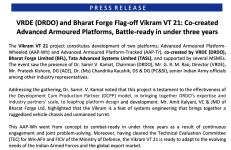
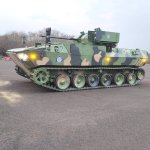
WhAP is not Tata's design, it's DRDO's. It was developed for non-army requirements and its derivative is meant for the army. The derivative, a second WhAP was designed with Mahindra.

First gen WhAP is for police forces, the second gen falls significantly short of army requirements compared to FICV/WhICV. So it will be superceded by Vikram for the main tender. DRDO calls Vikram their third generation design after the first 2 WhAPs.

When it comes to WhAFV(R&S), the competitors are Tata and Mahindra WhAPs alongside AVNL's new design for WhICV, perhaps more at a later date. This is meant to replace BRDM for RS roles. So the IA is not looking for commonality with FICV/WhICV here, even if desired.

Stryker was competing for the WhICV tender before it was kicked out for non-performance. IA claims WhAP is not sufficient too.

I don't see WhAP capable of beating Vikram either, since the prime designer claims Vikram is a whole lot better.

If WhAP doesn't work out, it's likely we will start seeing commonality between WhAFV(R&S) and WhICV tenders. But two different designs could win. Maybe DRDO wins RS using Vikram and a private company could win WhICV and a third company can win FICV, which implies there could be no commonality. The only way out is IA deliberately forces commonality between WhAFV(R&S) and WhICV. Best case, a company comes out with a superlative design and wins all three.

For those who do not know what's happening, IA needs 50 battalions. 30 tracked, 10 wheeled, and 10 R&S. Earlier it was 40 tracked and 10 R&S. 30 tracked are FICV, 10 wheeled are WhICV, and 10 R&S is a mix of wheeled and tracked. Overall, a battalion has 53-59 vehicles. Essentially, 39 combat units and the remaining are reserves, 6 minimum attached to the squadrons, up to 14 more attached to the regiment.

The R&S uses a mix of BRDM-2, BMP-2, and NAMIS. BMP-2 will be replaced by FICV over a long period of time and NAMIS stays as is until phase out after 40 years.
I see...Screenshot_2025-01-30-16-26-39-41_40deb401b9ffe8e1df2f1cc5ba480b12.jpg
 
Last edited:
Had to look that up. 60+ ton IFV with a 1200hp engine & helical coil spring suspension. An IFV with a power to weight ratio worse than Arjun Mk2, without the firepower to match. The Israelis are wilding. This is less of an IFV, more of a mobile bunker. This is probably used in urban/semi-urban settings against insurgents.
Firepower can be increased by simple changing the turret, it's hardly a problem. Heavy IFV like Namer can work great at open terrain of desert & it can take repeated hits from suicide drones & still manage to keep going. The fetish of light IFV just so that it can cross rivers on west ignoring everything else will be Indian ground forces undoing if one look at what happened to Russian lightly armoured tin cans during Ukrain invasion.
 
  • Like
Reactions: _Anonymous_
Heavy IFV like Namer can work great at open terrain of desert & it can take repeated hits from suicide drones & still manage to keep going.
Sure, let's say it can survive repeated hits from loitering munitions & suicide drones. Can it survive an ATGM? Probably not. Most modern ATGMs have ~600-900 mm DoP. In an open desert environment ATGM crews will have an easier time targeting this vehicle. To have proper survivability this Namer needs a more powerful engine, better suspension, higher caliber weapons, APS, ERA/NERA armour, laser countermeasures, more smoke rounds etc. You need a tank basically.

Just get a tank. Let AFVs/IFVs be lighter.
 
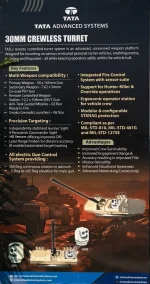
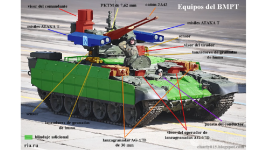
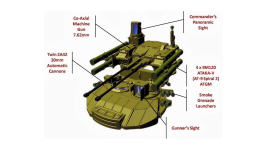
30mm turret reminded me of this:


Not very practical. Reason for its creation was that (as usual) russian incompetence. They werent able to retofit a dual feed system, so they decided it was easier to have diff guns for diff ammos. But looks & sounds nice.
Screenshot (690).pngScreenshot (691).pngScreenshot (692).png

 
Perhaps one of the top-tier APS out there. Impressive to see how far things have come along. It can engage incoming UAS and FPV drones effectively. Elbit has done a pretty good job with this one.


Systems similar to this will be needed for IFVs and MBTs as the battlefield evolves. I hope that the establishment here is looking into providing better EW and APS protection for their vehicles.
 
Sure, let's say it can survive repeated hits from loitering munitions & suicide drones. Can it survive an ATGM? Probably not. Most modern ATGMs have ~600-900 mm DoP. In an open desert environment ATGM crews will have an easier time targeting this vehicle. To have proper survivability this Namer needs a more powerful engine, better suspension, higher caliber weapons, APS, ERA/NERA armour, laser countermeasures, more smoke rounds etc. You need a tank basically.

Just get a tank. Let AFVs/IFVs be lighter.

If your ATGM can penetrate 900 mm of RHA, then it means you will have to hit the tank at the same spot multiple times for penetration 'cause modern tanks typically have upwards of 1500 mm of CE protection.

The Chinese Type 99 for example has just 700 mm of protection against APFSDS, but 1300 mm against HEAT.

ERA adds a single layer of protection, it counts on ATGMs being inaccurate enough to end up hitting other bricks instead of layering missiles at one point. NERA adds multiple layers of protection against HEAT at the same spot. ERA+NERA is also a good combination.

The point of ATGMs is to destroy optics or penetrate through weaker parts of the tanks via flanking or top attack modes. It's not meant to penetrate frontal armor, sometimes even sides.

Namer has limited to no weak points against any modern ATGMs from the front, sides, or top. Only the rear is weak due to the crew door. But it has Trophy to compensate. Using open source to date there have been no ATGM penetrations. Only 1 limited penetration led to secondary explosions inside the tank that killed a crew. It's unclear if there are unknown cases where the armor was breached.

You need a combination of both light and heavy IFVs. Heavy IFVs are necessary for armored brigades, otherwise the light IFV becomes the weak link in the unit 'cause it can't accompany tanks for more risky maneuvers. India may not have a requirement though.
 
  • Like
Reactions: PhotonVish

He's talking about APFSDS penetration. The Mango and Mango 2 rounds on T-90 provide up to 550 mm DoP. Western shells go up to 800 mm using tungsten. The latest American and Russian shells now exceed 1000 m using DU.

Arjun's shells used to do 370 mm and have now been upgraded to 600-650 mm.

Russian T-90s with a new autoloader design can manage new longer rod Lekalo shells with DoP of 650 mm and Svinets can do up to 750 mm.

So the goal of FRCV is to achieve Western standards using tungsten.
 
H
He's talking about APFSDS penetration. The Mango and Mango 2 rounds on T-90 provide up to 550 mm DoP. Western shells go up to 800 mm using tungsten. The latest American and Russian shells now exceed 1000 m using DU.

Arjun's shells used to do 370 mm and have now been upgraded to 600-650 mm.

Russian T-90s with a new autoloader design can manage new longer rod Lekalo shells with DoP of 650 mm and Svinets can do up to 750 mm.

So the goal of FRCV is to achieve Western standards using tuntungsten
How will FRCV achieve over 1000mm using tungsten ? Longer rod ?