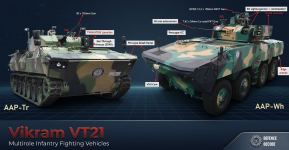
View attachment 51299
I've added some extra additions on VT-21 VIKRAM TRACKED Varient using AI as per my own suggestion.
There won't be 4x ATGM launchers for an IFV, only reconnaissance vehicles have those.
View attachment 51299
I've added some extra additions on VT-21 VIKRAM TRACKED Varient using AI as per my own suggestion.
What's the reason for that ? This IFV is not much heavy ( around 25 ton only ) , adding 2 more ATGM launchers will not affect it's mobility at all. Additionally it'll get more fire power to stand in a contested battlefield having enemy tanks . With ready-to-fire 4 Nag MK2 missiles of 7 to 8 km range ( + 8 to 10 stored) it'll have an upper hand on enemy tanks. It provides STANAG LEVEL 5 PROTECTION, which can be further increased to STANAG LEVEL 6. And with indigenous APS it'll be more protected.There won't be 4x ATGM launchers for an IFV, only reconnaissance vehicles have those.
There won't be 4x ATGM launchers for an IFV, only reconnaissance vehicles have those.
What's the reason for that ? This IFV is not much heavy ( around 25 ton only ) , adding 2 more ATGM launchers will not affect it's mobility at all. Additionally it'll get more fire power to stand in a contested battlefield having enemy tanks . With ready-to-fire 4 Nag MK2 missiles of 7 to 8 km range ( + 8 to 10 stored) it'll have an upper hand on enemy tanks. It provides STANAG LEVEL 5 PROTECTION, which can be further increased to STANAG LEVEL 6. And with indigenous APS it'll be more protected.
Yes, as I posted sometime ago. BFL ones is this (which I had posted last year).I might be wrong but ain't this the same turret by ADSL ?
View attachment 51296
If it turns out to be true then there are possibly two different turrets .
Lame excuse and self-deniel of capabilities. Even if it is for destroying bunkers, as per your statement, 4× ATGM launchers provide more strength over 2× ATGM launchers. If 2 added launchers are not hampering mobility but enhancing capability then it's better to include them than rejecting.Because its an IFV and they are meant to be transporting troops as close to the enemy as possible. ATGMs mounted on them during such missions will mostly armed with thermobaric warheads to destroy bunkers.
For Recon vehicles performing counter reconnaissance missions or providing overwatch during offensive operations 4x ATGMs make sense.

No idea. X-band has some advantages over Ku-band. Better weather penetration, resolution & range.It's fairly larger than any of it's counterparts bcoz of X band spectrum (centred around 11ghz probably) . IDK why we didn't we go with the KU band similar to Trophy , strikeshield or Afghanit ?
Some docs say 125 some say 120. Don't know what do believe. DRDO has been trying to improve armour penetration depth with APFSDS rounds. 125 would be better.I could guarantee you that Ranjeet would have a 120 mm smoothbore for sure . They want main gun launched nag mk2 for a reason. & also it doesn't make sense for a jacket on those smaller bore weapons .

UnderstoodNah...APS is still some time away. Also, the radar panels are fairly large. Probably designed for Arjun Mk1A, we will have scaled down versions later:
View attachment 51297
The work on development of the new turret (uncrewed with a 125mm smoothbore & autoloader) for the Ranjeet tank seems to have slowed down the APS project.
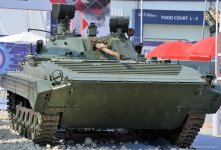
Probably two version of the same design. They will run through a few iterations during testing period; this is very normal. I am very interested to know more about the 30mm auto-cannon. Is it a new design? Or is it the same old Shipunov 2A42 cannon. BF was making 30mm primarily for naval use.
Understood
Also, what do we know about Ranjeet, especially the gun and autoloader?
Was autoloader is duel, carousal and bustle type?
I assume that the entire crew would sit in the capsule up front like T14
Arjun Mk1A is a 68-ton tank carrying 42 rounds, 120 mm rifled gun, no autoloader, 4-man crew & a power to weight ratio of 20.5 hp/ton. NGMBT will be a 45-55 ton tank carrying 40 rounds, 120 mm smoothbore gun on a crewless turret, bustle mounted auto-loader, 3-man crew, with a power to weight ratio of 27+ hp/ton (assuming 55-ton weight).
Can we expect to see the prototype before 2028?

Nobody calls it Ranjeet except that one instance by some Army guy and he meant it for the FRCV tender.Also, what do we know about Ranjeet, especially the gun and autoloader?
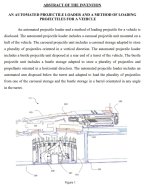
CVRDE had this patent, can't say if it will come like this. Idk about Zorawar or Arjun UGCV autoloader, but those should also exist.Was autoloader is duel, carousal and bustle type?
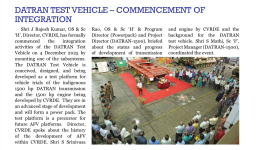
We have an automotive test rig at the moment:Can we expect to see the prototype before 2028?

What is the technical challenge with creating a 125mm APFSDS single piece round? I was thinking a larger bore means more charges & a longer round. Length of the penetrator has a direct effect on DoP. I know we have to look at autoloader compatibility too.The existing 125 mm ammunitions are a 2 piece type . Soviets loved the 2 piece arrangement since it means a smaller autoloader which means a smaller footprint . The autoloader patent by DRDO "An Automated Projectile Loader And A Method Of Loading Projectiles For A Vehicle " is designed to handle one piece ammunition (similar to NATO 120 mm) . A single piece 125mm doesn't exist . Not even for T14 armata .
Why not? The SAMHO will be cheaper than the Nag Mk2. SAL seeker vs. IIR seeker. We could reserve the Mk2 for enemy tanks & AFVs/IFVs & the SAMHO for JLTV/Humvee type vehicles or fixed forward positions. After all the Army still uses Kornets/Konkurs at Pak LoC bunkers despite having better ATGMs.Also CLGM Samho has orignally been built for Arjun's 120 mm . Samho is ultimately never gonna see combat since a much advanced nag mk2 exists . You definitely don't want a semi active laser guided atgm for your futuristic tank .

Not technical but logistics challenge. You definitely don't want to use a ammunition which is only exclusive to you .What is the technical challenge with creating a 125mm APFSDS single piece round?
Nope , a longer round can be achieved by keeping the bore dia constant . Rheinmetall DM13 and DM53 all have a 120 mm propellant casing yet they differ massively in length .I was thinking a larger bore means more charges & a longer round
Both EMBT and KF51 panther are preety much still a far fetched dream whose success only depends upon allied nations acceptance of a larger caliber. Else logistics would be a nightmare. Both Challenger 3 and Abrams X are currently going with 120 mm . Also kf51 does comes with a Rh-120 main gun too .Europeans seem to be moving toward higher caliber tank guns.
Yeah, I got that. The problem with this approach is that we will always depend on somebody else setting the standard.Not technical but logistics challenge. You definitely don't want to use a ammunition which is only exclusive to you .

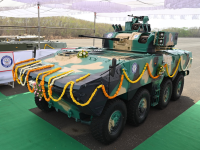
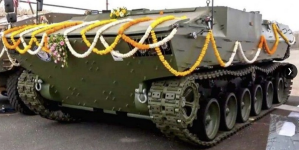
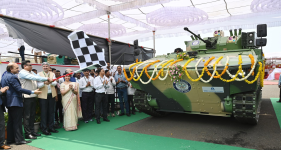
I forgot what this was supposed to be. A BMP replacement candidate? Or amphibious assault vehicle like the AAV. The tracked version looks awesome. Now after Zorawar's hull we have another candidate hull for a SPGMDs, if we ever feel like making one.
I think wheeled ones should go to the WhAFV(R&S) tender.These are DRDO's designs for tracked and wheeled FICV contenders.