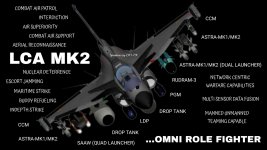
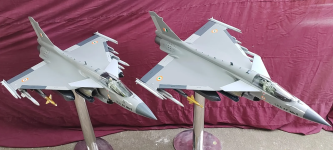
LCA AF Mk2 (Medium Weight Fighter) - News and discussions

I wish more people would understand the sheer importance of the Tejas Mk2 as a platform, and the importance of the capability it brings to the table - especially if we manage to get the F414 deal done and start making that engine locally, which would then clear the way for ~200+ Mk2 eventually.

Can't help but be pessimistic about the timelines given the track record we're working with...at the same time, can't help but be hopeful that it'll fly sometime this year.

Fp5z0ciX0AEP4zi.jpg

tejas mk2 maws dorsal.png

Whenever it does fly, I'll literally be the happiest man in the world. Though the high will dissipate soon cuz I know the real key lies in producing it in large numbers.
 
I wish more people would understand the sheer importance of the Tejas Mk2 as a platform, and the importance of the capability it brings to the table - especially if we manage to get the F414 deal done and start making that engine locally, which would then clear the way for ~200+ Mk2 eventually.

Can't help but be pessimistic about the timelines given the track record we're working with...at the same time, can't help but be hopeful that it'll fly sometime this year.

View attachment 51163

View attachment 51165

Whenever it does fly, I'll literally be the happiest man in the world. Though the high will dissipate soon cuz I know the real key lies in producing it in large numbers.
if the GoI is serious about tejas mk2 production then they need to set up a parallel production line for the mk2, preferably with the winner of the AMCA prototype contract so that they have experience for AMCA mass production later on. HAL will be busy with the mk1a and su30 upgrades or the future and will not have nearly enough capacity for the mk2 as well.
 
We are holding tight for so long. Nothing ever materialises.
Everything will materialise in due time. Defense procurement/production is all about patience(which runs very thin as you already know).
MK2 won't match Rafale and IAF chief confirmed this.
MK2 would match Rafale in EW, Radar and RCS. Plus being completely our own, it will connect and command with IACCS/AFNET and CCAs far better than any imported fighter. So, for us, it will be better than Rafale in many aspects and match in it many aspects like having 2 hour long CAP endurance on internal fuel(Rafale is around 2 hour and 18min on internal fuel). Only area it can't match Rafale is brute performance where Rafale thanks to being twin-engined jet would accelerate, climb and sustain a turn much better than LCA MK2.
We give 30-40 billion USD to Rafale. But cannot fund two parallel 7 billion engine projects. One with RR and Other with Safran.

Hoping this reverse jinx works.:(
And how do you know that we are not doing that? We would need to invest in a 6th gen VCE engine if not with SAFRAN then with RR.
 
  • Like
Reactions: Aniruddha
It won't match rafale in physical aspects like payload.
In terms of advancement of tech it will be ahead of F4, designed for MUMT from development phase itself

It can match the Rafale in combat payload, but not in range. Meaning, LCA Mk2 will be able to carry everything the Rafale can except for 2 additional drop tanks, and maybe 2 less missiles, although it's not that important to the IAF.

As for Rafale F4's MUMT, the IAF versions will come with it. LCA Mk2 will come with MUMT natively, while Rafale's needs to be an add-on capability. LCA Mk2 uses a new mission computer that acts as a neural hub to connect the aircraft to the drone, so the MDPU must be modified for the same purpose.

The LCA's AC or auxiliary mission computer performs all the necessary sensor fusion and AI control for the aircraft and the drones. It's a bit of a unique system 'cause the LCA also has a separate MC called MMDC mostly involved with helping the pilot rather than the sensors. The AC uses high speed buses to manage the high speed data rates meant for drones.

The AC also acts as a backup for the DFCC. So it not only performs sensor fusion and provides AI control, but it also has full access to real-time information from the FCS. And the LCA's AC provides all the FBW+sensor data necessary for drone control via high speed buses. If the DFCC is damaged during combat, the AC can take over all its functions.

But MDPU is a far more mature system and should easily be able to handle all the necessary modifications even if the French themselves do not plan on going for it.
 
if the GoI is serious about tejas mk2 production then they need to set up a parallel production line for the mk2, preferably with the winner of the AMCA prototype contract so that they have experience for AMCA mass production later on. HAL will be busy with the mk1a and su30 upgrades or the future and will not have nearly enough capacity for the mk2 as well.

Mk1A and Mk2 productions are in tandem. The Mk1A lines will be repurposed for Mk2.

I think the planned private line for Mk2 has been junked.

It's better for the private sector to create their own production process for AMCA rather than relying on HAL's LCA process.
 
  • Like
Reactions: Aniruddha
We give 30-40 billion USD to Rafale. But cannot fund two parallel 7 billion engine projects. One with RR and Other with Safran.

That doesn't make sense. What will you do with the other engine?

Different case if we needed a different class of engine, like MKI. It's better to dump that much money on a 6th gen JV instead.
 
It can match the Rafale in combat payload, but not in range. Meaning, LCA Mk2 will be able to carry everything the Rafale can except for 2 additional drop tanks, and maybe 2 less missiles, although it's not that important to the IAF.
😮‍💨 people can't control the urge to get into details.


I'm assuming similar combat range when i mention payload or more specifically combat payload

If i Have to be more clear, tejas mk2 will not match rafale's payload-range ratio.

Also on paper numbers, tejasmk2's absolute payload capacity is lower than rafale.

Physical aspects + kinematics, mk2 will not be equal to rafale.
 
Last edited:
Mk1A and Mk2 productions are in tandem. The Mk1A lines will be repurposed for Mk2.

I think the planned private line for Mk2 has been junked.

It's better for the private sector to create their own production process for AMCA rather than relying on HAL's LCA process.
we have 180 mk2 on order. If they want to start mk2 by 2029 then they need need a seperate line or they need to repurpose a HAL line into mk2 which means mk1a will take even longer to finish.
assuming we have 20 mk1a ready right now(engines not counted), thats 160 left at 24 per year which is approx 7 years of production. 2033 is when mk1a production finishes. Unless you want mk2 to only start major production in 2033 or you want to keep inducting mk1as into the late 2030s then we need a 2nd line for the mk2.
 
  • Like
Reactions: batman
😮‍💨 people can't control the urge to get into details.


I'm assuming similar combat range when i mention payload or more specifically combat payload

If i Have to be more clear, tejas mk2 will not match rafale's payload-range ratio.

Also on paper numbers, tejasmk2's absolute payload capacity is lower than rafale.

Physical aspects + kinematics, mk2 will not be equal to rafale.
What about the 6th Gen VCE being developed ? How did you miss that ?

Till date all across the net this is the only handle which has been repeatedly claiming we're developing both the 5th & 6th Gen TF with SAFRAN (?) .
 
😮‍💨 people can't control the urge to get into details.


I'm assuming similar combat range when i mention payload or more specifically combat payload

If i Have to be more clear, tejas mk2 will not match rafale's payload-range ratio.

Also on paper numbers, tejasmk2's absolute payload capacity is lower than rafale.

Physical aspects + kinematics, mk2 will not be equal to rafale.

There was a need to be specific because of Tamilian's assertion.

There's not much difference between the two jets from an operational perspective if you don't consider red line limits but consider operational limits.

And some limitations are made up by other advantages. For example, Rafale has higher range, but LCA compensates with a higher turnaround time. Rafale has greater kinematics, but LCA has a faster scramble time.

So Rafale and LCA carry essentially the same payload, but Rafale can fly farther while LCA can reload and takeoff faster. So one gives you strategic reach, the other gives you tactical mass.
 
That doesn't make sense. What will you do with the other engine?

Different case if we needed a different class of engine, like MKI. It's better to dump that much money on a 6th gen JV instead.

RR is going to be technologically superior and more scalable than the Safran engine.

Also if one program fails due to geopolitics, other one becomes a fail safe.
 
we have 180 mk2 on order. If they want to start mk2 by 2029 then they need need a seperate line or they need to repurpose a HAL line into mk2 which means mk1a will take even longer to finish.

Mk2 metal cutting will begin in 2029, but assembly will only begin by 2030-31. So that's enough time to repurpose the Nashik line to Mk2. And initial number for 2029 is just 3 jets. There's an additional hangar in Bangalore that has enough space for 3 jets where Mk1As are being made, so this is where it could begin too. Overall Mk1A production capacity is 8x3 + 3. People tend to skip out on mentioning this line, which was actually the very first line.

IAF's contractual demand is 16 jets a year. HAL wants to finish it ASAP. So HAL has time to deliver all jets by 2035, but they want it done by 2032.

The Nashik line will get an additional Mk2 line while the remaining lines gets repurposed to Mk2 alongside it as and when the Mk1As finish delivery. So if the Surya Kiran hangars remain untouched, the second Nashik line will take over for the first 3.

HAL is still undecided on whether they build a new line or repurpose the old line. It depends on a large Mk2 order, 100+, or a piecemeal order, 40+. Then they will repurpose one line and take their time to deliver Mk1A, 'cause they have time until 2035.

assuming we have 20 mk1a ready right now(engines not counted), thats 160 left at 24 per year which is approx 7 years of production. 2033 is when mk1a production finishes. Unless you want mk2 to only start major production in 2033 or you want to keep inducting mk1as into the late 2030s then we need a 2nd line for the mk2.

160/27 = 6 years.

Anyway, we do not know which month the 2029 production will begin, Jan or Dec.

Can't we assume they have planned this already instead of having to rely on a new private line? HAL will obviously not give it up in any case.

And I don't know why we are expecting ADA to keep to their schedule.
 
  • Like
Reactions: YoungWolf
ma
Mk2 metal cutting will begin in 2029, but assembly will only begin by 2030-31. So that's enough time to repurpose the Nashik line to Mk2. And initial number for 2029 is just 3 jets. There's an additional hangar in Bangalore that has enough space for 3 jets where Mk1As are being made, so this is where it could begin too. Overall Mk1A production capacity is 8x3 + 3. People tend to skip out on mentioning this line, which was actually the very first line.

IAF's contractual demand is 16 jets a year. HAL wants to finish it ASAP. So HAL has time to deliver all jets by 2035, but they want it done by 2032.

The Nashik line will get an additional Mk2 line while the remaining lines gets repurposed to Mk2 alongside it as and when the Mk1As finish delivery. So if the Surya Kiran hangars remain untouched, the second Nashik line will take over for the first 3.

HAL is still undecided on whether they build a new line or repurpose the old line. It depends on a large Mk2 order, 100+, or a piecemeal order, 40+. Then they will repurpose one line and take their time to deliver Mk1A, 'cause they have time until 2035.


160/27 = 6 years.

Anyway, we do not know which month the 2029 production will begin, Jan or Dec.

Can't we assume they have planned this already instead of having to rely on a new private line? HAL will obviously not give it up in any case.

And I don't know why we are expecting ADA to keep to their schedule.
mate we are bottlenecked by engine production for the tejasmk1a, idk if GE can go beyond 24 per year.
As for the mk2 the IAF has alr said 120 jets at the start expanding to 200 as deliveries start) so HAL is incentivised to build another line as is a private sector partner.
 
Mk2 metal cutting will begin in 2029, but assembly will only begin by 2030-31. So that's enough time to repurpose the Nashik line to Mk2. And initial number for 2029 is just 3 jets. There's an additional hangar in Bangalore that has enough space for 3 jets where Mk1As are being made, so this is where it could begin too. Overall Mk1A production capacity is 8x3 + 3. People tend to skip out on mentioning this line, which was actually the very first line.

IAF's contractual demand is 16 jets a year. HAL wants to finish it ASAP. So HAL has time to deliver all jets by 2035, but they want it done by 2032.

The Nashik line will get an additional Mk2 line while the remaining lines gets repurposed to Mk2 alongside it as and when the Mk1As finish delivery. So if the Surya Kiran hangars remain untouched, the second Nashik line will take over for the first 3.

HAL is still undecided on whether they build a new line or repurpose the old line. It depends on a large Mk2 order, 100+, or a piecemeal order, 40+. Then they will repurpose one line and take their time to deliver Mk1A, 'cause they have time until 2035.


160/27 = 6 years.

Anyway, we do not know which month the 2029 production will begin, Jan or Dec.

Can't we assume they have planned this already instead of having to rely on a new private line? HAL will obviously not give it up in any case.

And I don't know why we are expecting ADA to keep to their schedule.

ma

mate we are bottlenecked by engine production for the tejasmk1a, idk if GE can go beyond 24 per year.
As for the mk2 the IAF has alr said 120 jets at the start expanding to 200 as deliveries start) so HAL is incentivised to build another line as is a private sector partner.

Nashik line also depends on Su57. If we go ahead and pull tge trigger on that, personally I can see that happening then it would be even more difficult for HAL to add additional line.
HAL will end up building 3 planes in parallel

And then there might be two other companies each building Rafale and AMCA
Not Ideal
 
What about the 6th Gen VCE being developed ? How did you miss that ?

Till date all across the net this is the only handle which has been repeatedly claiming we're developing both the 5th & 6th Gen TF with SAFRAN (?) .
?? IRCC there's no indication AMCA jv engine will be VCE, its TET maybe somewhat higher than current 5th gen.
 
Last edited:
why not ideal? It would give us redundancy to prevent *censored* ups. the AMCA is only going to start full scale production by 2033-35. so we have enough time on that. As for the rafale, if a deal is singed by 2027 it will be done wayy before the AMCA even starts at a 24 per year rate.

We need a seperate line for the mk2 if they want to start in 2029-2030. otherwise we wait until 2032 for the first serial production to start which is too late.
Nashik line also depends on Su57. If we go ahead and pull tge trigger on that, personally I can see that happening then it would be even more difficult for HAL to add additional line.
HAL will end up building 3 planes in parallel

And then there might be two other companies each building Rafale and AMCA
Not Ideal
 
why not ideal? It would give us redundancy to prevent *censored* ups. the AMCA is only going to start full scale production by 2033-35. so we have enough time on that. As for the rafale, if a deal is singed by 2027 it will be done wayy before the AMCA even starts at a 24 per year rate.

We need a seperate line for the mk2 if they want to start in 2029-2030. otherwise we wait until 2032 for the first serial production to start which is too late.

No ideal because while we will have 3 players
the workshare wont even be close

Rafale ~150 will be manufactured in India
AMCA ~200

HAL will have in the post 2030 world
LCA mk1 ~100
LCA mk2 ~200
Su57 ~60-100

Also the two private player are competing for Medium class while HAL builds both light and heavy class

So HAL will have more than 50% workshare.
Much better than today but still not ideal is where I was coming from
 
which is why i asked for a seperate production line for the tejas mk2 using the private line. a 16 per year line until the HAL facilities shift completely and this line could then be reterofitted to handle AMCA production. tejas mk1a is a done deal. no more will be ordered.

We need to create competition for the HAL, not eliminate it completely after all the effort put into its facilities. a 40% workshare for HAL is fine as long as they have the threat of losing it all.
No ideal because while we will have 3 players
the workshare wont even be close

Rafale ~150 will be manufactured in India
AMCA ~200

HAL will have in the post 2030 world
LCA mk1 ~100
LCA mk2 ~200
Su57 ~60-100

Also the two private player are competing for Medium class while HAL builds both light and heavy class

So HAL will have more than 50% workshare.
Much better than today but still not ideal is where I was coming from
 
RR is going to be technologically superior and more scalable than the Safran engine.

France is half a generation ahead of the British in terms of 6th gen, the French are already earning revenue from CMC. The M88 nozzles are CMC, the LEAP engine also uses French CMC. But both countries are obviously on par with 5th gen.

Btw, what we need from the engine is entirely up to us. All the Europeans are giving us is the 5th gen hot parts. If we want VCE or not, it's up to how GTRE designs the cold parts 'cause that's where you decide the airflow, ie, inlet guide vanes and LPC.

P&W's original XA101 from 2017 was quite literally an F135 with a three-stream fan. They had called this the Growth Option 2 for the F-35. Then they worked on a redesigned core with CMC to develop the XA101 to make it more competitive with GE's XA100.

Let me break it down.

AMCA's 5th/6th gen journey by Safran is two phase. First phase, we get a non-adaptive 120 kN engine and the second phase will see a thrust upgrade to 140 kN. The engine will be modular and scalable. The first phase will finish by year 7 and enter production (2036 operational, 2038 AMCA in service), the thrust increase is meant for year 12, so about 15 years from contract before it becomes operational (perhaps 2041?, 2045 for AMCA NG?). And like the F-35's GW 2, the engine will see the front-end cold parts replaced with multi-mode vanes and a new fan module for VCE without touching the hot parts. So Safran delivers the 5th gen engine by year 7 for AMCA and then we adapt it with VCE, AI-integration, next gen thermal management etc (cold parts) and turn it into a 6th gen engine while the French deliver the thrust upgrade (hot parts). In the meantime comes replacing the nickel SX with CMCs, probably for MLU or whenever it becomes available. We may have to develop our own CMCs for the turbines, the French are gonna deliver CMC for other parts.

Rolls-Royce's offer is a better deal in terms of technology. Their engine scales from 120-152 kN. Their core is not from a previous design like M88, it's a new one. It comes natively with VCE instead of France's modular approach. It will be more stealthy in terms of IR signature. But the main drawback is it will take longer develop, which defeats the purpose.

So France offered mature tech whereas UK offered more advanced tech. We were to go by how dangerous we want things to get and we decided to go with France 'cause we are boring.

The French version completely derisks engine for AMCA and the growth potential is also good. With 140 kN, the IAF gets a 14T airframe like SCAF and GCAP, and IN gets a 16T design. AMCA NG could become a 14T tailless design powered by this engine. The IN's next gen aircraft too.

Also if one program fails due to geopolitics, other one becomes a fail safe.

Once a contract is signed, the Europeans tend to deliver. And if geopolitics is a problem, then we can't buy engine tech from 2 European countries while dealing with the same problem. Your geopolitics argument makes more sense if the other partner is non-European due to the potential scale of the seriousness of the problem that;s enough to affect existing contracts signed with Europe.