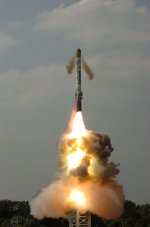
At the launch of Vishnu Som's book on Operation Sindoor, Air Marshal Narmdeshwar Tiwari (Retd) made a case against the idea of a dedicated rocket forc

swarajyamag.com
Such a good article that goes straight to the core of the problem. IAF is fearful of losing its turf. Thats what its all about. Air force is also the most backwards now when it comes to indegenisation.
----------------------------------------------------------------------------------------------------------------------------------------------------------------
At the launch of Vishnu Som's book on Operation Sindoor, Air Marshal Narmdeshwar Tiwari (Retd) made a case against the idea of a dedicated rocket force for India. Only China and Russia have done it, he argued, adding that Iran was forced into it by sanctions. No Western country has bothered, he said, adding that India should invest in modern fighter aircraft instead.
The Air Marshal's argument might sound reasonable until you examine what Operation Sindoor actually revealed about how India fights, and how its adversaries have reorganised since.
A detailed analysis published in War on the Rocks by Brigadier (Retd) Anil Raman lays out the problem with uncomfortable clarity. His argument is not about what weapons India needs. It is about the speed at which a country can authorise action, execute strikes, and establish a narrative before diplomatic intervention shuts down the space for escalation.
Operation Sindoor illustrated this perfectly. India's strikes were operationally brilliant. But nearly two weeks elapsed between the Pahalgam attack and the authorisation to strike, because intelligence confirmation, diplomatic preparation, and inter-service planning each ran through separate bureaucratic channels with no mechanism to synchronise them.
By the time Indian forces delivered their precise, devastating blows, the United States had already activated its machinery. Trump claimed credit for preventing nuclear war. Pakistan's preferred framing, including restraint, victimhood, escalation risk, had already seeped into Washington's crisis assessment.
The post-Sindoor reforms that Pakistan enacted were designed to ensure this timing advantage widens in the next crisis. A new Chief of Defence Forces position collapsed multiple coordination layers into one decision channel. But the most consequential reform was the Army Rocket Force Command, which consolidated conventional missiles, cruise missiles, and armed drone swarms under a single operational authority reporting directly to the CDF. The logic is straightforward.
In a limited war, the side that can execute controlled strikes within hours of crisis onset, without waiting for three services to coordinate targeting, proportionality, and execution, holds a decisive first-day advantage. Target selection, escalation calibration, and execution orders flow through one vertical chain.
Conventional strike forces were also formally decoupled from nuclear command and control, with nuclear assets placed under a separate national strategic command. This means conventional missile capability can be used rapidly without the action being read as nuclear signalling, reducing the ambiguity that, in past crises, deterred both sides from acting.
Now consider what India has on its side, and why it still loses the speed contest. India's long-range conventional strike assets are individually superior: BrahMos missiles, Nirbhay cruise missiles, armed Heron drones, standoff munitions. But they are scattered across the Army's artillery divisions, the Air Force's strike squadrons, and the Navy's missile systems. Using them in a coordinated, proportional response requires inter-service coordination that consumes 24 to 48 hours, precisely the window in which limited wars are decided.
The structural asymmetry this creates is stark. An adversary with a unified strike command can act first, shape the narrative around its "proportional response," and de-escalate before India's distributed assets are synchronised. The problem is not capability. India has better missiles, better platforms, better trained personnel. The problem is organisational velocity, the gap between the speed at which India's hardware can perform and the speed at which India's institutions can authorise and coordinate that performance.
The world that India now operates in, with instant American diplomatic activation, Chinese intelligence-sharing with Pakistan, and media amplification compressing everything, demands convergence within hours. A rocket force, or at minimum a Joint Strike Command consolidating crisis-time control of non-nuclear long-range strike systems under the Chief of Defence Staff, is the structural precondition for India's superior hardware to matter when it matters.
So why is a retired Air Marshal making the opposite case at precisely the moment the strategic logic has never been clearer? The answer, unfortunately, is institutional.
The IAF carries deep scars from losing roles to sister services. In 1976, the maritime reconnaissance mission, long performed by the IAF's No. 6 Squadron with its Super Constellations, was transferred to the Indian Navy, which raised INAS 312 to take it over. A decade later, in 1986, the Air Observation Post units were transferred from the Air Force to the Army, forming the Army Aviation Corps. Both transfers were operationally sound.
Both were bitterly resisted. A rocket force or joint strike command that consolidates long-range conventional strike under a unified authority would represent the most significant such migration yet, pulling the Air Force's deep-strike mission, its most prestigious warfighting role, into a structure it does not control.
The United States went through an identical convulsion. When the Air Force became independent in 1947, the turf wars over who controls carrier aviation, who owns close air support, and who runs strategic bombing nearly paralysed the new defence establishment.
It took Defence Secretary James Forrestal physically hauling the Joint Chiefs to Key West, Florida, in March 1948 to broker a settlement. The Key West Agreement delineated primary and collateral functions for each service, preserved Naval Aviation under Navy control, and gave the Air Force its strategic bombing mission.
It was ugly, it was political, and it required direct civilian intervention to override service parochialism. India has no equivalent mechanism. The CDS was supposed to be that mechanism. Theatre commands were supposed to operationalise it. Neither has materialised with the speed or authority the situation demands.