MMRCA 2.0 - Updates and Discussions

What is your favorite for MMRCA 2.0 ?

  • F-35 Blk 4

    Votes: 44 16.4%
  • Rafale F4

    Votes: 205 76.5%
  • Eurofighter Typhoon T3

    Votes: 5 1.9%
  • Gripen E/F

    Votes: 5 1.9%
  • F-16 B70

    Votes: 1 0.4%
  • F-18 SH

    Votes: 10 3.7%
  • F-15EX

    Votes: 11 4.1%
  • Mig-35

    Votes: 2 0.7%

  • Total voters
    268
  • Poll closed .

The people cited above said the plan is to “hardwire” ICD into the final contract for the ₹3.25 lakh crore mega deal. ICD is a critical system engineering document that controls and defines all the vital protocols between a system and sub-systems. According to the proposal cleared by DAC, 18 fighters will be delivered in fly away condition from France while remaining 96 will be manufactured in India with indigenous content of over 25%.

What s the use of paid ISE if get ICD now
So far we haven't seen any Indian weapons on Rafale.
 

The people cited above said the plan is to “hardwire” ICD into the final contract for the ₹3.25 lakh crore mega deal. ICD is a critical system engineering document that controls and defines all the vital protocols between a system and sub-systems. According to the proposal cleared by DAC, 18 fighters will be delivered in fly away condition from France while remaining 96 will be manufactured in India with indigenous content of over 25%.
How is the IC going down by every report? 60% -> 50% -> 25% !

Defense Secretary was adamant that it should be a minimum of 50% in his interview.
 
What s the use of paid ISE if get ICD now

Large parts of the ISE go into F4 too, like X-Guard, low band jammer, data recording, IRNSS integration, Litening pod, and engine and OBOGS enhancements for the Himalayas.

The new stuff coming with F4 that will replace ISE are just the new IRST and new software modes. Unsure about HMDS.

Let's not forget that the oldest F3R will be 12 years old when the first F4 squadron enters service in India.

So far we haven't seen any Indian weapons on Rafale.

Astra and SAAW coming on F3R. Flight trials for Astra are still 2 years away. Spice too. All three are part of ISE.

When it comes to SAAW, the French are integrating their quad-pack ejectors, so they can hold other weapons too, like Spice-250, AASM-125. Even swarm drones.
 
  • Like
Reactions: Sathya
How is the IC going down by every report? 60% -> 50% -> 25% !

Defense Secretary was adamant that it should be a minimum of 50% in his interview.

Just the first phase in a multi-phase system. It's already at 10-15% on paper today via F3R and M, so that's a further boost to 25% right off the bat.

Tata's gonna produce lateral shells of the airframe after Rafale M signature.

BEL delivering TRMs since F3R offsets.

Other contracts are wired structures for the radar by SFO and DRAL's been producing spares. And an MRO facility for engines in Hyderabad.
 
  • Like
Reactions: YoungWolf

The people cited above said the plan is to “hardwire” ICD into the final contract for the ₹3.25 lakh crore mega deal. ICD is a critical system engineering document that controls and defines all the vital protocols between a system and sub-systems. According to the proposal cleared by DAC, 18 fighters will be delivered in fly away condition from France while remaining 96 will be manufactured in India with indigenous content of over 25%.
Yes. If we take this logic all the way to the Rafale F5, the challenge for India is no longer simply to have an aircraft capable of carrying the Astra or the Rudram. The challenge becomes integrating the Rafale into a much broader Indian combat system, while retaining control of the interface without touching the aircraft’s core French technology. And that’s where the evolution toward the F5 becomes very interesting.

The first point is that the F5 standard will automatically make India’s requirements more ambitious. With a Rafale F3R or even an F4, it’s already possible to integrate indigenous weapons, provided you have the right interface documentation and a well-managed validation process. But with the F5, we’re moving to a whole new level, because we’re no longer just talking about a fighter jet; we’re talking about a network node, a tactical orchestrator, a platform that distributes information, controls remote effectors, and serves as an interface between multiple layers of combat. For India, this means that the battle will no longer focus primarily on “source code” in the media sense of the term, but on the degree of openness of the functional architecture: which buses, which protocols, which data streams, which services are exportable to an Indian combat cloud, which weapons and which drones can be connected without touching the core French software.

This is precisely where the “communication server” comes into its own. If the Rafale evolves toward an architecture where part of the connectivity is outsourced to a more modular block, then India may seek not control of the radar, SPECTRA, or native fusion, but a robust insertion point between the aircraft and the outside world. This would allow India to develop its own tactical communications environment, its own encryption, its own gateways to the IACCS, and even its own management logic for indigenous drones or missiles, without having to penetrate the most sensitive intellectual property of Dassault, Thales, or Safran. In other words, the F5 is potentially much more compatible with the Indian philosophy than previous versions, provided that the boundary between the “French sovereign core” and the “Indian integration zone” is clearly defined.

The second point is the integration of national weapons into an F5 ecosystem. On an older aircraft, integrating a weapon primarily involves making the missile “talk” with the aircraft: power supply, pre-launch communication, launch sequences, potential terminal guidance, separation tests, etc. On an F5 aircraft, integrating a weapon means much more. It means embedding it within a collaborative combat architecture. An Indian long-range missile, such as a new-generation Astra or an air-to-ground missile like the Rudram or BrahMos-NG, will no longer be merely an object dropped by the aircraft: it can be engaged based on a tactical picture built collaboratively, with remote targeting, in-flight updates, track sharing, and even coordination with an escort drone. So for India, obtaining an ICD is only the beginning. What it will ultimately want is an ICD rich enough that its weapons are not merely “Rafale-compatible,” but fully “F5-compatible.”

The same applies to sensors and the Indian combat cloud. India is well aware that it won’t get access to SPECTRA’s or the radar’s internal algorithms, and in truth, it doesn’t need them if it can seamlessly integrate the Rafale into its own combat system. The real ambition is to use the Rafale as a premium sensor-shooter within a broader Indian system, not to “de-Frenchify” it. In this context, the Rafale is even better positioned than a so-called fifth-generation aircraft with a highly restricted architecture, because France has historically taken a more pragmatic approach to customer sovereignty. It protects what needs to be protected, but it doesn’t lock the user in to the same extent as a fully captive American system. This is, in fact, one of the key arguments in favor of the Rafale in India: it’s not just a good aircraft, it’s a good platform for relative autonomy.

The third point is the issue of escort drones. Here again, we must clearly distinguish between what India wants and what it can reasonably obtain. While the Rafale F5 is designed to operate with a loyal wingman-type escort drone, India’s concern will not be to request the source code for the French autonomous control system. Rather, it will be to determine to what extent it can integrate its own drones—or develop a locally co-developed drone—within an operational framework inspired by the F5. In other words, the real issue is not “Will France hand over the drone’s brain?”, but “Can the Indian Rafale serve as a mother platform in an environment of Indian drones?”. If the answer is yes, even partially, then the Rafale F5 becomes a training ground for collaborative combat for India, while awaiting the AMCA and what follows.

And this is where timing works in the Rafale’s favor. The AMCA is higher on the priority list than the TEDBF, but it will remain a high-risk program for a long time, dependent on the engine, stealth capabilities, system integration, and industrial ramp-up. The TEDBF, for its part, has drifted away, shifting toward a more ambitious stealth approach. So in the 2030s, the only system truly available to India in significant numbers, with advanced network capabilities, domestically produced weaponry, and potentially drones, will very likely be the Rafale F5. This means that the F5 will not merely be a transitional purchase: it risks becoming, for India, the first true “pre-6th generation” combat system available on an operational scale.

The industrial implications are significant. If India acquires 114 “Made in India” Rafales, plus 26 naval variants, and likely additional units, it will have every interest in making the F5 not just a simple imported version, but the foundation of a local ecosystem. Indian missiles will be integrated onto it. Maintenance and testing tools will be localized. The M88 could have a local support network, with Safran having even publicly hinted at its openness to an engine assembly line in India, according to reports from late 2025. And above all, Indian personnel will learn to work on a top-tier Western platform, within a framework where France remains demanding but not stifling. For the AMCA, for future drones, and for engines, this accumulation of experience will count for a great deal.

Ultimately, the Rafale F5 in India could play three simultaneous roles. First, an immediate operational role: restoring the size and quality of the fleet, with a platform whose effectiveness against Pakistan and Chinese-origin systems has already weighed heavily in decision-making. Second, a doctrinal role: learning to conduct collaborative combat, integrate national missiles, and utilize the combat cloud, even before indigenous programs are mature. Finally, an industrial role: serving as a springboard toward future autonomy, not by handing over all French secrets, but by giving India the interface points that truly matter.

This is why the false debate over source codes masks the real issue. The F5 does not need to be “open” in the naive sense of the term. It must be “interoperable in a controlled manner.” If France accepts this logic and if India understands that sovereignty depends on interfaces, weapons, communications, and industrial chains rather than on ownership of the software core, then the Rafale F5 can become much more than a fighter jet purchased abroad: it can become the backbone of India’s transition to its own air combat system of the future.

 
I think there is a basic misunderstanding in the way people are reading the “25% indigenous content” figure for the Rafale.

A lot of people seem to assume that this percentage refers only to the physical content inside each aircraft, as if one were simply opening the jet and asking what fraction of the parts are Indian-made. But that is usually not how these programmes are measured in practice. There is a major difference between indigenous content inside the aircraft itself and indigenous value created by the programme as a whole.

If the discussion is about the aircraft taken in a narrow sense, then 25% is not shocking at all for the early phase of a highly complex fighter localisation programme. The most sensitive and highest-value subsystems remain foreign at first: radar, electronic warfare suite, mission computers, flight-control laws, engine core technology, key avionics software, and so on. That automatically caps the “internal” Indian share for quite a while. Even if major fuselage sections, structures, wiring, some mechanical assemblies, ground support equipment and final assembly are localised, the deep-value items are still concentrated in a relatively small number of sovereign systems.

But if the original objective of 50% or 60% was stated at the programme level, then the calculation is much broader. It should include not only the content physically embedded in the aircraft, but also the final assembly line, tooling, test benches, quality processes, local industrial ramp-up, training of Indian personnel, maintenance infrastructure, spares pipelines, depot-level maintenance, repair and overhaul, documentation, certification effort, integration of Indian weapons, software interface work, and the long-term MRO ecosystem. Once you account for all that, the number can become much higher than the “internal content” of the jet itself.

This is particularly important for a fighter like Rafale, because what India is really buying is not just 114 airplanes. India is buying an industrial capability. A local final assembly line has value. A local engine MRO capability has value. The ability to manufacture major fuselage sections has value. The ability to qualify local suppliers to aerospace-military standards has value. The ability to integrate Indian missiles through ICDs and validation campaigns has value. None of that necessarily shows up if one looks only at the content physically bolted inside each aircraft.

The same applies to Safran. Cooperation on the M88, and later possibly on the M88 growth path or the M88-derived T-Rex family, should not be judged only by asking how many engine parts are immediately Indian-made. If India gets local assembly, maintenance, repair, overhaul, test capability, hot-section know-how in limited areas, manufacturing process transfer, supplier development, and eventually some production responsibilities, that creates industrial value far beyond the narrow “local content inside one engine” metric.

There is also another point that is often ignored: not all technology is counted equally. In many defence-industrial localisation discussions, critical technologies are weighted differently from ordinary manufacturing work. A local bracket is not the same thing as local capability in high-temperature materials, turbine blades, EW integration, radar modules, or mission-system interfaces. Even when no official public formula is disclosed, everyone knows that a transfer involving critical know-how carries a strategic value that is much higher than its raw mass or part count. So it is entirely possible for the programme to move toward 50–60% “Indian value” without the aircraft’s strictly internal Indian-built bill of materials reaching anything close to 50–60%.

In other words, the right question is not: “How much of the jet is Indian if I strip it down to components?” The right question is: “How much strategic, industrial and lifecycle value stays in India across the whole programme?”

If you ask the first question, 25% may sound disappointing. If you ask the second, 25% in the aircraft at an early stage can be perfectly compatible with a much larger localisation outcome at programme level.

And frankly, that is how India should judge the deal. The goal is not to repaint a foreign aircraft and call it indigenous. The goal is to use the Rafale programme to build Indian capability in structures, assembly, sustainment, engine support, weapons integration, supplier qualification and eventually next-generation combat aviation. If that is the yardstick, then the programme-level percentage matters much more than the narrow internal percentage.

So my reading is simple: 25% likely refers to the aircraft in a narrow production sense, while 50–60% was always more plausibly a programme-level ambition. Once you include assembly, support, MRO, local infrastructure, industrial learning and technology transfer — especially on sensitive areas handled with higher strategic weighting — the apparent contradiction largely disappears.
 

The people cited above said the plan is to “hardwire” ICD into the final contract for the ₹3.25 lakh crore mega deal. ICD is a critical system engineering document that controls and defines all the vital protocols between a system and sub-systems. According to the proposal cleared by DAC, 18 fighters will be delivered in fly away condition from France while remaining 96 will be manufactured in India with indigenous content of over 25%.
Wait what !? 25% ? Are you sure France isnt being extremely kind and generous here? This tech transfer will revolutionalise our industry, I'm scared about how our PSU and Private Companies would be able to handle this extreme task and not be overworked in the process with this unparallel tot. France shouldn't have been so generous, its not like we are a trusted military partner or spent billions of dollars for the jet.
 
I think there is a basic misunderstanding in the way people are reading the “25% indigenous content” figure for the Rafale.

A lot of people seem to assume that this percentage refers only to the physical content inside each aircraft, as if one were simply opening the jet and asking what fraction of the parts are Indian-made. But that is usually not how these programmes are measured in practice. There is a major difference between indigenous content inside the aircraft itself and indigenous value created by the programme as a whole.

If the discussion is about the aircraft taken in a narrow sense, then 25% is not shocking at all for the early phase of a highly complex fighter localisation programme. The most sensitive and highest-value subsystems remain foreign at first: radar, electronic warfare suite, mission computers, flight-control laws, engine core technology, key avionics software, and so on. That automatically caps the “internal” Indian share for quite a while. Even if major fuselage sections, structures, wiring, some mechanical assemblies, ground support equipment and final assembly are localised, the deep-value items are still concentrated in a relatively small number of sovereign systems.

But if the original objective of 50% or 60% was stated at the programme level, then the calculation is much broader. It should include not only the content physically embedded in the aircraft, but also the final assembly line, tooling, test benches, quality processes, local industrial ramp-up, training of Indian personnel, maintenance infrastructure, spares pipelines, depot-level maintenance, repair and overhaul, documentation, certification effort, integration of Indian weapons, software interface work, and the long-term MRO ecosystem. Once you account for all that, the number can become much higher than the “internal content” of the jet itself.

This is particularly important for a fighter like Rafale, because what India is really buying is not just 114 airplanes. India is buying an industrial capability. A local final assembly line has value. A local engine MRO capability has value. The ability to manufacture major fuselage sections has value. The ability to qualify local suppliers to aerospace-military standards has value. The ability to integrate Indian missiles through ICDs and validation campaigns has value. None of that necessarily shows up if one looks only at the content physically bolted inside each aircraft.

The same applies to Safran. Cooperation on the M88, and later possibly on the M88 growth path or the M88-derived T-Rex family, should not be judged only by asking how many engine parts are immediately Indian-made. If India gets local assembly, maintenance, repair, overhaul, test capability, hot-section know-how in limited areas, manufacturing process transfer, supplier development, and eventually some production responsibilities, that creates industrial value far beyond the narrow “local content inside one engine” metric.

There is also another point that is often ignored: not all technology is counted equally. In many defence-industrial localisation discussions, critical technologies are weighted differently from ordinary manufacturing work. A local bracket is not the same thing as local capability in high-temperature materials, turbine blades, EW integration, radar modules, or mission-system interfaces. Even when no official public formula is disclosed, everyone knows that a transfer involving critical know-how carries a strategic value that is much higher than its raw mass or part count. So it is entirely possible for the programme to move toward 50–60% “Indian value” without the aircraft’s strictly internal Indian-built bill of materials reaching anything close to 50–60%.

In other words, the right question is not: “How much of the jet is Indian if I strip it down to components?” The right question is: “How much strategic, industrial and lifecycle value stays in India across the whole programme?”

If you ask the first question, 25% may sound disappointing. If you ask the second, 25% in the aircraft at an early stage can be perfectly compatible with a much larger localisation outcome at programme level.

And frankly, that is how India should judge the deal. The goal is not to repaint a foreign aircraft and call it indigenous. The goal is to use the Rafale programme to build Indian capability in structures, assembly, sustainment, engine support, weapons integration, supplier qualification and eventually next-generation combat aviation. If that is the yardstick, then the programme-level percentage matters much more than the narrow internal percentage.

So my reading is simple: 25% likely refers to the aircraft in a narrow production sense, while 50–60% was always more plausibly a programme-level ambition. Once you include assembly, support, MRO, local infrastructure, industrial learning and technology transfer — especially on sensitive areas handled with higher strategic weighting — the apparent contradiction largely disappears.

The beancounters are not looking at all that. They take unit price and then say they want 50-60% of that unit price to be Indian. How that 60% is achieved is left to the OEM, but of course, it needs to be meaningful. Program-level ambition is just a byproduct depending on how much the OEM and OEM's govt wishes to share with India. There is no real direct benefit to R&D, indirect benefits are possible, like AMCA's engine, and whatever benefit the manufacturers get out of it is a byproduct.

Production ToT is centered pretty much entirely on the extent the IAF can use the jet operationally without requiring a new contract with the OEM. And for Indian researchers it's about future support via creating alternative technologies or supplementing with new weapons and technologies or study the program to further evolve indigenous R&D, and for manufacturers it's just a new revenue stream.

The primary goal is strategic autonomy to the highest extent possible, everything else is a byproduct.
 
25%. Awesome. paying 32.5 billion for only 25%. If the gov accepts the deal as is today then all i can say is that we are *censored*ed beyond belief in terms of future aquisitions. 25% gets us nothing apart from the fuselage. the radar, the engine, everything else is imported from france. If they acually do accept this deal while paying 32.5 billion, then the opposition is completely right to call them out for this BS.
 
25%. Awesome. paying 32.5 billion for only 25%. If the gov accepts the deal as is today then all i can say is that we are *censored*ed beyond belief in terms of future aquisitions. 25% gets us nothing apart from the fuselage. the radar, the engine, everything else is imported from france. If they acually do accept this deal while paying 32.5 billion, then the opposition is completely right to call them out for this BS.
Let's wait for something official before jumping to conclusions, the Defence Secretary had said in a previous interview that at min indigenous content needs to be 50% and successively needs to increase in the 96 airframes to be manufactured in India.
 
Wait what !? 25% ? Are you sure France isnt being extremely kind and generous here? This tech transfer will revolutionalise our industry, I'm scared about how our PSU and Private Companies would be able to handle this extreme task and not be overworked in the process with this unparallel tot. France shouldn't have been so generous, its not like we are a trusted military partner or spent billions of dollars for the jet.

According to the submitted proposal, in phase one 60 helicopters will come in fly away condition from Russia and 35 would be manufactured in India with 3.3 per cent indigenisation of the original Russian content.

Under phase 2, 25 helicopters will be manufactured in India with 15 per cent indigenisation. This will increase to 35 per cent in phase 3 under which 30 helicopters will be manufactured.

Only in phase 4 will India achieve 62.41 per cent of indigenisation to build 50 Kamov 226T helicopters.


The first batch of 5,000 rifles had only 5 percent indigenous components, which will increase to 70 percent when the initial lot of 70,000 is completed in 32 months, sources said.

The idea is to have rifles made of 100 percent indigenous components over a period of 128 months.


Another 8,000 will be handed over in the next two weeks. Indigenisation level achieved is around 25%,”

"So, the process will be slow. Even our initial timelines catered for two years for this process of 70% indigenous content," adding, "We are aiming to achieve it before that."


Same process. But starting off with 25% instead of 3% or 5%. This is what I meant when I said Su-57 production won't benefit AMCA. The ToT will take so long that AMCA will already be operational by the time 50-60% ToT is achieved. The same with Rafale ToT.

The French offered 100% ToT for Panther to replace the Ka-226T. And Rafale today's already at 15% in India. Only 60 MKIs were produced in India from raw materials stage, ie, Phase 4, the remaining 210+ were either flyaway or kits. Even the options were kits. The new order for 12 jets is from raw materials.
 
Yes. If we take this logic all the way to the Rafale F5, the challenge for India is no longer simply to have an aircraft capable of carrying the Astra or the Rudram. The challenge becomes integrating the Rafale into a much broader Indian combat system, while retaining control of the interface without touching the aircraft’s core French technology. And that’s where the evolution toward the F5 becomes very interesting.

The first point is that the F5 standard will automatically make India’s requirements more ambitious. With a Rafale F3R or even an F4, it’s already possible to integrate indigenous weapons, provided you have the right interface documentation and a well-managed validation process. But with the F5, we’re moving to a whole new level, because we’re no longer just talking about a fighter jet; we’re talking about a network node, a tactical orchestrator, a platform that distributes information, controls remote effectors, and serves as an interface between multiple layers of combat. For India, this means that the battle will no longer focus primarily on “source code” in the media sense of the term, but on the degree of openness of the functional architecture: which buses, which protocols, which data streams, which services are exportable to an Indian combat cloud, which weapons and which drones can be connected without touching the core French software.

This is precisely where the “communication server” comes into its own. If the Rafale evolves toward an architecture where part of the connectivity is outsourced to a more modular block, then India may seek not control of the radar, SPECTRA, or native fusion, but a robust insertion point between the aircraft and the outside world. This would allow India to develop its own tactical communications environment, its own encryption, its own gateways to the IACCS, and even its own management logic for indigenous drones or missiles, without having to penetrate the most sensitive intellectual property of Dassault, Thales, or Safran. In other words, the F5 is potentially much more compatible with the Indian philosophy than previous versions, provided that the boundary between the “French sovereign core” and the “Indian integration zone” is clearly defined.

The second point is the integration of national weapons into an F5 ecosystem. On an older aircraft, integrating a weapon primarily involves making the missile “talk” with the aircraft: power supply, pre-launch communication, launch sequences, potential terminal guidance, separation tests, etc. On an F5 aircraft, integrating a weapon means much more. It means embedding it within a collaborative combat architecture. An Indian long-range missile, such as a new-generation Astra or an air-to-ground missile like the Rudram or BrahMos-NG, will no longer be merely an object dropped by the aircraft: it can be engaged based on a tactical picture built collaboratively, with remote targeting, in-flight updates, track sharing, and even coordination with an escort drone. So for India, obtaining an ICD is only the beginning. What it will ultimately want is an ICD rich enough that its weapons are not merely “Rafale-compatible,” but fully “F5-compatible.”

The same applies to sensors and the Indian combat cloud. India is well aware that it won’t get access to SPECTRA’s or the radar’s internal algorithms, and in truth, it doesn’t need them if it can seamlessly integrate the Rafale into its own combat system. The real ambition is to use the Rafale as a premium sensor-shooter within a broader Indian system, not to “de-Frenchify” it. In this context, the Rafale is even better positioned than a so-called fifth-generation aircraft with a highly restricted architecture, because France has historically taken a more pragmatic approach to customer sovereignty. It protects what needs to be protected, but it doesn’t lock the user in to the same extent as a fully captive American system. This is, in fact, one of the key arguments in favor of the Rafale in India: it’s not just a good aircraft, it’s a good platform for relative autonomy.

The third point is the issue of escort drones. Here again, we must clearly distinguish between what India wants and what it can reasonably obtain. While the Rafale F5 is designed to operate with a loyal wingman-type escort drone, India’s concern will not be to request the source code for the French autonomous control system. Rather, it will be to determine to what extent it can integrate its own drones—or develop a locally co-developed drone—within an operational framework inspired by the F5. In other words, the real issue is not “Will France hand over the drone’s brain?”, but “Can the Indian Rafale serve as a mother platform in an environment of Indian drones?”. If the answer is yes, even partially, then the Rafale F5 becomes a training ground for collaborative combat for India, while awaiting the AMCA and what follows.

And this is where timing works in the Rafale’s favor. The AMCA is higher on the priority list than the TEDBF, but it will remain a high-risk program for a long time, dependent on the engine, stealth capabilities, system integration, and industrial ramp-up. The TEDBF, for its part, has drifted away, shifting toward a more ambitious stealth approach. So in the 2030s, the only system truly available to India in significant numbers, with advanced network capabilities, domestically produced weaponry, and potentially drones, will very likely be the Rafale F5. This means that the F5 will not merely be a transitional purchase: it risks becoming, for India, the first true “pre-6th generation” combat system available on an operational scale.

The industrial implications are significant. If India acquires 114 “Made in India” Rafales, plus 26 naval variants, and likely additional units, it will have every interest in making the F5 not just a simple imported version, but the foundation of a local ecosystem. Indian missiles will be integrated onto it. Maintenance and testing tools will be localized. The M88 could have a local support network, with Safran having even publicly hinted at its openness to an engine assembly line in India, according to reports from late 2025. And above all, Indian personnel will learn to work on a top-tier Western platform, within a framework where France remains demanding but not stifling. For the AMCA, for future drones, and for engines, this accumulation of experience will count for a great deal.

Ultimately, the Rafale F5 in India could play three simultaneous roles. First, an immediate operational role: restoring the size and quality of the fleet, with a platform whose effectiveness against Pakistan and Chinese-origin systems has already weighed heavily in decision-making. Second, a doctrinal role: learning to conduct collaborative combat, integrate national missiles, and utilize the combat cloud, even before indigenous programs are mature. Finally, an industrial role: serving as a springboard toward future autonomy, not by handing over all French secrets, but by giving India the interface points that truly matter.

This is why the false debate over source codes masks the real issue. The F5 does not need to be “open” in the naive sense of the term. It must be “interoperable in a controlled manner.” If France accepts this logic and if India understands that sovereignty depends on interfaces, weapons, communications, and industrial chains rather than on ownership of the software core, then the Rafale F5 can become much more than a fighter jet purchased abroad: it can become the backbone of India’s transition to its own air combat system of the future.
Excellent write up as usual but then that's nothing new for someone with your experience & articulation skills .

From my limited understanding the issue of "source code" popped up only to address the question of how would India integrate it's growing weapons sensors & avionics portfolio into the Rafale without running to Dassault every now & then & being charged an arm & a leg.

None of what you've put out addresses that question. However from what I've understood this 25% IC in value could also be a trade off against India getting le Francais to agree for our own ICD which maintains some degree of control with us as opposed to being at the mercy of Dassault.

I could be wrong in my assessment though .
 
Yes. If we take this logic all the way to the Rafale F5, the challenge for India is no longer simply to have an aircraft capable of carrying the Astra or the Rudram. The challenge becomes integrating the Rafale into a much broader Indian combat system, while retaining control of the interface without touching the aircraft’s core French technology. And that’s where the evolution toward the F5 becomes very interesting.

The first point is that the F5 standard will automatically make India’s requirements more ambitious. With a Rafale F3R or even an F4, it’s already possible to integrate indigenous weapons, provided you have the right interface documentation and a well-managed validation process. But with the F5, we’re moving to a whole new level, because we’re no longer just talking about a fighter jet; we’re talking about a network node, a tactical orchestrator, a platform that distributes information, controls remote effectors, and serves as an interface between multiple layers of combat. For India, this means that the battle will no longer focus primarily on “source code” in the media sense of the term, but on the degree of openness of the functional architecture: which buses, which protocols, which data streams, which services are exportable to an Indian combat cloud, which weapons and which drones can be connected without touching the core French software.

This is precisely where the “communication server” comes into its own. If the Rafale evolves toward an architecture where part of the connectivity is outsourced to a more modular block, then India may seek not control of the radar, SPECTRA, or native fusion, but a robust insertion point between the aircraft and the outside world. This would allow India to develop its own tactical communications environment, its own encryption, its own gateways to the IACCS, and even its own management logic for indigenous drones or missiles, without having to penetrate the most sensitive intellectual property of Dassault, Thales, or Safran. In other words, the F5 is potentially much more compatible with the Indian philosophy than previous versions, provided that the boundary between the “French sovereign core” and the “Indian integration zone” is clearly defined.

The second point is the integration of national weapons into an F5 ecosystem. On an older aircraft, integrating a weapon primarily involves making the missile “talk” with the aircraft: power supply, pre-launch communication, launch sequences, potential terminal guidance, separation tests, etc. On an F5 aircraft, integrating a weapon means much more. It means embedding it within a collaborative combat architecture. An Indian long-range missile, such as a new-generation Astra or an air-to-ground missile like the Rudram or BrahMos-NG, will no longer be merely an object dropped by the aircraft: it can be engaged based on a tactical picture built collaboratively, with remote targeting, in-flight updates, track sharing, and even coordination with an escort drone. So for India, obtaining an ICD is only the beginning. What it will ultimately want is an ICD rich enough that its weapons are not merely “Rafale-compatible,” but fully “F5-compatible.”

The same applies to sensors and the Indian combat cloud. India is well aware that it won’t get access to SPECTRA’s or the radar’s internal algorithms, and in truth, it doesn’t need them if it can seamlessly integrate the Rafale into its own combat system. The real ambition is to use the Rafale as a premium sensor-shooter within a broader Indian system, not to “de-Frenchify” it. In this context, the Rafale is even better positioned than a so-called fifth-generation aircraft with a highly restricted architecture, because France has historically taken a more pragmatic approach to customer sovereignty. It protects what needs to be protected, but it doesn’t lock the user in to the same extent as a fully captive American system. This is, in fact, one of the key arguments in favor of the Rafale in India: it’s not just a good aircraft, it’s a good platform for relative autonomy.

The third point is the issue of escort drones. Here again, we must clearly distinguish between what India wants and what it can reasonably obtain. While the Rafale F5 is designed to operate with a loyal wingman-type escort drone, India’s concern will not be to request the source code for the French autonomous control system. Rather, it will be to determine to what extent it can integrate its own drones—or develop a locally co-developed drone—within an operational framework inspired by the F5. In other words, the real issue is not “Will France hand over the drone’s brain?”, but “Can the Indian Rafale serve as a mother platform in an environment of Indian drones?”. If the answer is yes, even partially, then the Rafale F5 becomes a training ground for collaborative combat for India, while awaiting the AMCA and what follows.

And this is where timing works in the Rafale’s favor. The AMCA is higher on the priority list than the TEDBF, but it will remain a high-risk program for a long time, dependent on the engine, stealth capabilities, system integration, and industrial ramp-up. The TEDBF, for its part, has drifted away, shifting toward a more ambitious stealth approach. So in the 2030s, the only system truly available to India in significant numbers, with advanced network capabilities, domestically produced weaponry, and potentially drones, will very likely be the Rafale F5. This means that the F5 will not merely be a transitional purchase: it risks becoming, for India, the first true “pre-6th generation” combat system available on an operational scale.

The industrial implications are significant. If India acquires 114 “Made in India” Rafales, plus 26 naval variants, and likely additional units, it will have every interest in making the F5 not just a simple imported version, but the foundation of a local ecosystem. Indian missiles will be integrated onto it. Maintenance and testing tools will be localized. The M88 could have a local support network, with Safran having even publicly hinted at its openness to an engine assembly line in India, according to reports from late 2025. And above all, Indian personnel will learn to work on a top-tier Western platform, within a framework where France remains demanding but not stifling. For the AMCA, for future drones, and for engines, this accumulation of experience will count for a great deal.

Ultimately, the Rafale F5 in India could play three simultaneous roles. First, an immediate operational role: restoring the size and quality of the fleet, with a platform whose effectiveness against Pakistan and Chinese-origin systems has already weighed heavily in decision-making. Second, a doctrinal role: learning to conduct collaborative combat, integrate national missiles, and utilize the combat cloud, even before indigenous programs are mature. Finally, an industrial role: serving as a springboard toward future autonomy, not by handing over all French secrets, but by giving India the interface points that truly matter.

This is why the false debate over source codes masks the real issue. The F5 does not need to be “open” in the naive sense of the term. It must be “interoperable in a controlled manner.” If France accepts this logic and if India understands that sovereignty depends on interfaces, weapons, communications, and industrial chains rather than on ownership of the software core, then the Rafale F5 can become much more than a fighter jet purchased abroad: it can become the backbone of India’s transition to its own air combat system of the future.

The issues you pointed out are the same reasons for not to go for a Rafale or Su-57.

Because none of this is a "stop gap measure" and it certainly doesn't stop at Rafale F-3,4,5. Rafale could be the no.1 jet, but it still isn't worth putting that much time and investment into a non-Indian owned IP. Yes, I understand the advantages it brings to the leveling up of Indian MIC but with a hard cap and inflexible in nature. I hope you understand the point i am getting at, and certainly you would have the similar opinion if you were at the other end of things. Sorta like how European MIC became too dependent on China.

I would rather GOI use JVs, IC of various technologies from different different products being bought, as incentives to indian industrialists to build capability and capacity ( R&D not included). So, when the time comes, DRDOs results can be put to work in a timely manner. A very big part of delay in various projects like LCA, Helis, subs etc was the lacking industry more so than lack of scientists.

Nothing against rafale, but let's stop at F4.x with local integration of weapons. For India to talk the walk it needs a system built around LCA, AMCA, etc etc.. we have achieved a lot in last decade or so when it comes to building the base for aerospace MIC. It's time we the people also stop dreaming about rafale or Su-57 as THE system. Neither mirage or Sukhoi became that nor will their upgraded versions.
 
If India can already build MKIs from raw materials, sinking $55B+ (not including the IN purchase) for some minor sigma-6 industrial upgrade for building Rafales would be beyond foolish.

God knows how many in IAF/MoD will fall for this pretty yarn about using Rafales as a CCA enabler instead of investing the limited funds directly in building domestic capability.

At this point India should buy whatever stopgaps it needs at the best price it can get. Dassault/Safran/etc. will come crawling to build GCCs just like everyone else and IC will automatically go up -- ultimately dollar is king in capitalist economies and India offers great arbitrage across all value levels.
 
The ICD is just a common documentation for dual MCs, or MC+bridge, it's nothing special. The ICD has been specially mentioned 'cause it will tie into multiple variants across the life of the program. We have the same type of system on other imported aircraft that uses foreign avionics.

The M2000 uses a parallel HAL MC along with MDPU and the Mig-29UPG uses a hybrid Indian/Russian computer.

On Jaguar we have the Munitions Control Unit that helps integrate American weapons. It's on DARIN II and III.

Jaguar is the only exception, where a hardware-based middleware is used. All other aircraft use hybrid/dual MCs in some way or the other, all software-defined.

The ICD creates the bridge protocols necessary to perform the integration without giving away each other's technologies.

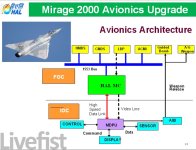
Rafale will very likely use the same setup as M2000.
1.jpg

Here we have MDPU handling all the core systems and weapons whereas the pilot transmits/receives all usable data to/from HAL MC. ICD helps create the link between MDPU and HAL MC.

Basically the HMDS, CMDS, LDP, and ACMI are using non-French/mixed technologies, so HAL MC acts as a bridge that translates all the non-French formats into French formats. This protects foreign OEMs and French OEMs from sharing technology with HAL acting as the intermediary. And the MC acts as a single point integrator and translator layer for non-French systems.

As for weapons, non-French weapons from Israel and India, even export grade weapons from Russia, use the MIL-STD-1760 bus (part of 1553), the same as M2000 and Rafale. So these weapons can directly be integrated into the MDPU. They are already designed to be plug and play. HAL can use their MC to update the weapons tables and software used by the MDPU.

The end result is after the French completed the IOC, the HAL finished FOC all on their own based on the M2000's ICD, and HAL owns all the integration flight programs and protocols, and France provided the interfaces that connect to the MDPU.

F4 uses the same 1553B data bus, so it's fine. But F5 uses fiber, so it needs a new set of protocols.

There's more. On the M2000, it is quite limited, but Rafale's is more likely to be at the F-35I level at the very least, especially the F5. The F-35I doesn't just end with a few external devices, the Americans gave them access to a part of the F-35's ICP for a complete C4I system owned by Israel. The weapons are integrated using the same 1553+1760 bus, but the Israeli EW suite is directly integrated into the F35's ICP. And unlike what's expected on M2000 and possibly F4, the Israeli EW suite and other sensors also provide targeting data in parallel to the F-35's core American systems.

We can manage F4 at the M2000 level, but if we want the F5 to talk to our drones and our network seamlessly, we will need some direct sovereign access to the MDPU, the same as the F-35I, along with a translator layer between the two formats. It's essentially an app running on top of the core OS.

Mig-29UPG is similar to the F-35I, but lacks the deep sovereign layer and is dependent on Russian assistance. It essentially transfers the HAL MC's functions straight into the hybrid MC. This is fine 'cause the Mig-29 is not as sensor fused as the M2000. The UPG Mk2 and K upgrades coming up will make us independent of Russia so that's an entirely different topic. Mig-29UPG and F-35I show it's doable on Rafale F5. We will be able to add our own independent EW suite too.
 
The issues you pointed out are the same reasons for not to go for a Rafale or Su-57.

Because none of this is a "stop gap measure" and it certainly doesn't stop at Rafale F-3,4,5. Rafale could be the no.1 jet, but it still isn't worth putting that much time and investment into a non-Indian owned IP. Yes, I understand the advantages it brings to the leveling up of Indian MIC but with a hard cap and inflexible in nature. I hope you understand the point i am getting at, and certainly you would have the similar opinion if you were at the other end of things. Sorta like how European MIC became too dependent on China.

I would rather GOI use JVs, IC of various technologies from different different products being bought, as incentives to indian industrialists to build capability and capacity ( R&D not included). So, when the time comes, DRDOs results can be put to work in a timely manner. A very big part of delay in various projects like LCA, Helis, subs etc was the lacking industry more so than lack of scientists.

Nothing against rafale, but let's stop at F4.x with local integration of weapons. For India to talk the walk it needs a system built around LCA, AMCA, etc etc.. we have achieved a lot in last decade or so when it comes to building the base for aerospace MIC. It's time we the people also stop dreaming about rafale or Su-57 as THE system. Neither mirage or Sukhoi became that nor will their upgraded versions.

All true, but the IAF needs fighter jets, and with capabilities that actually work, not just paper ones. Our indigenization goals are clearly long term, based on ADA's own timelines.

Even I predicted 6th gen imports, but local production came as a surprise to me, which means we are worse off than what was publicly known.

Come to terms with reality. It is what it is. We still have 3 main indigenous programs complementing 2 imports, followed by 2 more indigenous programs, successors to TEDBF and 6th gen, after a decade. So we are doing well.
 
If India can already build MKIs from raw materials, sinking $55B+ (not including the IN purchase) for some minor sigma-6 industrial upgrade for building Rafales would be beyond foolish.

God knows how many in IAF/MoD will fall for this pretty yarn about using Rafales as a CCA enabler instead of investing the limited funds directly in building domestic capability.

At this point India should buy whatever stopgaps it needs at the best price it can get. Dassault/Safran/etc. will come crawling to build GCCs just like everyone else and IC will automatically go up -- ultimately dollar is king in capitalist economies and India offers great arbitrage across all value levels.

The IAF is chasing after Rafales to significantly bring down operational costs while inducting next gen tech.

Had MKIs been our own IP, we wouldn't have gone after local production of Rafales. We would have bought 60 Rafales to replace M2000s and built 150-200 more MKIs.

The IAF is a 70% high-end force, so we were aiming for a 35%-35% Russian-French split with 30% Indian (LCAs). The 35-35% split was done to avoid diplomatic complications by placing all our high-end eggs in one basket.

Another problem for MKI, Flankers in general, was pre-2014 Putin showered his military with stepmotherly love. He did not release the funds necessary for modernization, which means Flanker modernization was pushed behind for the pie-in-the-sky Su-57. So we did not get Russian AESA tech for MKI. While they are paying for that decision now, we decided to chase after readymade Western tech to compensate for their folly. We did the same elsewhere too. Moskva sank because of that while we upgraded our ships with Barak 1.

A combination of 35-35 high-end split and Russia halting Flanker development resulted in bringing Rafale and Typhoon to our shores. In fact, with both SEF (2001 MRCA) and TEF (2004 MMRCA), we were looking at a 30-30-30-10 split between Russia (270), SEF, TEF, and LCA Mk1 (650 combined) in the early 2000s.

Today, Russian jets represent 60% of our air force, dropped from 70% just a few years ago, post Mig-21. Can you imagine how dangerous that is? Almost 100% of our high-end today is Russian. If we are to bring them back to 30-35%, we need to induct 500-600 non-Russian jets quickly. That's where LCA and Rafale come in.

By 2045, with all the Rafales, LCAs, and AMCAs inducted, we will have a mix of 25-25-50 in favor of Indian. By 2070, when the last of the MKIs are gone, we will be at 40-60 (or 20-20-60 if GCAP is chosen) in favor of Indian, assuming numbers stay the same. It will then take until the end of the century to get rid of Rafales and into the early 22nd century for SCAF/GCAP.

That's why we can't do what you want done. Without Rafales, we will still have almost 95% high-end consisting only of Russian jets in 2040. The Russians are denying more indigenization, preventing indigenous upgradation with new technologies, while trying to upsell older technologies at higher prices. And without any of the advantages Rafale's bringing to the party; low cost, ease of use, and next gen tech. They essentially have us by the balls.

And now you know why we aren't gonna buy Su-57s. And also why the West is keen to help us move away from Russia.

200+ Rafales and 400+ LCAs will balance things out for us by 2040.
 
Frankly IMHO we're going in for the Rafales only coz the 120 KN TF JV will never materialize otherwise & will in effect jeopardize our future growth plans.

All other considerations like the IAF's love affair with it etc are of secondary & tertiary importance.

Since we won't be getting the Rafales when we go up against the Chinese later this decade IMO it's a waste of resources since the Mk-2 will come with more or less F3R standards , give or take , between 2032-35 & the AMCA Mk-1 whose LRIP you can expect from 2035 onwards will be equivalent to the F4 standards .

All other considerations like CCA , the wherewithal needed for it & other aspects /picdelamirand-oil detailed in his eloquently penned post can be brought about provided the IAF takes the initiative. So far I really don't see them doing so .

As far as best mfg practices go you can rope in anyone from LM to Boeing to even Dassault or BAe & they'd gladly participate in it for a handsome fee. More so BAe since they're glorified sub contractors now of the US MIC.

But we don't have a choice in the matter as of now , hence the 114 Rafales which we're haggling over to prevent haemorrhaging more than we have to .

Btw that reminds me of a conspiracy theory that I heard way back on Twitter ~ 2020 . I'd created the account on Twitter long ago but rarely accessed it . Since the COVID pandemic left me like it did all of us with plenty of time I started frequenting Twitter.

An ex IAF veteran I followed then who was into ground maintenance disclosed the reason the top brass of the IAF were hell bent on the Rafale apart from its performance reputation , the need to shake off our dependency on the Russians , the PLAAF growing rapidly & planning their 5th Gen FA , PAKFA / FGFA hitting a wall etc was if they inveigled GoI into committing for the Rafales , it meant budget for indigenous programs would flow come what may since GoI would be open to turn off the tap on imports irrespective of the party in power but wouldn't do so for indigenous programs even if they wouldn't provide as much funds the project actually needed to fructify .

Needless to say events have by & large proven him right . At the time though the very thought of it seemed too outlandish. Moreover , these are the kind of seers we ought to be seeking not the kind who crowd our forum polluting them with their views masquerading as facts assaulting our senses & sensibilities.
 
All true, but the IAF needs fighter jets, and with capabilities that actually work, not just paper ones. Our indigenization goals are clearly long term, based on ADA's own timelines.

Even I predicted 6th gen imports, but local production came as a surprise to me, which means we are worse off than what was publicly known.

Come to terms with reality. It is what it is. We still have 3 main indigenous programs complementing 2 imports, followed by 2 more indigenous programs, successors to TEDBF and 6th gen, after a decade. So we are doing well.

I believe I have not said anything far reaching even by "Indian Standard Time".

The "Rafale/57 deal or not deal" ship has already sailed. We are importing them. IAFs gonna fly them. But the extent and nature of inbuilt dependency of an acquisition and integration mentioned by Pierce is not something to make lightly of. Otherwise the reality we face down the years will not be the one we are buying for now.
On that note, it's not like the scenario presented by Pierce is easy.. infact it might turn out to be more demanding.


Secondly, you aren't wrong but you aren't completely correct either. Accepting reality doesn't mean surrendering to it. Just a decade ago there was no aerospace MIC to speak of. 2 decades ago there was no Agni-I in service ( inducted in 2007). 3-4 decades ago there was not enough money to run things for a month. And the present decade goes a step ahead with the building and integration of civil+military industry.. probably the first Indian govt not looking at pvt sector with wary eyes.

With the wide acceptance of JVs in various technologies bring in various manufacturing methods... with DPSUs bringing in pvt companies into the fold as more than component factory (HAL LCA was started being outsourced in 2020-21 only ), the points I wrote are very much achievable.

Just to clarify.. we are taking about manufacturing here, not R&D.
 
Last edited:
  • Like
Reactions: batman
I believe I have not said anything far reaching even by "Indian Standard Time".

The "Rafale/57 deal or not deal" ship has already sailed. We are importing them. IAFs gonna fly them. But the extent and nature of inbuilt dependency of an acquisition and integration mentioned by Pierce is not something to make lightly of. Otherwise the reality we face down the years will not be the one we are buying for now.
On that note, it's not like the scenario presented by Pierce is easy.. infact it might turn out to be more demanding.


Secondly, you aren't wrong but you aren't completely correct either. Accepting reality doesn't mean surrendering to it. Just a decade ago there was no aerospace MIC to speak of. 2 decades ago there was no Agni-I in service ( inducted in 2007). 3-4 decades ago there was not enough money to run things for a month. And the present decade goes a step ahead with the building and integration of civil+military industry.. probably the first Indian govt not looking at pvt sector with wary eyes.

With the wide acceptance of JVs in various technologies bring in various manufacturing methods... with DPSUs bringing in pvt companies into the fold as more than component factory (HAL LCA was started being outsourced in 2020-21 only ), the points I wrote are very much achievable.

Just to clarify.. we are taking about manufacturing here, not R&D.

Forgot to mention one important thing here..

We were talking about building a whole system around a platform/tech i.e our IAFs wargaming, MIC, supply chains, expertise, logistics, paperwork etc etc. Like how US MIC built around F & B series. China with its J. Russia with Su and mig. France themselves around Rafale and mirage.