Shivalik-class & Nilgiri-class (Project 17 A/B) Frigates : Discussions

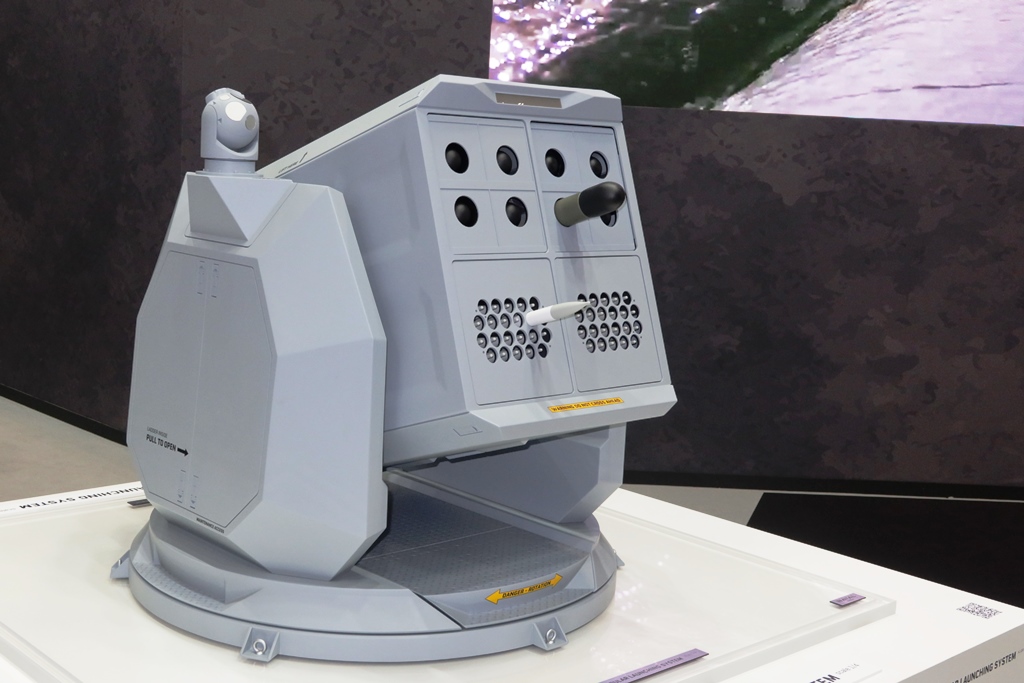
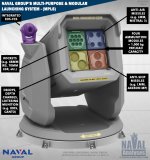
Rather than VLS, it's better to put Bhargavastra on a rotating swivel mount launcher like this:

Naval-Group-MPLS_04.jpg


Two such launchers, one on each side, will go a long way in dealing with multiples of close-in swarm threats.
This type of launchers are more vulnerable to swarm attacks compared to VLS particularly when FPV types are involved.
The way they stick out of the structure makes them vulnerable to detection and fly-in maneuver.
 
Rather than VLS, it's better to put Bhargavastra on a rotating swivel mount launcher like this:

Naval-Group-MPLS_04.jpg


Two such launchers, one on each side, will go a long way in dealing with multiples of close-in swarm threats.
a little off topic but these missiles will be incredible if integrated on the prachand? they only like 2.5kg so the prahcand can carry 64 easily, your only limited by dimensions since you need ground clearance and drag stuff. If we can put 64 on a prachand on 2 stores(32*2) then they would quite literally make the prachand the defenition of anti swarm
 
Standardized VLS allows for more cells on the larger P-17B compared to P-17A. That's about all we know today.

My guess is all Indian ADS from here on 'cause they are calling it NGF, so it's gonna be designed to work seamlessly with NGD and NGC.
sorry, the universal VLS is ready? As for the naval interceptors, there's Barak-8 and VL-SRSAM. Are you also including the BMD missile tested a couple of years ago?

if P-17B is indeed the NGF and not a gap-filler for the NGF, it should have more indigenous content as well. Maybe the Kirloskar engine instead of MTU if it works out (their delivery target is 2028, coinciding with the P-17B and NGC construction). For indigenous turbines, maybe will have to wait until 2040.

**While the government is tight-lipped over the DAC meeting, HT learns that Singh will also take a call on approving the construction of seven more Project 17 B stealth frigates at a cost of ₹70,000 crore. The new frigates will weigh around 8000 tonnes each and are expected to have significant strike capability**
as you said, no official confirmation. and the RFP has already been delayed at this point. hopefully they make some design improvements.
 
sorry, the universal VLS is ready? As for the naval interceptors, there's Barak-8 and VL-SRSAM. Are you also including the BMD missile tested a couple of years ago?

if P-17B is indeed the NGF and not a gap-filler for the NGF, it should have more indigenous content as well. Maybe the Kirloskar engine instead of MTU if it works out (their delivery target is 2028, coinciding with the P-17B and NGC construction). For indigenous turbines, maybe will have to wait until 2040.


as you said, no official confirmation. and the RFP has already been delayed at this point. hopefully they make some design improvements.
I think all future systems are going to be using the MT30 engine. I mean we have been seeing a shit ton of news about RR recently. I think its going to be RR for the navy and Safran for the airforce.
 
This type of launchers are more vulnerable to swarm attacks compared to VLS particularly when FPV types are involved.
The way they stick out of the structure makes them vulnerable to detection and fly-in maneuver.

If your ship's location is already discovered and you're under attack, it really doesn't matter. I'd rather the FPVs hit a launcher than hit the bridge or below the waterline.

Problem with VLS is that the missile wastes a lot of energy flying up and then maneuvering towards the threat's direction. On a tiny short-range (~2.5 km) missile like Bhargavastra, you're gonna be reducing it to about 1.5-2 km of useful range. That's the last thing you want.

Secondly, you have limited space on any given ship where a VLS farm can sit - as it requires space below deck as well. You'd rather use that space for proper SAMs that can defend against ASCMs.

There's a reason even the SeaRAM and Chinese equivalents are placed on swivel mounts on most ships.

a little off topic but these missiles will be incredible if integrated on the prachand? they only like 2.5kg so the prahcand can carry 64 easily, your only limited by dimensions since you need ground clearance and drag stuff. If we can put 64 on a prachand on 2 stores(32*2) then they would quite literally make the prachand the defenition of anti swarm

Yes, A2A role against drones is actually one of the stated goals of the LCH program. This role will take on even more importance after we saw how Apaches were being pressed into anti-drone duties (with 30mm gun) now in the MidEast.

Back in the day we meant to use only Mistral ATAMs (air-to-air version of the MANPAD) on LCH but now we can use Bhargavastra as well. But we'll need either an IR-guided version or have to put a radar on LCH.

We won't carry 2 x 32, that'd be too big and ruin aerodynamics. Plus there's no need of that much magazine depth on an airborne platform. A smaller number (perhaps 2 x 6) that won't need a launcher much bigger than the unguided rocket pods it currently carries will do.
 
sorry, the universal VLS is ready? As for the naval interceptors, there's Barak-8 and VL-SRSAM. Are you also including the BMD missile tested a couple of years ago?

I don't know if the VLS is ready today, but the ship itself is many years away from delivery anyway.

I don't know if BMD will find its way into NGF. Long range SAMs are possible. If Kusha is introduced, I don't get the point of Barak 8.

if P-17B is indeed the NGF and not a gap-filler for the NGF, it should have more indigenous content as well. Maybe the Kirloskar engine instead of MTU if it works out (their delivery target is 2028, coinciding with the P-17B and NGC construction). For indigenous turbines, maybe will have to wait until 2040.

6 MW fits into corvette and frigate requirements. So who knows?
 
VLS is better. Need 360 deg protection.

VLS missiles generally need more time to re-orient themselves towards a target post-launch (vertical to horizontal flight). If dealing with an incoming FPV swarm, this time lag could be fatal.

Imo, trainable launchers offer more flexibility in this regard.

Having said that, I believe that close-in self defence against swarm threats will be handled by microwave DEW/laser weapons in the future.
 
If your ship's location is already discovered and you're under attack, it really doesn't matter. I'd rather the FPVs hit a launcher than hit the bridge or below the waterline.

Problem with VLS is that the missile wastes a lot of energy flying up and then maneuvering towards the threat's direction. On a tiny short-range (~2.5 km) missile like Bhargavastra, you're gonna be reducing it to about 1.5-2 km of useful range. That's the last thing you want.

Secondly, you have limited space on any given ship where a VLS farm can sit - as it requires space below deck as well. You'd rather use that space for proper SAMs that can defend against ASCMs.

There's a reason even the SeaRAM and Chinese equivalents are placed on swivel mounts on most ships.

You are confused between RIM-116 and Bhargavastra.

RIM-116 as CIWS is better on a swivel mount, but Bhargavastra is necessary in a VLS due to the need for rapid salvo rate and rapid reorientation requires 360 deg coverage. Plus, unlike RIM-116, it's LOAL, so it doesn't need pointing before firing. VLS also absorbs more damage, which is necessary if you are fighting drones.

With that said, we need to develop a CIWS missile too. Bhargavastra is only anti-swarm.
 
  • Like
Reactions: CATS @hunter
You are confused between RIM-116 and Bhargavastra.

RIM-116 as CIWS is better on a swivel mount, but Bhargavastra is necessary in a VLS due to the need for rapid salvo rate and rapid reorientation requires 360 deg coverage. Plus, unlike RIM-116, it's LOAL, so it doesn't need pointing before firing. VLS also absorbs more damage, which is necessary if you are fighting drones.

With that said, we need to develop a CIWS missile too. Bhargavastra is only anti-swarm.

It's always a tradeoff. VLS space is limited and is better spent on increasing magazine depth for missiles like VLSRSAM, MRSAM or LACMs. Those are missiles too big for swivel mounts.

RIM-116/SeaRAM trains on its axis very quickly. A mount like that can get the job done. A launcher on each side can easily cover 180 deg responsibility each, as the missile itself does some maneuvering on its own.

Remember, the targets in question (FPVs or Shahed-like drones) are fairly slow-moving. You aren't exactly trying to intercept supersonic CMs here. A trainable Bhargavastra working in conjuction with the multiple onboard 12.7mm RCWS can mop up pretty much anything...even if AK630s are held in reserve for sea skimmer threats.

The one thing I'd like to see is more 30mm cannons with programmable airburst ammo. That's your ultimate cost-benefit bonanza against cheap swarms.

1000003647.jpg
 
It's always a tradeoff. VLS space is limited and is better spent on increasing magazine depth for missiles like VLSRSAM, MRSAM or LACMs. Those are missiles too big for swivel mounts.

RIM-116/SeaRAM trains on its axis very quickly. A mount like that can get the job done. A launcher on each side can easily cover 180 deg responsibility each, as the missile itself does some maneuvering on its own.

Remember, the targets in question (FPVs or Shahed-like drones) are fairly slow-moving. You aren't exactly trying to intercept supersonic CMs here. A trainable Bhargavastra working in conjuction with the multiple onboard 12.7mm RCWS can mop up pretty much anything...even if AK630s are held in reserve for sea skimmer threats.

The one thing I'd like to see is more 30mm cannons with programmable airburst ammo. That's your ultimate cost-benefit bonanza against cheap swarms.

View attachment 50705

Yeah, but what you say is suitable for RIM-116, not for Bhargavastra.

RIM-116 is a 75 kg missile meant to stop AShMs. Bhargavastra is a micro-missile meant to stop drones. The two systems are completely different.

Swarm drones will not come in 1s or 2s, but in dozens or even hundreds. Swivel mount is primarily to attack within one sector and has a slow firing rate, but Bhargavastra requires 360 deg launching capabilities with launches in rapid salvos. That's why Bhargavastra is getting VLS even for land use.

It was tested in inclined launcher, but the main capability will come via VLS.

Agni-5-3RD-Gen-(1).jpg


Same configuration for ships too.

It probably takes just 10 seconds to launch all 64. Swivel mount can't do that.

As for damage, its minimum range is just 20 m, a swivel mount will receive damage at that range, primarily due to the momentum of the drone. While AShMs aim for weak spots in a ship, drones can be made to attack the CIWS itself.

In short, swivel for CIWS, but VLS for anti-drone.
 
  • Like
Reactions: Shan and YoungWolf
The one thing I'd like to see is more 30mm cannons with programmable airburst ammo. That's your ultimate cost-benefit bonanza against cheap swarms.

Against light-skin drones like Shahed, DEW is better. Particularly HPM.

The USMC is likely to use this soon.
 
Major difference for P-17A is 1 helo vs 2 and 8 vs 16 Brahmos VLS. Also, P-17/A only carry LWTs vs HWTs on the Delhi/Kolkata/Visakhapatnam classes.

In terms of tonnage, it is true the INs ship classification criteria has changed a lot since the 1980s.

For example, the upcoming NGCs are classified as corvettes at 3500t displacement.

What we need to do is to optimize the design platforms for higher weaponry, Make weapons more potent, put batter EW systems and batter survivability. With arrival of every vehicle, it is improving. However, it is the time for shifting to next gen technologies to equip vessels like hypersonic Brahmos, Laser, GAN or GAO based AESA. We are planning a 13000-ton class destroyer. However, if optimize the design and free space by the means such as folding wing choppers, reducing the size of missile etc. We can accommodate more weapons in 7700 ton class destroyers. Frankly speaking, only 16 Brahmos seem insufficient number. It should atleast be 24 and More MRSAM should also be fitted. Recent war has shown a new threat from drones. Some countermeasures from drone should also be employed.
 
Yeah, but what you say is suitable for RIM-116, not for Bhargavastra.

RIM-116 is a 75 kg missile meant to stop AShMs. Bhargavastra is a micro-missile meant to stop drones. The two systems are completely different.

Swarm drones will not come in 1s or 2s, but in dozens or even hundreds. Swivel mount is primarily to attack within one sector and has a slow firing rate, but Bhargavastra requires 360 deg launching capabilities with launches in rapid salvos. That's why Bhargavastra is getting VLS even for land use.

It was tested in inclined launcher, but the main capability will come via VLS.

Agni-5-3RD-Gen-(1).jpg


Same configuration for ships too.

It probably takes just 10 seconds to launch all 64. Swivel mount can't do that.

That's a function of the launcher, not the mount itself.

The mount is just a swiveling pedestal, it's not nothing to do with what kind of missile or launcher you put on it. For example, the same mount is used for both SeaRAM and Phalanx even though they're entirely different systems, one is a 75kg missile like you said, the other's a rotary cannon.

You can use the same mount (and even same launcher) to fire multiple kinds of projectiles, which is what Naval Group/Thales is doing with MPLS:

MPLS.jpg

See the Laser Guided Rocket (LGR) pod on top left? That's basically what they're pitching for the anti-swarm role.

As for damage, its minimum range is just 20 m, a swivel mount will receive damage at that range, primarily due to the momentum of the drone. While AShMs aim for weak spots in a ship, drones can be made to attack the CIWS itself.

Engagements will happen at much farther ranges when talking about ships cuz there's no terrain to hide the drones till the last second. Regardless, if a drone gets too close, the ship is gonna take some damage. I'd rather it damages the launcher than try to get toward the VLS and damage the bridge instead.

But a trainable launcher that ensures the micromissile retains most of its kinetic capability (instead of wasting it on reorienting after vertical launch) is a better way to ensure a drone doesn't get close in the first place.

In short, swivel for CIWS, but VLS for anti-drone.

It depends on how much space you have really. VLS space is precious.

If your anti-drone capability is coming at the expense of point-defence or area-defence capability, that's not a good solution.

Against light-skin drones like Shahed, DEW is better. Particularly HPM.

The USMC is likely to use this soon.

Eventually, yeah. But guns are available right now.
 
  • Like
Reactions: Shan and YoungWolf
What we need to do is to optimize the design platforms for higher weaponry, Make weapons more potent, put batter EW systems and batter survivability. With arrival of every vehicle, it is improving. However, it is the time for shifting to next gen technologies to equip vessels like hypersonic Brahmos, Laser, GAN or GAO based AESA. We are planning a 13000-ton class destroyer. However, if optimize the design and free space by the means such as folding wing choppers, reducing the size of missile etc. We can accommodate more weapons in 7700 ton class destroyers. Frankly speaking, only 16 Brahmos seem insufficient number. It should atleast be 24 and More MRSAM should also be fitted. Recent war has shown a new threat from drones. Some countermeasures from drone should also be employed.

Adding GaN radar, EW, laser to older gen ships may not be practical due to SWAP considerations. Even if integration were possible, performance may be degraded due to cooling/power requirements, etc.

In the case of Russian origin ships, the cost of replacing core systems can be too high or otherwise restricted by OEMs.

No wonder, the IN stuck with the Fregat/Shtil combination on the Delhi class and has ordered VL Shtil for the Talwar class.

You just have to look at the USS Pinckney, an older Flight 2A Burke class DDG, to get a sense of how complicated such ad-hoc upgrades can be. And this is a 9000t hull we're talking about.

images (1).jpeg


images (2).jpeg
 
Last edited:
That's a function of the launcher, not the mount itself.

The mount is just a swiveling pedestal, it's not nothing to do with what kind of missile or launcher you put on it. For example, the same mount is used for both SeaRAM and Phalanx even though they're entirely different systems, one is a 75kg missile like you said, the other's a rotary cannon.

You can use the same mount (and even same launcher) to fire multiple kinds of projectiles, which is what Naval Group/Thales is doing with MPLS:

View attachment 50716

See the Laser Guided Rocket (LGR) pod on top left? That's basically what they're pitching for the anti-swarm role.

That rocket pod is a very basic system. To defeat drones, you need a micromissile with LOAL. Without LOAL, you need this turret, but it is still not a replacement for VLS.

They have actually designed the turret for the other weapons.

Basically, what I'm trying to say is our ships would need this turret as well as the Bhargavastra VLS.

Engagements will happen at much farther ranges when talking about ships cuz there's no terrain to hide the drones till the last second. Regardless, if a drone gets too close, the ship is gonna take some damage. I'd rather it damages the launcher than try to get toward the VLS and damage the bridge instead.

But a trainable launcher that ensures the micromissile retains most of its kinetic capability (instead of wasting it on reorienting after vertical launch) is a better way to ensure a drone doesn't get close in the first place.

Swarm drones won't give you the liberty of engaging from long range. Many will not just make it close, but actually hit the ship.

In fact, over water, missiles and drones can fly lower than over terrain.

Regardless of reorientation, micromissiles will perform better because they can be launched much earlier. And when using gravity-assist, they become more accurate than swivel launch. It's easier to hit a maneuvering target from above (high RCS) than straight forward (low RCS).

You need swivel launcher for CIWS against missiles 'cause of speed. But against drones, you need very high end-game performance, which neither rockets nor a straight burst from a swivel launcher can provide.

These are entirely different systems, so the logic used is entirely different.

It depends on how much space you have really. VLS space is precious.

If your anti-drone capability is coming at the expense of point-defence or area-defence capability, that's not a good solution.

That argument supports a VLS. Swivel launcher comes at the cost of space. On our ships, you gotta replace CIWS with a swivel launcher.

But with VLS, you can start cutting the hull wherever you have already made space for future enhancement.

And the Bhargavastra VLS is so small that you can find more imaginative ways to do it without placing the deck at risk.

 
sorry, the universal VLS is ready? As for the naval interceptors, there's Barak-8 and VL-SRSAM. Are you also including the BMD missile tested a couple of years ago?

if P-17B is indeed the NGF and not a gap-filler for the NGF, it should have more indigenous content as well. Maybe the Kirloskar engine instead of MTU if it works out (their delivery target is 2028, coinciding with the P-17B and NGC construction). For indigenous turbines, maybe will have to wait until 2040.


as you said, no official confirmation. and the RFP has already been delayed at this point. hopefully they make some design improvements.

VLSRSAM was made based on ASTRA propulsion to replace BARAK 2 if I am not wrong. Since Astra MK1's range is increased from 110 KM to 160, will VLSRSAM's range will increase.
 
That rocket pod is a very basic system. To defeat drones, you need a micromissile with LOAL. Without LOAL, you need this turret, but it is still not a replacement for VLS.

They have actually designed the turret for the other weapons.

Basically, what I'm trying to say is our ships would need this turret as well as the Bhargavastra VLS.

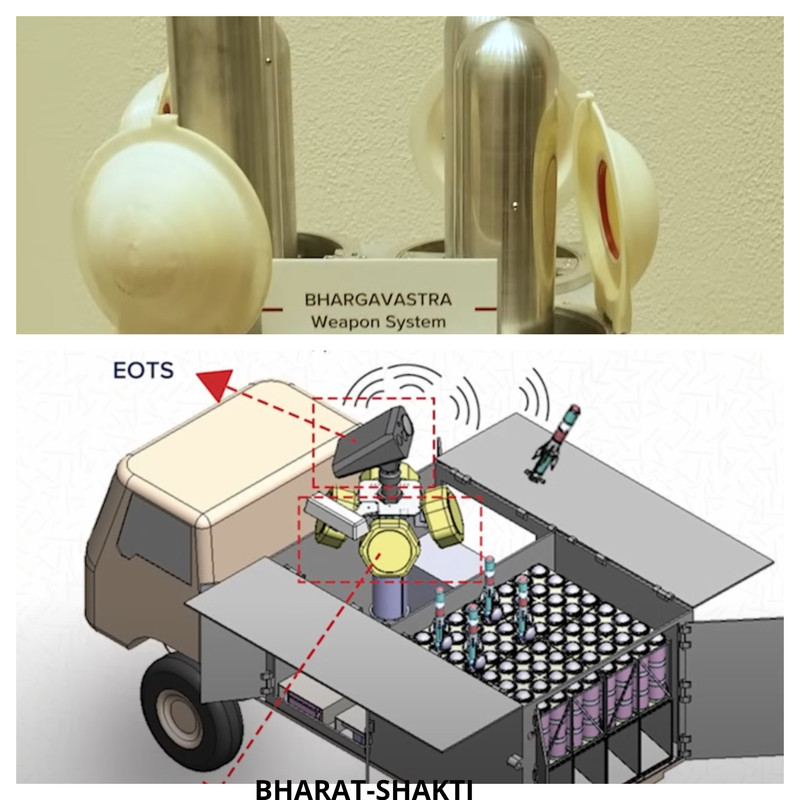
Bhargavastra's ground version has it's own standalone EOIR/FCR mounted on the truck. On a ship, it's possible we can integrate it with the ship's EO/radar systems for guidance but if it turns out a co-located fire control system is best for anti-drone launches, then a swivel mount will be optimal.

We'll see how it goes.

Swarm drones won't give you the liberty of engaging from long range. Many will not just make it close, but actually hit the ship.

In fact, over water, missiles and drones can fly lower than over terrain.

If you're integrated with the ship's main FCR, you'll always seen them coming much sooner than a ground launcher ever could.

No terrain so the horizon is the only limitation. Ship's radars are mounted much higher than the truck's radar. It's just physics.

Regardless of reorientation, micromissiles will perform better because they can be launched much earlier. And when using gravity-assist, they become more accurate than swivel launch. It's easier to hit a maneuvering target from above (high RCS) than straight forward (low RCS).

VLS pop-up won't be high enough to make a difference. If the micromissile has to attain altitude, it'll have to do it under its own power in either case. But in the case of VLS, it'll have to spend some power on reorienting as well, so it's a double whammy on kinematics.

But against drones, you need very high end-game performance

That argument supports the trainable launcher option. You retain kinetic performance for a longer period as you don't expend any of it on initial orientation.

That argument supports a VLS. Swivel launcher comes at the cost of space. On our ships, you gotta replace CIWS with a swivel launcher.

Depends on the footprint & how big of a launcher you want. You don't necessarily have to go with the full 64-round pack.

Regardless, there's many more spots for a trainable mount as you only have to worry about above-deck space. For a VLS, you have to worry about both above-deck & below-deck space. So the number of options will inherently be fewer. No way around it.

But with VLS, you can start cutting the hull wherever you have already made space for future enhancement.

As I said, that would mean you're installing this capability at the expense of additional land-attack/point-defence/area-defence capability (which is ostensibly what those spaces were made for considering anti-swarm wasn't what anyone had in mind back then).

And the Bhargavastra VLS is so small that you can find more imaginative ways to do it without placing the deck at risk.


A launcher like this basically has the same footprint as a swivel/trainable mount...and all the same drawbacks (big, obvious target), but none of the benefits (you still have to spend energy on reorientation). So it's kinda the worst of both worlds.

Anyway, let's just wait to see how we do it. As of now even the ground version of Bhargavastra isn't ready...which means even the 64-cell launcher with standalone FCS that we're seeing now may not be how it finally turns out.