
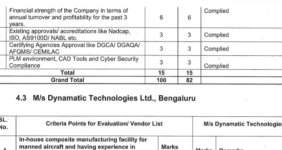
Looks like L&T-BEL-Dynamatic scored the highest of the three
I love it!!!
BYE BYE HAL!!
All those LCA orders to full the order book to the brim!
Just to lower their rating. This is well thought out and pre-meditated move by everyone involved.
From stuffing hal up to making the distinct criteria list. Ah! Sukoon
Admin, Shall we have a poll among these 3 finalists?
3 finalists were not announced..
 Taking support of Chini now.
People are more interested in talking about HAL's exclusion than actually discussing how the three consortiums shortlisted for the program plan to build the AMCA.
Hindustan Aeronautics Limited (HAL) has reportedly been excluded from India’s next big defence aviation project—the AMCA, a fifth-generation fighter jet programme worth INR 15,000 crore. For decades, HAL has led India’s aircraft manufacturing. But missed deadlines, delayed deliveries, and stalled engine projects have raised concerns. The Indian Air Force needs more jets. And with HAL falling short, private players are stepping in. The Air Chief has voiced his frustration. This shift marks a major reset in India’s defence manufacturing strategy—where competition, timelines, and delivery now matter more than legacy.
Not really. HAL CMD was just trying to gaslight his shareholders that they have a way back into AMCA program. Their stock is down 12-13% in two days.
Things are getting interesting.

And HAL already has too much on their plate, with 180 Mk1A, 12 Su-30 MKI, 156 LCH, 72 HTT-40, dozens of ALH Dhruv and Do228s etc on order, and would get orders for hundreds of LCA Mk2 or who knows Su-57 as well, so even if they had bagged the AMCA tender they would still need to create a fresh new capacity for the project from scratch to produce it in large numbers, which is what private consortium will do.
"NO import, let the forces suffer" gang started showing true colors out of frustration now.
Chinese MIC is made of atleast 5 different mega companies (AVIC, CAC, SAC, XAC, Hongdu ) who can produce fighters. There are multiple competing designs for each category of Chinese Air Force requirements. That's why you see so many mini bomber and UAV designs from China.
HAL is a state monopoly, we need alternative and competition, period.
In my assumptions the L1 will be L&T with partners, L 2 will be TASL, and L3 will be BHARAT FORGE with partners. The work share may be like L1 70%, L2 20%, L3 10%. Other 4 non selected will be components suppliers.And HAL already has too much on their plate, with 180 Mk1A, 12 Su-30 MKI, 156 LCH, 72 HTT-40, dozens of ALH Dhruv and Do228s etc on order, and would get orders for hundreds of LCA Mk2 or who knows Su-57 as well, so even if they had bagged the AMCA tender they would still need to create a fresh new capacity for the project from scratch to produce it in large numbers, which is what private consortium will do.
But problem is, the consortium should've been formed a long time ago as DcPPs not now, so that they could absorb product design capabilities as well, instead of just screwdrivering and rent seeking on existing products. TASL would be making at least 55 C-295 in India, will they absorb design capabilities? I doubt. Same goes for the Joint Venture firm that will manufacture at least 114 Rafales in India, will they in future once orders dry up, be able to design and pitch their own products? Less said about Adani D&A the better.
HAL for all it's shortcomings have been able to design many products, irrespective of the shortcomings and delays. Including turboprop and jet trainers along with turbojet, turbofan and turboshaft engines of own design. CATS programme is their own R&D. Point is, those Joint Venture firms and Consortiums need to create own ARDC equivalent otherwise they will remain just an assembly line for ADA and foreign aerospace firms.
In my assumptions the L1 will be L&T with partners, L 2 will be TASL, and L3 will be BHARAT FORGE with partners. The work share may be like L1 70%, L2 20%, L3 10%. Other 4 non selected will be components suppliers

The only engine they made was a small turbojet, and that was few decade ago. Zero progress in HTSE and HTFE.HAL for all it's shortcomings have been able to design many products, irrespective of the shortcomings and delays. Including turboprop and jet trainers along with turbojet, turbofan and turboshaft engines of own design. CATS programme is their own R&D. Point is, those Joint Venture firms and Consortiums need to create own ARDC equivalent otherwise they will remain just an assembly line for ADA and foreign aerospace firms.


Talent retention can be an issue for a State owned corporation. However, unless the HR dept. at the pvt. org. is completely incompetent, it can always amend the guidelines and practices to adapt to the current market trends/needs. The problem with DPSUs starts with a set of constraints within which they must operate. Hiring the best possible is less feasible for them in comparison to Pvt. organisations. This is just one problem amongst a host when it comes to Talent management for PSUs. As you stated, picking up some employees can always be achieved by being, amongst other things, flexible and generous.Imo, what pvt companies lack in experience, they make up for in terms of precision manufacturing and automated assembly. As someone said earlier, experienced design talent can always be acquired ex HAL or DRDO.
Iirc, it wasn't until LCA Mk1A that HAL started making parts that were interchangeable across airframes. This was one of the key maintenance improvements demanded by the IAF.
(earlier, HAL used bespoke hand-made parts that you'd otherwise associate with boutique car mfgrs like Bentley or Maybach)
As a subcontractor to HAL, L&T lost no time in automating wing fabrication for Mk1A using robotic sheet cutting and drilling tech.
Besides, project management hasn't been one of HALs biggest strengths. Otoh, pvt companies follow global best practices to win orders and fulfill them on time.
Imo, what pvt companies lack in experience, they make up for in terms of precision manufacturing and automated assembly. As someone said earlier, experienced design talent can always be acquired ex HAL or DRDO.
Talent retention can be an issue for a State owned corporation. However, unless the HR dept. at the pvt. org. is completely incompetent, it can always amend the guidelines and practices to adapt to the current market trends/needs. The problem with DPSUs starts with a set of constraints within which they must operate. Hiring the best possible is less feasible for them in comparison to Pvt. organisations. This is just one problem amongst a host when it comes to Talent management for PSUs. As you stated, picking up some employees can always be achieved by being, amongst other things, flexible and generous.
If there is long term visibility of orders, pvt companies will certainly invest in in-house R&D. In the case of Baba Kalyani, he ventured into arty mfg without any assurances of orders from MoD/GoI.And it's not like there is no experience altogether. Granted, they don't have experience in building a complete aircraft. But all 3 have substantial experience in building various aerospace Components, FA parts, electronics etc. They also have their vendors , supply chain and there is no restriction that they cannot source components from other Indian firms.
Most importantly, major part of Initial R&D is/will be done by ADA. If these three consortia are serious and sincerely try to absorb the R&D culture, establish in house labs, testing facilities etc.. then this could work.
Just one thing needs to remain constant, and that is administrative support. If every factory, plants, land get stuck due to some file and a babu.. that will just kill the project enthusiasm.
WE can only hope that GOI gets strictly behind these two (AMCA+ENGINE) Program and doesn't allow rent seekers to create issues ( and doesn't become a rent seekers of their own).