Indian Missiles and Munitions Discussion

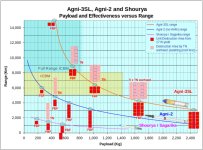
Considering the missile diameter and the fact we've tested only 6 times, if it is MIRV the MIRVed warheads will only be 15 maybe 20 kilotons, maybe with boosting 25-30 kilotons. Not more than that. And even then perhaps it can carry only 2 warheads.
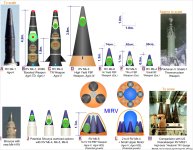
Won't speculate on yields but the K4 nose cone appears to have an ogive shape (unlike the conical nose on A5 et all) which should theoretically allow for 2-3 RVs of 50cm dia.

First Soviet SLBMs were single warhead and believe it or not iirc under SALT Treaty for some years Trident had only 1 warhead too 😂. Edit: that was actually Minuteman which is land based. But the earlier Chinese SLBMS JL1 and even JL2 is described as MIRV capable but deployed in single warhead config in open sources.
Barring tech limitations, India is under no obligation to limit MIRV deployment on its missiles. Given the deployment of ABM/ASAT by our eastern adversary, MIRV is no longer optional, imo.
 
Last edited:
Won't speculate on yields but the K4 nose cone appears to have an ogive shape (unlike the conical nose on A5 et all) which should theoretically allow for 2-3 RVs of 50cm dia.


Barring tech limitations, India is under no obligation to limit MIRV deployment on its missiles. Given the deployment of ABM/ASAT by our eastern adversary, MIRV is no longer optional, imo.
The limitations are technological not Treaty as you said and they are even worse than Treaty obligations. K4 is not a normal missile and I highly doubt Chinese ABM is capable of intercepting all K4s launched at them.

Chinese have achieved superior miniaturization than us due to more testing and JL2 has a much higher diameter than K4 and even then they struggled to deploy MIRV capable JL2 so I think it's highly unlikely K4 can be made to carry more than 2 warheads that too of only fission or boosted fission designs. There was a leaked image of Rajnath visiting RCI in Hyd and in the background they showed the MIRV bus and what appeared to be dummy warheads on the bus, and they looked very big, taller than a human if not as tall and I'm sure that are 200 kt as R Chidambaram revealed that the nukes we tested in Pokhran can be scaled up to 200 kt. The US W88 warhead is less than half the height of a human and reaches 475 kilotons. Considering this, its impossible to put multiple of any 100 kt or above 2 stage warhead on K4. K4 diameter is too small.

Are MIRVs of 15-20 kt worth having? If striking military airbases, ports, airports, etc then yes, but it's not enough to destroy huge cities. So, we will need bulk of K4s to carry single warhead of 200 kt.
 
Won't speculate on yields but the K4 nose cone appears to have an ogive shape (unlike the conical nose on A5 et all) which should theoretically allow for 2-3 RVs of 50cm dia.
It is possible, we just not sure yet about it. For a 2nd strike purpose it also depend on whom you want to target. Not much need against pak, can be useful against others but for this you need certain mastery over the tech which can be achieved once the basic is proven.

For test purpose drdo ansp use the conical rv with the cylindrical ejectable nosecone on top as the pseudo stage. Ogive shape means it is a fairing and there is no picture or any suggestion yet on this being true for a 1.4m dia stage.
Higher payload mass is due to K-4 itself having transitioned from old metallic airframe to now all composite airframe & compatible higher isp composite propellant, lighter avionics etc. This means either or both combination of payload mass / range increase. They still quote the old range so obviously payload is greater.
To implement mirv, one can definitely use the new smaller rv being made now. There are various dia sized are being made now. So some version will have mirv payload while some with higher yield single payload.
 
  • Like
Reactions: Speedster1
Posted by ex Bharat rakshak member Haridas kukkur
The thing is this is literature , ie scientific knowledge/theory. No one would hand down the product specific engineering used in it. You will have to make this theory scaled into the product both for the delivery system and the payload itself. That takes half a century or more years work to get into a position of making it, then prove the same in flight tests. We are at this flight stage for now, miniaturisation can follow once the tech is proven & data available on hand.
 
I'd say SLBMs are MIRV capable by default. K4 would be no exception, esp in our strategic scenario. This missile will form the core of our 2nd strike N capability for the next 7-10 years. S5 is still a long way off.
Most SLBMs that are made so far have matured into very long range system , with much higher dia stages & hence mirv yield. This also depends on the carrier vehicle ssbn somewhat because you need the sea leg to be a 2nd strike option. Now consider that usa Rus got ssbn with much higher tonnage able to carry huge slbm, so the volume and size both are addressed.
We only started out and slbm'ed the first long range system we made, that is A4 of 1.2m dia to 1.4m dia K-4. Such a slim missile is literally IRBM class and if mirv is implemented range would further decrease, but would be suitable for a pocket sized ssbn like the Arihant class that likely has limitation about how powerful a BM it can fire from underwater. So if K-4 has to rely on a nose mounted ejectable tractor puller setup for launch and has the RCS unit + countermeasure to deceive enemy bmd, obviously certain restriction can be there wrt mirv implementation. Now up to the decision makers to decide.
 
For test purpose drdo ansp use the conical rv with the cylindrical ejectable nosecone on top as the pseudo stage
If you're referring to the nose cap on K15 that's a protective cover jettisoned after the weapon surfaces from the sea.

Ogive shape means it is a fairing and there is no picture or any suggestion yet on this being true for a 1.4m dia stage.
As you pointed out, K4 has a ejection motor mounted atop the actual nose cone fairing. So it is unlikely to be conical in the same mould as A5, in my view.

Some commentators even say that it might have a blunt nose based on the airflow pattern observed during a previous flight test.

 
Last edited:
  • Like
Reactions: YoungWolf and Shan
If you're referring to the nose cap on K15 that's a protective cover jettisoned after the weapon surfaces from the sea.
I meant K-4, underneath its the blunt top conical rv for the test missions.
As you pointed out, K4 has a ejection motor mounted atop the actual nose cone fairing. So it is unlikely to be conical in the same mould as A5, in my view.

Some commentators even say that it might have a blunt nose based on the airflow pattern observed during a previous flight test.
Although the 1.4m crmc is quite powerful as used in asat stage, for traversing underneath the water surface it is probably better to use this mechanism.

I think due to presence of a liquid rcs package for the third/final stage , any mirv system we make will be for a rocket that is proven to deliver a min 3 ton class payload. Without such a mass haul capacity, design choice will not have enough freedom to include the countermeasure, decoys, rcs package etc along with miniature payload. Payload is still a miniturised rv, inside it has similar setup to the original big rv bays for electronics, rcs module, chaff flare etc. So there need to be some freedom else weight penalty will reduce the performance. Not sure they will use dumb rv in real case.
 
  • Like
Reactions: Speedster1
Can we achieve 1000- 1200km range with rudram3, if we convert it for AShM roles, changing it's trajectory
Making it a BGRV? @marich01 @Speedster1
In current spec, no. Range is one of primary fixed constraint that has to be defined at the start of its initial design & conceptualisation. The flight path ie trajectory is varied/shaped accordingly with suitable guidance & navigation programming. But the max/min range has to be defined from the start. Hence Rudram 3 is conceptualised with max 550km engagement zone.
 
In current spec, no. Range is one of primary fixed constraint that has to be defined at the start of its initial design & conceptualisation. The flight path ie trajectory is varied/shaped accordingly with suitable guidance & navigation programming. But the max/min range has to be defined from the start. Hence Rudram 3 is conceptualised with max 550km engagement zone.
with that diameter & size it can achieve the hypersonic speed and 1000km range with a quasi ballastic trajectory, with steep dive we can achieve the desired parameters right?
 
with that diameter & size it can achieve the hypersonic speed and 1000km range with a quasi ballastic trajectory, with steep dive we can achieve the desired parameters right?
Its not like that. Rudram 2 with total flight time of 300sec is designed for 300-330km range within which various trajectories are implemented via software & other control process. Actual rocket motor burn is for much less time, up to reaching certain altitude. With the acceleration gained it can go few 10km or so but can not cover 100 of km distance.
Hence for rudram 3 they used dual pulse mode and a more powerful booster so it need not spend the thrust from the dual pulse motor to gain the desired altitude then start the mid-course flight. They could have just made an uniform body cylindrical airframe with 1 single motor to do everything but it would need a continuous propulsion like ramjet operation to cover the desired 550km range. Here the altitude gain is much smaller < 40-50km as opposed to BM gaining way more height > 70km. Therefore solid rocket motor based system has limitation for atmospheric flight wrt total distance covered & how fast it is flying.
 
Its not like that. Rudram 2 with total flight time of 300sec is designed for 300-330km range within which various trajectories are implemented via software & other control process. Actual rocket motor burn is for much less time, up to reaching certain altitude. With the acceleration gained it can go few 10km or so but can not cover 100 of km distance.
Hence for rudram 3 they used dual pulse mode and a more powerful booster so it need not spend the thrust from the dual pulse motor to gain the desired altitude then start the mid-course flight. They could have just made an uniform body cylindrical airframe with 1 single motor to do everything but it would need a continuous propulsion like ramjet operation to cover the desired 550km range. Here the altitude gain is much smaller < 40-50km as opposed to BM gaining way more height > 70km. Therefore solid rocket motor based system has limitation for atmospheric flight wrt total distance covered & how fast it is flying.
Let's say a cylindrical shaped dual pulse missile, with a booster, fly near edge of the edge of the atmosphere, Guided through satcom in mid phase enters into lower atmosphere 2nd stage motor Kicks in glides towards the target, the RF/ IIR/ MMW seekers locks onto it and makes a steep dive with High terminal velocity, can it cover such distance & with High speed?
 
Let's say a cylindrical shaped dual pulse missile, with a booster, fly near edge of the edge of the atmosphere, Guided through satcom in mid phase enters into lower atmosphere 2nd stage motor Kicks in glides towards the target, the RF/ IIR/ MMW seekers locks onto it and makes a steep dive with High terminal velocity, can it cover such distance & with High speed?
If fired in a lofted trajectory at altitude, it should be able to boost coast over a longer distance while retaining good maneuverability thanks to the midbody fins. I'm just not sure it could fly 2x the range though.
 
If you're referring to the nose cap on K15 that's a protective cover jettisoned after the weapon surfaces from the sea.


As you pointed out, K4 has a ejection motor mounted atop the actual nose cone fairing. So it is unlikely to be conical in the same mould as A5, in my view.

Some commentators even say that it might have a blunt nose based on the airflow pattern observed during a previous flight test.

This dude in the tweet is assuming too much. The expanded exhaust plume is due to high altitude, not the nose cone. At high altitude the atmosphere is thin and doesn't exert enough pressure to contain the exhaust gases in a tight area and they expand very quickly.
At that distance and altitude the exhaust is the only thing visible. You can't see the missile.
 
Ok... my comments give epileptic fits to some people over here . So I will write this comment and do the runner.

The video being posted is old video of the pontoon test, and no new video is available.

he video in circulation
I noticed something.

The missile has 2 ejection systems working simultaneously.
Anyone knows why ?

InShot_20251227_090408544.jpg
 
This dude in the tweet is assuming too much. The expanded exhaust plume is due to high altitude, not the nose cone. At high altitude the atmosphere is thin and doesn't exert enough pressure to contain the exhaust gases in a tight area and they expand very quickly.
At that distance and altitude the exhaust is the only thing visible. You can't see the missile.
No. He's talking about the airflow separation at the nose tip.
 
Let's say a cylindrical shaped dual pulse missile, with a booster, fly near edge of the edge of the atmosphere, Guided through satcom in mid phase enters into lower atmosphere 2nd stage motor Kicks in glides towards the target, the RF/ IIR/ MMW seekers locks onto it and makes a steep dive with High terminal velocity, can it cover such distance & with High speed?
It will defeat the purpose & won't be cost effective. As the missile development cycle goes, below iteration is standard practice

1766830587040.png

so for a tactical battlefield missile, the aim is to be cost effective while having high degree of accuracy & being able to operate in tightly fought over battle space. That means working in dense ew environment, having counter to enemy jam/spoof effort , able to defeat enemy AD and being undetected as much possible with very short mission time. Battlefield AD systems cover altitude upto 18-20km at best , 25 is a stretch. So your Rudram needs to be flying just above this zone, fly fast and conclude mission within short span.

So why would you want to send it up to edge of atmosphere at 70km ? This would mean enemy OTH radar will be able to track it & be aware of it much ahead of time. Second point, to send it up to that altitude you will need a bigger booster ie heavier missile, not suitable for air launch.

Then even if you have made it glide from an altitude like 70km, the acceleration gained will be much greater than the thrust provided by the 2nd pulse itself ie the 2nd pulse motor will be useless. If you already have high acceleration due to coming down from 70km above, your airframe will generate some aerodynamic lift, enough to make you glide at high speed if there are suitable control surfaces. So the 2nd motor will not add to this kinetic acceleration and enhance it. Therefore you can only cover a 100km or some more but not go from a 550km range to 1000km+ range. To cover such distance , your rudram has to be bigger & differently conceptualised, or use something like ramjet/scamjet/turbojet etc propulsion.

Then comes the weapon delivery system method, explained in below gist , which is another challenge on its own.

1766831701043.png
1766831717540.png
 
View attachment 48601View attachment 48613
Posted by ex Bharat rakshak member Haridas kukkur

If we follow the Moore's law, then the miniaturization has happened to a great level, keeping the rigidity of aerospace grade electronics intact for heavy duty work, better cabling procedures, better and compact very high redundancy check PLCs onboard having multiple backups in case of IC frying up, the electronics will function to the last chip.