
The IAF should consider converting civilian B767/A330 class ac as mil transports to reduce the wear and tear on the C-17 fleet imo. But the window of opportunity may be closing now that civil air traffic is picking up again.
Medium Transport Aircraft (MTA) for IAF
- Thread starter Fatalis
- Start date
-
- Tags
- embraer c-390
You are using an out of date browser. It may not display this or other websites correctly.
You should upgrade or use an alternative browser.
You should upgrade or use an alternative browser.


Lockheed Martin and Tata Advanced Systems Announce Agreement to Expand C-130J Super Hercules Opportunities in India
Agreement Supports India's Medium Transport Aircraft Program and New Maintenance Facility
DELHI, India, Sept. 10, 2024 /PRNewswire/ -- Lockheed Martin (NYSE: LMT) and Tata Advanced Systems Limited have entered into a teaming agreement to expand upon the companies' business relationship through the C-130J Super Hercules tactical airlifter. This announcement marks a significant step in enhancing India's defence and aerospace capabilities while also deepening India-U.S. strategic ties.
This agreement provides a framework for collaboration on future potential business opportunities to include:
- Establishing a Maintenance, Repair and Overhaul (MRO) facility in India to support the Indian Air Force's (IAF) existing fleet of 12 C-130Js as well as other global Super Hercules fleets;
- Expanding C-130J manufacturing and assembly in India to produce aircraft for the IAF's Medium Transport Aircraft (MTA) program, subject to U.S. and Indian government approvals.
"Collaborating with Lockheed Martin on the C-130J platform proposition for IAF's MTA project is a milestone for Tata Advanced Systems," said Sukaran Singh, chief executive officer and managing director of Tata Advanced Systems. "The current announcement is also significant as it marks the entry of Tata Advanced Systems into the defence MRO space in India for large aircraft platforms. This also helps towards a deeper relationship between the two companies, adding to the aerostructure work by Tata Advanced Systems for Lockheed Martin platforms."
"The C-130J is known as the world's workhorse, not just for its large global presence, but also for its international supply chain partners including the single source provider of empennages — Tata Lockheed Martin Aerostructures Limited in Hyderabad," said Rod McLean, vice president and general manager of the Air Mobility and Maritime Missions line of business at Lockheed Martin. "This teaming agreement between Lockheed Martin and Tata Advanced Systems further demonstrates Lockheed Martin's commitment to a self-reliant India and the degree of confidence that exists in our relationships with our partners in India and the Indian industry at large."
The IAF is actively seeking to acquire up to 80 medium transport aircraft and issued a request for information (RFI) last year. Lockheed Martin responded to the RFI as the C-130J-30 Super Hercules is ideally suited to meet the requirements.
Lockheed Martin and Tata Advanced Systems Limited have a long-standing partnership through the Tata Lockheed Martin Aerostructures Ltd., (TLMAL) joint venture. Established in 2010, TLMAL exemplifies the government of India's "Make in India" objectives and has the distinction of being the single global source of C-130J empennage assemblies included on all new Super Hercules aircraft produced in the United States. To date, TLMAL has manufactured more than 220 C-130J empennages.
Medium Transport Aircraft to be procured will replace AN-32 and IL-76 fleets of IAF
The Medium Transport Aircraft, in the 18-30 tonne category, that is planned to be procured by the Indian Air Force (IAF) is going to be a common replacement for the aging AN-32 and IL-76 transport aircraft fleet.The AN-32 is the workhorse of the IAF with over 100 aircraft in service and the IL-76 with over 40 tonne load capacity is in the heavy lift category. A combined replacement shows the changing transport requirements of the force.
“As far as the MTA is concerned, the fleet that is aging is the AN-32 and IL-76. We need to find a replacement for these. The decision that has been taken is we will go for a common aircraft of 18-30 tonnes and for that the RFI has been issued. We have not shortlisted which aircraft we will be going for,” IAF Chief Air Chief Marshal A.P. Singh said on Thursday.
The IAF issued a Request for Information (RFI) for a MTA in December 2022 with a load carrying capacity between 18 to 30 tonnes for up to 80 aircraft. A comprehensive study was also carried out to identify the current and future payload carrying requirements of the force. There are three responses to the RFI which include Airbus A-400M, Lockheed Martin C-130 and Embraer C-390. Among them, the A-400M has a maximum carrying capacity of 37 tonnes, the C-130 close to 20 tonnes and the C-390 can carry up to 26 tonnes.
The 2020 standoff with China in Eastern Ladakh has changed the nature of airlift and the support for the Army required in high altitude areas. There is a huge gap in carrying capacities at the moment with the current aircraft which needs to adjusted, as reported earlier.
The transport fleet of the IAF currently consists of over 100 AN-32s, 56 AVROs in the process of being replaced with the Airbus C-295, IL-76 heavy transports, and IL-78 mid-air refuelling tankers from Russia, 12 C-130J Super Hercules and 11 C-17 Globemaster strategic airlift aircraft from the U.S. Of these, the IL-76 has a capacity to list 45-50 tonnes and the C-17 up to 70 tonnes.
As the deal makes progress, U.S. defence major Lockheed Martin and Tata Advanced Systems Limited (TASL) announced collaboration for establishing a Maintenance, Repair and Overhaul (MRO) facility in India to support the IAF’s fleet of 12 C-130J Super Hercules transport aircraft as well as other global C-130J fleets.
Similarly, Brazilian aircraft manufacturer Embraer Defense & Security and Mahindra signed a Memorandum of Understanding (MoU) to jointly bid for the MTA tender.
The MTA fits a critical requirement of the Army which is looking on the process of procuring a light tank weighing up to 25 tonnes for deployment in the mountains especially in Eastern Ladakh. So, IAF needs sizeable number of aircraft to airlift them.
In September 2021, the Defence Ministry signed a ₹21,935 crore contract with Airbus and Space S.A., Spain for procurement of 56 C-295MW transport aircraft, with a capacity of nine tonnes, to replace the Avro aircraft in service.
While the RFI did not specify the number of MTA required, vendors have been asked to provide “Rough Order of Magnitude (ROM) cost of aircraft and associated equipment” for a batch of 40, 60 and 80 aircraft. With the IAF deciding to make MTA replacement for both AN-32 and IL-76, clarity on the numbers is now awaited.

Poll added. 
It appears that the Embraer C390 is best suited to meet the requirements. It has a clear advantage in airlifting light tank and FICV. The Airbus A400M is extremely expensive to purchase and operate. It has all the disadvantages of a European collaboration, like the Eurofighter and Tiger. I wish the Kawasaki C-2 were in the race. We could have localized it with only an active production line and even exported it. Japanese need to wake up!.
It appears that the Embraer C390 is best suited to meet the requirements. It has a clear advantage in airlifting light tank and FICV. The Airbus A400M is extremely expensive to purchase and operate. It has all the disadvantages of a European collaboration, like the Eurofighter and Tiger. I wish the Kawasaki C-2 were in the race. We could have localized it with only an active production line and even exported it. Japanese need to wake up!.

I think a portion of An-32 RE will be replaced by C-295Ws. The An-32 RE can do 7.5 tons payload while C295W can do 7 tons. In special cases it can be overloaded to 9 tons. So it's a perfect replacement.Medium Transport Aircraft to be procured will replace AN-32 and IL-76 fleets of IAF
The Medium Transport Aircraft, in the 18-30 tonne category, that is planned to be procured by the Indian Air Force (IAF) is going to be a common replacement for the aging AN-32 and IL-76 transport aircraft fleet.
The AN-32 is the workhorse of the IAF with over 100 aircraft in service and the IL-76 with over 40 tonne load capacity is in the heavy lift category. A combined replacement shows the changing transport requirements of the force.
“As far as the MTA is concerned, the fleet that is aging is the AN-32 and IL-76. We need to find a replacement for these. The decision that has been taken is we will go for a common aircraft of 18-30 tonnes and for that the RFI has been issued. We have not shortlisted which aircraft we will be going for,” IAF Chief Air Chief Marshal A.P. Singh said on Thursday.
The IAF issued a Request for Information (RFI) for a MTA in December 2022 with a load carrying capacity between 18 to 30 tonnes for up to 80 aircraft. A comprehensive study was also carried out to identify the current and future payload carrying requirements of the force. There are three responses to the RFI which include Airbus A-400M, Lockheed Martin C-130 and Embraer C-390. Among them, the A-400M has a maximum carrying capacity of 37 tonnes, the C-130 close to 20 tonnes and the C-390 can carry up to 26 tonnes.
The 2020 standoff with China in Eastern Ladakh has changed the nature of airlift and the support for the Army required in high altitude areas. There is a huge gap in carrying capacities at the moment with the current aircraft which needs to adjusted, as reported earlier.
The transport fleet of the IAF currently consists of over 100 AN-32s, 56 AVROs in the process of being replaced with the Airbus C-295, IL-76 heavy transports, and IL-78 mid-air refuelling tankers from Russia, 12 C-130J Super Hercules and 11 C-17 Globemaster strategic airlift aircraft from the U.S. Of these, the IL-76 has a capacity to list 45-50 tonnes and the C-17 up to 70 tonnes.
As the deal makes progress, U.S. defence major Lockheed Martin and Tata Advanced Systems Limited (TASL) announced collaboration for establishing a Maintenance, Repair and Overhaul (MRO) facility in India to support the IAF’s fleet of 12 C-130J Super Hercules transport aircraft as well as other global C-130J fleets.
Similarly, Brazilian aircraft manufacturer Embraer Defense & Security and Mahindra signed a Memorandum of Understanding (MoU) to jointly bid for the MTA tender.
The MTA fits a critical requirement of the Army which is looking on the process of procuring a light tank weighing up to 25 tonnes for deployment in the mountains especially in Eastern Ladakh. So, IAF needs sizeable number of aircraft to airlift them.
In September 2021, the Defence Ministry signed a ₹21,935 crore contract with Airbus and Space S.A., Spain for procurement of 56 C-295MW transport aircraft, with a capacity of nine tonnes, to replace the Avro aircraft in service.
While the RFI did not specify the number of MTA required, vendors have been asked to provide “Rough Order of Magnitude (ROM) cost of aircraft and associated equipment” for a batch of 40, 60 and 80 aircraft. With the IAF deciding to make MTA replacement for both AN-32 and IL-76, clarity on the numbers is now awaited.
I see half of An32 squadrons getting C295s and other half C390s.
Embraer Deepens Commitment to India with New Subsidiary
New subsidiary and corporate office mark Embraer’s expanded footprint in India to pursue opportunities across defense, commercial aviation, business aviation and service & support sectorsNew Delhi, India, May 30, 2025 – Brazilian aerospace and defense major Embraer today announced a significant reinforcement of its commitment to India with the establishment of a fully owned Indian subsidiary which will have its corporate office in AeroCity, New Delhi. This strategic move underscores Embraer’s long-term vision for growth and potential collaboration with India’s rapidly evolving aerospace and defense landscape.
The establishment of a subsidiary in India aims at strengthening its interests across defense, commercial aviation, business aviation, services & support and the burgeoning urban air mobility sector. Embraer is working on growing its team in the country, building capacity to capitalize on the opportunities within the country’s ever-evolving aerospace and defense industry. This includes establishing teams across corporate functions and specialized cells focused on procurement, supply chain and engineering.
“India is a key market for Embraer, and this expansion demonstrates our unwavering commitment to the country,” said Francisco Gomes Neto, President & CEO of Embraer. “We are excited to deepen our collaboration with the Indian aerospace and defense industry, leveraging our expertise and technology to contribute to the nation’s growth and Make in India efforts. We see significant opportunities across defense, commercial aviation, business aviation, services & support, and the emerging urban air mobility sector.”
Embraer is significantly deepening its engagement in India. The company has a substantial footprint with nearly 50 Embraer aircraft and 11 aircraft types currently operating in the country - from commercial aviation, defense and business aviation, all supported by Embraer’s service and support network in the country.
Embraer's growth in the country also underscores the strengthening of ties between Brazil and India, with Embraer’s expansion in the region reflecting a shared commitment to deeper collaboration and mutual growth. Embraer’s involvement in India, including participating at the upcoming IATA AGM 2025 in New Delhi, highlights the company’s strategic focus on the Indian market and ongoing efforts to engage with key stakeholders across the aviation ecosystem.
This announcement builds upon recent strategic moves Embraer has made in India, including an MoU signed in February 2024 between Embraer Defense & Security and Mahindra Defence Systems to evaluate the opportunity to jointly pursue the Indian Air Force’s Medium Transport Aircraft (MTA) program with the C-390 Millennium.
The C-390 is a new generation multi-mission aircraft designed and built to take on the demands of the 21st century operating environment. The aircraft is the most advanced in its class and flies faster (470kts) and further on a standard crew duty day. It also carries more cargo (26 tons) compared to other medium sized military cargo aircraft. The C-390 has been in operation for many years at Full Operational Capability and can perform a wide range of missions such as transporting and dropping cargo and troops, medical evacuation, search and rescue, humanitarian missions, firefighting and air-to-air refueling both as a tanker and a receiver.
On the commercial aviation front, the E-Jets family of regional and small narrowbody aircraft brings significant benefits to India’s air connectivity by unlocking ‘blue ocean’ opportunities found in tier two and tier three cities and contributing to India's aspirations of becoming a leading global aviation hub.
The E-Jets have transformed and enhanced regional connectivity as proven with Star Air – an all-Embraer operator of E175 and ERJ145 aircraft. With a range beyond the turboprop and capacity below the 180-seat narrowbody, the E-Jets are empowering airlines to tap on the next frontier of growth through enhanced regional connectivity and optimization of capacity to demand on thin routes.
Embraer aircraft that are operated by Indian Forces include the Legacy 600 aircraft used for the transportation of government officials and VIPs by the Indian Air Force (IAF) and Border Security Force (BSF) and the ‘Netra’ AEW&C aircraft based on the Embraer ERJ145 platform operated by the IAF.

IAF to buy up to 80 transport aircraft; US, Brazil, European firms in competition
The defence ministry is expected to soon initiate the procurement of medium transport aircraft (MTA) to bolster the Indian Air Force’s airlift capabilities | India News
 www.hindustantimes.com


Can't say whether one should be elated or depressed at this bit of news. This particular requirement along with the proposed development of the RTA should've taken off 2 decades ago as planned & we'd be inducting them both around this time.AoN by December end. Tender early next year.IAF to buy up to 80 transport aircraft; US, Brazil, European firms in competition
The defence ministry is expected to soon initiate the procurement of medium transport aircraft (MTA) to bolster the Indian Air Force’s airlift capabilities | India News
OTOH , important procurements like Refuellers have been pending since long & the procurement of ISR aircraft of various categories meandering & OTOH this is the second proposed procurement of transporters moving along smoothly after the C-295 .
I won't even bring up the procurement of MRFA for that's been done to death in here & out there. Seems to me both IAF & MoD / GoI apart from resigning themselves to being tied down by bureaucratic procedures , refusing to cut the Gordian Knot have also become fairly apathetic to the looming dangers surrounding us which leaves them free to pursue softer options like this in terms of procurement , priority or salience of the procurement be damned.
A victory in skirmish over a moth eaten Paxtan further boosting this sense of complacency & sense of BAU - business as usual.

Airbus & Embraer in the mix, IAF plans revamp of military transport fleet with MTA as new workhorse
Once acquired by IAF, the medium transport aircraft (MTA) will replace both AN-32s and IL-76s, it is learnt. The idea behind the revamp is to meet modern operational needs.
theprint.in
Airbus & Embraer in the mix, IAF plans revamp of military transport fleet with MTA as new workhorse
New Delhi: The Indian Air Force is firming up plans to revamp its airlift capabilities with a medium transport aircraft (MTA) that will be assembled in India and serve as its main workhorse, ThePrint has learnt.
The new aircraft is expected to fill critical gap between the ageing Soviet-era Antonov AN-32s and the larger Ilyushin IL-76s and will herald a new era in India’s military transport fleet.
Currently, IAF relies on multiple transport aircraft of varying lift capacity to meet its requirements. It is now streamlining the fleet to ensure commonality and ease of training and maintenance, with an eye on modern operational requirements.
Sources in the defence and security establishment told ThePrint Thursday that the MTA will replace both AN-32s and IL-76s in terms of numbers and capability.
IAF is currently in the midst of drawing up a request for proposal (RFP) for the aircraft and it is likely to be issued in the next fiscal year, sources said.
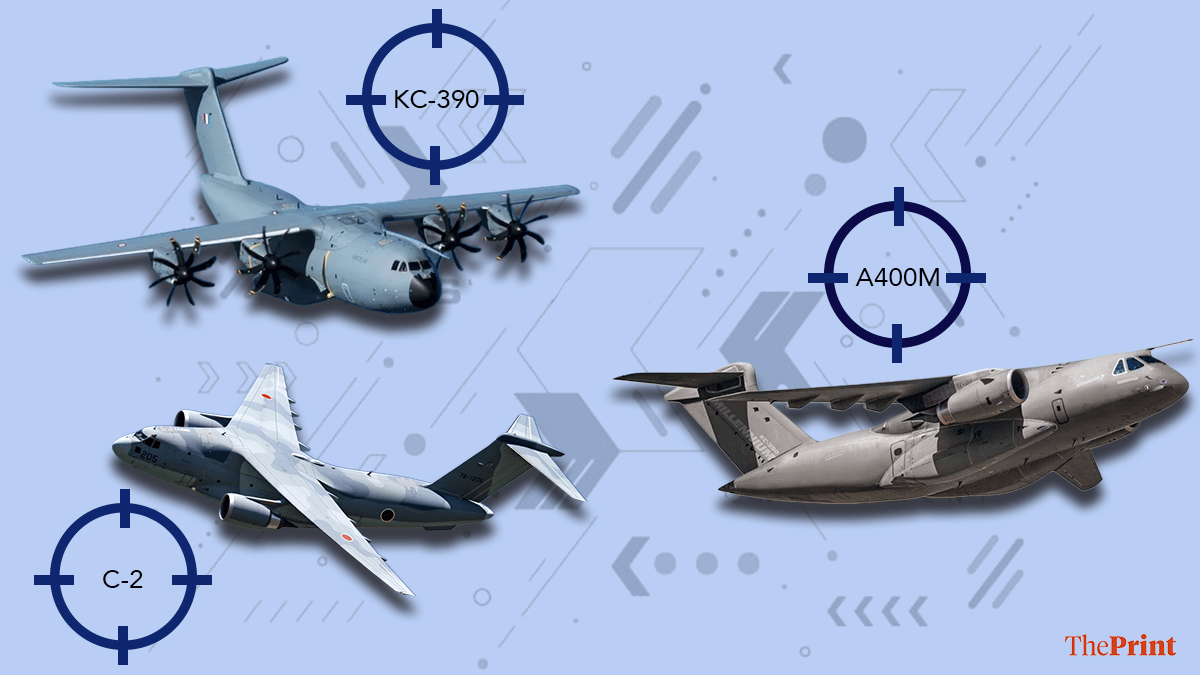
The main competitors for this project are Brazil’s Embraer, which has offered its latest KC-390 Millennium aircraft, and Europe’s Airbus with its A400M. Inputs indicate that Japan’s Kawasaki C-2 could also be an option.
Embraer, Airbus in mix for MTA order
The IAF, in December 2022, issued a request for information (RFI) to foreign original equipment manufacturers (OEMs) for an aircraft with a load capacity of 18-27 tonnes.The load capacity specification in the RFI meant Lockheed Martin’s C-130J Hercules met the minimum requirement, with its airlift capacity of about 20 tonnes. KC-390 by Embraer met the upper requirement, with its load carrying capacity logged at 26 tonnes. The Airbus alternative (A400M) goes beyond the specified requirement with its capacity of 37 tonnes.
It is learnt that earlier this year, IAF sent in another RFI with a ceiling limit of 30 tonnes and this could have even gone to the Japanese for their Kawasaki C-2.
RFIs allow the force to gather information from potential suppliers about their products and their capabilities. It is only the first stage of formal interaction with a manufacturer, after which the force firms up its plans and approaches the defence ministry for clearances before a formal tender is issued.
But if the IAF is looking at replacing the IL-76—which has a maximum capacity of 40 tonnes—it would need to increase the upper limit of the required load capacity.
Sources said that in such a case, the competition lies between Embraer and Airbus. The Japanese aircraft has a capacity of a little less than 37 tonnes but is reported to be cheaper than the Airbus. There were murmurs earlier that India could buy more C-130J from Lockheed Martin separately, but sources said there is no plan to split the MTA order.
Streamlining fleet
Sources explained that IAF is looking at revamping its transport aircraft fleet to meet modern needs. Instead of operating multiple aircraft of different weight categories, it is looking at something like the Airbus C-295MW to cater to the lower end (5-10 tonnes), and the C-130J Super Hercules to undertake missions where the need is up to 20 tonnes.The MTA will take care of the rest while the C-17 Globemaster III (with a load capacity of 70 tonnes) by Boeing remains for heavy lifting. India has ordered 56 C-295MW aircraft, and has an existing fleet of 11 C-17s. Sources said IAF does not plan to scout for second-hand C-17s since the aircraft is no more in production, and the force doesn’t need more at the moment. If Boeing restarts its production line, IAF might revisit this decision, they said.
Also part of the IAF fleet are 12 C-130s but they can’t lift light tanks.
Sources said IAF wants the medium transport aircraft to be capable of undertaking operations at high altitudes, and be able to land on and take off from unprepared runways like India’s Advanced Landing Grounds (ALGs) in Ladakh and the Northeast.
The latest contenders—KC-390, A400M and the C-2—differ not only in terms of load capacity but also when it comes to engines. The A400M and the C-2 are turboprops, while the KC-390 has a jet engine.
Another issue that needs to be looked at is the flying capacity of the aircraft. While the C-130J of the IAF has landed at Advanced Landing Ground in Daulat Beg Oldie (DBO), which is at 17,700 feet in Ladakh, the certified landing of the Embraer aircraft is only 14,000 feet.
Embraer officials argue that the aircraft is capable of landing at DBO but they are yet to exhibit the landing. The A400M can land onto short and unpaved airstrips where IL-76s and C-17s cannot. Airbus’s argument against its competition in the MTA programme is that its aircraft can carry heavy loads over longer distances and can fly up to a maximum altitude of 40,000 feet.

Kawasaki C-2 is the best option among all three...... Go Banzai


Liked the Go Banzai. Why do you say so, South Block? I see a lot of people leaning towards the Embraer offering.Kawasaki C-2 is the best option among all three...... Go Banzai

IAF operates IL 76 MD which has a capacity of 40 tones,
so A400 at 37 tones comes close to it.
Replacing both IL76 and AN32 with same air craft not a good idea,
IAF should focus on MTA first like C390
Also we can replace IL76 with Newer IL76, It is back in production. and has payload of 60 tones.
Everything you need to know about the Ilyushin Il-76
With war ending in near future we may get a chance with ordering them, but political and economic implications will be needed to be analyzed.
also Boeing may restart C17 production then we can replace il 76 with C17.
Boeing Hints at Restarting C-17 Production
IMO now deal with C390 for MTA but asking some production line in India. Though i wish A400.
so A400 at 37 tones comes close to it.
Replacing both IL76 and AN32 with same air craft not a good idea,
IAF should focus on MTA first like C390
Also we can replace IL76 with Newer IL76, It is back in production. and has payload of 60 tones.
Everything you need to know about the Ilyushin Il-76
With war ending in near future we may get a chance with ordering them, but political and economic implications will be needed to be analyzed.
also Boeing may restart C17 production then we can replace il 76 with C17.
Boeing Hints at Restarting C-17 Production
IMO now deal with C390 for MTA but asking some production line in India. Though i wish A400.
IAF operates IL 76 MD which has a capacity of 40 tones,
so A400 at 37 tones comes close to it.
Replacing both IL76 and AN32 with same air craft not a good idea,
IAF should focus on MTA first like C390
Also we can replace IL76 with Newer IL76, It is back in production. and has payload of 60 tones.
Everything you need to know about the Ilyushin Il-76
With war ending in near future we may get a chance with ordering them, but political and economic implications will be needed to be analyzed.
also Boeing may restart C17 production then we can replace il 76 with C17.
Boeing Hints at Restarting C-17 Production
IMO now deal with C390 for MTA but asking some production line in India. Though i wish A400.
Order C2 now.
And develop a 4 engines version of it with Japan, capable of 70 tons for future.
Kawasaki C-2...a turboprop?The latest contenders—KC-390, A400M and the C-2—differ not only in terms of load capacity but also when it comes to engines. The A400M and the C-2 are turboprops, while the KC-390 has a jet engine.
Contd..
Jokes apart, the IAF is probably better off buying KC-390 off the shelf with limited offsets (production of airframe components/avionics vs local assembly). It is likely to be cheaper than the A-400M and the very niche C-2.
License production will cost 2X the flyaway cost and delay deliveries. Given the MoF's endless foot-dragging over MRTT, this could result in another compromise in the form of a lease deal a few years down the line.
The C-17 line will, in all probability, be restarted as the USAF has no C-XX transport on the drawing board at the moment. So we can acquire more Globemasters in due course.
Jokes apart, the IAF is probably better off buying KC-390 off the shelf with limited offsets (production of airframe components/avionics vs local assembly). It is likely to be cheaper than the A-400M and the very niche C-2.
License production will cost 2X the flyaway cost and delay deliveries. Given the MoF's endless foot-dragging over MRTT, this could result in another compromise in the form of a lease deal a few years down the line.
The C-17 line will, in all probability, be restarted as the USAF has no C-XX transport on the drawing board at the moment. So we can acquire more Globemasters in due course.
Kawasaki C-2...a turboprop?
Contd..
Jokes apart, the IAF is probably better off buying KC-390 off the shelf with limited offsets (production of airframe components/avionics vs local assembly). It is likely to be cheaper than the A-400M and the very niche C-2.
License production will cost 2X the flyaway cost and delay deliveries. Given the MoF's endless foot-dragging over MRTT, this could result in another compromise in the form of a lease deal a few years down the line.
The C-17 line will, in all probability, be restarted as the USAF has no C-XX transport on the drawing board at the moment. So we can acquire more Globemasters in due course.
I kind of agree.
Instead of % of localisation, our focus should be % of control.
Can we install our own Self Protection Suite on it. Can we maybe install our own Mission Computers in future.
These types of accesses and capabilities are way more important.

Order C2 now.
And develop a 4 engines version of it with Japan, capable of 70 tons for future.
I have no hopes for Japanese jet..
Shinmaya aircraft talk went on and on..but nothing happened.
CMDS, radios, IFF etc can always be specified as customer furnished equipment (CFE). Mission computers are part of the core avionics.I kind of agree.
Instead of % of localisation, our focus should be % of control.
Can we install our own Self Protection Suite on it. Can we maybe install our own Mission Computers in future.
These types of accesses and capabilities are way more important.
Unless the IAF plans on making extensive modifications (along the lines of Netra Mk1), not worth the cost.