
A critical aspect that has been ignored amidst the hype. There are some rumours circulating around for now. Let's see what happens.Anything about building a high altitude test facility/flying testbed aircraft, etc.
You are using an out of date browser. It may not display this or other websites correctly.
You should upgrade or use an alternative browser.
You should upgrade or use an alternative browser.


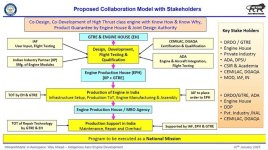

I hope the IN ties up with RR for this project else this has a high chance of resembling the way the Kaveri project unfolded.
24-28 MW is ~ 160-190 KN of thrust . The IN couldn't get the Marine Kaveri certified which delivered 12 MW to power their boats as the performance was inconsistent. How're they going to get this project going without outside help ?
Will the AL-31 play some part in it thru adaptation for naval application ?
I think they want to indigenize the Zorya-Mashproekt DT-59 engine. On paper this is doable. Most of the work has already been done with the Al-31FP's indigenization.I hope the IN ties up with RR for this project else this has a high chance of resembling the way the Kaveri project unfolded.
24-28 MW is ~ 160-190 KN of thrust . The IN couldn't get the Marine Kaveri certified which delivered 12 MW to power their boats as the performance was inconsistent. How're they going to get this project going without outside help ?
Will the AL-31 play some part in it thru adaptation for naval application ?


I didn't get this part . Is this related to the indigenization of the DT-59 MGT or is this an independent development ?I think they want to indigenize the Zorya-Mashproekt DT-59 engine. On paper this is doable. Most of the work has already been done with the Al-31FP's indigenization.
Which TF is DT-59 derived from , if at all ? Any idea ?
Further this is what I got from Wiki .
Power plant
edit
The Talwars features the Zorya designed and Mashproekt (Ukraine) manufactured M7N.1E gas turbine plant which comprises two DS-71 cruise turbines and two DT-59 boost turbines in two engine rooms. The cruising component consists of two DS-71 gas-turbine engines, each rated at 9,000 horsepower (6,700 kW) in forward running, and 1,500 hp (1,100 kW) in reverse. Two cruising RO63 two-speed gearboxes and one cruising R1063 auxiliary gearbox which makes it possible to use any of the cruising engines to drive both propeller shafts. A boost component with two DT-59.1 gas-turbine engines, each rated at 19,500 hp (14,500 kW) forward running, 4,500 hp (3,400 kW) in reverse and two RO58 single-speed reduction gearboxes. The four gas turbines are mounted on isolated cradles which minimize their contact with the hull and thereby considerably reduce the transmission of her vibration and sound.<a href="Talwar-class frigate - Wikipedia"><span>[</span>4<span>]</span></a><a href="Talwar-class frigate - Wikipedia"><span>[</span>37<span>]</span></a>
Electrical power is provided by four 1 MW Wärtsilä WCM-1000 generator sets with Cummins KTA50G3 engines and Kirloskar 1 MV AC generators. The contract for the generators was signed with Wärtsilä Denmark.
This is the first time I'm coming across boost turbines & cruise turbines or maybe I've passed by B Mech too far back to remember. Aren't turbines meant for boost anyway & cruise being the responsibility of diesel engines ?
Finally if the IN has no compunctions about copying Russian / Ukranian MTs why's it the IAF & GTRE are so adamant on going in for a western TF ?
Had we reverse engineered the RD-33 or its various improved versions or even the AL-31 FP , all this circus we're seeing on account of the delay in delivery of the F-404 would've been avoidable ?
Or are we to understand that the AF TFs from Russia / Ukraine have a low MTBO & TTSL whereas the MGTs are somehow technically superior & if so why ?
We don't know if it will be a clean sheet design or an indigenization effort. I am guessing it will be an indigenization of the DT-59. A lot of the alloys & coatings used in the DT-59 is similar/same to those used on the Al-31FP, for obvious reasons. Since we already make the Al-31 at Koraput it seems like a logical assumption.I didn't get this part . Is this related to the indigenization of the DT-59 MGT or is this an independent development ?
Russia had done a similar thing in the past. Some Russian Navy ships used to be equipped with Zorya-Mashproekt engines. The supply of those engines was stopped after Russia annexed Crimea. A few years later NPO Saturn made their own analogues to these Ukrainian engines which Russia now uses on their ships.
During the course of the Russo-Ukrainian war the Russian had bombed the Zorya-Mashproekt factory in Ukraine. Since we use those engines in our ships, we started a partial localization effort around that time:
India partially localizes Ukrainian gas turbine engines for ships - Militarnyi
Russia has recently offered the UEC/Saturn M-90FR marine gas turbine to India:
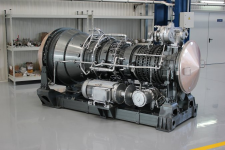
These engines produce 20.2 MW each compared to the 16.55 MW from the DT-59s
Probably this:Which TF is DT-59 derived from , if at all ? Any idea ?
Soloviev D-30 - Wikipedia
Well yes. Diesel engines produce steady power at good efficiency, so they are used for cruising. This is only true if you have a CODAG propulsion configuration. But if you go for a COGAG set up, then you use one set of turbines for cruise & another set for boost.This is the first time I'm coming across boost turbines & cruise turbines or maybe I've passed by B Mech too far back to remember. Aren't turbines meant for boost anyway & cruise being the responsibility of diesel engines ?
Had a fight about a similar subject few months back. Not getting sucked into this again.Finally if the IN has no compunctions about copying Russian / Ukranian MTs why's it the IAF & GTRE are so adamant on going in for a western TF ?
Had we reverse engineered the RD-33 or its various improved versions or even the AL-31 FP , all this circus we're seeing on account of the delay in delivery of the F-404 would've been avoidable ?
I'll only say this, IN has designed at least 2-3 generations of ships with Russian/Ukrainian MGTs. They also seem to maintain a pretty good availability rate for these MGTs. When was the last time you heard for a ship being pulled out of action for powerplant related problems.
It seems the phrase "Perfect is the enemy of good" applies here quite well. IAF wanted their first domestically designed 4th gen fighter to be perfect. They wanted it to be a good dog fighter, so it has to be very light- made of composite, have fly-by-wire & have a western TF engine. They also want it to be a modern multirole fighter. So, it has to have AESA radars, RWRs, datalink & BVR capabilities. They also want it to carry air to ground sensors & weapons. Oh & they also want it to be cheap & produced very quickly. All of this for a fighter that was meant to replace the Mig-21.
The naval equivalent of this would be a fast attack boat, made of composites, powered by MGTs. Equipped with MF-STAR, Brahmos & Barak-8. Also equipped for ASW sensors & weapons. Basically, the capability of NGMV & ASW-SWC combined together. Imagine if this was the 1st ship the Navy tried to design.
MGTs like turboshafts operate in much more forgiving environments. Thus, if maintained well all MGTs seem to have similar MTBOs & TTSLs.Or are we to understand that the AF TFs from Russia / Ukraine have a low MTBO & TTSL whereas the MGTs are somehow technically superior & if so why ?
Western TFs/MGTs are in many cases better. Power to weight ratio & fuel efficiency are 2 areas where western MGTs remain ahead.

Thanks for this . Just a couple of queries .
Neither do we have the expertise to develop a 160 -180 KN TF which is the reason I suggested a tie up with RR in the first place.
At best we've certain expertise & experience in mfg the AL-31 FP which gives an output of ~ 125 KN . The short fall is still significant.
I thought the saline environment the MGTs operate in is as unforgiving as the environment the TFs operate in from high mountains to deserts to plains to the seas & the multiple demands made on it from quick surges of power to equally quick throttling of it & so on much like in MGTs though perhaps it's much more pronounced in case of the former.
Besides Russian metallurgy was always considered inferior to that of the west . Wasn't that one of the reasons behind lesser MTBO & TTSLs for Russian TFs ?
Frankly I'm surprised to note both Russian / Ukrainian MGTs have more or less the same MTBO & TTSLs as western MGTs .
DT-59 offers an output of ~ 16 MW as you yourself confirm. How's the IN going to get an output of their targeted 24-28 MW from this ?These engines produce 20.2 MW each compared to the 16.55 MW from the DT-59s
Neither do we have the expertise to develop a 160 -180 KN TF which is the reason I suggested a tie up with RR in the first place.
At best we've certain expertise & experience in mfg the AL-31 FP which gives an output of ~ 125 KN . The short fall is still significant.
MGTs like turboshafts operate in much more forgiving environments. Thus, if maintained well all MGTs seem to have similar MTBOs & TTSLs.
I thought the saline environment the MGTs operate in is as unforgiving as the environment the TFs operate in from high mountains to deserts to plains to the seas & the multiple demands made on it from quick surges of power to equally quick throttling of it & so on much like in MGTs though perhaps it's much more pronounced in case of the former.
Besides Russian metallurgy was always considered inferior to that of the west . Wasn't that one of the reasons behind lesser MTBO & TTSLs for Russian TFs ?
Frankly I'm surprised to note both Russian / Ukrainian MGTs have more or less the same MTBO & TTSLs as western MGTs .
No idea. Which is why I am saying this is just my theory.DT-59 offers an output of ~ 16 MW as you yourself confirm. How's the IN going to get an output of their targeted 24-28 MW from this ?
MGTs are mostly derived from high bypass TFs. If a high bypass TF & a low bypass TF were to produce the same level of thrust, the high bypass engine would still run much cooler. This is because the engine is physically much larger, therefore the heat flux is much lower.Neither do we have the expertise to develop a 160 -180 KN TF which is the reason I suggested a tie up with RR in the first place.
At best we've certain expertise & experience in mfg the AL-31 FP which gives an output of ~ 125 KN . The short fall is still significant.
MGT don't have the space & weight constraints that low-bypass TFs have to deal with. So, maybe they plan on increasing the size of the engine, upping the compression ratio & using the newly developed blade alloys & TBCs. While this is not ideal from a power to weight ratio POV, it could still give us a working engine. We can think about weight/size optimization later.
These are just my guesses. Don't take them seriously.
RR's MT-30 is probably going to be procured & used on some future IN ships. I don't know if they would be open to a tie up since they already have a MGT in this category.
Ships have enough space to fit in filters, de-humidifiers, intercoolers on the intake of their MGTs. Most of the environmental effects can be counteracted with that. This is why you never have issues like bird strikes, foreign object damage, engine flame out, compressor stalls on MGTs.I thought the saline environment the MGTs operate in is as unforgiving as the environment the TFs operate in from high mountains to deserts to plains to the seas & the multiple demands made on it from quick surges of power to equally quick throttling of it & so on much like in MGTs though perhaps it's much more pronounced in case of the former.
Aircraft don't have that luxury.
MGTs, like high bypass TFs, don't require the highest end of metallurgy. Russian metallurgy isn't so inferior that it would affect their high-bypass TFs & MGTs. The difference is only noticeably large in low-bypass TFs.Besides Russian metallurgy was always considered inferior to that of the west . Wasn't that one of the reasons behind lesser MTBO & TTSLs for Russian TFs ?
Frankly I'm surprised to note both Russian / Ukrainian MGTs have more or less the same MTBO & TTSLs as western MGTs .
For example, try comparing contemporary Russian high bypass TFs (like PD-14 & PS-90) with Western high bypass TFs (PW1000G & CFM-56).

In marine applications.Neither do we have the expertise to develop a 160 -180 KN TF which is the reason I suggested a tie up with RR in the first place.
Size and weight is not as big of concern as in aircraft jet engines.
Its not about difficulty of achieving thrust, its the difficulty of twr.
The expertise of upscaling kaveri tech for marine applications is relatively very easy compared to developed a jet engine for fighter jets with same thrust.
You don't need twr of 10+ like in 5 th gen jets engines or 8-9 in 4 and 4+ gen jets engines.
Once dry kaveri is operational, we will have an operation 4+/middle of 4th gen jets engine tech in operational service.
A bigger engine for marine applications with 160-180kn thrust is not currently a leap for us technology wise to develop after developing kaveri.
Its more of a industrial and financial challenge, then technological.
Plus unlike jet engines in aircraft, marine ones are in less difficult enviornment, with no problem with optimal oxygen and airflow, and less extreme performance requirements relative to their capabilities
Tech wise its pretty doable.
Where did you get that figure from? Can you link the original article or interview you found this in?
View attachment 42138
Is this 1850K figure with or without TBC. When DMRL first developed the DMS4 alloy SC blades it could with stand ~1725K. The blade design was being improved with the introduction of cooling channels & holes. So, it is not surprising if the temp capacity of the DMS4 SC blades have improved.
Man if achieving the thrust wasn't so much of an issue why didn't the IN do the needful with the KMGT ? They got an output of 12 MW out of it way back in 2016 IIRC , good enough to power our NGCs .In marine applications.
Size and weight is not as big of concern as in aircraft jet engines.
Its not about difficulty of achieving thrust, its the difficulty of twr.
The expertise of upscaling kaveri tech for marine applications is relatively very easy compared to developed a jet engine for fighter jets with same thrust.
You don't need twr of 10+ like in 5 th gen jets engines or 8-9 in 4 and 4+ gen jets engines.
Once dry kaveri is operational, we will have an operation 4+/middle of 4th gen jets engine tech in operational service.
A bigger engine for marine applications with 160-180kn thrust is not currently a leap for us technology wise to develop after developing kaveri.
Its more of a industrial and financial challenge, then technological.
Plus unlike jet engines in aircraft, marine ones are in less difficult enviornment, with no problem with optimal oxygen and airflow, and less extreme performance requirements relative to their capabilities
Tech wise its pretty doable.
Yet they didn't proceed with the project then , in fact closing the project now choosing to go in directly with the development of a 24-28 MW MGT .
I'm sure they've worked out something for them to decide so else conventional wisdom dictates they go in for a 10-12 MW MGT first before progressing up the ladder for higher capacities.
Ditto for Diesel Engines. They ought to have gone in for indigenous development much earlier especially since Kirloskar Engines has been an old vendor of IN & is renowned in the industry for building robust diesel engines with decades of a good service track record.
Dry variant? Around 5.3 I think.@Gautam what's Kaveri Derivative's TWR?
Ask @ShiroBarks. This is from his twitter page.Where did you get that figure from? Can you link the original article or interview you found this in?
Huh. That's it? It doesn't sound that great.Dry variant? Around 5.3 I think.
Kay. Thanks.Ask @ShiroBarks. This is from his twitter page.
@ShiroBarks where did you get that info from?
Last edited:

Kay. Thanks.
@ShiroBarks where did you get that info from?
Sorry, tried searching, but can't seem to find the discussion now

India's 5th generation fighter programme - from MCA to AMCA
India defense forum users claim that this IRST image is old information meaning that they are probably not going with it in the end? Apparently there are users whom I am not going to say who show up in su-57 and PAK-DA threads on this forum posting old info images so its not that much of a...
 www.secretprojects.co.uk
I stick to that opinion btw, but when DRDO chief goes on stage, and says we need foreign help. Little one can do
Last edited:
Aw. Shucks. You got the screenshot of the entire article/interview?It was from some forum, they were discussing cooling methods and what we can achieve with DMS4 (1140°C raw material capability)
Sorry, tried searching, but can't seem to find the discussion now
Even if I were to die today, I'd die a happy man.