India-Russia Relations

I had a blogpost on Russia's energy exports and India's role in Oil.
India's Russian oil imports - the reality
With talks between the US and Russia initiated, with a view to ending the war, my latest post has my ideas on how the war might
end. Posting here as it's a vindication of Indian diplomacy where India has said from the outset that the way forward was a
negotiated settlement, with give and take on both sides, rather than fighting on till Russia was defeated and isolating Russia until then.
Ukraine war Part 12. How the war might end
 
Aircraft parts from UK, US routed through India to Russia skirting sanctions: Report

According to The Guardian, there has been a ban on direct sale of aircraft products to Russia, its airlines and other entities by the United Kingdom (UK) and European Union (EU). The direct sale is also restricted by the United States (US).

DH Web Desk
Last Updated: 21 February 2025, 15:37 IST
1740250281389.png
Since February 2022, UK had put extensive sanctions including ban on export for aviation, directing companies to make sure that the end destination of aircraft products isn't Russian soil. (Representative image)

Boeing and other British companies are amongst more than 100 other western companies that have exported aircraft parts to India which were re-exported/transported to Russian buyers. According to a report by The Guardian, an analysis of the data by the customs, has suggested that products worth Rs 433 crore ($50 million) have reached Russian airlines and their organizations through Indian intermediaries over a period of 21 months until September 2024.

Items including - sensors, propeller blades, critical generators and cockpit displays, filters, small screws and bolts - have been sent to Russia in 700 individual cargoes. It looks like the western firms are not aware of the fact that their products are being sent to Russia by India.

According to The Guardian, there has been a ban on direct sale of aircraft products to Russia, its airlines and other entities by the United Kingdom (UK) and European Union (EU). The direct sale is also restricted by the United States (US). Since February 2022, UK had put extensive sanctions including ban on export for aviation, directing companies to make sure that the end destination of aircraft products isn't Russian soil.

An analysis of the Indian customs data which was done by another publication and was accessed by The Guardian, suggested that about a dozen Indian firms acquired products from western companies which were later sent to Russian entities (buyers) between January 2023 and September 2024.

Over 60 cargoes containing products worth Rs 25 crore ($3 million) was sent to India's Shaurya Aeronautics by Step Aviation, which were sent to three Russian buyers. In October 2023, the US had applied economic sanctions on Shaurya for transporting sensitive dual-use parts to Russia, in order 'to diminish and degrade Russia’s ability to equip its war machine'.

According to the publication's report, it appears that another company named ASL Aerospace had also sent 60 shipments from UK and US for 4 Indian entities which were exported to Russia. One of the firms which had re-exported the shipments was Indian firm named Agrim Aviation which was put under sanctions by the US on November 1, 2023.

Bryan Poulier, Chief Executive of ASL Aerospace had said, "ASL Aerospace takes stringent measures in its supply chain to prevent such trade to sanctioned parties." The data of the Indian customs suggests that American multinational corporation Boeing had sent 80 cargoes to India which were transported to Russia in parts or whole.

Most of these re-exports were done by Indian firm named Ascend Aviation, on which US had put economic sanctions on October 30, 2024, for involvement in 'sanctions evasion networks'. According to The Guardian, a Boeing spokesperson said, "In March 2022, we suspended major operations in Russia, including providing parts, maintenance and technical support for customers."

The data analysis also revealed that Ascend Aviation also received 12 cargoes from Satair between September 2023 and May 2024 which were all sent to Russia for its airline named Aeroflot.

Aircraft parts from UK, US routed through India to Russia skirting sanctions: Report
 
Exclusive: Indian firm shipped explosives to Russia despite US warnings

By Gram Slattery, Tom Balmforth and Shivam Patel
July 24, 20259:06 PM GMT+5:30Updated 4 hours ago
1753388544010.png
Officials, including Russia's President Vladimir Putin, Defence Minister Andrei Belousov and India's Defence Minister Rajnath Singh, attend a meeting in Moscow, Russia December 10, 2024. Sputnik/Sofya Sandurskaya/Pool via REUTERS/File Photo.

Summary
  • HMX 'critical for Russia's war effort,' U.S. government says
  • Indian companies have been shipping materiel to Russia despite threat of US sanctions
  • One Russian recipient has ties to Moscow's military, Ukraine says
WASHINGTON/KYIV/NEW DELHI, July 24 (Reuters)- An Indian company shipped $1.4 million worth of an explosive compound with military uses to Russia in December, according to Indian customs data seen by Reuters, despite U.S. threats to impose sanctions on any entity supporting Russia's Ukraine war effort.

One of the Russian companies listed as receiving the compound, known as HMX or octogen, is the explosives manufacturer Promsintez, which an official at Ukraine's SBU security service said has ties to the country's military.

The official said that Ukraine launched a drone attack in April against a Promsintez-owned factory. According to the Pentagon's Defense Technical Information Center and related defense research programs, HMX is widely used in missile and torpedo warheads, rocket motors, exploding projectiles and plastic-bonded explosives for advanced military systems.

The U.S. government has identified HMX as "critical for Russia's war effort" and has warned financial institutions against facilitating any sales of the substance to Moscow.

The HMX sale to Russian firms has not been previously reported.

Russian defense manufacturers have been working around the clock for the past several years to sustain President Vladimir Putin's war in Ukraine, which intensified with Russia's full-scale invasion of its neighbor in 2022.

India, which has recently forged closer ties with the United States in an effort to counterbalance China's growing influence, has not abandoned its longstanding military and economic ties with Moscow.

India's trade with Russia - especially its purchases of Russian oil - has remained robust, even as Western nations have tried to cripple Russia's war economy with sanctions.

U.S. President Donald Trump threatened earlier in July to hit nations with a 100% tariff if they continued purchasing Russian crude.

The U.S. Treasury Department has the authority to sanction those who sell HMX and similar substances to Russia, according to three sanctions lawyers. HMX is known as a "high explosive," meaning it detonates rapidly and is designed for maximum destruction.

Reuters has no indication that the HMX shipments violated Indian government policy. One Indian official with knowledge of the shipments said that the compound has some limited civilian applications, in addition to its better-known military uses.

India's foreign ministry said in a statement: "India has been carrying out exports of dual-use items taking into account its international obligations on non-proliferation and based on its robust legal and regulatory framework that includes a holistic assessment of relevant criteria on such exports."

The U.S. State Department did not comment on the specific shipments identified by Reuters but said it had repeatedly communicated to India that companies doing military-related business are at risk of sanctions.

"India is a strategic partner with whom we engage in full and frank dialogue, including on India's relationship with Russia," a spokesperson said.

"We have repeatedly made clear to all our partners, including India, that any foreign company or financial institution that does business with Russia's military industrial base are at risk of U.S. sanctions."

Russia's defense ministry did not respond to a request for comment.

"While India has not typically been among the primary jurisdictions used for circumventing sanctions, we are aware that isolated cases can occur," Ukrainian presidential adviser Vladyslav Vlasiuk told Reuters.

"We can confirm that the Russian company Promsintez has appeared on our radar in the past, including in connection with cooperation involving Indian counterparts," added Vlasiuk, President Volodymyr Zelenskiy's top sanctions official.

WASHINGTON WOOS NEW DELHI

Reuters identified two HMX shipments sent in December by Indian firm Ideal Detonators Private Limited, both of which were unloaded in St. Petersburg, according to the Indian customs data. An Indian government official with direct knowledge of the shipments confirmed them.

One shipment, worth $405,200, was purchased by a Russian company called High Technology Initiation Systems, the data show. The other shipment, worth more than $1 million was purchased by Promsintez. Both purchasers are based in Samara Oblast, near the border of Kazakhstan in southern Russia, according to the data.

Ideal Detonators Private Limited, based in the Indian state of Telangana, did not respond to a request for comment.

Promsintez and High Technology Initiation Systems also did not respond to requests for comment.

While several Indian entities were sanctioned during the administration of former U.S. President Joe Biden for supporting Russia's war effort, sanctions were applied sparingly due to geopolitical considerations, according to two U.S. officials who worked on sanctions under Biden.

Under Trump, Russia-related sanctions work has slowed to a trickle, and it is not clear if the United States will take further action against Indian companies doing business with Russia's defense industry.

Washington has long sought closer relations with India to pull the South Asian country away from China.

Jason Prince, a partner at Washington-based law firm Akin, said the U.S. government often prefers to communicate its concerns privately to allies and only take punitive actions as a last resort.

(This story has been refiled to correct the name of the lawyer to Jason Prince, not Eric Prince, in paragraph 26)

Reporting by Gram Slattery in Washington, Tom Balmforth in Ukraine and Shivam Patel in New Delhi; Editing by Don Durfee, Mike Collett-White and Cynthia Osterman

https://www.reuters.com/business/ae...osives-russia-despite-us-warnings-2025-07-24/

 
Exclusive: Indian firm shipped explosives to Russia despite US warnings

By Gram Slattery, Tom Balmforth and Shivam Patel
July 24, 20259:06 PM GMT+5:30Updated 4 hours ago
View attachment 45451
Officials, including Russia's President Vladimir Putin, Defence Minister Andrei Belousov and India's Defence Minister Rajnath Singh, attend a meeting in Moscow, Russia December 10, 2024. Sputnik/Sofya Sandurskaya/Pool via REUTERS/File Photo.

Summary
  • HMX 'critical for Russia's war effort,' U.S. government says
  • Indian companies have been shipping materiel to Russia despite threat of US sanctions
  • One Russian recipient has ties to Moscow's military, Ukraine says
WASHINGTON/KYIV/NEW DELHI, July 24 (Reuters)- An Indian company shipped $1.4 million worth of an explosive compound with military uses to Russia in December, according to Indian customs data seen by Reuters, despite U.S. threats to impose sanctions on any entity supporting Russia's Ukraine war effort.

One of the Russian companies listed as receiving the compound, known as HMX or octogen, is the explosives manufacturer Promsintez, which an official at Ukraine's SBU security service said has ties to the country's military.

The official said that Ukraine launched a drone attack in April against a Promsintez-owned factory. According to the Pentagon's Defense Technical Information Center and related defense research programs, HMX is widely used in missile and torpedo warheads, rocket motors, exploding projectiles and plastic-bonded explosives for advanced military systems.

The U.S. government has identified HMX as "critical for Russia's war effort" and has warned financial institutions against facilitating any sales of the substance to Moscow.

The HMX sale to Russian firms has not been previously reported.

Russian defense manufacturers have been working around the clock for the past several years to sustain President Vladimir Putin's war in Ukraine, which intensified with Russia's full-scale invasion of its neighbor in 2022.

India, which has recently forged closer ties with the United States in an effort to counterbalance China's growing influence, has not abandoned its longstanding military and economic ties with Moscow.

India's trade with Russia - especially its purchases of Russian oil - has remained robust, even as Western nations have tried to cripple Russia's war economy with sanctions.

U.S. President Donald Trump threatened earlier in July to hit nations with a 100% tariff if they continued purchasing Russian crude.

The U.S. Treasury Department has the authority to sanction those who sell HMX and similar substances to Russia, according to three sanctions lawyers. HMX is known as a "high explosive," meaning it detonates rapidly and is designed for maximum destruction.

Reuters has no indication that the HMX shipments violated Indian government policy. One Indian official with knowledge of the shipments said that the compound has some limited civilian applications, in addition to its better-known military uses.

India's foreign ministry said in a statement: "India has been carrying out exports of dual-use items taking into account its international obligations on non-proliferation and based on its robust legal and regulatory framework that includes a holistic assessment of relevant criteria on such exports."

The U.S. State Department did not comment on the specific shipments identified by Reuters but said it had repeatedly communicated to India that companies doing military-related business are at risk of sanctions.

"India is a strategic partner with whom we engage in full and frank dialogue, including on India's relationship with Russia," a spokesperson said.

"We have repeatedly made clear to all our partners, including India, that any foreign company or financial institution that does business with Russia's military industrial base are at risk of U.S. sanctions."

Russia's defense ministry did not respond to a request for comment.

"While India has not typically been among the primary jurisdictions used for circumventing sanctions, we are aware that isolated cases can occur," Ukrainian presidential adviser Vladyslav Vlasiuk told Reuters.

"We can confirm that the Russian company Promsintez has appeared on our radar in the past, including in connection with cooperation involving Indian counterparts," added Vlasiuk, President Volodymyr Zelenskiy's top sanctions official.

WASHINGTON WOOS NEW DELHI

Reuters identified two HMX shipments sent in December by Indian firm Ideal Detonators Private Limited, both of which were unloaded in St. Petersburg, according to the Indian customs data. An Indian government official with direct knowledge of the shipments confirmed them.

One shipment, worth $405,200, was purchased by a Russian company called High Technology Initiation Systems, the data show. The other shipment, worth more than $1 million was purchased by Promsintez. Both purchasers are based in Samara Oblast, near the border of Kazakhstan in southern Russia, according to the data.

Ideal Detonators Private Limited, based in the Indian state of Telangana, did not respond to a request for comment.

Promsintez and High Technology Initiation Systems also did not respond to requests for comment.

While several Indian entities were sanctioned during the administration of former U.S. President Joe Biden for supporting Russia's war effort, sanctions were applied sparingly due to geopolitical considerations, according to two U.S. officials who worked on sanctions under Biden.

Under Trump, Russia-related sanctions work has slowed to a trickle, and it is not clear if the United States will take further action against Indian companies doing business with Russia's defense industry.

Washington has long sought closer relations with India to pull the South Asian country away from China.

Jason Prince, a partner at Washington-based law firm Akin, said the U.S. government often prefers to communicate its concerns privately to allies and only take punitive actions as a last resort.

(This story has been refiled to correct the name of the lawyer to Jason Prince, not Eric Prince, in paragraph 26)

Reporting by Gram Slattery in Washington, Tom Balmforth in Ukraine and Shivam Patel in New Delhi; Editing by Don Durfee, Mike Collett-White and Cynthia Osterman

https://www.reuters.com/business/ae...osives-russia-despite-us-warnings-2025-07-24/
Indian politicians will not even constitute a law which denies market access or prevents trading with Indian firms on entities which support terror or sells military equipment to pakistan.
 
If white House comes out and make this claim .. I hope mr. Misri will come and say something along the lines of ..
" USA shouldn't show double standards. If they really want peace, then she should put a complete blanket ban of chip export to China. Because those chips will be used by China to train their AI. Chips and AI meant for their weapons, which they will use to kill young American soldiers. And sell it to russia to kill zalenskys army. For the life of Americans, stop chips to China "
🤣🤣
Indian politicians will not even constitute a law which denies market access or prevents trading with Indian firms on entities which support terror or sells military equipment to pakistan.
Most of the politicians are in the gun business or backed by those who are.
 
  • Like
Reactions: Sathya

National Security Advisor Ajit Doval reached Russia Wednesday for his annual meeting with his Russian counterpart Sergei Shoigu and will also call on Russian President Vladimir Putin who is scheduled to visit India later this year.
 

11th Session of India-Russia Working Group on Modernization & Industrial Cooperation held in New Delhi


India and Russia reaffirm strategic partnership; sign Protocol to deepen cooperation in aluminium, fertilizers, railways, and mining technology​

Posted On: 06 AUG 2025 6:37PM by PIB Delhi

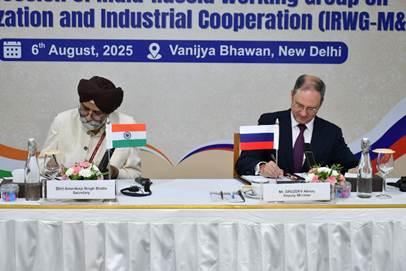
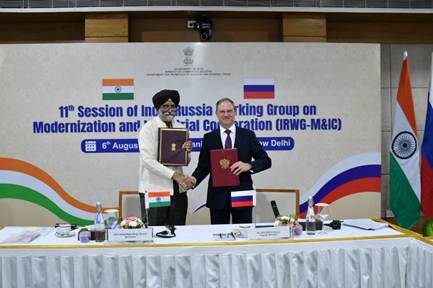
The 11th Session of the India-Russia Working Group on Modernization and Industrial Cooperation was held today at Vanijya Bhawan, New Delhi, under the framework of the India-Russia Intergovernmental Commission on Trade, Economic, Scientific, Technological and Cultural Cooperation.

From the Indian side, the session was co-chaired by Secretary, Department for Promotion of Industry and Internal Trade (DPIIT), Ministry of Commerce and Industry, Shri Amardeep Singh Bhatia, and from the Russian side by Deputy Minister of Industry and Trade of the Russian Federation, H.E. Mr. Alexey Gruzdev.

The meeting reviewed the progress made since the 10th session and provided a platform to strengthen cooperation across key sectors. Discussions included updates from the sub-groups on modernization, mining, fertilizers, and railway transport, as well as emerging areas of collaboration.

image001NANS.jpg


Key focus areas included cooperation in aerospace science and technology, including the establishment of a modernized wind tunnel facility, production of small aircraft piston engines, and joint development in carbon fibre technology, additive manufacturing, and 3D printing. Both sides also explored opportunities in rare earth and critical minerals extraction, underground coal gasification, and creation of modern industrial infrastructure.

The two sides welcomed enhanced engagement in aluminium, fertilizers, and railway transport, alongside capacity building and technology transfer in mining sector equipment, exploration, and industrial and domestic waste management.

The meeting concluded with the signing of the Protocol of the 11th Session by both co-chairs, reaffirming the strategic India-Russia partnership and shared commitment to deepen industrial and economic cooperation.

image002RPCT.jpg


The session saw participation from around 80 delegates representing both sides, including senior government officials, domain experts, and representatives from industry.
 

11th Session of India-Russia Working Group on Modernization & Industrial Cooperation held in New Delhi

India and Russia reaffirm strategic partnership; sign Protocol to deepen cooperation in aluminium, fertilizers, railways, and mining technology​

Posted On: 06 AUG 2025 6:37PM by PIB Delhi

The 11th Session of the India-Russia Working Group on Modernization and Industrial Cooperation was held today at Vanijya Bhawan, New Delhi, under the framework of the India-Russia Intergovernmental Commission on Trade, Economic, Scientific, Technological and Cultural Cooperation.

From the Indian side, the session was co-chaired by Secretary, Department for Promotion of Industry and Internal Trade (DPIIT), Ministry of Commerce and Industry, Shri Amardeep Singh Bhatia, and from the Russian side by Deputy Minister of Industry and Trade of the Russian Federation, H.E. Mr. Alexey Gruzdev.

The meeting reviewed the progress made since the 10th session and provided a platform to strengthen cooperation across key sectors. Discussions included updates from the sub-groups on modernization, mining, fertilizers, and railway transport, as well as emerging areas of collaboration.

image001NANS.jpg


Key focus areas included cooperation in aerospace science and technology, including the establishment of a modernized wind tunnel facility, production of small aircraft piston engines, and joint development in carbon fibre technology, additive manufacturing, and 3D printing. Both sides also explored opportunities in rare earth and critical minerals extraction, underground coal gasification, and creation of modern industrial infrastructure.

The two sides welcomed enhanced engagement in aluminium, fertilizers, and railway transport, alongside capacity building and technology transfer in mining sector equipment, exploration, and industrial and domestic waste management.

The meeting concluded with the signing of the Protocol of the 11th Session by both co-chairs, reaffirming the strategic India-Russia partnership and shared commitment to deepen industrial and economic cooperation.

image002RPCT.jpg


The session saw participation from around 80 delegates representing both sides, including senior government officials, domain experts, and representatives from industry.
If possible, one of the most valued collaborations could be between India and Russia on a passenger aircraft that can accommodate around 150 passengers. We can ask to collaborate on a larger version of the Sukhoi Superjet and work with RR to obtain the required engine.

1754649563214.png
 
We can also collaborate on heavy military transport jet.
If you can construct a passenger jet, you will know how to build a safe aircraft. For military transport planes, you need to export them to manage the spare parts supply chain, and it also relies on the size of the order from the IAF for that specific model. The product development should be self-sustaining in terms of sales; otherwise, it will just be another dent to the R&D budget.
 
If you can construct a passenger jet, you will know how to build a safe aircraft. For military transport planes, you need to export them to manage the spare parts supply chain, and it also relies on the size of the order from the IAF for that specific model. The product development should be self-sustaining in terms of sales; otherwise, it will just be another dent to the R&D budget.
I'm talking about this russian project.
 
  • Like
Reactions: Ironhide and TARGET
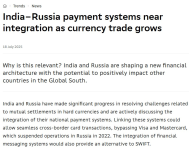
Significant progress seems to have been made in de-dollarizing the India-Russia trade in the past few months:

From July:
1755719259102.png

Early August:
RBI on August 5 allowed authorized dealer (AD) category-1 banks to open special rupee vostro accounts (SRVAs) for their foreign correspondent banks without prior approval.

“An SRVA facilitates oil trade with Russia by enabling transactions to be settled directly in rupees without converting through third-party currencies like the dollar,” experts note.

Rupee-rouble rule: RBI clears path for faster India-Russia payments

Yesterday:
The Russian Embassy reports that 90% of trade payments between India and Russia are now being conducted using the rupee-rouble currency pair.

https://scanx.trade/stock-market-ne...s-90-of-payments-now-in-rupee-rouble/17219738

If this keeps up it will be increasingly difficult for the US to sanction Indian companies for selling weapon components (alloys, machine tools, microelectronics etc.) to Russia.
 
Significant progress seems to have been made in de-dollarizing the India-Russia trade in the past few months:

From July:
View attachment 45971

Early August:


Rupee-rouble rule: RBI clears path for faster India-Russia payments

Yesterday:


https://scanx.trade/stock-market-ne...s-90-of-payments-now-in-rupee-rouble/17219738

If this keeps up it will be increasingly difficult for the US to sanction Indian companies for selling weapon components (alloys, machine tools, microelectronics etc.) to Russia.
The main issue is that Russia didn't have anything to use ruppe on. There was little india could export to Russia before, leading to slowing of movement.
But now, if they are sincere about investing in co-production and investment in India, they have a use for all the rupees they will amass.

And they also need labor and goods that India can provide now with better manufacturing capacity relative to past.