Dassault Rafale - Updates and Discussion

Even USA didn't face a network-centric opponent so far.
They sure did exercised it.


Spectra was studied at a time when not a single competitor did it. And since : Spectra evolved with every rafale standart, and strangely everyone copies it !

The main difference between US approach and France one is that US used dedicated and brutal EW birds to ease and protect a whole raid, when Rafale uses less and smart EW for its own protection.
Looks like copying american way is the way forward.


It's only for export France doesn't want it. It's a thales initiative :ROFLMAO:

Internal Jammers do have their Limitations

A Fighter plane can be attacked from any Angle and Any Direction

In such a situation if Internal Jammer is unable to produce enough Jamming Power in a Particular direction then
The Radar Guided missile will find its target
 
  • Like
Reactions: Shan
Internal Jammers do have their Limitations

A Fighter plane can be attacked from any Angle and Any Direction

In such a situation if Internal Jammer is unable to produce enough Jamming Power in a Particular direction then
The Radar Guided missile will find its target
It's smart jamming not force jamming you don't need Power.
 
  • Like
Reactions: john0496
Looks like copying american way is the way forward.
Not financed yet, so only an industrial concept, nothing more.
Internal Jammers do have their Limitations

A Fighter plane can be attacked from any Angle and Any Direction

In such a situation if Internal Jammer is unable to produce enough Jamming Power in a Particular direction then
The Radar Guided missile will find its target
Spectra has several AESA antennas (some said it is already made of GaN T/R...).
AESA means each antenna can deal with more than one threat.
 
Australian Strategic Policy Institute:
France surges in fighter sales as GCAP, SCAF loom


Selling combat aircraft against US competition has never been easy. Pentagon research budgets tend to push US fighters to the front of the technological pack, and Washington’s political clout slants the playing field even further.

But tell that to France’s Dassault. Its Rafale fighter has a future that looks so bright it’s gotta wear shades. The closest non-US competitor, the Eurofighter consortium with the Typhoon, isn’t doing so well, yet it has hopes, and Saab is signing up more customers for its Gripen JAS 39E/F design.

The volatility of policies of President Donald Trump can only help these companies in future competitions. If some customer countries are a little less confident in relying on US political support, they must be a little more inclined to buy European. Maybe the playing field is beginning to slant away from Washington.

That may become an advantage for the next two European fighter programs, GCAP and SCAF.

After a two-decade slog of slow production, team Rafale has a path to being the most complete non-US air combat offering for the 2030s. The latest big export customer is Indonesia, expected to announce an order for 24 more Rafales to bring its total to 66, with deliveries starting in 2026. Among other customers over the past few years has been the United Arab Emirates, which ordered 80.

Rafales are being delivered to the F4.1 standard, with the Thales Scorpion helmet-mounted display and improvements to the Spectra electronic warfare system. F4.1 incorporates a partitioned avionics architecture (as pioneered by the Saab JAS 39E Gripen) which makes releases of the forthcoming F4.2 and F4.3 standards easier. The goal is to make the Rafale network-ready.

New weapons cleared in F4.1 include a 1000-kilogram version of the Sagem Hammer rocket-aided bomb. It can be equipped with a hard-target warhead and is the first such weapon in the West outside the US.

Development of the Rafale F5, the deepest upgrade yet, was authorised in October. It will include the uprated Safran M88 T-Rex engine, which provides 20 percent more thrust without changing the diameter, so the engine should be retrofittable: so far, a unique feature of the Rafale program is that all production aircraft have been or will be brought up to F4.

Alongside the Rafale F5, Dassault is developing a stealthy unmanned combat aircraft based on the Neuron demonstrator, which first flew in 2012 and, according to the company, has flown more than 170 times and is still active at Istres flight-test centre. This is a full-size, non-attritable, very-low-observable aircraft, with a non-afterburning M88, much bigger than the US Collaborative Combat Aircraft designs.

Dassault’s production line is sold out through to the early 2030s. The company delivered 21 aircraft last year, is moving to a three-per-month rate and has struck a first-time deal with Tata Advanced Systems to build full sets of fuselage modules in India. Dassault and Tata will collaborate to deliver 26 newly ordered Rafale Ms for the navy and secure 110 more for the air force.

India aspires to buy F-35s, and its state-owned industry dreams of an indigenous stealth fighter, but Dassault and Tata are betting that neither will happen for a while. And who knows? They may be right.

Rafale’s improved prospects explain Dassault’s renewed ambitions for a higher share of work in the Franco-German-Spanish future combat air system (SCAF, in French) project. France wants to simplify requirements and move towards allocating development work on a best-athlete standard—which, for the French, means that Rafale contractors, above all Dassault, would lead.

But here’s a question for the other national partners to consider: how fast does France want to push SCAF when the Rafale F5, T-Rex and the UCAV demand resources?

The Rafale’s progress contrasts with the much quieter business of the Eurofighter Typhoon. Orders from three of the partner nations, Germany, Spain and Italy, have kept the doors open in those countries, but the British assembly line comes to an end with the completion of an order from Qatar (It will resume if the newly announced deal with Turkey goes through.)

Eurofighter is shipping 14 aircraft per year, and campaigns in Austria, Poland, Turkey and Saudi Arabia could support a 30-per-year rate in 2028. But one problem is that the partners’ upgrade programs have diverged. After trailing behind Dassault or Saab to offer an active electronically scanned array (AESA) radar, Typhoon now has three alternative designs for such sensors: one developed initially for Qatar; a German-Spanish version for those nations’ new Typhoons; and Britain’s advanced but expensive ECRS Mk 2.

For Britain, Italy and Japan, it may be a better bet to focus on the Global Combat Aircraft Program (GCAP), a competitor to SCAF. Managed by the newly named Edgewing joint venture (BAE Systems, Leonardo and Japan Aircraft Industrial Enhancement Corp, itself a joint venture led by Mitsubishi Heavy Industries) seems to be free of the SCAF rancour, and Germany is clearly feeling buyer’s remorse in choosing to work with France and Spain.

Saab has broken its JAS 39E/F sales drought this year, winning competitions in Thailand (for 12 aircraft), Peru (24) and Colombia (16) announced since April. The Gripen and Typhoon are the leading contenders in Canada if the country backtracks again on its F-35 buy. (Dassault is presumably not a contender, since it submitted no bid in Canada’s previous contest.)

Canada signed for 88 F-35s in June 2023 and has put down money for the first 16. Prime Minister Mark Carney indicated the deal would be reviewed, and a recommendation is expected by the end of September. The new defence procurement minister, Stephen Fuhr, is a former CF-18 pilot and a long-time F-35 sceptic.

But Saab is looking at a massive opportunity as a result of US policy, as the FY26 defense budget junks the USAF’s procurement of E-7 Wedgetail air-surveillance aircraft. Congress is being pressured to preserve the program, but such efforts are hard for a prospective export customer to count on.

This leaves Saab’s GlobalEye and IAI-Elta’s Conformal AEW as the most solid programs for Western large-cabin AESA-based airborne air-surveillance systems. And this is happening just as combat experience from Ukraine and Pakistan is pointing to the tactical utility of such systems, and just as the war in Gaza makes IAI politically radioactive for many intending buyers.

So that leaves Saab.

France announced its intention to buy two GlobalEyes, with an option for two more, at the Paris air show. Other NATO prospects include Finland, Denmark and Canada, the latter two unhappy with Trump’s territorial ambitions. The consortium of NATO members that operates old Boeing E-3A air-surveillance aircraft decided in November 2023 to buy an initial six E-7s, but a contract was expected during 2024, and none has been signed yet.

Saab is competing with a bid by IAI-Elta and L3Harris for South Korea’s E-X Phase II requirement, which calls for the acquisition of four aircraft by 2028 with a $2.6 billion budget. Boeing did not bid in the latest round, but says that its offer of E-7s, to add to South Korea’s current fleet of four, still stands.

Beyond the boost to Saab’s revenue, success in this segment would make GlobalEye, and Sweden’s expertise with datalinks, compatible with multiple fighter types, from France’s Rafale F5 and uncrewed combat aircraft to Korea’s Boramae.

All this is further strengthening the non-US industry.

 
Not financed yet, so only an industrial concept, nothing more.

Spectra has several AESA antennas (some said it is already made of GaN T/R...).
AESA means each antenna can deal with more than one threat.
AN/ALQ-249(V)1 Next Generation Jammer-Mid Band, AESA GaN.

The AN/ALQ-249(V)1 Next Generation Jammer-Mid Band (NGJ-MB) is a pod-mounted electronic warfare system that provides advanced jamming capabilities to the EA-18G Growler aircraft. It is designed to replace the legacy AN/ALQ-99 Tactical Jamming System and offers increased power and the ability to target multiple systems. The NGJ-MB pod is self-sustaining, generating its own power, cooling, and transmission capabilities.


And even with all this, they are still going for *5* pods of this system, specialized for specific bands.

now.
Single pod electrical power generation.

"It has doors on both sides that open up when it’s airborne, and it takes the air through those doors, turns a turbine and generates 82 kW


A single pod generates peak 90+ kva Electrical power.
It will carry 5 such pods.

What's the peak electrical power in kva that rafale f4 can generate? How much total will f5 generate?

This american pod is arguebly the most advanced ew systems in existence.
Definitely more advance than current spectra.
American's wouldn't be fitting 5 such advanced and smart pods and having dedicated ew jets if they though advanced smart internal jamming suite is enough against the adversaries they will face( Russia, china).

Stealth + advanced smart jamming + high power jamming.
That's where the Americans and rest of world is moving towards.

French ew game is not at the level of Americans, and the audacity to claims your electronic stealth is better than radar stealth, while a country that has better "electronic stealth" in both advancement, smartness and also in raw power that you considers stealth to be crucial, and do not consider ew to be alternative of stealth.


If French officials consider, their internal spectra ew, and its smart jamming to be sufficient, than its a stratigic mistake on their part.
You guys needs to see just how much advancements in deployble jamming capabilities russia has achieved since the start of the war.
 
If French officials consider, their internal spectra ew, and its smart jamming to be sufficient, than its a stratigic mistake on their part.
You guys needs to see just how much advancements in deployble jamming capabilities russia has achieved since the start of the war.
Your problem is that the IAF has seen Spectra's performance and has the same opinion as the French Air Force on the validity of the approach!
 
  • Like
Reactions: john0496
We were the first to study it seriously with the deterrence program (how to help Mirage IV to penetrate the USSR airspace).
And when you see that between 1/4 of the total R&D effort of the Rafale program goes to Spectra....
And?
The latest american ew pod is better.
Its confirmed gan aesa with all the features and modes we know of.

Unlike "speculated" GaN on spectra.

Americans also have the first operational operational GaN aesa in their f18 now.

You may be the first and invested heavily in ew at start, but americans are master of it right now.
And they do not consider ew to be an alternative of stealth, neither do they consider only smart internal ew suite to be enough.
 
And they do not consider ew to be an alternative of stealth, neither do they consider only smart internal ew suite to be enough.
This proves that they are 10 years behind us, but only us know that.

For example, the Carbone program was already being tested in 2000. Operational tests demonstrated Carbone's effectiveness (NATO MACE X field tests in August 2000, where it was the only NATO system that successfully countered the Russian ground-to-air systems in the exercise).

Carbone's philosophy was to analyze the incoming signal using interferometry, locate the transmitter, reproduce the signal using DRFM, and send it several times to the transmitter. So it's not just white noise, as is generally the case with other offensive jammers. Carbone was at the same level as the NGJ, and we don't use it.

But it's important to remember that Carbone was just a demonstrator; perhaps the goal was simply to demonstrate a real-time signal reproduction capability. Because if you can do it in real time, there's no doubt you'll be able to slightly modify the replica to make jamming more intelligent.

Finally, the technologies are the same as SPECTRA: DRFM, location, but the power is greater and the jamming approach is less smart. The corresponding operational system is undoubtedly SPECTRA.
 
  • Like
Reactions: john0496
First Indonesian Rafale spotted

The first Rafale B for the Tentara Nasional Indonesia, Angkatan Udara (TNI-AU, Indonesian Air Force), was spotted at the Dassault factory in Bordeaux on 30 July 2025. It bore the serial number T-0301.

Indonesia_Rafale_B_credit_Dassault_Aviation_640.jpg

Credit photo (just illustrative): Dassault Aviation

Following the initial order of 24 aircraft, of which the first six are currently in production, an option for an additional 18 was exercised earlier this year, bringing the total to 42. The first unit is scheduled for delivery in early 2026.

Meanwhile, PT Indonesia (IPTN) has signed a contract with Turkish manufacturer TAI to co-produce the KAAN fighter aircraft. This agreement would allow IPTN to fulfill a potential future order for 48 of these aircraft, should the order be finalized.
 
I had hoped that the F5 version that improves certain aspects of the previous variants would come sooner. It is currently set for 2030.

DA could have worked with India to make an India specific version. That would have been ideal. The integration of Indian weapon systems still looms as a huge question mark over any more procurements that are to be made. The nature of air combat has changed with BVR taking a leading role.

Lots of misses with DA. I hope certain concerns (with have facts to be back them up) are addressed. I still think that amongst the 4.5 gen on offer, DA has complete edge over whatever is offered in the MRFA considering the prior purchase. More should have been ordered along with IN order.
 
  • Like
Reactions: Sathya
I had hoped that the F5 version that improves certain aspects of the previous variants would come sooner. It is currently set for 2030.

DA could have worked with India to make an India specific version. That would have been ideal. The integration of Indian weapon systems still looms as a huge question mark over any more procurements that are to be made. The nature of air combat has changed with BVR taking a leading role.

Lots of misses with DA. I hope certain concerns (with have facts to be back them up) are addressed. I still think that amongst the 4.5 gen on offer, DA has complete edge over whatever is offered in the MRFA considering the prior purchase. More should have been ordered along with IN order.
When you ask Dassault for something, they always say yes, but they also say what the price and delivery time will be. The problem is that the price and delivery time seem exaggerated, but in fact, if you ask others for the same thing, they will make more attractive offers, but in the end, their solutions will cost more and come later.
 
  • Like
Reactions: Sathya and Shan

France puts Rafale fighter’s F4.3-standard updates through early assessment

Elements of the Dassault Aviation Rafale’s future F4.3 operating standard have undergone early assessment by France’s DGA defence procurement body.

Conducted during operationally-representative sorties flown from Istres air base, the purpose of the ‘fitness for use review’ was to “assess the development of the F4.3 standard in its current state, before its final definition”, the DGA says.

“A total of seven missions were carried out, with scenarios covering the air-to-air, air-to-ground and air-to-sea domains,” it says, with ongoing analysis to have a “particular focus on connectivity and weapons systems”.

The campaign was staged with the involvement of airframer Dassault, sensor provider Thales and guided weapons specialist MBDA.


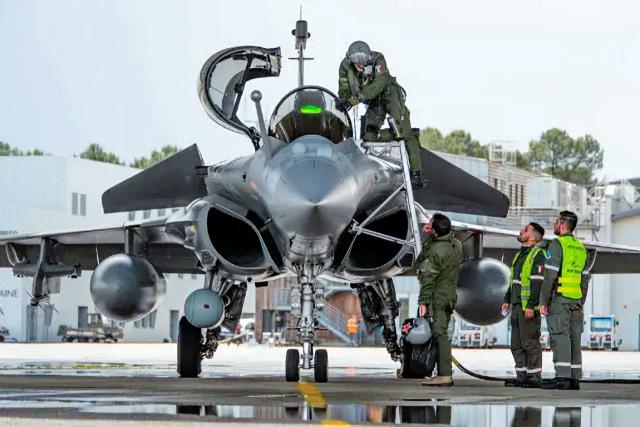
111870_rafalecrew_755695.jpg


Supporting assets included four Rafales employed in a “blue air” role, and an equal number which were used to represent enemy assets. The French air force also provided Airbus Defence & Space A330 Phenix tanker and Boeing E-3F airborne warning and control system aircraft, while the navy allocated a Northrop Grumman E-2C Hawkeye.

The DGA will draw on results from the test flights to inform further development work, and expects to fully define the package of updates during 2027.

Due for introduction to service with the French air force and navy late this decade, the F4.3 standard will deliver operational enhancements in areas including connectivity, weapons and electronic warfare.

Almost all of France’s in-service Rafales have now been brought up to the latest F4.1 operational standard, General Arvind Badrinath, head of combat air for the DGA, told FlightGlobal ahead of the Paris air show.
 

France puts Rafale fighter’s F4.3-standard updates through early assessment

Elements of the Dassault Aviation Rafale’s future F4.3 operating standard have undergone early assessment by France’s DGA defence procurement body.

Conducted during operationally-representative sorties flown from Istres air base, the purpose of the ‘fitness for use review’ was to “assess the development of the F4.3 standard in its current state, before its final definition”, the DGA says.

“A total of seven missions were carried out, with scenarios covering the air-to-air, air-to-ground and air-to-sea domains,” it says, with ongoing analysis to have a “particular focus on connectivity and weapons systems”.

The campaign was staged with the involvement of airframer Dassault, sensor provider Thales and guided weapons specialist MBDA.


111870_rafalecrew_755695.jpg


Supporting assets included four Rafales employed in a “blue air” role, and an equal number which were used to represent enemy assets. The French air force also provided Airbus Defence & Space A330 Phenix tanker and Boeing E-3F airborne warning and control system aircraft, while the navy allocated a Northrop Grumman E-2C Hawkeye.

The DGA will draw on results from the test flights to inform further development work, and expects to fully define the package of updates during 2027.

Due for introduction to service with the French air force and navy late this decade, the F4.3 standard will deliver operational enhancements in areas including connectivity, weapons and electronic warfare.

Almost all of France’s in-service Rafales have now been brought up to the latest F4.1 operational standard, General Arvind Badrinath, head of combat air for the DGA, told FlightGlobal ahead of the Paris air show.
We will be getting F4.3 or F4.1 for navy?