
Lockheed Martin F-35 Lightning and F-22 'Raptor' : News & Discussion
- Thread starter Nick
- Start date
You are using an out of date browser. It may not display this or other websites correctly.
You should upgrade or use an alternative browser.
You should upgrade or use an alternative browser.


A good link on the P-8Great Britain will buy 12 F-35A and 15 F-35B.
American P-8s are about to get more reach and firepower
The F-35A will be used mainly for training as part of an OCU unit. Its secondary role is NATO nuclear delivery with B-61 13.
F-35B will be used to raise a 3rd squadron.
I saw this article on the site about the UK F-35A

UK leaves door open to more F-35A purchases
The UK government has signalled that further purchases of the F-35A stealth fighter remain under consideration, following confirmation that an initial batch of 12 aircraft will be drawn from existing F-35B procurement plans.
 ukdefencejournal.org.uk
Finally a very emotional moment for Keralites & India. F-35 is leaving kerala India tomorrow. It's time to say goodbye, we will miss you....


F-35B Fighter Leaves Kerala Airport After Being Stranded For 5 Weeks
The British Royal Navy's F-35B fighter jet, which had been stranded in Kerala for five weeks after making an emergency landing, has finally left the Thiruvananthapuram airport.
 www.ndtv.com
The British Royal Navy's F-35B fighter jet, which had been stranded in Kerala for five weeks after making an emergency landing in June, flew out of the Thiruvananthapuram airport this morning. The stealth jet had been grounded in Kerala due to a hydraulic fault that took an expert team from the UK to repair.
The fighter received a green signal yesterday, allowing it to return to the skies. Visuals this morning showed the aircraft taking off from the Thiruvananthapuram airport.
If it was there any longer, it could have applied for citizenship

Amit (YouTuber) has made an observation that the UK and US appeared to be interested in testing Indian IACCS and Indian radars against the F-35. However, after the F-35 was successfully tracked and identified by Indian radar, they provided an excuse and proceeded to land in India.
Upon landing in India, all computer systems activated self-destruct protocols to prevent any potential enemy access to the software or threat libraries. Since the fighter jet did not crash and the GPS indicated that it was no longer in a friendly territory, it is now incapable to fly and firmwares needs to be reloaded.
Amit Sengupta focuses mainly on geopilitics, some of his videos are good also, he gave his best what he could comprehend. May be he was thinking about MiG-25 defection in 1976 & USN EP-3 which had to land in China in 2001 after collision with Chinese J-8.
But we are in a new era of digital spying, sniffing, snooping.
Proactive suspicion is normal reaction in International Defence matters.
May be it is really some hydraulic or other tech issue. IDK how violent the Arabian Sea is during June/Monsoon in our coasts. But this would definitely be a concern for any ship supporting helicopters & VTOL jets.
What if tomorrow in an active war this happens away from neutral nations coasts?
Why was UK Navy having excercise so near our territorial waters?
Why would F-35 sniff only Kerala coast?
Or is it related to international maritime traffic passing below Srilanka?
S/w are evolving at rapid pace towards automation, AI, ML & they can be made to do anything doable in various emergencies.


USAF won’t resume full F-35 buys until Lockheed wrings problems from upgrade: service chief
Gen. Allvin says the decision flows from new DOD priorities.ROYAL AIR FORCE FAIRFORD, England—Lockheed Martin needs to make progress on a host of delayed upgrades to the F-35 fighter jet before the Pentagon will return to buying the jet in planned levels, the Air Force’s chief said.
Frustration over delays with the Block 4 upgrade—coupled with a broader Pentagon budget reprioritization—led the service to buy just two dozen jets in its 2026 budget proposal—half of last year’s plan and down from the 44 bought in 2025.
The Air Force will increase procurement again when it can buy “F-35s that are most relevant for the fight,” Gen. David Allvin told Defense One on the sidelines of the Royal International Air Tattoo.
"In the end, because we have limited financial resources, we need to make sure that the F-35s we buy have the capability to meet the pacing threat. So, some of the delays with respect to Block 4 and TR-3 weighed into decisions by the department,” Allvin said.
Officials argue that they need a fully capable Block 4 jet from the start, rather than receive jets that will need to be retrofitted with the full suite of upgrades, which includes new software, weapons, sensors, and a new processor—capabilities the Pentagon argue would be needed in a fight against China.
Lockheed has run into problems integrating new software and hardware for the upgrade, resulting in years of schedule and cost overruns. Delays with TR-3, the “backbone” of Block 4, led the Pentagon to stop taking deliveries for a year. The military resumed accepting the jets last July, even though they come with a “truncated” version of the upgrade.
Lockheed executives recently announced that the full combat version of the TR-3 upgrade is ready, but the F-35 Joint Program Office has yet to confirm that, or say when TR-3 will get formal approval.
Beyond TR-3, the timeline for the entire Block 4 effort remains uncertain. Lawmakers have warned its planned capabilities have already been “reduced,” according to an adopted amendment from Rep. Seth Moulton, D-Mass., in the House Armed Services committee’s version of the 2026 defense policy bill.
Lawmakers “remain frustrated” over the program’s delays and performance, according to Moulton’s amendment, which requests a briefing on the status of TR-3 and Block 4. In their bill, House lawmakers did not add to the planned purchase of 24 F-35s in 2026, and HASC Chairman Mike Rogers said that the committee recognizes that the F-35 cut stems from a “strategic decision to finally prioritize funding towards sustainment and modernization.” The Senate Armed Services Committee, however, has moved to add 10 jets, bringing their version up to 34 jets.
The F-35 program came on the chopping block after Defense Secretary Pete Hegseth announced a 8 percent shift of DOD funds to pay for new priorities from the Trump administration, and the Air Force needed money to move ahead with a sixth-gen fighter jet, the F-47. Other high-ticket items got the axe as well in this year’s budget proposal, including the service’s E-7 radar plane.
While programs like the F-47 and B-21 stealth bomber are poised to win big in the budget, total aircraft procurement is taking a nosedive. The service is now saying that previous benchmarks, such as buying 72 fighters a year, are no longer achievable.
Leading up to the budget release, Allvin argued in public statements that Hegseth’s priorities necessitated “more Air Force”—and therefore more money for his service.
During the July 18 interview, Allvin maintained that his call was heard. He said he will wait until Congress finalizes its budget before issuing a final verdict.
"We were able to clearly articulate what we believe the U.S. needs from its Air Force and the value of more Air Force. To the extent that weighed against the other priorities of the Department, in the end, I’ll leave it to others to keep score. I will tell you that I am satisfied my voice was heard. I'm satisfied we are moving forward with some of the key programs, like F-47. I will continue to advocate for more Air Force, while I’ll also continue to respect the decisions that the senior leaders make,” he said.
The service is also requesting to divest 340 aircraft, including shedding all of its A-10s ahead of schedule. The service had planned a gradual decommissioning of the A-10 Warthogs but, Allvin said, Hegseth’s budget reallocation caused the service to take another look at its plans.
Congress wants to protect some of the A-10s in its defense policy bill—a move Allvin hopes will come with the funding needed to keep the aircraft flying. If not, something else will be cut: "If they don't give us more resources, then something that was above the line, that was a higher priority will have to come off."
Long term, it’s “still unknown” whether the Air Force will be able to reverse its shrinking fleet size, Allvin said. It’s more important to focus on the “outcomes” of what it buys, rather than the specific number of tails it has, he said.
"Will we have fewer aircraft? Will we have more [Collaborative Combat Aircraft]? Still an unknown question, but to me, it's the outcome that counts. What are the capabilities that we can provide? How much will it cost to sustain? How much will the investment cost? Are the investments paying off? Those are year to year conversations we have, but the overall arc, I think, will prove out that more Air Force is better for the nation,” he said.
Lessons from Midnight Hammer
The might of the U.S. Air Force was on full display last month during Operation Midnight Hammer, Allvin said, when seven B-2 bombers attacked three Iranian nuclear facilities, a testament to how gaining control of the air can help prevent a wider war.
“We're not fighting. We're not in a big war. We didn't send thousands of troops that were going to be engaged, and we couldn't disentangle for months or years. That to me, demonstrates very, very viscerally the importance of air power and air dominance,” he said.
Midnight Hammer also proved that stealth “still matters,” Allvin said. Some speculate that advanced sensors could render stealth obsolete one day, but Allvin described stealth as the “price of admission” in a future fight.
While a long-range strike on enemy territory in the Pacific would look vastly different than what the U.S. did in Iran, “the same principles apply that we need to be able to penetrate and create effects in dense threat environments,” Allvin said, pointing to the development of the future B-21 bomber, a stealthier and smaller replacement of the B-2.
The complex operation featured more than 125 aircraft, including the B-2s, fourth and fifth-gen fighters, and dozens of tankers, and the chief lauded the work of U.S. airmen, from pilots to maintainers, who made it happen.
“When you put American airmen in a tough situation, in a time that matters, they're going to perform,” Allvin said.

US Finds Solution to Corrosion Problem on F-35 Jets  ROFLMAO:
 : just a coating !!)
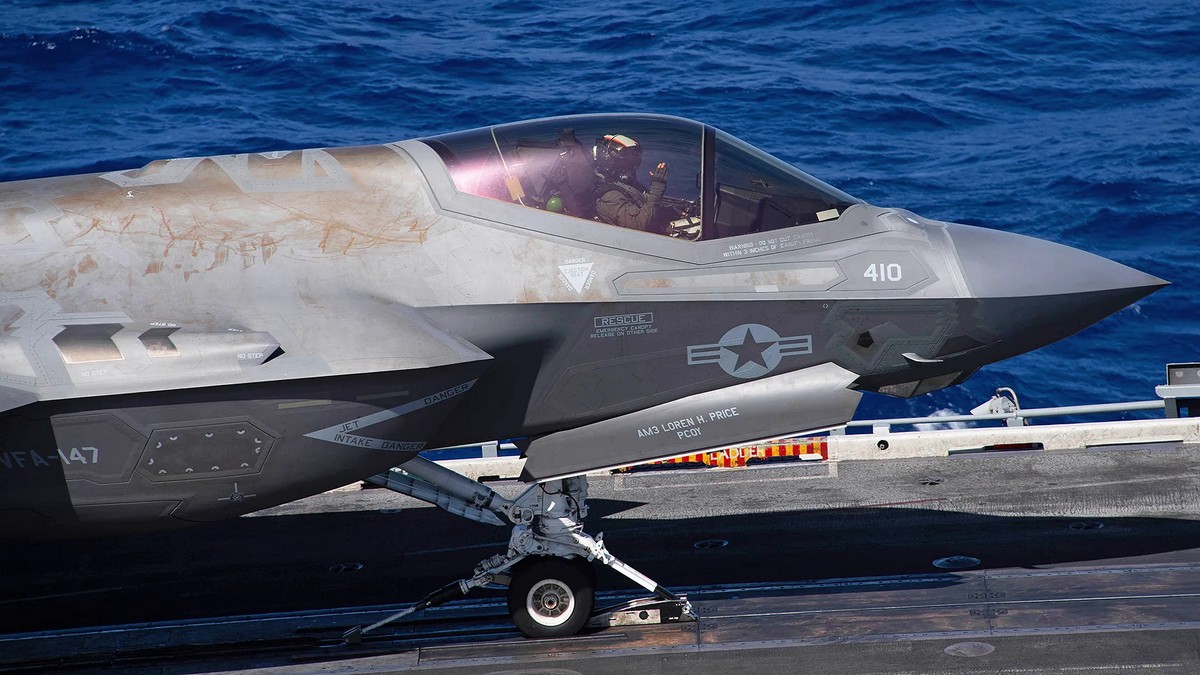
The F-35 Joint Program Office (JPO) is actively addressing corrosion-related issues affecting the aircraft, with a focus on ensuring their long-term mission readiness and operational reliability. According to a statement from the program’s public affairs office, the issue has become particularly noticeable due to surface discoloration observed after deployment, especially under demanding operating conditions. The JPO emphasizes that these changes do not indicate structural damage or a degradation of the aircraft’s stealth capabilities.

The agency clarified that many of the surface changes perceived by the public as damage – such as discoloration after deployment – do not negatively impact the aircraft’s condition. F-35 jets are frequently exposed to harsh environments during naval operations, including constant contact with saltwater, contamination from lubricants and other fluids, and proximity to rotor wash and cleaning activities. These factors can lead to wear or discoloration of the coating, but they do not compromise the structural integrity or stealth performance of the aircraft.
To address the issue, the F-35 Joint Program Office has developed a new coating designed to significantly reduce or eliminate discoloration, improve wear resistance, and extend the coating’s lifespan. This new finish will be applied during routine maintenance cycles, following a process similar to how coatings are refreshed on both commercial and military aircraft.

One of the core challenges with corrosion is that it’s often not immediately visible. As explained by a program officer, corrosion doesn’t typically trigger obvious signs of malfunction, and its effects can be hidden beneath surface coatings or within joints and seams. The F-35’s construction – using a mix of aluminum, titanium, and carbon composites – can create conditions for galvanic corrosion, particularly in humid and salty environments.
The F-35 Joint Program Office has made corrosion control a strategic priority, implementing a coordinated approach to reduce long-term risks to the fleet. Initially, the program lacked a well-structured system to manage this issue, which led to a reactive posture as the aircraft aged. Recent improvements now include a more organized strategy, supported by dedicated engineering and technical teams. The goal is to ensure that each aircraft meets established standards and remains consistently ready for operational deployment.

The program office emphasized that, while corrosion control doesn’t attract the same level of attention as headline-making advancements in other areas of the F-35 program, it remains a critical factor in maintaining the aircraft’s longevity and reliability. Through the continued efforts of technical staff and engineers, the program aims to keep the fleet not only mission-ready but also capable of maintaining air superiority for decades to come.
US Finds Solution to Corrosion Problem on F-35 Jets
The F-35 Joint Program Office (JPO) is actively addressing corrosion-related issues affecting the aircraft, with a focus on ensuring their long-term mission readiness and operational reliability. According to a statement from the program’s public affairs office, the issue has become particularly noticeable due to surface discoloration observed after deployment, especially under demanding operating conditions. The JPO emphasizes that these changes do not indicate structural damage or a degradation of the aircraft’s stealth capabilities.
The agency clarified that many of the surface changes perceived by the public as damage – such as discoloration after deployment – do not negatively impact the aircraft’s condition. F-35 jets are frequently exposed to harsh environments during naval operations, including constant contact with saltwater, contamination from lubricants and other fluids, and proximity to rotor wash and cleaning activities. These factors can lead to wear or discoloration of the coating, but they do not compromise the structural integrity or stealth performance of the aircraft.
To address the issue, the F-35 Joint Program Office has developed a new coating designed to significantly reduce or eliminate discoloration, improve wear resistance, and extend the coating’s lifespan. This new finish will be applied during routine maintenance cycles, following a process similar to how coatings are refreshed on both commercial and military aircraft.
One of the core challenges with corrosion is that it’s often not immediately visible. As explained by a program officer, corrosion doesn’t typically trigger obvious signs of malfunction, and its effects can be hidden beneath surface coatings or within joints and seams. The F-35’s construction – using a mix of aluminum, titanium, and carbon composites – can create conditions for galvanic corrosion, particularly in humid and salty environments.
The F-35 Joint Program Office has made corrosion control a strategic priority, implementing a coordinated approach to reduce long-term risks to the fleet. Initially, the program lacked a well-structured system to manage this issue, which led to a reactive posture as the aircraft aged. Recent improvements now include a more organized strategy, supported by dedicated engineering and technical teams. The goal is to ensure that each aircraft meets established standards and remains consistently ready for operational deployment.
The program office emphasized that, while corrosion control doesn’t attract the same level of attention as headline-making advancements in other areas of the F-35 program, it remains a critical factor in maintaining the aircraft’s longevity and reliability. Through the continued efforts of technical staff and engineers, the program aims to keep the fleet not only mission-ready but also capable of maintaining air superiority for decades to come.
You seem to have a grudge against F-35. Why? Even stealth features includes a specialised coating. Radar absorbent coating are like classified formula for a defense firm

He's French.You seem to have a grudge against F-35. Why? Even stealth features includes a specialised coating. Radar absorbent coating are like classified formula for a defense firm
It's not specialy against f-35 but 5gen fighters are not game changer as soon as you take into account MCO.You seem to have a grudge against F-35. Why? Even stealth features includes a specialised coating. Radar absorbent coating are like classified formula for a defense firm
MCO make that you can't use these planes as you want.
Well the only countries to have an actual 5th gen manufactured and inducted are two of the world's biggest economy surpassing any other by huge margin. I am assuming MCO means Managing cost of operation or something along that line.It's not specialy against f-35 but 5gen fighters are not game changer as soon as you take into account MCO.
MCO make that you can't use these planes as you want.
I would say it's game changing enough. As we haven't actually seen both the countries use their 5th gen in an actual contested airspace. Especially against each other ( the intended targets) . While these have laid the foundation for 6th gen already.
But it's not about cost. MCO means managing availibilty of your plane on the battle field. When you can only employ a figher 13 hours/month that's not the same that using it 25 or 30 hours monthly.I am assuming MCO means Managing cost of operation or something along that line.
The most disturbing is that il all western country goes together at war, parts wont be suffcient to support every one.
Do you understand what is a coating ? A coating is a very thin layer of material that have to be changed very often to stay effective. Look at the F-35 picture and tell me if the anti corrosion coating is effective ?Even stealth features includes a specialised coating

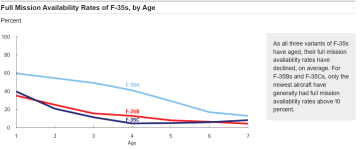
While f35's availability has been disappointing.Look at this disastrous availibility rate with fighter only 6 years old. I just read US reports
View attachment 45561
But the report here mentions, "full mission availability" aka capabilities of execute any and all missions that a multirole fighter can.
Large part of those f35 not available for " full mission availability", will be available for specific missions, multiple missions.
So its misleading conclusion.
Yes I understand what coating means. And I also understand that there's a difference between discoloration and corrosion. The aforementioned coating is part of discoloration issue as far as I can see in your post.Do you understand what is a coating ? A coating is a very thin layer of material that have to be changed very often to stay effective. Look at the F-35 picture and tell me if the anti corrosion coating is effective ?
While corrosion problem is slightly mentioned in the post, there's no conclusion there that the coating is fully directed towards corrosion or that it is the only measure taken.
Secondly, the photo is of discoloration, not corrosion. And there's no indication that the photo is taken after the new coating.
In the doomsday scenario, no parts for any plane will have required availability. And the number of 4th Gen FA shot down in that scenario is likely to increase the cost of relying only on them.. countering any claims of availability of a 5th gen FA.But it's not about cost. MCO means managing availibilty of your plane on the battle field. When you can only employ a figher 13 hours/month that's not the same that using it 25 or 30 hours monthly.
The most disturbing is that il all western country goes together at war, parts wont be suffcient to support every one.
And if whole west goes to war.. number of spares is the last thing to worry about. The priority should be .. why is whole west going to war. It's not even close to 100 years since you guys went gung ho.
And if the enemy has enough preparedness to go against NATO.. I will say, induct 5th gen cause your enemy surely will have by then.
And it's all hypothetical remember. Most of the battlefield today..
West Asia, Africa, don't have the power to match west. And the west ( barring USA) doesn't have the power to match China+Russia.