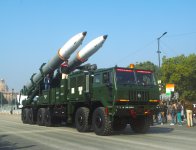

Maybe the latter as the former is still in design stage and yet to be tested AFAIK.Do they mean Dhvani or LRHASM?
Maybe the latter as the former is still in design stage and yet to be tested AFAIK.Do they mean Dhvani or LRHASM?

By when do you think Dhvani will be tested and deployed?Maybe the latter as the former is still in design stage and yet to be tested AFAIK.
of course LRAShM, they will not acknowledge dhvani yet as its strategic.Do they mean Dhvani or LRHASM?

Something does not makes sense we all know multiple components of project vishnu were under fabrication, obviously it won't happen without govt sanction."The hypersonic glide missile is in a much more advanced stage. We have done one development trial, and we expect that in the next two to three years, we will complete all the development trials, and then it will be inducted," the DRDO chief said.
"In hypersonic cruise missiles, we have recently proven scramjet propulsion for more than 1000 seconds, which is a major breakthrough. We hope the government will sanction a program to convert this scramjet propulsion into a hypersonic cruise missile weapon system. I estimate that it will take about five to seven years before it can be inducted," he added.

'India's Hypersonic Glide Missile Is In Advanced Stage': DRDO Chief To NDTV
Indian weapons systems were a success during Operation Sindoor when India struck Pakistan during its 100-hour aerial battle, damaging enemy airfields, drones, and air defence systems.www.ndtv.com
As per DRDO chief it shall be ready for induction within next 2-3 years:By when do you think Dhvani will be tested and deployed?

K-15 and Shaurya have lift generating fixed trapezoidal fins. It has a much higher lift to drag ratio than the RV of DF15B and DF16.
And if consider these RV as HGV, then this is also a HGV.
LRAShM .Do they mean Dhvani or LRHASM?

Is there any literature which comprehensively sums up our Hypersonic initiatives ? Not sure about you guys but I'm totally confused by the various terminologies doing the rounds.As per DRDO chief it shall be ready for induction within next 2-3 years:
India’s Hypersonic Glide Missile To Be Ready In 2–3 Years: DRDO Chief
India’s Defence Research and Development Organisation (DRDO) has made significant progress in the development of hypersonic weapons, with pa...www.indiandefensenews.in
PS: Gotta remember that Project Dhvani consists of multiple HGVs and not just of one type. So you'll see Conical, Winged and Blended-Body HGVs deployed under this project. The last one is ready for test by the looks of it. My guess would be that within this very decade all these HGVs would be operationally deployed and combat ready.
Project Vishnu for HCMs and Project Dhvani for HGVs. That's the base and then there are derivative programmes like LRAShM(HGV maybe part of project Dhvani) and ET-LDHCM(HCM-part of project Vishnu) plus the Zircon derived BrahMos 2(HCM). Sometimes all the chaos is goodIs there any literature which comprehensively sums up our Hypersonic initiatives ? Not sure about you guys but I'm totally confused by the various terminologies doing the rounds.
There's the LRAShM , then there's the HGV ( several versions I believe ) then there's the HCM . Where does Project Vishnu & Project Dhvani fit into these ? The former is the HCM if I'm not mistaken whereas the latter is the HGV project .
If yes , where does the LRAShM fit into ? Moreover has the LRAShM been cleared by the CCS for induction into the various armed forces ? What about development of the land based version of the LRAShM ?

Some general literatureIs there any literature which comprehensively sums up our Hypersonic initiatives ? Not sure about you guys but I'm totally confused by the various terminologies doing the rounds.
Thanks for this. Much appreciated.Some general literature
and basic CIA spy report of drdo
What's the difference between the LRAShM & ET-LDHCM ? I mean I get the former is anti ship. But what else besides this ? Or is the ET-LDHCM the land version of the LRAShM ?Project Vishnu for HCMs and Project Dhvani for HGVs. That's the base and then there are derivative programmes like LRAShM(HGV maybe part of project Dhvani) and ET-LDHCM(HCM-part of project Vishnu) plus the Zircon derived BrahMos 2(HCM). Sometimes all the chaos is good
Huge difference. The first is a Delta-Wing HGV which means after separation from the powered stages, it glides towards its target at the speed of around Mach 10(maybe using a second stage rocket powered sustainer). The latter on the other hand is a scramjet based Hypersonic Cruise missile like Zircon under Project Vishnu. Both have got different tech and different attack trajectory.What's the difference between the LRAShM & ET-LDHCM ? I mean I get the former is anti ship. But what else besides this ? Or is the ET-LDHCM the land version of the LRAShM ?

LRASHM, is more similar to a boost glide vehicle and shaurya missile, kind of like mix of both , it's booster takes it 100+km up in altitude then second stage seprates, it falls & gains speed, activate It's rocket motor, start flying horizontal at 40-50km altitude at hypersonic speed.Thanks for this. Much appreciated.
What's the difference between the LRAShM & ET-LDHCM ? I mean I get the former is anti ship. But what else besides this ? Or is the ET-LDHCM the land version of the LRAShM ?
Huge difference. The first is a Delta-Wing HGV which means after separation from the powered stages, it glides towards its target at the speed of around Mach 10(maybe using a second stage rocket powered sustainer). The latter on the other hand is a scramjet based Hypersonic Cruise missile like Zircon under Project Vishnu. Both have got different tech and different attack trajectory.
Yup. I'm not thinking this out well plus memory is fading @LRAShM is more of a boost glide vehicle as opposed to an HCM.LRASHM, is more similar to a boost glide vehicle and shaurya missile, kind of like mix of both , it's booster takes it 100+km up in altitude then second stage seprates, it falls & gains speed, activate It's rocket motor, start flying horizontal at 40-50km altitude at hypersonic speed.
Drdo calls it hypersonic glide missile, but the flight of its second stage after it gains sustained thrust is more similar to cruise than glide, hence mu comparison with shaurya.
ET-LDHCM, is scramjet HCM.
The HCM is powered flight via scramjet , lower initial thrust by solid booster followed by scramjet operation for a long duration.What's the difference between the LRAShM & ET-LDHCM ? I mean I get the former is anti ship. But what else besides this ? Or is the ET-LDHCM the land version of the LRAShM ?
Shaurya & K-15 never leaves the atmosphere , neither does the new glider. if something leaves the 80-100km atmospheric level, it would need/look like the reentry vehicle on BM-04 and/or a high heat withstanding blunt nose cap.LRASHM, is more similar to a boost glide vehicle and shaurya missile, kind of like mix of both , it's booster takes it 100+km up in altitude then second stage seprates, it falls & gains speed, activate It's rocket motor, start flying horizontal at 40-50km altitude at hypersonic speed.
Drdo calls it hypersonic glide missile, but the flight of its second stage after it gains sustained thrust is more similar to cruise than glide, hence mu comparison with shaurya.
ET-LDHCM, is scramjet HCM.
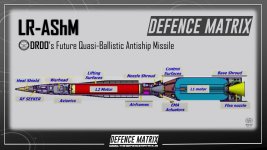
The design of LRAShM is something different from the traditional HGV, it's an HGV as drdo clearly mentioned it, the first stage motor helps the missile to get desired altitude and the initial Speed, then the second stage sustainer engine Kicks in and helps it to maintain the High hypersonic Speed through it's glide phase, the glide phase in this missile powered by the second sustainer engine, the max speed it achieve is mach-10 in glide phase, it's Thier to provide power throughout the glide phase as it doesn't bleed energy to maneuverability throughout the flight, the missile never leaves the atmosphere to begin with, it stays slightly above HCM flight path, hence the drdo scientist quoted in vigyan mela, it flies within the atmosphere at low altitude to evade detection,Yup. I'm not thinking this out well plus memory is fading @LRAShM is more of a boost glide vehicle as opposed to an HCM.
In which case how are reports emanating in the press of the imminent test of the ET-LDHCM when Dr Kamat has publicly confirmed in an interview to Shiv Aroor they're awaiting government sanction for the project ?
Shaurya & K-15 never leaves the atmosphere , neither does the new glider. if something leaves the 80-100km atmospheric level, it would need/look like the reentry vehicle on BM-04 and/or a high heat withstanding blunt nose cap.
For it to be a hgv, it needs to glide.The design of LRAShM is something different from the traditional HGV, it's an HGV as drdo clearly mentioned it, the first stage motor helps the missile to get desired altitude and the initial Speed, then the second stage sustainer engine Kicks in and helps it to maintain the High hypersonic Speed through it's glide phase, the glide phase in this missile powered by the second sustainer engine, the max speed it achieve is mach-10 in glide phase, it's Thier to provide power throughout the glide phase as it doesn't bleed energy to maneuverability throughout the flight, the missile never leaves the atmosphere to begin with, it stays slightly above HCM flight path, hence the drdo scientist quoted in vigyan mela, it flies within the atmosphere at low altitude to evade detection,
Same thing also said by ex drdo chief it's not a HCM but it behaves like one,
Unlike the other HGV lRAShM is different from others, Also the Speed is reduced in the terminal phase, RF seeker comes into play for target accusations, the terminal Speed at best would be mach -6,
It can't be a cruise missile without turbojet/ramjet/scramjet engineView attachment 44742
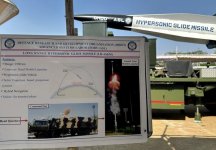
My comment was based on this poster, which suggest it does leave the atmosphere/rise up to the edge of space(~100km) before descending.
Now it could be a intern copy pasting hgv trajectory poster from Google search.
But that's the only refrence I had of guessing it's trajectory.
So if it's wrong, can you roughly explains it's flight profile.
For it to be a hgv, it needs to glide.
From your description quoting drdo scientists, it's flight profile looks more like shaurya/k-15 than an hgv aka cruising at sustained altitude at hypersonic speeds using rocketpropulsion, a rocket sustained-hypersonic cruise missile(RS-HCM).
 . Of course, your point is well understood but just assume that LRAShM uses the second stage sustainer motor to glide just like a Waver-rider but to keep the terminal energy and manoeuvrability really high. It's really a very novel concept and definitely builds upon K-15 experience.