Operation Sindoor: India Strikes Terroist Camps Inside Pakitsan

Status
Not open for further replies.
Not sure why you are fascinated by su57. It can never match f-35 or Chinese latest.

Also - in a conflict with China, Russians may not help us (like in 62 war).

Russians are not saints. They did not help in 62, but made us return hajipir pass in 65.
Because it's the only option. Otherwise, we should just expedite AMCA and try to develop our AHCA quicker. F-35 doesn't cut it 'cause we don't want any American jet along with it not being an ASF. It's a dedicated SAM hunter and flying computer but not an counter to J-20 or likes. Period.
 
No. I'm saying we don't need to walk backwards by kneejerking our way into contracts which won't fit into our system just 'cause the PAF will operate J-35s.

Any counter to the J-35 isn't another 5th gen jet but a vast array of sensors and C2 networks. We are building that to counter the J-20 and J-XX, which means J-35 will automatically get countered by it too.

That's just defensive strategy. And it will work to eventually get us the upper hand against Pak, but not China.

Against PLAAF, you need a way to push the battle into the enemy's airspace. You can't do that with sensors & C2, you need fighters that are at least capable of holding their own against J-20B/J-XX and then make use of our geographical advantage & sorties-per-day that Western engines allow to eventually push them on the backfoot.

You can't do this with fighters that are nearly guaranteed to be seen first & shot first every time they fly. That means non-LO are a no-go out of the box. Because with them, you're gonna have to hold back sorties till such time that at least most of the enemy's 5G fighters have worn themselves out & became hangar queens.

But depending on how effective their sorties up till that point were, and how effectively the PLARF manage to damage our air bases & AD before that point (they're liable to have an insane magazine depth of short/medium-range munitions), it might be too late. We are anyway not yet (and probably never will be in foreseeable future) equipped to fight & win a long war with China.

So I don't see how this strategy will allow us to stalemate, let alone beat, China.

Vanilla Su-57 isn't good enough and requires its next gen modernization, and the F-35 Block 4 won't be ready anytime before 2030. So neither are answers to the J-35 at this time. If AMCA fails, they can become options. Ultimately, we need stealth, the raising-costs version and the true-stealth version, but not imported ones.

The F-35 as it exists is good enough as a stop-gap solution against J-20 till such time that AMCA is operational (~2040). Without the Block-4 upgrades it's longevity will be questionable, but that will only become a concern if & when either AMCA is delayed indefinitely or if the next-gen engine program fails.

At that point we'll need the Block-4. Su-57M should also become viable as an option which would give us leverage to get Block-4.

If we manage to get an F-35 that can work alongside our CCAs, that would be golden. But it's likely we may have to buy Ghost Bat or something (Boeing actually pitched it & the MQ-25 earlier).

When combined with a drone it is. The same with the F-35. And against the PLAAF, not PAF.

MUMT won't help to penetrate if the mothership is less stealthy than the drones.

But on its own, it can still hit air bases, which most of our air force cannot without using standoff weapons.

Why would you not want to use standoff weapons if you have the option?

It's about degrees. If you want to breach a well-defended airspace without conducting SEAD/DEAD, you need excellent stealth and/or EW. Or you could soften it a bit using standoff weapons before breaching it. Or you gotta empty the bases of anything remotely related to SAMs and then breach it. We don't know where Rafale fits in for cases 1 or 2, but we know for sure the rest of our air force is at case 3.

Any airbase in TAR that's within reach of Rafale flying a lo-lo profile is within reach of standoff saturation strikes.

We really have no case 1 option against China unless we field a 6G within the next 10 years, that's not happening. Only a 5G can do case 2. Missiles are anyway easier & cheaper to replenish than a manned aircraft loss, so we wouldn't resort to anything but case 3 until & unless there's absolutely no choice (all our missiles are spent & our factories are destroyed).

We already saw this against Pak on May 9-10 (though we ceased hostilities before we could take this to conclusion). So resorting to case 1/2 against China would amount to insanity given what we currently have or are expected to have in the next 10 years.

Missiles have their place but on the whole are unreliable and can be intercepted. Gotta get close to guarantee a hit.

That's why the B-21 exists.

The US can't go with the missile strategy alone as the bases they have close to China are on islands & therefore they can't really spread out their assets as much as they like, which means counter-battery fire is almost guaranteed to wipe out all of them within the first few days of war. That's why B-21 exists.

Our geography allows us to mount a more sustained standoff strike campaign, as long as we manage to replenish our stocks by defending factories in the interior (or receive stocks from abroad, but that's less likely).

An "SDR" is not, but BNET is SDR + data link.

Only if we use the default link that comes with BNET out of the box - but that's highly unlikely. Our links are specific to us & are furnished by BEL.
 
Last edited:
That's just defensive strategy. And it will work to eventually get us the upper hand against Pak, but not China.

Against PLAAF, you need a way to push the battle into the enemy's airspace. You can't do that with sensors & C2, you need fighters that are at least capable of holding their own against J-20B/J-XX and then make use of our geographical advantage & sorties-per-day that Western engines allow to eventually push them on the backfoot.

You can't do this with fighters that are nearly guaranteed to be seen first & shot first every time they fly. That means non-LO are a no-go out of the box. Because with them, you're gonna have to hold back sorties till such time that at least most of the enemy's 5G fighters have worn themselves out & became hangar queens.

But depending on how effective their sorties up till that point were, and how effectively the PLARF manage to damage our air bases & AD before that point (they're liable to have an insane magazine depth of short/medium-range munitions), it might be too late. We are anyway not yet (and probably never will be in foreseeable future) equipped to fight & win a long war with China.

So I don't see how this strategy will allow us to stalemate, let alone beat, China.

That's where Ghatak comes into the picture.

Su-57, F-35, and AMCA cannot penetrate well-defended Chinese airspace.

The F-35 as it exists is good enough as a stop-gap solution against J-20 till such time that AMCA is operational (~2040). Without the Block-4 upgrades it's longevity will be questionable, but that will only become a concern if & when either AMCA is delayed indefinitely or if the next-gen engine program fails.

At that point we'll need the Block-4. Su-57M should also become viable as an option which would give us leverage to get Block-4.

If we manage to get an F-35 that can work alongside our CCAs, that would be golden. But it's likely we may have to buy Ghost Bat or something (Boeing actually pitched it & the MQ-25 earlier).

Block 4 is the minimum required to fight China. "Minimum."

“So, as far as why we need those [Block 4] capabilities… Most of what we need the F-35 to do rests on the Block 4 electronic warfare capabilities,” said Kelly. “Those rest on the suite of hardware and software, Technology Refresh-3, that supports all that Block 4 EW. That kind of goes back to my E-7, EC-37, EPAWSS, Block 4… You’ve got to have that amount of processing power, transmitting power, speed, and sensors to punch in to truly appear a threat network.”

The F-35 needs TR-3, then Block 4 updates, and then an engine upgrade to power it. And in the Himalayas, we need additional thrust to compensate for the small wings.

MUMT won't help to penetrate if the mothership is less stealthy than the drones.

You are thinking of CCAs, but Neuron and Ghatak are not your typical CCAs, they are exotic jets.

American CCAs are support aircraft meant to generate mass, it's a noisy idea. But Neuron is a direct complement of the Rafale and meant to generate stealth.

Why would you not want to use standoff weapons if you have the option?

'Cause it failed in Ukraine. Missiles had some success against fixed sites, but completely failed against mobile ones. Russia failed to capitalize their missile superiority due to lack of penetration aircraft and the right munitions and communication systems. They have only somewhat fixed their munitions limitations, but without any advanced systems yet, like SPICE and Rampage.

Any airbase in TAR that's within reach of Rafale flying a lo-lo profile is within reach of standoff saturation strikes.

We really have no case 1 option against China unless we field a 6G within the next 10 years, that's not happening. Only a 5G can do case 2. Missiles are anyway easier & cheaper to replenish than a manned aircraft loss, so we wouldn't resort to anything but case 3 until & unless there's absolutely no choice (all our missiles are spent & our factories are destroyed).

We already saw this against Pak on May 9-10 (though we ceased hostilities before we could take this to conclusion). So resorting to case 1/2 against China would amount to insanity given what we currently have or are expected to have in the next 10 years.

High failure rate, high interception rate, low kill probability.

Pak's issue is different, their systems were compromised and they seem to have atrophied due to lack of funds. The Chinese information network is superior to India's by a mile.

The US has a lot more missiles than we do, and they still think it's not enough.

The US can't go with the missile strategy alone as the bases they have close to China are on islands & therefore they can't really spread out their assets as much as they like, which means counter-battery fire is almost guaranteed to wipe out all of them within the first few days of war. That's why B-21 exists.

Our geography allows us to mount a more sustained standoff strike campaign, as long as we manage to replenish our stocks by defending factories in the interior (or receive stocks from abroad, but that's less likely).

The opposite. The US is far better spread out than India is in our respective theaters facing China. And China's facing the combined military funds of 4-5 countries, one of them being a global superpower with a lot of firepower.

The American plan is to bust open air corridors for B-21s to slip in. They also want India to open up its airspace for overflight rights during war, but were denied. So they are now looking at Myanmar for the same.

That's our plan too. Use Rafales to bust open some corridors for Ghatak/Neuron to get to depth areas. The Russians will use S-70.

So LCAs and MKIs for standoff saturation attacks while Rafales do their job via low altitude penetration.

Only if we use the default link that comes with BNET out of the box - but that's highly unlikely. Our links are specific to us & are furnished by BEL.

Why would we change BNET's datalink when we already use an Israeli ODL? Our indigenous joint C4ISR network is still some ways away.

Btw, this means the IAF's Rafale's been integrated with Meteor.

You don't fly a missile without it completing full integration first.
 
That's where Ghatak comes into the picture.

Su-57, F-35, and AMCA cannot penetrate well-defended Chinese airspace.

It's all relative. Su-57, F-35, AMCA can get much deeper/closer to Chinese targets than Rafale can.

Rafale in turn can get much deeper than MKI can.

As your platform becomes stealthier, your options increase. It doesn't matter if the platform meets the 'standard' of stealth or not, what matters is what's the best option you got.

R2Pqbno.jpg

Block 4 is the minimum required to fight China. "Minimum."

“So, as far as why we need those [Block 4] capabilities… Most of what we need the F-35 to do rests on the Block 4 electronic warfare capabilities,” said Kelly. “Those rest on the suite of hardware and software, Technology Refresh-3, that supports all that Block 4 EW. That kind of goes back to my E-7, EC-37, EPAWSS, Block 4… You’ve got to have that amount of processing power, transmitting power, speed, and sensors to punch in to truly appear a threat network.”

The F-35 needs TR-3, then Block 4 updates, and then an engine upgrade to power it. And in the Himalayas, we need additional thrust to compensate for the small wings.

As I said in a previous conversation, the USAF is worried about how to keep the F-35 relevant till post-2050. Remember, it's gonna be their main backbone fighter till well past mid-century.

Our requirement is only till <2040. After that one of two things will happen:

1) AMCA is delivered & NG engine is ready, so F-35 will be sidelined.
2) AMCA is delayed/fails which means F-35 will need to be relevant for longer. But by this point Blk-4 will be ready, so we'll upgrade our jets to the new standard (we don't need new-build airframes for Blk-4). We can also make the call to order more if needed.

Same is true if we want to keep F-35s relevant as a backup to AMCA till we build enough numbers. We can always upgrade to Block-4.

You are thinking of CCAs, but Neuron and Ghatak are not your typical CCAs, they are exotic jets.

Ghatak in all likelihood will be a standalone strike aircraft, not a loyal wingman. Unlike whatever Neuron-derivative the French have planned to be Rafale's companion. The Ghatak program began way before the concept of loyal wingmen/CCAs, it's for a different role.

Our CCAs will be more akin to the American ones, but smaller & cheaper. We've also just heard that an attritable version of SWiFT (subscale Ghatak) is in the works by ADE. We don't exactly know what IAF is planning wrt CCA strategy.

American CCAs are support aircraft meant to generate mass, it's a noisy idea. But Neuron is a direct complement of the Rafale and meant to generate stealth.

It's quite clear than only one of these approaches is serious about fighting China.

'Cause it failed in Ukraine. Missiles had some success against fixed sites, but completely failed against mobile ones. Russia failed to capitalize their missile superiority due to lack of penetration aircraft and the right munitions and communication systems. They have only somewhat fixed their munitions limitations, but without any advanced systems yet, like SPICE and Rampage.

That's totally different geography.

In the Himalayas, the terrain practically funnels any heavy forces into very few predictable avenues of approach. The logistics chain isn't easy to sustain across thousands of kms of Tibetan plateau. There won't be the kind of scope for movement here as you can see on the North European Plain.

Besides, it's only really their air bases that we need to address. If we manage to take them out, air superiority at the front is basically secured for us. After that it's just down to a slugging match of artillery & missiles to see who buckles first. With air superiority secured, we'll have the freedom to carry out thrusts of our own into places like Chumbi Valley.

The only thing that can throw a wrench into this is if China manages to field J-36 in sufficient numbers - because then they'll have an ability to mount regular, survivable sorties from bases in the hinterland. We don't have an answer for that - there's nothing either Rafale, F-35, AMCA or Ghatak can do about that.

The only potential option would be something developed out of the BM-04 HGV concept, but with longer range. Ideally, we should only be taking care of PLA forces in TAR/Xinjiang while the US takes care of the hinterland from the Pacific, but we need to be prepared to fight China alone because that is very likely to be the case.

High failure rate, high interception rate, low kill probability.

Pak's issue is different, their systems were compromised and they seem to have atrophied due to lack of funds. The Chinese information network is superior to India's by a mile.

The US has a lot more missiles than we do, and they still think it's not enough.

Well unlike us the US actually has 5G aircraft in large numbers and is going to field a 6G soon (not to mention, VLO bombers). So they have a significantly greater ability to penetrate IADS and win the war sooner.

We can't do that with our 4.5 gens, at least not without high risk of loss - which we can't replace cuz we have so few.

The opposite. The US is far better spread out than India is in our respective theaters facing China. And China's facing the combined military funds of 4-5 countries, one of them being a global superpower with a lot of firepower.

The American plan is to bust open air corridors for B-21s to slip in. They also want India to open up its airspace for overflight rights during war, but were denied. So they are now looking at Myanmar for the same.

That's our plan too. Use Rafales to bust open some corridors for Ghatak/Neuron to get to depth areas. The Russians will use S-70.

So LCAs and MKIs for standoff saturation attacks while Rafales do their job via low altitude penetration.

I don't mean how spread out their initial positions are, but the freedom of movement those positions have once the shooting starts. They don't have much of that, they're sitting on small islands.

And they know the limitations that brings. Which is why they are developing longer-ranged aircraft, so they can strike from further back.

Why would we change BNET's datalink when we already use an Israeli ODL? Our indigenous joint C4ISR network is still some ways away.

I highly doubt we would use a foreign data link. We use Israeli SDRs because their encryption is good & they meet the weight & size requirements for easy airborne fitment, but that doesn't necessarily mean that the actual datalink it runs is off the shelf.

It's most probably a SDR-compliant version of this software:


While IN uses this:


Btw, this means the IAF's Rafale's been integrated with Meteor.

You don't fly a missile without it completing full integration first.

Again, I never denied that our Rafales are capable of carrying/firing Meteors. Here's what I said:

"...What that means is that the Meteor's engagement envelope could currently be limited to what the Rafale's own FCR is able to see & guide the missile onto, because the Rafale might not yet be able to take inputs from Netra & feed them to Meteor via the datalink that connects the missile to the Rafale.

In this situation, because of the fact that we would be operating under a heavy EW environment, it's likely that there might not have been much of a difference in effective range (with good Ph/Pk) between Meteor and MICA-EM, cuz they would both only be relying on what the Rafale itself can see, within that range MICA itself is capable of prosecuting all targets.

So no point in using the much more expensive Meteor..."
 
With the hostilities around India, Indians will be prompted deploy ECMs on their satellites.

While covering long-term developments, the report includes new activities over the past year. Notably, it suggests that China has deployed an experimental satellite in geostationary orbit (GEO) to practice space-based jamming, citing People’s Liberation Army reports which state, for example, that their existing jamming techniques don’t work on certain types of GEO communications satellites and calls for research into new techniques and strategies. The report could not identify which Chinese satellite or satellites have been conducting experimental space-based jamming.

“China has also begun developing the policy, doctrine, and organizational frameworks to support the integration of counterspace capabilities into its military planning and operations,” the report finds.
 
I think I know what RAW is going to do next.

I think dawood will be murdered. Very publicly.

And they will also murder his acomplices in India.

if I were the underworld- I would be VERY VERY concerned. This is not like before- Mumbai Police Vs mob fighting like kids. There will likely be no legal process- just outright assasnation of known accomplices.
 
It's all relative. Su-57, F-35, AMCA can get much deeper/closer to Chinese targets than Rafale can.

Rafale in turn can get much deeper than MKI can.

As your platform becomes stealthier, your options increase. It doesn't matter if the platform meets the 'standard' of stealth or not, what matters is what's the best option you got.

Yes. And today they don't exist. By the time they exist (and we get it), things will change to the point where they will have to operate like the Rafale does.

Su-57 hasn't been designed for penetration anyway. We can tell by its avionics. They are developing a penetration version, a twin-seat version. So we gotta wait for that.

Nothing we can use as a stopgap is gonna be in time as long as AMCA is successful.

As I said in a previous conversation, the USAF is worried about how to keep the F-35 relevant till post-2050. Remember, it's gonna be their main backbone fighter till well past mid-century.

Our requirement is only till <2040. After that one of two things will happen:

1) AMCA is delivered & NG engine is ready, so F-35 will be sidelined.
2) AMCA is delayed/fails which means F-35 will need to be relevant for longer. But by this point Blk-4 will be ready, so we'll upgrade our jets to the new standard (we don't need new-build airframes for Blk-4). We can also make the call to order more if needed.

Same is true if we want to keep F-35s relevant as a backup to AMCA till we build enough numbers. We can always upgrade to Block-4.

There is no "upgrade" to Block 4. B4 is their standard FOC model with "full warfighting capabilities."

Article from 2017.
The F-35 program should wait until the all-up Block 3F software version is fully developed before asking industry to offer upgrades for future iterations, known as Block IV, and before significantly increasing the fighter’s production rate, the Government Accountability Office said Monday.

And guess what? 3F isn't ready even today. They thought they will achieve it with TR-2 hardware, but turned out they need TR-3.

The 3F version is the last step in achieving the baseline capabilities of the F-35, with all the weapons and electronic warfare capabilities planned for the initial version. The Marine Corps and Air Force declared initial operational capability with the jet in July 2015 and August 2016, respectively, with the Block 3i version of the software. The Navy plans IOC in 2018 with the full-up 3F software iteration.

So it's still at early FOC.

Another one from 2015.
This modernization package, with the so-called Block 4 software upgrade at its core, is essential to the aircraft reaching its “full warfighting capability,” Maj. Gen. Jeffrey Harrigian, the Air Force’s F-35 integration director, told Congress yesterday.

“We will improve electronic attack [e.g. jamming]. We will improve electronic warfare [in general]. We will improve the radar,” said Lt. Gen. Christopher Bogdan, head of the F-35 Joint Program Office, speaking to reporters after the House air-land forces subcommittee hearing. “We will add many weapons in Block 4, many unique weapons that the [foreign] partners need and use.” Those first two improvements are particularly important because the Air Force has said the F-35 won’t need the help of dedicated jamming aircraft like the Navy’s EA-18G Growler.


Sure, they have just added some later block upgrades to the original 2015 version of B4. But it's still in the works.

2016 article. Planned date: :ROFLMAO:
“The next software version is block 4. It won’t be available until 2020. So there’ll be nothing but fixing bugs in the original software between 2013 and 2020.”

B4 should have been ready by 2019 as per the original schedule. And it's unlikely to be ready even by 2030. So good luck convicing the IAF to go for the F-35 without fully completing B4 first.

Ghatak in all likelihood will be a standalone strike aircraft, not a loyal wingman. Unlike whatever Neuron-derivative the French have planned to be Rafale's companion. The Ghatak program began way before the concept of loyal wingmen/CCAs, it's for a different role.

Our CCAs will be more akin to the American ones, but smaller & cheaper. We've also just heard that an attritable version of SWiFT (subscale Ghatak) is in the works by ADE. We don't exactly know what IAF is planning wrt CCA strategy.

Yeah. So Neuron and Ghatak are meant to penetrate, whereas the cheaper CCAs are meant to accompany the main fighter.

The degree of advancement doesn't matter because Neuron will be able to operate hundreds of kms away from the Rafale.

Btw, the primary fighter isn't a "mothership." A mothership is something that carries other aircraft, akin to an aircraft carrier that flies.

It's quite clear than only one of these approaches is serious about fighting China.

No. The Americans plan to generate mass to drill a hole so the B-21 can get in. We just don't know the full extent of what India and France have planned because they move slower than the Americans and Chinese.

That's totally different geography.

In the Himalayas, the terrain practically funnels any heavy forces into very few predictable avenues of approach. The logistics chain isn't easy to sustain across thousands of kms of Tibetan plateau. There won't be the kind of scope for movement here as you can see on the North European Plain.

Besides, it's only really their air bases that we need to address. If we manage to take them out, air superiority at the front is basically secured for us. After that it's just down to a slugging match of artillery & missiles to see who buckles first. With air superiority secured, we'll have the freedom to carry out thrusts of our own into places like Chumbi Valley.

The only thing that can throw a wrench into this is if China manages to field J-36 in sufficient numbers - because then they'll have an ability to mount regular, survivable sorties from bases in the hinterland. We don't have an answer for that - there's nothing either Rafale, F-35, AMCA or Ghatak can do about that.

The only potential option would be something developed out of the BM-04 HGV concept, but with longer range. Ideally, we should only be taking care of PLA forces in TAR/Xinjiang while the US takes care of the hinterland from the Pacific, but we need to be prepared to fight China alone because that is very likely to be the case.

J-36 will be dealt with by both Rafale and AMCA. As I said, it's about information, not about the capabilities of an individual aircraft.

At the very least, we are not gonna make kneejerk purchases for the J-35 when we didn't for the far superior J-20.

Well unlike us the US actually has 5G aircraft in large numbers and is going to field a 6G soon (not to mention, VLO bombers). So they have a significantly greater ability to penetrate IADS and win the war sooner.

We can't do that with our 4.5 gens, at least not without high risk of loss - which we can't replace cuz we have so few.

India and France need to go in up to 1000 km. The Americans need to go in up to 3000 km. So we are both trying to achieve different scales, with the Americans requiring higher grade of technologies. They cannot do it with 5th gen either, they need 6th gen.

I don't mean how spread out their initial positions are, but the freedom of movement those positions have once the shooting starts. They don't have much of that, they're sitting on small islands.

And they know the limitations that brings. Which is why they are developing longer-ranged aircraft, so they can strike from further back.

That's worse for the attacker. Smaller areas are easier to defend. It gets even better for the US 'cause those smaller areas are islands.

Haven't you heard of the Battle of Thermopylae?

How did you come to the opposite conclusion?

I highly doubt we would use a foreign data link. We use Israeli SDRs because their encryption is good & they meet the weight & size requirements for easy airborne fitment, but that doesn't necessarily mean that the actual datalink it runs is off the shelf.

It's most probably a SDR-compliant version of this software:


While IN uses this:


BEL makes datalinks for the IN, that's separate from the IAF's program which was won by the Israelis. There's a larger indigenous one meant to integrate all three services. Right now integration between the three services is siloed.

Again, I never denied that our Rafales are capable of carrying/firing Meteors. Here's what I said:

"...What that means is that the Meteor's engagement envelope could currently be limited to what the Rafale's own FCR is able to see & guide the missile onto, because the Rafale might not yet be able to take inputs from Netra & feed them to Meteor via the datalink that connects the missile to the Rafale.

In this situation, because of the fact that we would be operating under a heavy EW environment, it's likely that there might not have been much of a difference in effective range (with good Ph/Pk) between Meteor and MICA-EM, cuz they would both only be relying on what the Rafale itself can see, within that range MICA itself is capable of prosecuting all targets.

So no point in using the much more expensive Meteor..."

That's not how it works. Netra only has an L band radar, it's not good enough to cue missiles. And Rafale's radar significantly outranges Netra.

The way it actually works... Netra uses TWS to figure out basic target data. That data is sent to Rafale to generate fire control. The missile is then fired in the general direction of the target and midcourse updates are provided by Netra through the Rafale. Once the missile gets close enough, the Rafale uses its own radar to refine fire control data until the seeker kicks in. This is a basic sensor-shooter loop of an AWACS + fighter pair.

But a better version of that is to just use 2 Rafales instead. The MKI's had this since the very beginning, that's why it's called mini-AWACS. A group of 4 MKIs could join up to create a loop.
 

India’s S-400 air defence system in Adampur went into action no less than 11 times during Operation Sindoor and destroyed a Pakistani SAAB-2000 airborne early warning system as far as 315 kilometres away deep in Pakistan.

Indian Air Force also has proof of its missiles having downed one C-130 J medium lift aircraft, a JF-17 and two F-16 fighters on ground and in the air, they added.
 

India’s S-400 air defence system in Adampur went into action no less than 11 times during Operation Sindoor and destroyed a Pakistani SAAB-2000 airborne early warning system as far as 315 kilometres away deep in Pakistan.

Indian Air Force also has proof of its missiles having downed one C-130 J medium lift aircraft, a JF-17 and two F-16 fighters on ground and in the air, they added.
How dumb are these reporters, how are you gonna hide a big plane like awacs, it's nearly impossible also in a country where ppl don't even know what is opsec, a population who proudly hammer thier own drones as a enemy drone
 
  • Like
Reactions: Sathya
Our requirement is only till <2040. After that one of two things will happen:

1) AMCA is delivered & NG engine is ready, so F-35 will be sidelined.
2) AMCA is delayed/fails which means F-35 will need to be relevant for longer. But by this point Blk-4 will be ready, so we'll upgrade our jets to the new standard (we don't need new-build airframes for Blk-4). We can also make the call to order more if needed.
I will say, we should either select or reject F-35 Block 4 right now. Otherwise we will be left with no options in a post 2040 scenario once more. No AMCA (which looks riskier as the time passes due to complete lack of engine options) AND we will have a F-35 Block 4 which will need another 10-15 years of integration into Indian airforce and familiarization of IAF personnels with the platform. This way India can hope to get a fifth gen fighter in 2060 or so because of delay/queue in production and delay in "MKI"-zation of F-35.

Only way forward is to start that process right now and somehow survive with a fifth-gen platform till 2045 or so...
 
  • Like
Reactions: Rajput Lion
Yes. And today they don't exist. By the time they exist (and we get it), things will change to the point where they will have to operate like the Rafale does.

Su-57 hasn't been designed for penetration anyway. We can tell by its avionics. They are developing a penetration version, a twin-seat version. So we gotta wait for that.

Nothing we can use as a stopgap is gonna be in time as long as AMCA is successful.

The F-35 as a platform exists. And that's what we'd essentially buy it for - just as a stop-gap VLO platform till AMCA is ready. We don't need a gold-plated version for that. And if it turns out we do need the upgrades (cuz of AMCA delay or otherwise), we can do them post-induction. Just like how ISEs were being implemented on our Rafales years after induction.

The relative differences between the platforms will still remain. Even the F-35 as it exists will be capable of getting much closer to any given target than a Rafale.

There is no "upgrade" to Block 4. B4 is their standard FOC model with "full warfighting capabilities."

Article from 2017.
The F-35 program should wait until the all-up Block 3F software version is fully developed before asking industry to offer upgrades for future iterations, known as Block IV, and before significantly increasing the fighter’s production rate, the Government Accountability Office said Monday.

And guess what? 3F isn't ready even today. They thought they will achieve it with TR-2 hardware, but turned out they need TR-3.

The 3F version is the last step in achieving the baseline capabilities of the F-35, with all the weapons and electronic warfare capabilities planned for the initial version. The Marine Corps and Air Force declared initial operational capability with the jet in July 2015 and August 2016, respectively, with the Block 3i version of the software. The Navy plans IOC in 2018 with the full-up 3F software iteration.

So it's still at early FOC.

Another one from 2015.
This modernization package, with the so-called Block 4 software upgrade at its core, is essential to the aircraft reaching its “full warfighting capability,” Maj. Gen. Jeffrey Harrigian, the Air Force’s F-35 integration director, told Congress yesterday.

“We will improve electronic attack [e.g. jamming]. We will improve electronic warfare [in general]. We will improve the radar,” said Lt. Gen. Christopher Bogdan, head of the F-35 Joint Program Office, speaking to reporters after the House air-land forces subcommittee hearing. “We will add many weapons in Block 4, many unique weapons that the [foreign] partners need and use.” Those first two improvements are particularly important because the Air Force has said the F-35 won’t need the help of dedicated jamming aircraft like the Navy’s EA-18G Growler.


Sure, they have just added some later block upgrades to the original 2015 version of B4. But it's still in the works.

2016 article. Planned date: :ROFLMAO:
“The next software version is block 4. It won’t be available until 2020. So there’ll be nothing but fixing bugs in the original software between 2013 and 2020.”

B4 should have been ready by 2019 as per the original schedule. And it's unlikely to be ready even by 2030. So good luck convicing the IAF to go for the F-35 without fully completing B4 first.

Rafale without ISEs wouldn't have been considered fully mission-capable by IAF. That doesn't mean we wouldn't induct them till after all ISEs were implemented.

The thing is, like I said before, we're in an extraordinary place with regard to procurement paralysis right now - we've never been in such a place before.

Yeah. So Neuron and Ghatak are meant to penetrate, whereas the cheaper CCAs are meant to accompany the main fighter.

The degree of advancement doesn't matter because Neuron will be able to operate hundreds of kms away from the Rafale.

If staying 100s of kms behind the penetrator is the way Rafale wants to play the game, then we frankly don't need something that expensive for this role. A Tejas Mk2 with drop tanks would do the job just as well, if not better considering it will be stealthier than the Rafale.

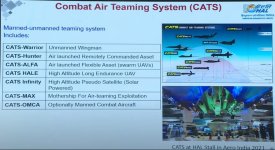
Btw, the primary fighter isn't a "mothership." A mothership is something that carries other aircraft, akin to an aircraft carrier that flies.

It's the terminology we use to describe the aircraft that controls the CATS system. It's the M in MAX.
GhB4UXjbYAAXQyr.jpeg

But frankly, it doesn't matter what you call it - MUMT involves a man in the loop. I'm talking about the plane where the man sits.

No. The Americans plan to generate mass to drill a hole so the B-21 can get in. We just don't know the full extent of what India and France have planned because they move slower than the Americans and Chinese.

Well, I think I have a fairly solid idea that drilling holes in Chinese IADS isn't exactly a pressing requirement for France.

J-36 will be dealt with by both Rafale and AMCA. As I said, it's about information, not about the capabilities of an individual aircraft.

Information can't change physical properties. Information is to be used in conjunction with a stealthy platform, not instead of.

Why do you think there's a VLO/ULO plane at the heart of every system-of-systems program in the works (FCAS, GCAP, NGAD) right now?

At the very least, we are not gonna make kneejerk purchases for the J-35 when we didn't for the far superior J-20.

By the time we assessed the J-20, the J-20B was already flying. Now that we finally sanctioned development of AMCA & working on NG engine program as an answer to J-20B, now 2-3 different J-XX are flying.

Whether we actually buy a stop-gap 5G or not is anyone's guess, and a lot of it will come down to politics. I'm just saying that if we've determined that a VLO platform is necessary to deal with future threats (which we did when we sanctioned AMCA), it might be worthwhile to get one via G2G sooner as a stop-gap because the enemy is rapidly building numbers in this department AND because very soon this will become a two-front problem.

If the stop-gap G2G isn't available, I already told you what we'll do.

That's worse for the attacker. Smaller areas are easier to defend. It gets even better for the US 'cause those smaller areas are islands.

Haven't you heard of the Battle of Thermopylae?

How did you come to the opposite conclusion?

:ROFLMAO:

Yep, cratering a whole 5km x 5km island is more difficult than searching the whole Indo-Gangetic Plain for where that BrahMos MAL moved after it launched.

BEL makes datalinks for the IN, that's separate from the IAF's program which was won by the Israelis. There's a larger indigenous one meant to integrate all three services. Right now integration between the three services is siloed.

BEL makes datalinks for everybody. The IN uses it's Link-II in conjunction with indigenous SDRs, while IAF uses its DL in conjunction with Israeli SDR (BNET).

The BNET was purchased instead of the indigenous alternative called SDR-2010, which was developed by HAL. Mostly due to size & weight constraints. Even if we had bought the HAL SDR, the datalink would've still been from BEL.

The reason cross-service integration is siloed is because the different SDRs use different encryptions. We need to fix that, either by modifying them all to use the same encryption, or replacing them all with our own SDRs.

And Rafale's radar significantly outranges Netra.

Yeah, sure buddy.

The way it actually works... Netra uses TWS to figure out basic target data. That data is sent to Rafale to generate fire control. The missile is then fired in the general direction of the target and midcourse updates are provided by Netra through the Rafale.

You just repeated what I said regarding the process of what's supposed to happen, but without addressing the question I asked therein:

"What that means is that the Meteor's engagement envelope could currently be limited to what the Rafale's own FCR is able to see & guide the missile onto, because the Rafale might not yet be able to take inputs from Netra & feed them to Meteor via the datalink that connects the missile to the Rafale."

Once the missile gets close enough, the Rafale uses its own radar to refine fire control data until the seeker kicks in. This is a basic sensor-shooter loop of an AWACS + fighter pair.

But a better version of that is to just use 2 Rafales instead. The MKI's had this since the very beginning, that's why it's called mini-AWACS. A group of 4 MKIs could join up to create a loop.

This is where you err, combined with that other assumption of Rafale (or MKI) radar outranging Netra. Wake me up when either of those can generate tracks of fighter-sized targets at +475 km like Netra can.

An additional problem is you're gonna be operating under a heavy EW environment, meaning significant sensor degradation. Which I already talked about, but you conveniently ignored. Fighter FCRs are considerably easier to degrade than AEWs, cuz the latter are much more powerful - and would operate out at farther ranges meaning the same jammer is less effective against them.

A Netra could be operating 200 km behind the fighters, and still outrange their radars by a 100 kms when it comes to tracking fighter-sized targets. The BARS can track fighters at 140 km in the best-case scenario. And no, the instrumented detection range (what fanboys love to call mini-AWACS) doesn't matter. You need to be able to generate tracks & vector data, otherwise the fighters you're guiding won't know whether they're firing their missiles ahead of or behind the target. One of those would significantly reduce the Ph/Pk.

Missiles like Meteor or Gandiva cannot be leveraged to their full extent unless you can rely on offboard target data.

And that is the crux of my doubt - whether the Rafale is yet able to take information from Netra via datalink, translate it & feed it to Meteor via fighter-to-missile datalink (which is a different system) or not. This would require our Rafales to have:

1) BNET SDR hardware installed - status: DONE.
2) Rafale's software patched to recognize the Indian datalink fed via the BNET - status: UNKNOWN, but likely DONE.
3) Translation layer installed to allow this data to be converted & fed to Meteor's datalink (which is proprietary MBDA software) - status: UNKNOWN.

I wouldn't be surprised if some of this is still work in progress.

 
How dumb are these reporters, how are you gonna hide a big plane like awacs, it's nearly impossible also in a country where ppl don't even know what is opsec, a population who proudly hammer thier own drones as a enemy drone

Damn u poured cold water right in next post..

Quite a lot of rumours around to trust anything. AI has made it worse ..
 
How dumb are these reporters, how are you gonna hide a big plane like awacs, it's nearly impossible also in a country where ppl don't even know what is opsec, a population who proudly hammer thier own drones as a enemy drone

GrsQqN7XcAER7hM


This is getting traction..

How some evidence comes out
 
Last edited by a moderator:
Status
Not open for further replies.