
Trump Offers F-35 Jet to India in Push for More Defense Deals
- Thread starter Ginvincible
- Start date
You are using an out of date browser. It may not display this or other websites correctly.
You should upgrade or use an alternative browser.
You should upgrade or use an alternative browser.



We're going to use this "F-35 offer" as a leverage point over the Russians to bargain a better Su-57 deal. Time is going to tell.......


F35 or not, but no way in hell India should not for Su57. We need to have counter to Chinese air force. I will prefer AMCA and Stealth unmanned bombers any day over F35, and F35 over Su57 junk.We're going to use this "F-35 offer" as a leverage point over the Russians to bargain a better Su-57 deal. Time is going to tell.......

Modi doesn't have the freedom of action he did back in 2014 when he broke the MMRCA deadlock and signed for 36 Rafale. RaGa's disproved corruption allegations have already spooked him into okaying another tender for MRFA, instead of placing a follow-on order. As on date, the IAF is yet to release the RfP for MRFA.Nothing new will happen beyond what's already planned.
Starting another contest for an 'interim' 5G fighter will be an equally long-drawn out affair. Hectic lobbying from Russia and the US, political games by the Opposition, and a whole new round of classified briefings, trials and commercial negotiations, US Congressional approvals, etc. means it could be years before a deal is signed. I just don't see the GoI buying Rafales and F-35s at the same time. It'll be either/or.
If a relative newbie like Turkey can fly a 5G prototype (even though a nanga model) within a couple of years, we definitely can do better. Rapid prototyping via digital twin tech can shrink dev time frames signifcantly, just ask the IN.It's not possible. First flight is expected in 2028, so 3 years is not enough.
The problem is GoI's insistence on milestone-linked release of funds. Linking LCA Mk2 funding to US approval for the F-414 has already hit the prog hard. Such penny pinching will make it impossible for ADA, HAL and pvt companies to invest in capacity building. We need to set up the Defence Tech Board now and allocate funds to cover the 110kN engine and the AMCA. The decision-making authority should be in the hands of people who understand tech, not babudom.

Sure. PDR in a few months then, I guess delayed by the new design changes after Deodhare had claimed completing its PDR in 2023. But prototype construction is set for 2026.
No, they plan for CDR by 2026, and project sanction by 2027. This is as per statements of ADA reps at current Aero India (which are obviously very optimistic).
https://****/ada-advances-tedbf-program-targets-2027-for/
But this is all assuming IN doesn't change its QRs, which it seems set to.
Pushing Vikky further is cheaper than buying a new carrier.
Only if operating a carrier was our end goal in of itself. We've evolved past that stage as a Navy.
That's in the future. It's not in competition with TEDBF.
N-AMCA itself is going to become the TEDBF. Explained below.
That's a permissible airspace. When you do not require penetration, you are in a permissible airspace. F/A-XX will also launch its LRASM at enemy ships from permissible airspace.
Permissible airspace is inside your BARCAP - where non-combatant support assets like E-2D and MQ-25 refuelers are free to operate. The BARCAP itself is of course being enforced by F/A-XX and/or F-35.
But these jets themselves aren't inside permissible airspace - they are in airspace where a Chinese strike package could show up at any time. That's contested airspace.
All the jets you see today will become second-line jets in 20 years, even Rafale, even F-35. The USAF is worried NGAD will become second-line in just 10 years after service entry.
But the MRFA are already second-line jets according to your own measure.
At least F-35 (in its current form) still has 15+ years left to go.
The F-35 currently has 2x80 kVA generators connected to the engine. It will be upgraded to 300 or 400 kVA, probably in 2029. All engines can be upgraded like this.
No, the growth capacity of 5th gen engines is much, much higher than 4th gen ones.
The peak sustainable output that can be drawn from a 4th gen after decades of design improvement is like the starting point for a 5th gen.
How does that change the fact that the IAF will expect B4 to be ready anyways?
You don't know that. You're guessing based on the assumption that IAF will approach F-35 procurement like it's going to be our main fighter till 2070.
I'm saying that assumption is wrong.
Nope. The F-35I uses generic F-35 avionics, and comes with extras added for Israeli use.
The point is that it's adapted for Israel's requirement which is unique from NATO., as it includes an ability to incorporate other Israeli systems by giving them plug-and-play access to the mission computer.
Ours will take this forward - but only with Israeli electronics. Like Rafael BNET SDR for example.
It's possible there are elements of this that haven't been publicly revealed yet. Back in 2021, Lockheed was given a contract to develop a custom F35 variant for an undisclosed export customer. IMO, this was meant to be for UAE. It didn't go through as the Biden admin messed up that contract but it's possible that a lot of work needed to develop an 'export-spec' F35 has already been done.
Er... yeah. Concept phase in 2030, review around 2035. PDR and CDR around 2040. First flight between 2040-45, and flight testing and introduction after 2050. FOC squadron deliveries by 2055-60.
You can expect first flight of the new jet when TEDBF is in production in the 2040s. So this new jet is not competing with the TEDBF, this is already well-known.
That's why I said both IAF and IN will get new jet programs once AMCA and TEDBF are approaching IOC or have achieved it. So don't expect anything new to happen until the 2040s. And naturally, both designs will have to be a generation ahead of whatever comes out of the West in 2030.
It's clearly said that TEDBF itself is to be a naval counterpart to the AMCA. I don't know what more you need to hear.
IN always only wanted a 5th gen for the long-term. They only agreed to TEDBF in its current form (then defined as 4++ gen) because they were promised a rapid timeline of realization back in 2019. They were promised a service entry by 2028.
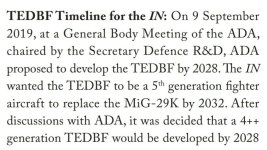
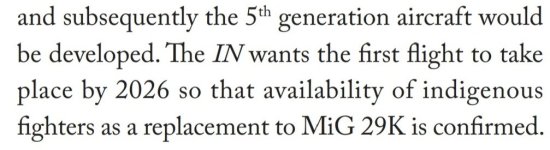
But then this timeline was pushed back by 10 years. They now expect TEDBF to enter service only by 2038.
In the meantime, IN got approval to pursue Rafale-M order to fill the need for Vikrant & Govt now seems favourable for a 2nd Vikrant to replace the Vikky (which means more Rafales can now fill the need for 2nd carrier without needing a new type).
So a lot of the compulsions that forced IN to agree to the ADA proposal for a 4++ gen interim TEDBF are now gone.
We've entered a totally new environment. So IN now has the freedom to pursue TEDBF like how they originally wanted it to be - a 5th gen fighter. And that's what they've indicated they're gonna do now.
We agree, and in fact the French engineers were aiming to optimise the Rafale's survivability when they designed it, whereas the US engineers were only thinking in terms of stealth.
We got the best survivability for the lowest price and the US got the best stealth for the highest price.
And that equation makes a lot of sense for a lot of buyers. Just not for India.
We are facing a threat that is far more advanced than anything Europe envisioned back when this equation was reached. Waiting till 2045 to receive your first VLO fighter may be acceptable to Europe as Russia isn't capable of ramping up production of Su-57, plus you have lots of countries between you & Russia that have F-35s (not to mention US presence as a tripwire long before they get to you).
Our threat environment is very different. Your timeline for achieving real stealth (through FCAS/SCAF by the 2040s) is not acceptable for the threat we face.
We're going to use this "F-35 offer" as a leverage point over the Russians to bargain a better Su-57 deal. Time is going to tell.......
It's gonna be the other way round actually. We're gonna use Su-57E as leverage for a better deal with F-35.
It's the F-35 we want. If it was Su-57, we'd never have left FGFA.
^^IAF only wants MRFA read Rafales along with AMCA. F-35 or US fighters are a strict no go as far as IAF is concerened.
Personally I won't mind IAF having a small fleet of F-35. But that's about as far as they would go. A roadmap for large scale Su-57 production in India is being readied(@marich01). In light of J-35 acquisition by PAF, it's the correct counter, IMHO. A restricted F-35 that can't communicate with AFNET is a "burden", not an asset. Period.
Personally I won't mind IAF having a small fleet of F-35. But that's about as far as they would go. A roadmap for large scale Su-57 production in India is being readied(@marich01). In light of J-35 acquisition by PAF, it's the correct counter, IMHO. A restricted F-35 that can't communicate with AFNET is a "burden", not an asset. Period.

It is why F35 already don't have enough cooling power.No, the growth capacity of 5th gen engines is much, much higher than 4th gen ones.
It is why a new engine is already needed.
hum hum....

^^IAF only wants MRFA read Rafales along with AMCA. F-35 or US fighters are a strict no go as far as IAF is concerened.
Personally I won't mind IAF having a small fleet of F-35. But that's about as far as they would go. A roadmap for large scale Su-57 production in India is being readied(@marich01). In light of J-35 acquisition by PAF, it's the correct counter, IMHO. A restricted F-35 that can't communicate with AFNET is a "burden", not an asset. Period.
Rafale supposed to be our last foreign fighter purchase .
Because of Chinese 5G fighter proliferation + Trump factor,
Rafale ie MRFA could be split with F35.
However I find Su 57 chance could be less because of CAATSA , extensive modification of Su 30 UPG & AMCA .
It is why F35 already don't have enough cooling power.
It is why a new engine is already needed.
hum hum....
The ECU upgrade is to increase electrical output even higher.
As said previously, a cooling system with 80 kW capacity is already in flight testing. The current one has 35 kW and isn't enough for the GaN upgrade.
Because unlike 4.5 gen jets that might get GaN upgrade, F35 is actually capable of utilizing the increased power capacity of GaN because of the 5th gen engine.
^^IAF only wants MRFA read Rafales along with AMCA. F-35 or US fighters are a strict no go as far as IAF is concerened.
Heh. We'll see.
I'm of the opinion that IAF will buy F35 if given the option. As a stop-gap of course. Because the threat of hostile 5th gens will manifest on the LAC & Western border much before the Navy feels the heat.
I think Navy will go ahead with Rafale-M. We're at a very advanced stage of the deal and we don't want to upset the French politically either.
A roadmap for large scale Su-57 production in India is being readied(@marich01).
I don't think that's ever gonna happen.
IAF has already rejected the Felon as inadequate for our needs.
By the time the Russians change up the tech entirely (we don't know when that might happen or if it will happen at all. Russia's timelines are all shot to hell right now) we're likely to have equivalent or better tech at home.
A restricted F-35 that can't communicate with AFNET is a "burden", not an asset. Period.
IAF F35 is more than likely to come with Rafael BNET. There's not gonna be any communication problem. Our Tejas Mk-1A and MKI use the same.
CAATSA was already there when india purchased S400. It was not a problem for US to sell India P8I, Apache etc...Rafale supposed to be our last foreign fighter purchase .
Because of Chinese 5G fighter proliferation + Trump factor,
Rafale ie MRFA could be split with F35.
However I find Su 57 chance could be less because of CAATSA , extensive modification of Su 30 UPG & AMCA .
No, the real problem is the risk of datas leaks about F35 radar signature thanks to S400 radars. It is possible that russia fitted S400 with back door systems to collect datas, and F35 is the USAF jewels : if it failed good bye the air dominance.
Anybody know if IN P-8Is got NATO-spec kit (comms, ESM, DL, etc) since signing CISMOA/COMCASA? They were fitted with BEL kit initially. If yes, they could be used as an alternative comms node for the F-35 in Indian service. Although we may need some kind of joint command structure between the IAF and IN to use them effectively.
This would also allow the P-8I to fly in MUM-T mode with the MQ-9Bs.
This would also allow the P-8I to fly in MUM-T mode with the MQ-9Bs.
Last edited:

Modi doesn't have the freedom of action he did back in 2014 when he broke the MMRCA deadlock and signed for 36 Rafale. RaGa's disproved corruption allegations have already spooked him into okaying another tender for MRFA, instead of placing a follow-on order. As on date, the IAF is yet to release the RfP for MRFA.
Starting another contest for an 'interim' 5G fighter will be an equally long-drawn out affair. Hectic lobbying from Russia and the US, political games by the Opposition, and a whole new round of classified briefings, trials and commercial negotiations, US Congressional approvals, etc. means it could be years before a deal is signed. I just don't see the GoI buying Rafales and F-35s at the same time. It'll be either/or.
The tender is the safe bet. RaGa's entire point of attack was the Rafale GTG was bought without a competitive tender. Only GTG with Russia and US are fully trusted because the French do not have the same system. They used that against Modi. The French have since started work on their own GTG type system like FMS and Russia's RoE.
Basically, if it's not a GTG with Russia or US, it has to be a transparent tender. Those are our procurement rules. That's the reason deals with Russia and the US go so smoothly.
The Rafale deal worked out because the SC gave it a clean chit.
If a relative newbie like Turkey can fly a 5G prototype (even though a nanga model) within a couple of years, we definitely can do better. Rapid prototyping via digital twin tech can shrink dev time frames signifcantly, just ask the IN.
KAAN's development started in 2011. They picked their final design in 2016 and that went into production in 2018. Their true first flight is scheduled for 2026. Their timeline is of development is pretty much the same as AMCA's. They expect FOC versions coming out after 2035.
The problem is GoI's insistence on milestone-linked release of funds. Linking LCA Mk2 funding to US approval for the F-414 has already hit the prog hard. Such penny pinching will make it impossible for ADA, HAL and pvt companies to invest in capacity building. We need to set up the Defence Tech Board now and allocate funds to cover the 110kN engine and the AMCA. The decision-making authority should be in the hands of people who understand tech, not babudom.
That's how development is done, and ADA and DRDO are fine with it.
No, they plan for CDR by 2026, and project sanction by 2027. This is as per statements of ADA reps at current Aero India (which are obviously very optimistic).
But this is all assuming IN doesn't change its QRs, which it seems set to.
Okay, new dates probably meet the new deadline. So 2023 PDR and 2025 CDR changed to 2025 PDR and 2026 CDR. Not much difference.
IN won't change its QRs.
Only if operating a carrier was our end goal in of itself. We've evolved past that stage as a Navy.
The IN wants carriers. More will be built.
N-AMCA itself is going to become the TEDBF. Explained below.
There is no N-AMCA, it's going to be a whole new design. ADA actually rejected the IN's proposal of modifying the jet for naval use. That's why TEDBF was taken up.
Anyway, the IAF doesn't want others to mess around with their primary jet, whether it's the SFC or IN.
Permissible airspace is inside your BARCAP - where non-combatant support assets like E-2D and MQ-25 refuelers are free to operate. The BARCAP itself is of course being enforced by F/A-XX and/or F-35.
But these jets themselves aren't inside permissible airspace - they are in airspace where a Chinese strike package could show up at any time. That's contested airspace.
No. That's still permissible airspace. Fighter jet presence does not define that.
But the MRFA are already second-line jets according to your own measure.
At least F-35 (in its current form) still has 15+ years left to go.
Rafale F5 will be effective until the mid-2050s. The F-35 is probably already coming to an end without its B4 avionics.
The entire argument of the Israelis for modifying the F-35 was they believed the F-35's stealth will no longer be effective in 10 years, and they said that in 2014. If we assume they said it for when Adir was expected to be ready, we could be talking about 2035.
No, the growth capacity of 5th gen engines is much, much higher than 4th gen ones.
The peak sustainable output that can be drawn from a 4th gen after decades of design improvement is like the starting point for a 5th gen.
Not really. You are just sticking the same generator on the engine. The only question is whether your heat sink can manage the heat generated.
You don't know that. You're guessing based on the assumption that IAF will approach F-35 procurement like it's going to be our main fighter till 2070.
I'm saying that assumption is wrong.
No, main fighter for 25-30 years and then second-line for the next 25 years. B5-10 + ISE will become outdated in 25 years after service entry, and EW upgrades are necessary every 7-10 years.
The point is that it's adapted for Israel's requirement which is unique from NATO., as it includes an ability to incorporate other Israeli systems by giving them plug-and-play access to the mission computer.
Ours will take this forward - but only with Israeli electronics. Like Rafael BNET SDR for example.
It's possible there are elements of this that haven't been publicly revealed yet. Back in 2021, Lockheed was given a contract to develop a custom F35 variant for an undisclosed export customer. IMO, this was meant to be for UAE. It didn't go through as the Biden admin messed up that contract but it's possible that a lot of work needed to develop an 'export-spec' F35 has already been done.
The F-35I's core avionics are still American. Their version only carries add-on Israeli systems that are separate from the core systems.
It's clearly said that TEDBF itself is to be a naval counterpart to the AMCA. I don't know what more you need to hear.
IN always only wanted a 5th gen for the long-term. They only agreed to TEDBF in its current form (then defined as 4++ gen) because they were promised a rapid timeline of realization back in 2019. They were promised a service entry by 2028.
Yes, as I've already mentioned, ADA does not have the ability to develop a stealth naval jet right away, especially when AMCA was going to happen in parallel. Developing 2 jets simultaneously with our resources was impossible, so ADA convinced the IN to go for TEDBF and that once AMCA's design work was done, they can take up a "5th gen" or "next gen" fighter after TEDBF and AMCA were under flight testing.
Furthermore, the IN believed that IAC-2 will be Vishal, a 65k DWT CATOBAR-carrier, instead of a second Vikrant. But with that plan delayed, they have more time to develop their next jet to meet the timeline for IAC-3, with its construction expected only in the 2040s. So they need their next jet for 2050+, which makes TEDBF all the more important.
But then this timeline was pushed back by 10 years. They now expect TEDBF to enter service only by 2038.
Years ago I had claimed that ADA's 2032 date was unrealistic, I had personally always assumed 2035. Now 2040 is much more realistic after the redesign and new dates. But it doesn't change the overall situation.
In the meantime, IN got approval to pursue Rafale-M order to fill the need for Vikrant & Govt now seems favourable for a 2nd Vikrant to replace the Vikky (which means more Rafales can now fill the need for 2nd carrier without needing a new type).
Rafale M was for Vikky, IAC-1, and later the CATOBAR IAC-2. So the requirement was older than their new plan. They wanted 57 Rafales for IAC-2. Today, the 3 STOBARs can carry a mix of Mig-29K and Rafale before replacing Mig-29K with TEDBF.
So a lot of the compulsions that forced IN to agree to the ADA proposal for a 4++ gen interim TEDBF are now gone.
Still exists. If a new plan is drawn up, it will still take until 2050 to get the new jet.
Just reduce my dates by 5 years. So concept + review by 2030. PDR+CDR by 2035. First flight between 2035-40. IOC/FOC by 2045. Squadron deliveries by 2050. But fat chance of starting a new program this year itself.
And 5th gen is a pretty low bar for 2050. I'm expecting the IAF to go for a jet that's at least a generation ahead of NGAD. So at least half a generation ahead for the IN, or they will end up importing SCAF.
A new program can start only after they prove the TEDBF's airframe and FBW on a carrier. They need ATOL and MUM-T operational for carrier use too.
Rafale ie MRFA could be split with F35.
Unlikely to happen as MRFA is a long term production deal and needs sufficient numbers for the private industry to participate. Of course, if the F-35 is also produced via ToT, that's a different story, but it will need to be an equally big order too.
However I find Su 57 chance could be less because of CAATSA , extensive modification of Su 30 UPG & AMCA .
The real reason is the Su-57's avionics don't suit our environment, it's made for Russia. The current version's still got GaAs, the EW suite is not sufficient for our needs as it's just export-grade junk, and MAWS uses UV instead of IR. So, if we are to buy it, the entire avionics suite will have to be changed, and that will take too much time. The Russians need 5 years for Su-57 + MKIzation alone or 8 years for an FGFA. Plus a whole suite of new weapons means endless testing.
Although stealthy, it's not as stealthy as the F-35. If the F-22 is 10 times more stealthy than the Su-57, the F-35 could be 50-100 times more stealthy. And even the F-35 is not going to be stealthy for long. So, if the Su-57 cannot perform penetration missions, it's pointless to the IAF. Our goal isn't air denial after all, and the MKI MLU + LCA/MRFA combo can do that quite effectively anyway.
Plus, when FGFA was expected to happen, the MKI was supposed to leave service simultaneously, it was a direct replacement. But with MKI's shelf life extended from 25 to 40 years, that need disappeared. So the IAF have set their sights on more advanced replacements, like AMCA and whatever comes next.
CAATSA is secondary. If we want a high altitude supercruiser, the US will have to offer an alternative or relent 'cause even they understand that our need for hard military capabilities are greater than our relationship. They won't stop us from buying exotic tech 'cause they know those won't be sold to other countries.
Anybody know if IN P-8Is got NATO-spec kit (comms, ESM, DL, etc) since signing CISMOA/COMCASA? They were fitted with BEL kit initially. If yes, they could be used as an alternative comms node for the F-35 in Indian service. Although we may need some kind of joint command structure between the IAF and IN to use them effectively.
This would also allow the P-8I to fly in MUM-T mode with the MQ-9Bs.
Not yet. After we became a partner, a new P-8I deal was supposed to be signed with all the new goodies, but was put on hold. It's been revived or some sort, so let's see where that goes.

Okay, new dates probably meet the new deadline. So 2023 PDR and 2025 CDR changed to 2025 PDR and 2026 CDR. Not much difference.
IN won't change its QRs.
I think they will - we'll see.
The IN wants carriers. More will be built.
IN wants capabilities. The carriers will be shaped according to the capabilities needed. If a carrier doesn't meet the capabilities, no money will be wasted on a refit. Especially now that MoD seems open to the idea of building a 2nd Vikrant. If they said a firm NO for that idea, then IN might have to consider the refit.
There is no N-AMCA, it's going to be a whole new design. ADA actually rejected the IN's proposal of modifying the jet for naval use. That's why TEDBF was taken up.
Anyway, the IAF doesn't want others to mess around with their primary jet, whether it's the SFC or IN.
That was before we decided to break the AMCA program into Mk-1 and Mk-2 developments, each with independent technology goals & timelines.
This way, IAF will get the Mk-1 without any interference from other services' requirements, or because of being linked to the next-gen engine program (a mistake we made in LCA development).
Any N-AMCA would be developed as a derivative of Mk-2 which is a long ways off. It'll come with 5th gen engine from the get go. It'll only see light of day in the 2040s. In time for a CATOBAR IAC-3.
Till then, 26+26 Rafale-Ms is all that IN needs. These planes will have enough airframe life to last till retirement of both Vikrant-class carriers. We don't need a new STOBAR jet.
No. That's still permissible airspace. Fighter jet presence does not define that.
If you're gonna make up your own definitions, I can't stop you.
Rafale F5 will be effective until the mid-2050s. The F-35 is probably already coming to an end without its B4 avionics.
Nah, Rafale will be effective at least till 23rd century.
Not really. You are just sticking the same generator on the engine. The only question is whether your heat sink can manage the heat generated.
It's not that simple. If you do that, you'll run into the same kind of problems F-35 pre-ECU is running into.
They've said it themselves. They're aiming for an evolutionary increase over current M88. An evolutionary increase doesn't mean going from ~70 kVa to ~300 kVa. It means probably going to ~ 100 kVa.
That's not enough to drive 5th gen avionics. F35 has determined it needs 400+ kVa with 80kW cooling capacity to drive a GaN FCR, EOTS & DAS to their full capability.
You want to drive all that (+ all the additional radar arrays F5 supposedly plans) with 1/4th the power on tap? Those sensors will be handicapped.
This is why we're gonna need next-gen engines for AMCA Mk-2.
Rafale M was for Vikky, IAC-1, and later the CATOBAR IAC-2. So the requirement was older than their new plan. They wanted 57 Rafales for IAC-2. Today, the 3 STOBARs can carry a mix of Mig-29K and Rafale before replacing Mig-29K with TEDBF.
Rafale M could never fit in Vikky. MRCBF for Vikky was only possible if we had gone for SH with the folding wings.
It is why F35 already don't have enough cooling power.
It is why a new engine is already needed.
hum hum....
There's no choice. If you want more powerful sensors, you need more electricity to drive them & more cooling to keep them working.
You'll do the same when you move to FCAS.
After having bought 36+26 Rafale, each after extensive in-country trials, there's no point in going for another open tender. Not if the IAF wants to shore up squadron numbers, at least. The GoI too would seek to amortize capex costs of over 15 billion Euros, than buy a new type.The tender is the safe bet. RaGa's entire point of attack was the Rafale GTG was bought without a competitive tender. Only GTG with Russia and US are fully trusted because the French do not have the same system. They used that against Modi. The French have since started work on their own GTG type system like FMS and Russia's RoE.
Basically, if it's not a GTG with Russia or US, it has to be a transparent tender. Those are our procurement rules. That's the reason deals with Russia and the US go so smoothly.
The Rafale deal worked out because the SC gave it a clean chit.
Most govts prefer G2G deals with as little ToT as possible. This helps protect them protect local jobs and industrial competitiveness. Afaik the French don't need parliamentary approval on G2G deals. It's at the discretion of their President. The IAF publicly said it didn't have a Plan B beyond Rafale back in 2015-16; it would have moved heaven and earth to get the deal approved.
KAAN's development started in 2011. They picked their final design in 2016 and that went into production in 2018. Their true first flight is scheduled for 2026. Their timeline is of development is pretty much the same as AMCA's. They expect FOC versions coming out after 2035.
Turkey has a specialized agency called SSM, distinct from its defence ministry to manage high-priority dev/procurement programs like KAAN with financial allocations separate from the latter. This allows Turkish companies to get faster approvals rather than having to run back to the MoD, MoF, DAC, CCS, et all, every time they need money. A DTB with adequate financial powers is the need of the hour, if we want the AMCA prog to deliver faster.That's how development is done, and ADA and DRDO are fine with it.
US secdef has announced a 40% cut in his whole budget in 5 years. Only 17 programs will be preserved. F-35 not, nor the constellation, but virginia will.
Hard to tell how the f-35 programm will be impacted.
Hard to tell how the f-35 programm will be impacted.