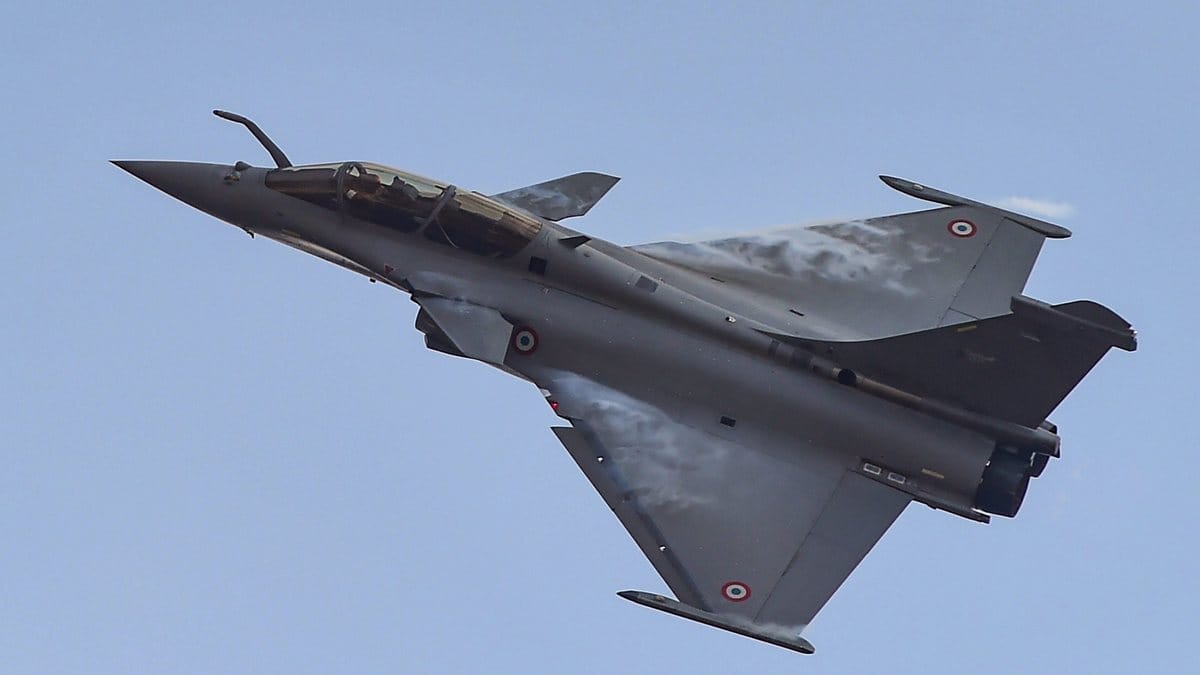
MMRCA 2.0 - Updates and Discussions

What is your favorite for MMRCA 2.0 ?

  • F-35 Blk 4

    Votes: 44 16.4%
  • Rafale F4

    Votes: 205 76.5%
  • Eurofighter Typhoon T3

    Votes: 5 1.9%
  • Gripen E/F

    Votes: 5 1.9%
  • F-16 B70

    Votes: 1 0.4%
  • F-18 SH

    Votes: 10 3.7%
  • F-15EX

    Votes: 11 4.1%
  • Mig-35

    Votes: 2 0.7%

  • Total voters
    268
  • Poll closed .
Three problems are in the public domain.

HAL wanted to choose their own production systems through a global tender instead of just using what Dassault uses for Rafale's production. Plus HAL wanted a more manpower heavy approach versus Dassault's more automated approach.

The first meant the Rafales produced by HAL would have to be recertified, which takes a few years. The second meant the labour cost and manpower hours of the program would increase by many times, 2.7 times as per Dassault.

And the CNC insisted Dassault guarantee quality. So HAL wants to change the entire production process without Dassault's involvement and then the CNC expects Dassault's guarantee, although, to be fair, HAL argued that they can do it. Doesn't make sense at all.

This increased the costs way over L2 and killed the program.

Things should have been fine if HAL stuck to Dassault's production processes. Who knows what they were thinking?

In any case, now DRAL is gaining experience in aircraft production.


By the time the MRFA-Rafale deal is signed and production begins, they could very well be rubbing shoulders with HAL as equals. And under DRAL, Dassault can use their own processes, control prices and guarantee quality. So at least that elephant's out of the room.

If Rafale wins MRFA, DRAL will be the lead integrator whereas subcontractors will produce the airframe and engine in India, and most electronics in France. So I suspect HAL will produce the engine, Tata/L&T/Dynamatics/VEM etc will produce the airframe, landing carriage (perhaps HAL here as well) etc. French companies will largely produce electronics in France, with some spares in India, and some tech dealing with comm systems like SDR, IFF, datalink etc should end up in India. There may be some form of MKIzation of the MDPU, especially because capability downgrades are possible if left entirely in French hands. Plus we need enough ToT that allows us to integrate new weapons and systems on our own.
 

AMCA: India & France To Sign An Agreement For A 125 KN Engine

The Joint Development Deal for a 125-kilonewton class engine is nearing completion, according to reports.

The Indian Air Force will purchase 40 AMCA Mark I jets as soon as flight certification and initial weapons trials are completed. While the AMCA Mark II will go into production in 2035 with a new powerful engine capable of producing 125 kilonewtons of thrust, talks with SAFRAN, a French engine manufacturer, have progressed and a contract will be finalised in 2023.

The new engine will make its debut flight on a Dassault Aviation Rafale testbed aircraft in 2030, and it is likely to be authorised for production in 2033.

The American F-414 engines of the AMCA Mark 1, Twin Engine Deck Based Fighter (TEDBF), and Tejas Mk 2 or Medium Weight Fighter will be replaced by this 125 kilonewton engine (MWF).
 

AMCA: India & France To Sign An Agreement For A 125 KN Engine

The Joint Development Deal for a 125-kilonewton class engine is nearing completion, according to reports.

The Indian Air Force will purchase 40 AMCA Mark I jets as soon as flight certification and initial weapons trials are completed. While the AMCA Mark II will go into production in 2035 with a new powerful engine capable of producing 125 kilonewtons of thrust, talks with SAFRAN, a French engine manufacturer, have progressed and a contract will be finalised in 2023.

The new engine will make its debut flight on a Dassault Aviation Rafale testbed aircraft in 2030, and it is likely to be authorised for production in 2033.

The American F-414 engines of the AMCA Mark 1, Twin Engine Deck Based Fighter (TEDBF), and Tejas Mk 2 or Medium Weight Fighter will be replaced by this 125 kilonewton engine (MWF).
What will be the electrical output from this engine? These days electrical out put also matters.
 

Le Rafale sera-t-il l’héritier du Mirage III pour l’avenir de l’industrie aéronautique française ?

Translated with www.DeepL.com/Translator (free version)

Will the Rafale be the heir to the Mirage III for the future of the French aeronautics industry?


Fast, agile, powerful and well armed, the Mirage III is undoubtedly a legend in military fighter aviation worldwide. In the hands of Israeli pilots, Dassault Aviation's single-engine delta-wing fighter won over Arab Migs and Hunters during the Six-Day and Yom Kippur Wars, and played a decisive role in the victory of the Hebrew State in these two conflicts, endowing the aircraft with an aura of efficiency and performance that built up its export success, with 1,400 aircraft built (Mirage IIIs and Vs), and which imposed Dassault Aviation's fighter aircraft on the international market for several decades. The Mirage III/V was exported to 13 countries, its successor the Mirage F1 to 10 countries, and the Mirage 2000 to 8 countries. Each of these aircraft retained the key strengths of the Mirage III, namely high performance for a compact aircraft that was economical to buy and operate compared to the majority of American aircraft, such as the F-100 Super Sabre and the F-104 Starfighter for the Mirage III, the F-4 Phantom II for the Mirage F1, and the Tornado, F-15 and F-18 for the 2000, even if the latter two have suffered from the arrival of the American F-16 Falcon, precisely designed as a light and economical fighter like the French ones, and not in the traditional Anglo-Saxon trend

With the Rafale, Dassault Aviation took an important risk, by aiming not at its favourite field, the single-engine high-performance fighters, but at a twin-engine multipurpose fighter, a field in which the Americans and the British had imposed themselves in the West for several decades, with the F-4 Phantom, then the F-14, F-15, Tornado and F-18, and while they were developing new models of this type with the Eurofighter consortium's Typhoon, the Lockheed-Martin F-22 and the Boeing F/A-18 E/F Super Hornet. After nearly two decades of hard times marked by resounding export failures against the F-16 (Morocco), the F-35 (Netherlands, Denmark) and even the Swedish Gripen (Brazil), the Rafale finally succeeded in convincing its first three export customers in 2015, Egypt for 24 aircraft, Qatar for 24 aircraft (+12 options exercised in 2017), and India with 36 aircraft. But the real consecration for the Rafale came in 2021, when Greece (18+6 aircraft), Croatia (12 aircraft), Egypt (30 aircraft) and the United Arab Emirates (80 aircraft) announced their orders, followed in 2022 by Indonesia (42 aircraft), making the French fighter the most successful export of its generation, far surpassing the Typhoon, Super Hornet, Eagle II and Su-35, and turning what was long perceived even in France as a costly failure, into a true international success.

The Mirage III forged the image and success of the French defence aeronautics industry for several decades

Other countries are negotiating with Dassault Aviation for new orders, even if the French manufacturer has learned from these failures and remains particularly discreet on the subject. Thus, the Rafale is considered to be very well placed in the competition with the Super Hornet to equip Indian aircraft carriers, especially since the future of the latter is now sealed with the cancellation of the German order and the refusal of the US Navy to order new aircraft in 2023, while a new order from the Indian Air Force is under discussion, and the Rafale is also considered to be a very serious contender for the MMRCA 2 super contract for 114 aircraft. Both Greece and Egypt have also hinted that a new Rafale order could be placed in the future, especially since the announced performance of the Rafale F4 and the anticipated capabilities of the F5 standard are of interest to these countries. Qatar must also decide on the remaining option of 24 aircraft, while Iraq also seems interested in the French aircraft as part of the modernisation of its air force. Finally, the French fighter is being proposed to other countries in a more or less supportive manner, while in an article published today, the very well-informed Michel Cabirol suggests that Serbia is also interested in the Rafale to replace its aircraft of Soviet origin with 12 French aircraft.
 
  • Informative
Reactions: Bon Plan

Le Rafale sera-t-il l’héritier du Mirage III pour l’avenir de l’industrie aéronautique française ?

Translated with www.DeepL.com/Translator (free version)

Will the Rafale be the heir to the Mirage III for the future of the French aeronautics industry?


Fast, agile, powerful and well armed, the Mirage III is undoubtedly a legend in military fighter aviation worldwide. In the hands of Israeli pilots, Dassault Aviation's single-engine delta-wing fighter won over Arab Migs and Hunters during the Six-Day and Yom Kippur Wars, and played a decisive role in the victory of the Hebrew State in these two conflicts, endowing the aircraft with an aura of efficiency and performance that built up its export success, with 1,400 aircraft built (Mirage IIIs and Vs), and which imposed Dassault Aviation's fighter aircraft on the international market for several decades. The Mirage III/V was exported to 13 countries, its successor the Mirage F1 to 10 countries, and the Mirage 2000 to 8 countries. Each of these aircraft retained the key strengths of the Mirage III, namely high performance for a compact aircraft that was economical to buy and operate compared to the majority of American aircraft, such as the F-100 Super Sabre and the F-104 Starfighter for the Mirage III, the F-4 Phantom II for the Mirage F1, and the Tornado, F-15 and F-18 for the 2000, even if the latter two have suffered from the arrival of the American F-16 Falcon, precisely designed as a light and economical fighter like the French ones, and not in the traditional Anglo-Saxon trend

With the Rafale, Dassault Aviation took an important risk, by aiming not at its favourite field, the single-engine high-performance fighters, but at a twin-engine multipurpose fighter, a field in which the Americans and the British had imposed themselves in the West for several decades, with the F-4 Phantom, then the F-14, F-15, Tornado and F-18, and while they were developing new models of this type with the Eurofighter consortium's Typhoon, the Lockheed-Martin F-22 and the Boeing F/A-18 E/F Super Hornet. After nearly two decades of hard times marked by resounding export failures against the F-16 (Morocco), the F-35 (Netherlands, Denmark) and even the Swedish Gripen (Brazil), the Rafale finally succeeded in convincing its first three export customers in 2015, Egypt for 24 aircraft, Qatar for 24 aircraft (+12 options exercised in 2017), and India with 36 aircraft. But the real consecration for the Rafale came in 2021, when Greece (18+6 aircraft), Croatia (12 aircraft), Egypt (30 aircraft) and the United Arab Emirates (80 aircraft) announced their orders, followed in 2022 by Indonesia (42 aircraft), making the French fighter the most successful export of its generation, far surpassing the Typhoon, Super Hornet, Eagle II and Su-35, and turning what was long perceived even in France as a costly failure, into a true international success.

The Mirage III forged the image and success of the French defence aeronautics industry for several decades

Other countries are negotiating with Dassault Aviation for new orders, even if the French manufacturer has learned from these failures and remains particularly discreet on the subject. Thus, the Rafale is considered to be very well placed in the competition with the Super Hornet to equip Indian aircraft carriers, especially since the future of the latter is now sealed with the cancellation of the German order and the refusal of the US Navy to order new aircraft in 2023, while a new order from the Indian Air Force is under discussion, and the Rafale is also considered to be a very serious contender for the MMRCA 2 super contract for 114 aircraft. Both Greece and Egypt have also hinted that a new Rafale order could be placed in the future, especially since the announced performance of the Rafale F4 and the anticipated capabilities of the F5 standard are of interest to these countries. Qatar must also decide on the remaining option of 24 aircraft, while Iraq also seems interested in the French aircraft as part of the modernisation of its air force. Finally, the French fighter is being proposed to other countries in a more or less supportive manner, while in an article published today, the very well-informed Michel Cabirol suggests that Serbia is also interested in the Rafale to replace its aircraft of Soviet origin with 12 French aircraft.

As long as Rafale wins MRFA and a contract is signed, more countries should join the bandwagon.
 
'With Us or Against Us?': What to Expect from the India-US '2+2' Ministerial Talks

The meeting in Washington assumes significance in the wake of the US's efforts in the recent weeks to try and wean India off Russian defence materiel and lure it into its own domestic military-industrial complex.

Chandigarh: Other than tackle the burning issue of Russia’s ongoing military campaign in Ukraine, the ‘2+2’ ministerial dialogue between the Indian and US defence and foreign ministers in Washington early next week is expected to see the two sides fast-track New Delhi’s deferred $3 billion purchase of multi-mission armed unmanned aerial vehicles.

Security sources have told The Wire that the April 11 meeting between Rajnath Singh and S. Jaishankar and their US counterparts Lloyd Austin and Antony Blinken is expected to progress the acquisition of 30 General Atomics-Aeronautics Systems Incorporated MQ-9B Reaper/Sea Guardian unmanned aerial vehicles – 10 for each of the three services – via the US Foreign Military Sales route.

“The high costs involved in the long-endurance MQ-9B unmanned aerial vehicles purchase is the principal handicap in clinching the deal, and the discussions in Washington next week are likely to focus on that aspect,” says retired Brigadier Rahul Bhonsle of the Security Risks Consultancy Group in Delhi.

Other technical and operational details of the Indian Navy-led unmanned aerial vehicles procurement have already been finalised over the past two years, he adds.

Major issues to be on the table

Earlier, in late 2020, the Indian Navy had leased two non-weaponised Sea Guardian unmanned aerial vehicles to monitor the Indian Ocean Region from Indian Naval Air Station INS Rajali in Tamil Nadu. With an endurance of over 30 hours, the two maritime variants of the armed Predator-B supplemented surveillance operations conducted over the Indian Ocean Region by the Indian Navy’s Boeing P-8I Neptune long-range maritime multi-mission fleet, that too is based at Rajali.

The two unmanned aerial vehicles were the first lot of military equipment that India had leased under the new provisions incorporated in the Defence Acquisition Procedure-2020 manual.

Alongside, the potential purchase by the Indian Navy of Boeing F/A-18 Block III ‘Super Hornet’ fighters for employment aboard, its indigenously designed and built 37, 500-tonne short take-off barrier arrested recovery aircraft carrier – scheduled for commissioning as INS Vikrant on Independence Day in August 2022 – is also expected to feature in next week’s 2+2 meet, the fourth such conclave since 2018.

The Indian Navy has a long-pending requirement for 57 multi-role carrier-borne fighters – a number which could be pared down to 36-odd platforms due to budgetary constraints – and consequently two F-18s are expected to imminently conduct a series of operational demonstrations at the shore-based test facility (SBTF) at INS Hansa in Goa. The SBTF’s 283m mock-up ski jump facility resembles the deck of an aircraft carrier and was also where Dassault’s two Rafale-Maritime (M) fighters displayed their capabilities earlier this year, as a possible rival to the F-18 in meeting the Navy’s eventual requirements.

At present, the Indian Navy operates two squadrons of 44 Russian MiG29K/KUB deck-based fighters that comprise the air arm of INS Vikramaditya (ex-Admiral Gorshkov), the Navy’s sole 44,750 tonne refurbished Kiev-class carrier. But these fighters are facing maintainability, availability and spare parts problems, industry sources say and need possible supplementation and subsequent replacement.

Official sources say that other than the MQ-9B UAVs and the F-18s, the “hugely sensitive” issue of invoking Countering America’s Adversaries Through Sanctions Act (CAATSA) on India over its procurement of five Russian Almaz-Antey S-400 Triumf self-propelled surface-to-air (SAM) missile systems too would doubtlessly feature in the 2+2 Dialogue.

The US has already effected CAATSA against Turkey and China in 2018 and 2020 respectively for installing their respective S-400s. With India deploying an analogous Russian SAM system earlier this year, it too was susceptible to embargoes. But as the US’ close strategic and military ally, India is hopeful of a CAATSA bypass, which can be granted by President Joe Biden under the Act’s “modified waiver authority” for “certain sanctionable transactions”.

Changed scenario

The transfer of diverse other materiel to India will also be high on the 2+2’s agenda following Washington’s repeated calls over the past three years for Delhi to reduce its extraordinary dependence on Russian defence equipment.

In recent weeks, the Ukrainian invasion has only raised Washington’s pitch to a frenzy to try and wean India off Russian materiel and lure it into its own domestic military-industrial complex, which senses a lucrative opportunity to enrich itself. Over 60% of India’s in-service defence equipment in all three services is of Soviet or Russian origin, which under harsh US-led sanctions faces severe problems in sourcing spares and ancillary equipment to remain operational.

“By severely sanctioning Russia’s arms industry, for which Delhi is the principal customer, the US is hoping to close it down and take up the slack with regard to India’s defence needs which remain substantial,” says Amit Cowshish, former Ministry of Defence (MoD) acquisitions advisor. “It’s a well-calculated move by Washington that has potentially lucrative spinoffs for US armament companies for decades in direct sales or in technology transfers.”

Potential problems with the US defence procurements

But despite the $20-odd billion worth of platforms like P-8Is, C-17 Globemaster IIIs and C-130J-30 Super Hercules transports, AH-64E Apache and CH-47F Chinook attack and heavy-lift helicopters, which India had acquired from 2002 onwards, there is an inherent inhibition in these procurements: it forecloses the possibility of India’s military pursuing its long-established and hugely accomplished, and at times, resort to jugaad (‘make do’) with regard to equipment.

Entirely feasible on Soviet or Russian platforms and equipment – at times even welcomed and with no restrictions whatsoever – the attitude of jugaad has not only provided India’s military flexibility in operating its kit but also ably rendered foreign equipment wholly serviceable in climatic extremes and assorted terrain and for varied operational deployments.

But the US protocols like the End Use Monitoring Agreement (EUMA), agreed upon in 2009 after much wrangling and extended negotiation, proscribes India from retrofitting and adapting military equipment to its needs without the Original Equipment Manufacturers (OEMs) consent and participation for the entire duration of its service, which in the US’s case, has almost never ever been permitted.

With the 80-odd countries with which Washington has concluded the EUMA, it has reportedly made an exception only a handful of times, once by allowing the Israel Air Force to incorporate locally developed sensors and weapons onto Lockheed Martin F-16’s supplied to Tel Aviv and subsequently with regard to some systems aboard Lockheed Martin’s F-35 Lightening II fifth generation fighters supplied recently to the Israel Air Force.

Besides, all US military purchases by India under the Foreign Military Sales programme have been concluded under the stricter ‘Golden Sentry’ EUMA, which governs the physical verification of the equipment and its eventual disposal. This protocol is far stricter than the less stringent ‘Blue Lantern’ EUMA which directs the direct commercial sale of US materiel worldwide.

And though the Congress Party-led United Progressive Alliance government had then obliquely claimed success in concluding the EUMA on Indian terms, by securing the concession that the time and location of the US equipment’s verification process would be determined by Delhi, it had deftly avoided all mention of life-long and costly reliance on OEMs to keep the US equipment in service.

Be that as it may, military officers say such foreclosure on the US defence gear supplied to India prohibits “amazing and efficient implementation of jugaad” that has been elevated to sophisticated levels. Generations of military officers concede that jugaad not only ensures that imported weapon systems perform well above their declared operational potential but also render a range of platforms and ordnance not only highly serviceable and effective, but in some instances even deadly.

These include the fleet of Chetak’s and Cheetah’s – principally Alouette IIIs and SA-315B Lama’s – rendered capable after jugaad of operating almost daily for decades at heights of over 14,000 feet in the Siachen glacier region and corresponding elevations, a feat their French OEMs could never ever have imagined possible.

Besides, some 100-odd MiG-21 ‘Bis’ ground attack fighters were effectively upgraded in the late 1990s with Russian collaboration by innovatively equipping them with French, Israeli, locally developed and commercial – off-the-shelf weapons, sensors and electronic warfare systems. The fleet of ground attack Anglo-French SEPECAT Jaguar’s too had been successfully retrofitted, provided with mid-air refuelling capability, amongst other systems, supplied by vendors other than their OEM.

Even the frontline Russian Sukhoi Su-30MkI multi-role fighters, which comprise the backbone of the Indian Air Force’s (IAF’s) combat squadrons, had local and other-than-Russian force multipliers fitted on board, increasing their lethality. And during the 1999 Kargil conflict, the IAF had ably equipped its Mirage 2000Hs with indigenous 1,000-lb precision-guided munitions, delivering them with devastating effect on Pakistani army bunkers in the Himalayas. Even the Dassault Rafale fighters, the IAF’s most recent buy, were fitted with Israeli helmet-mounted displays as part of the platforms 13 India Specific Enhancements in a somewhat more sophisticated version of jugaad.

Alongside, the Indian Army’s Soviet and Russian T72M1 and T 90S main battle tanks, 130mm M46 field guns and BMP-1/2 infantry combat vehicles, in addition to numerous naval assets had all been innovatively and effectively adapted through jugaad with their efficiency, operability and life span greatly enhanced.

But, under the EUMA, India’s military will have to forego this functional option to retrofit US-supplied equipment which, for the duration of its service would exclusively remain the OEMs responsibility to maintain, service and overhaul. This Agreement also irrevocably prevents India from getting US-origin defence equipment serviced by any other country or acquiring spares from other sources.

“Such cradle-to-grave restrictions provide Washington continuing leverage over the equipment recipient country,” says a two-star Indian Navy officer. “Such leverage,” he adds, “which is not the case with Russian equipment, has the inherent possibility of ensuring that the recipient country cooperates with Washington on US-centric strategic, political and diplomatic goals.

” Such a state of affairs would also firmly cement the “with-us-or-against-us” proclivity that Rambo-like the US is so fond of mouthing and one which will, no doubt, be in evidence at the 2+2 meet, though unsubtly sheathed in a velvet glove.

 
  • Like
Reactions: randomradio
Dassault Aviation said on 19 April that it had received the first instalment of the contract for the purchase of 80 Rafale aircraft by the United Arab Emirates.

Signed on December 3, 2021 in the presence of the President of the French Republic, Emmanuel Macron, and the Crown Prince of Abu Dhabi, Sheikh Mohammed ben Zayed Al Nahyane, this contract, by its exceptional scope, "attests to Dassault Aviation's technological expertise, the unique operational qualities of the Rafale, and illustrates the power of the strategic partnership between the United Arab Emirates and France," says the Dassault Aviation group, which continues: "It testifies to the historical and privileged relationship between Dassault Aviation and the United Arab Emirates Air Force & Air Defence (UAE AF & AD) since its creation and reaffirms its satisfaction with Dassault aircraft as demonstrated by the Mirage 2000-9 upgrade.

Translated with www.DeepL.com/Translator (free version)
 
  • Like
Reactions: Herciv
I mean the order for 114 jets. If Dassault wins that, even other non-traditional markets should open up to France due to the Indian connection, particularly SE Asia.
I dont think our orders does matters anymore now. Its an established aircraft, probably except European who is the development partners of ET & miser countries like India all will opt either F35 or Rafale.
 
Maybe 2-3 years from now. The tender will be out soon.
Ok lets beleive your assumption for a debate. We will be signing the deal in 2025 ( if regime change happens, then we will proudly go for new tender), then first the first Rafale will not coming to IAF befor 2028, and asper expectations MK2 will start flying with IAF by 2029. Do you really beleive that HAL & othe rotten desi weapon lobby & twitter warriors will stay quietly? They will definitely advertise mk2 as equivalent mk2 at fraction of expense. The ignorant & illiterate political leadership will do what these lobby is narrating.
 
  • Haha
Reactions: Picdelamirand-oil