South Korean KAI KF-21 Boramae Developments

Ashwin

Agent_47
Staff member
Administrator
Nov 30, 2017
11,430
27,625
Bangalore
SEOUL, South Korea ― South Korea’s arms acquisition agency unveiled June 29 the preliminary design of the KF-X fighter aircraft, nearly 30 months after the launch of the indigenous fighter development program in January 2016.

The disclose of the preliminary KF-X design came after the Defense Acquisition Program Administration, or DAPA, held a preliminary design review, or PDR, between June 26 and June 28 of the 4.5-generation twin-engine jet to decide whether to proceed to the next phase of critical design review, or CDR.

“Through the PDR, we’ve confirmed that all system requirements are met in the preliminary design so as to enter the CDR stage,” said Jung Kwang-sun, head of DAPA’s KF-X Program Group. “We plan to complete the detailed design work by September 2019 and begin the production of prototypes.”
Dg33hFaUYAAg_gj.jpg

Four Meteor long-range air-to-air missiles developed by MBDA are shown to be nestled under the fuselage, while two IRIS-T short-range guided air-to-air missiles are mounted on respective wingtip launchers. (South Korean Defense Acquisition Program Administration)
The unveiled design, codenamed C-109, has been completed following repeated wind tunnel tests and computational fluid dynamic analysis, he added.


Notably, the disclosed photos of the KF-X design shows the jet is armed with European missile systems. Four Meteor long-range air-to-air missiles developed by MBDA are shown to be nestled under the fuselage, while two IRIS-T short-range guided air-to-air missiles are mounted on respective wingtip launchers.
Dg33hqRVQAAIOcl.jpg

The photos show the KF-X design armed with European missile systems. (South Korean Defense Acquisition Program Administration)
“It’s the first time to see an official image of the KF-X jet equipped with European missiles,” said Kim Dae-young, a research fellow of the Seoul-based think tank Korea Research Institute for National Strategy. “That means KF-X engineers have modified the jet’s design to carry the European weapons systems in place of U.S. ones.”


The DAPA originally preferred fitting the KF-X aircraft with U.S. weapons systems, such as Raytheon-built AIM-120 and AIM-9 Sidewinder missiles, but the U.S. government has yet to approve the export license of the missiles, according to DAPA officials.


A DAPA source told Defense News, however, that his agency is still open to the possibility of U.S. air-to-air missile integration into the KF-X jet.


“Meteor and IRIS-T missiles are, in fact, more expensive than U.S. ones,” the source said, speaking on condition of anonymity. “Not just the cost matters ― U.S. weapons systems are easier to be integrated into the jet, so if the U.S. government shows a positive sign of offering its air-to-air missiles, we’ll discuss it for sure.”


The KF-X development is led by the DAPA-affiliated Agency for Defense Development and Korea Aerospace Industries, the country’s only aircraft developer, with a global partnership with Indonesia, which is obliged to burden 20 percent of the development costs.

The project aims to produce more than 120 cutting-edge fighters to replace the aging fleet of F-4s and F-5s. A first flight is planned in 2022, with testing and evaluation to take place until 2026.

On May 31, the DAPA announced that the preliminary design of KF-X’s active electronically scanned array radar was completed to move to the critical design phase.

The prototype of the KF-X radar are being developed by Hanwha Systems with the help of Israel’s Elta Systems, which is in charge of testing the AESA radar.

South Korea unveils first images of KF-X design with European missiles
 
Well I like that under-belly weapon carrying design is innovative. It will be cheaper to design. It will be stealthier, may be not F22 level but still better than 4th gen jets.
 
MBDA to integrate Meteor BVRAAM on RoKAF KF-X

Korea Aerospace Industries (KAI) has awarded MBDA a contract, of undisclosed value, to integrate the Meteor beyond visual range air-to-air missile (BVRAAM) on the Republic of Korea Air Force (RoKAF) future Korean Fighter eXperimental (KF-X) fifth-generation fighter aircraft.

Awarded during the Seoul International Aerospace and Defense Exhibition (ADEX) 2019 in mid-October, but announced by MBDA on 22 November, the contract provides for "the transfer of know-how and the manufacture of all the necessary test equipment to complete the integration, including integration support and instrumented missiles for the trials campaign," an MBDA spokesperson told Jane's . The spokesperson confirmed that the integration contract now paves the way for a future Meteor procurement contract for the KF-X from the RoKAF.

In the interim, the Meteor integration and platform trials campaign timeline on the KF-X is linked to the platform programme timeline. Developed by KAI, KF-X is part of the Republic of Korea (RoK) Defence Acquisition Programme Administration's (DAPA's) F-X phased fighter acquisition programme for the RoKAF, and is intended to replace the RoKAF's F-4E Phantom and F-5E Tiger II aircraft. The KF-X programme includes the production of six prototype platforms - with an initial platform prototype completed by the first half of 2021, and test flights in 2022; completion of platform trials and development is expected by mid-2026, with an initial production batch of 150-200 scheduled for the 2026-32 timeframe. DAPA will launch the KF-X Block 2 programme in 2021, which includes the development of internal weapon bays for the platform. Under F-X Phase 3 South Korea has also elected to acquire 40 Lockheed Martin F-35A conventional take-off and landing (CTOL) variant stealth fighters.

Meteor is a next-generation BVRAAM effector developed under a co-operative agreement between France, Germany, Italy, Spain, Sweden and the UK. Integration of the weapon has already been completed on the Eurofighter Typhoon, Saab Gripen JAS 39E/F and Dassault Rafale F3R-standard multirole combat aircraft; integration on the F-35 (short takeoff/vertical landing (STOVL) B variant for the UK) and now the KF-X is currently underway.
MBDA is okay with KFX but says no no to our Aircrafts for Meteor
 
MBDA is okay with KFX but says no no to our Aircrafts for Meteor
Rafales will come with Meteors. It's not aircraft. But radars. They don't want to integrate meteor on Russian or Israeli radars. If and when Uttam radar will be available they won't have any problem integrating it with it. They don't want leakage of source codes to Russia, China and Israel....
 
Rafales will come with Meteors. It's not aircraft. But radars. They don't want to integrate meteor on Russian or Israeli radars. If and when Uttam radar will be available they won't have any problem integrating it with it. They don't want leakage of source codes to Russia, China and Israel....
Umm no they even refused Meteors for Mirgage 2K so as not to harm their MiCA business
 
Umm no they even refused Meteors for Mirgage 2K so as not to harm their MiCA business
Meteor will be ineffective on mirage 2k since the range of rdy2 radar on mirage 2k is not that much. So why waste an uber expensive missile. On the other hand mica is perfect for rdy2 range of radar and missile is perfect match anything longer range than mica is waste as radar won't be able to provide mid course correction input.
 
Meteor will be ineffective on mirage 2k since the range of rdy2 radar on mirage 2k is not that much. So why waste an uber expensive missile. On the other hand mica is perfect for rdy2 range of radar and missile is perfect match anything longer range than mica is waste as radar won't be able to provide mid course correction input.
Why cant we have an aesa upragde for our M2000s as well. Scaled Uttam or a French variant of current Rafales
 
South Korea's next generation jet KF-X set to roll out, boost local defense industry


SACHEON, South Gyeongsang Province ― South Korea is set to roll out the first prototype of its indigenously developed next-generation fighter jet, widely known as the Korean Fighter eXperimental (KF-X) aircraft, late next month.

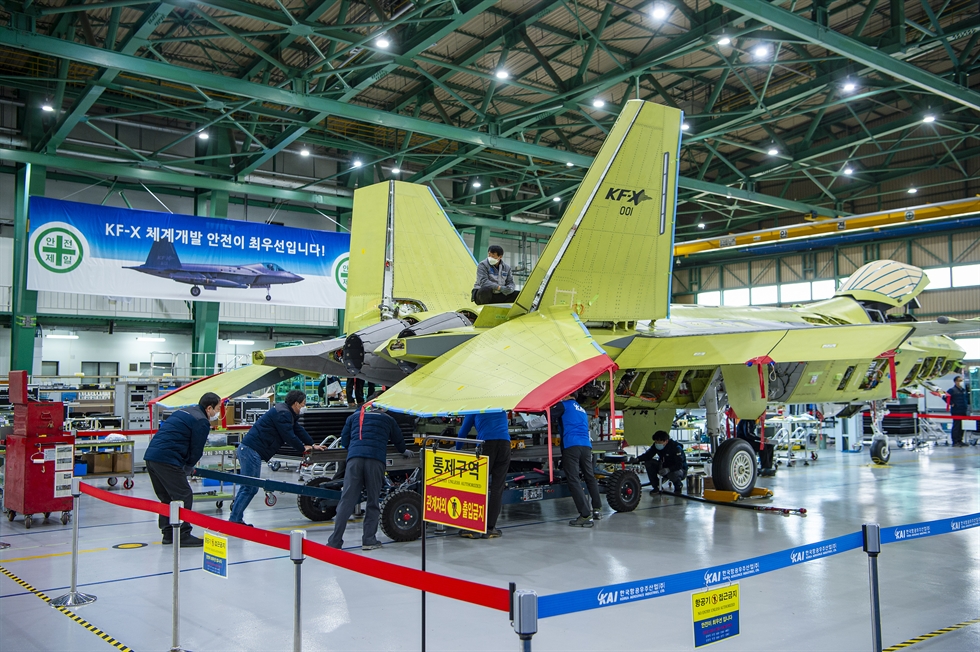
A total of six prototypes are in the final stages of assembly at the Korean Aerospace Industries (KAI) headquarters in Sacheon, Gyeongsang Province. Test flights will be carried out next year, following ground testing after the April roll-out.

Industry officials expressed expectations that the KF-X would not only help accelerate domestic production of fighter jet parts but also bring about a considerable economic effect, creating jobs for about 110,000 people during the full development period planned through 2028. Since the KAI embarked on the KF-X development project in 2016 after winning the contract from the government the previous year, the project has created jobs for more than 10,000 people as of 2020, according to the company.

Officials also expressed expectations that the KF-X fighter jets will compete in the global market with fifth-generation fighter jets such as the U.S. aerospace giant Lockheed Martin's F-35 and F-22, based on price and technology competitiveness. According to the KAI, the KF-X is designed as a 4.5-generation jet whose basic hardware and platform could be used for further development and conversion into a fifth-generation one with improved "stealth" technologies.

The first prototype of South Korea's indigenously developed next generation fighter jet KF-X is being assembled at the Korea Aerospace Industries (KAI) headquarters in Sacheon, South Gyeongsang Province, Feb. 24. Courtesy of Defense Acquisition Program Administration
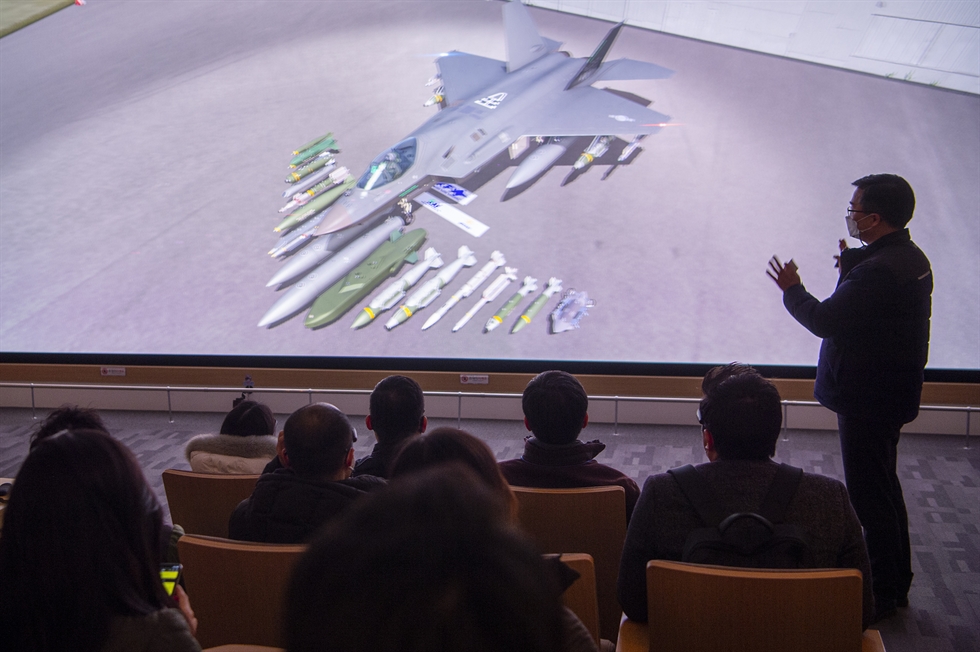
A Korea Aerospace Industries official explains the weapon systems of the KF-X fighter jet to reporters at company headquarters in Sacheon, South Gyeongsang Province, Feb. 24. Courtesy of Defense Acquisition Program Administration

"As the KF-X has been equipped with hardware to become a stealth fighter, we are currently exploring ways to apply stealth technologies to the jet, although we have yet to specify details for further developments as the military has yet to present the details necessary for further developments after Block I and Block II stages of the KF-X development project," Jung Kwang-sun, director general of the KF-X Program Group under the Defense Acquisition Program Administration (DAPA), told reporters who were visiting KAI headquarters, Feb. 24.

The KF-X project is an "evolutionary development" project which is divided into two phases. The first phase, or the Block I stage, is about developing the basic system of the fighter jet from 2016 to 2026. The second phase, or the Block II stage which would be carried out from 2026 to 2028, is about adding more weapon systems.

The first prototype of South Korea's indigenously developed next generation fighter jet KF-X is being assembled at the Korea Aerospace Industries (KAI) headquarters in Sacheon, South Gyeongsang Province, Feb. 24. Courtesy of Defense Acquisition Program Administration

While the core equipment of the KF-X has been developed with domestic technologies, including active electronically scanned array (AESA) radar, infrared search and track (IRST) equipment, electro-optical target tracking (EO TGP) devices and electronic warfare (EW) suite, the target ratio of localization is 65 percent, in terms of the total costs of the parts used for the jet.

With 10 stations on the jet, about 50 different weapons combinations that weigh up to 7.7 tons can be carried. The total fuel capacity of the jet is 5.3 tons and it has aerial refuelling capability.

@Gautam @randomradio @Picdelamirand-oil @vstol Jockey @Milspec
 
images
Introduction
:
The KAI KF-21 Boramae (formerly known as KF-X) is a joint South Korean/Indonesian 4.5 generation fighter aircraftdevelopment program with the goal of producing an advanced multirole fighter for the South Korean and Indonesian air forces. The airframe is stealthier than other fourth-generation fighters, but does not carry weapons in internal bays like fifth-generation fighters, though internal bays may be introduced later in development.
Quick Facts KF-21 Boramae, Role ...
KF-21 Boramae
side view of a jet fighter model
KAI KF-X miniature at Seoul ADEX 2017
RoleBlock 1: Air superiority fighter
Block 2:
Multirole combat aircraft, air superiority fighter
National originSouth Korea/Indonesia
ManufacturerKorea Aerospace Industries
Design groupAgency for Defense Development
First flight2022 (planned)
Introduction2026 (planned)
Primary usersRepublic of Korea Air Force(intended)
Indonesian Air Force(intended)
Number built4 prototype(s)
Close
The program is led by the South Korean government, which holds 60% of the program's shares. Indonesia took a 20% stake in the program in 2010, and the remaining 20% is held by private partners including the manufacturer
Korean Aerospace Industries (KAI). The KAI KF-X is South Korea's second domestic fighter jet development program, following the FA-50.
In April 2021, the first prototype was completed and unveiled during a rollout ceremony at the headquarters of KAI in Sacheon. It was officially given the name Boramae (Korean: 보라매, literally 'young hawk' or 'eyas'). The first test flight is anticipated in 2022, with manufacturing scheduled to begin in 2026. At least 40 aircraft are planned to be delivered by 2028, with South Korea expecting to deploy a total of 120 of the aircraft by 2032. It will also be available for export market.
In Indonesia, the KF-X development program is referred to as the IF-X program. The Jakarta Globe reported that the completed aircraft will receive the designation F-33.

Background​

The KF-X advanced multirole jet fighter project, intended to produce modern warplanes to replace South Korea's aging F-4D/E Phantom II and F-5E/F Tiger II aircraft, was first announced in March 2001 by South Korean President Kim Dae-jung at a graduation ceremony of the Korea Air Force Academy.Research and development (R&D) requirements were determined by the Joint Chiefs of Staff in 2002.: 18  The project was felt to be extremely ambitious, with the Korea Institute for Defense Analyses (KIDA, a defense ministry think tank) doubtful of the country's ability to complete the complicated project


Design and development​


The KF-21 production line

The initial goal for the program was to develop a single-seat twin-engine multirole fighter with stealth capabilities exceeding both the Dassault Rafale and Eurofighter Typhoon but less than those of the Lockheed Martin F-35 Lightning II. The Weapon Systems Concept Development and Application Research Center of Konkuk University advised that the KF-X should be superior to the F-16 Fighting Falcon, with 50% greater combat range, 34% longer airframe lifespan, better avionics, active electronically scanned array (AESA) radar, more-effective electronic warfare, and data link capabilities. Their recommendations also specified approximately 50,000 pounds-force (220,000 N) of thrust from two engines, supersonic interception and cruising capabilities, and multi-role capabilities. The project requirements were later downgraded by the Republic of Korea Air Force (ROKAF) to a 4.5 generation fighter with limited stealth capabilities.

South Korea possessed 65% of the necessary technology to produce the KF-X, and sought cooperation from other countries. To facilitate technology transfer, the Agency for Defense Development (ADD) proposed two primary concepts for the KF-X: C103, which resembled the F-35; and C203, which resembled European fighters with forward canards (the design chosen would depend on whether a development deal was reached with the US or European partners).

The C501 (a.k.a. KFX-E) was a third design, proposed by KAI and supported by the Defense Acquisition Program Administration (DAPA), which attempted to reduce costs with a smaller, single-engine fighter, but it had inferior performance to the F-16 and was unsuitable for the large airspace of Indonesia. ROKAF preferred the benefits of a twin-engine design, with better combat performance and safety, and a larger airframe with room for upgrades. These upgrades could lead to a future reclassification as a fifth-generation fighter, while the C501 was closer to fourth generation.

In 2014, the C103 configuration was chosen and Lockheed Martin agreed to transfer two dozen F-35A technologies as part of a purchase deal. However, the US government blocked the transfer of four vital technologies: AESA radar, infrared search and track (IRST), electro-optical target tracking devices, and radio jammer technology. South Korea was thus required to develop these technologies domestically. A 2015 audit estimated that 87% of technologies for the project had been secured.: 23  The preliminary design was finalized in June 2018. In September 2019, a critical design review examined 390 technical data sets and confirmed that the KF-X was adequate to ROKAF's requirements.

Estimated cost
[citation needed]KAI KFX-EADD C103ADD / KAI C105ADD / KAI C109
Empty weight9,300 kg (20,500 lb)10,900 kg (24,000 lb)11,100 kg (24,420 lb)11,800 kg (26,000 lb)
Max weight20,900 kg (46,000 lb)24,000 kg (53,000 lb)24,500 kg (53,900 lb)25,400 kg (56,000 lb)
Internal fuel3,600 kg (8,000 lb)5,400 kg (12,000 lb)5,400 kg (12,000 lb)5,400 kg (12,000 lb)
Wingspan9.8 metres (32 ft)10.7 metres (35. 2 ft)11.0 metres (36. 08 ft)11.2 metres (36. 75 ft)
Length15.2 metres (50 ft)15.7 metres (51. 3 ft)16.0 metres (52. 49 ft)16.9 metres (55. 4 ft)
Wing area37.1 square metres (399 sq ft)42.7 square metres (460 sq ft)42.7 square metres (460 sq ft)46.5 square metres (501 sq ft)
Engine1 × P&W F100 or GE F1102 × EJ200or GE F4142 × GE F4142 × GE F414
Hardpoints9101010
Weapons bayNoneSpace providedSpace provisionSpace provision


Budget​

R&D expenditures​

A 2015 government audit placed the development cost of the project at ₩8.8 trillion: 18  (equivalent to ₩9.06 trillion or US$8.01 billion in 2017). In an agreement signed at the end of 2015, Indonesia agreed to provide 20% of the development costs, KAI would provide an additional 20%,[citation needed]and the Korean government would support the remainder.[better source needed]

More information Calendar Year, Expenditures on R&D ...
KoreaIndonesia
Calendar
Year
Expenditures on R&DTotalRef
2011

2012
₩44 billion (US$39.06 million)₩11 billion (US$9.77 million)₩55 billion (US$48.83 million): 21 
Close
More information Calendar Year, Expenditures on R&D ...
Full Scale Development
DODKAIIndonesia
Calendar
Year
Expenditures on R&DTotal
2015₩55.2 billion (US$48.8 million)??
2016₩67 billion (US$57.74 million)??
2017₩303 billion (US$268.04 million)??
2018₩435.3 billion (US$395.55 million)??
2019₩664 billion (US$569.78 million)??


Project partners​

While KAI was the primary builder, numerous other domestic and foreign companies were contracted to provide aircraft components or support. Several of these firms had worked with KAI on the T-50. For certain sensitive technologies, foreign companies only consulted for testing support in order to avoid arms-trading restrictions.

Hanwha Techwin signed an agreement with General Electric to manufacture General Electric F414 engines for KF-X aircraft. According to the contract, Hanwha is to manufacture key parts, locally assemble the engines, and oversee the installation of the engine on the aircraft. The company will also support flight testing and build an extensive support system for the aircraft's operations.

A Defense News report stated that the AESA radar would be a particular challenge; it was developed by Hanwha Systemswith assistance from other domestic firms and support from foreign companies. Elta Systems helped to test the prototype AESA, and Saab worked with LIG Nex1 on software development and evaluation.

In addition to working on the AESA, LIG Nex1 is to develop a radio jammer.

US aerospace contractor Texstars was selected by KAI to develop canopy and windshield transparencies for KF-X. Under the contract, Texstars will work alongside KAI to provide the KF-X fighter with birdstrike resistant transparencies with high-quality optics.

Triumph Group was selected by KAI to provide airframe mounted accessory drives (AMADs) for the KF-X. Triumph will develop and manufacture the AMADs, which transfer engine power to other systems.

Aeronautical Systems [es] (Spanish: Compañía Española de Sistemas Aeronáuticos, CESA), a subsidiary of Héroux-Devtek, was contracted to develop the emergency braking system.

United Technologies announced in February 2018 that it was providing the environmental control system, including cabin pressurization and liquid cooling systems, as well as the air turbine starter and flow control valve.

Martin-Baker was contracted to provide the Mk18 ejection seat escape mechanism.

Cobham received contracts to provide missile ejection launchers, communications antennae, external fuel tanks, and oxygen systems.

Meggitt was contracted to provide a wheel braking system,standby flight displays, and internal sensors including a fire detection system.

MBDA was contracted to integrate the Meteor beyond-visual-range air-to-air missile (BVRAAM) onto the aircraft.

Elbit Systems was contracted by Hanwha Systems to provide terrain-following/terrain avoidance (TF/TA) systems for the aircraft.

Curtiss-Wright was contracted by KAI to Provide complete flight test instrumentation (FTI) system, it is data acquisition system (DAS) for use in flight-test campaigns.

Prototypes​

In February 2019, KAI began production work on the KF-X prototype, with six expected to be completed in 2021. These are to undergo four years of trials, and complete the development process by mid-2026. The first prototype was publicly rolled out on 9 April 2021; in addition to the six aircraft for airborne tests, two will be made for ground tests. DAPA anticipated a first test flight in 2022.


Specifications​

Data from Defense Acquisition Program Administration (DAPA)[better source needed]

General characteristics


Performance
Armament

 
Last edited:
  • Like
Reactions: TARGET

Meet South Korea's New KF-21 "Hawk" Indigenous Fighter​

Developed under an ambitious timeline, the fighter will complement F-35s and older fighters as part of a revamped Republic of Korea Air Force.​

BY THOMAS NEWDICK APRIL 9, 2021
KF-21-ROLLOUT-CEREMONY-scaled.jpg
MBC NEWS SCREENCAP
SHARE


THOMAS NEWDICKView Thomas Newdick's Articles
@CombatAir
South Korea has rolled out the first prototype of its next-generation indigenous fighter, previously referred to as the KF-X, and officially named it the KF-21 Boramae, meaning hawk in Korean. The jet, South Korea’s most ambitious yet, is expected to fly next year and the country’s president has confirmed a demanding schedule to complete the development program for the initial version of the aircraft by 2026.
The Republic of Korea Air Force (ROKAF) is expected to induct 40 KF-21s by 2028 and have the full fleet of 120 aircraft deployed by 2032. The aircraft are urgently required to replace aging F-4E Phantom II and F-5E/F Tiger II fighters and are intended to complement F-35A stealth fighters—60 of which are being procured from the United States—as well as older F-15K Slam Eagle and F-16C/D aircraft.
message-editor%2F1617970776196-kf-21pilot.jpg

MBC NEWS SCREENCAP
A ROKAF pilot disembarks the first prototype KF-21 at today’s ceremony in Sacheon.
The rollout ceremony took place today at the Korean Aerospace Industries (KAI) facilities in Sacheon, South Gyeongsang province, and saw an address by President Moon Jae In. He heralded “a new era of self-defense,” and “a historic milestone in the development of [South Korea’s] aviation industry. Moon also set a goal for South Korea to become the world’s seventh-biggest aviation industrial power by the 2030s.

Full-scale development work on what was then known as the KF-X began in 2015 and in 2019 South Korea’s Defense Acquisition Program Administration (DAPA), which manages defense procurement, announced the go-ahead for the construction of a prototype. Last September, KAI announced that the final assembly of the prototype fighter was underway, mating the fuselage sections and wings.


The Korea Fighter eXperimental Aircraft is to be indigenously developed and Hanwa System is to supply key onboard elements including AESA Radar, EOTGP (EO Targeting Pod), IRST (Infra Red Search and Tracking), SMC (Stores Management Computer), ACCS (Audio Communication Control System), MFD (Multi Function Display), MC (Mission Computer) and the RF Jammer.

시스템 점검
 
  • Like
Reactions: Chain Smoker