

United States Navy (USN) : News & Discussions
- Thread starter Nick
- Start date
You are using an out of date browser. It may not display this or other websites correctly.
You should upgrade or use an alternative browser.
You should upgrade or use an alternative browser.


EXCLUSIVE: Lockheed out of Navy’s F/A-XX future fighter competition - Breaking Defense
A source with knowledge of the program told Breaking Defense that Lockheed submitted a bid for the next-gen fighter effort, but the proposal did not satisfy the Navy’s criteria, leaving Boeing and Northrop Grumman as the remaining competitors.


Next-generation destroyers to pack more missiles, energy weapons
The Navy is requesting $133.5 million to research and develop the new destroyer in fiscal 2026, with the goal of procuring the first in the early 2030s.
 www.defensenews.com
The U.S. Navy is planning for its next-generation destroyer, currently known as the DDG(X), to feature directed-energy weapons and more capacity to carry and launch missiles.

U.S. Navy Destroyers, Submarine, Amphibious Ships Being Sent Toward Venezuela
The White House calls Venezuelan ruler Maduro a "narco-terrorist" and is deploying ships, planes and Marines in a major show of force.
 www.twz.com
President Trump last week ordered at least three Arleigh Burke class guided missile destroyers, a submarine and other assets to head toward the South American nation, a source familiar with the operation confirmed to The War Zone on Wednesday. Earlier this week, Reuters reported that in addition to the destroyers, some 4,000 Marines aboard an Amphibious Ready Group made-up of three ships were also deploying to the region. If this ends up being the case, it would put a remarkably large, versatile, and powerful armada of U.S. ships off Venezuela’s coast.

U.S. Navy gives first look at P-8A carrying LRASM in-flight - Naval News
The U.S Navy has provided Naval News with the first view of a P-8 Poseidon carrying an AGM-158C Long Range Anti-Ship Missile (LRASM).
 www.navalnews.com
The U.S Navy has provided Naval News with the first official view of a P-8 Poseidon carrying an AGM-158C Long Range Anti-Ship Missile (LRASM). This comes after spotters caught glimpses of a P-8A airborne with an LRASM under its wing.
Naval News first covered the integration efforts in 2023 when the U.S. Navy provided photos of a LRASM slung underneath the wing of a P-8A. These fit checks were performed in July 2020 at NAS Patuxent River, with a test aircraft inside a hangar. Since then, integration work has progressed to include flight testing, signifying an ongoing commitment to increase the amount of launch platforms for LRASM in U.S. Navy’s inventory.
The LRASM is a stealthy anti-ship missile designed and built by Lockheed Martin. Originating as a variant of Lockheed’s AGM-158B JASSM-ER (Joint Air-to-Surface Standoff Weapon, Extended Range) land-attack missile, the LRASM features a greater than 200 nautical mile (370km) range, incorporating Radio-Frequency/IR guidance, datalink, and a stealthy design.

South Korean manufacturers outline plans to bolster US shipbuilding
Three of South Korea's industrial titans are planning major shifts in current shipyard operations to help revitalize American shipbuilding.
www.defensenews.com
South Korea’s three leading shipbuilders announced more detailed plans this month to cooperate with the Pentagon and revitalize American shipbuilding.
Representatives of South Korean industrial titans Hanwha, Samsung and HD Hyundai Heavy Industries shared new insights about their work with the U.S. Navy during Korea Investment Week, which took place in Seoul from Sept. 9 to 12. The effort has become known as MASGA, or “Make American Shipyards Great Again.”

U.S. Navy to Introduce Next-Generation Modular Missile Program - Naval News
The U.S. Navy's upcoming modular missile program aims to bring a series of next-generation munitions to the fleet's VLS cells.
www.navalnews.com
The U.S. Navy is gearing up to begin the modular missile program, a next-generation effort that aims to bring a new series of missiles to the service amid hypersonic threats and the need for increased magazine capacity across the fleet.
A notice for an upcoming industry day stated that the Navy Modular Missile program will include multiple variants, specifying a dedicated long-range hypersonic missile and configurations covering existing short, medium and extended-range weapons. Enhanced capacity for dual or quad-packing the munitions into vertical launching systems was identified as a key attribute for the upcoming program, with the description stating that this aspect looked to improve “fleet endurance and combat effectiveness.” Recent combat in the Red Sea and concerns over the fleet’s endurance in a potential conflict with China in the Indo-Pacific have raised concerns regarding the magazine depth of U.S. warships.


Lol unreal Incompetence
US Navy scraps Constellation-class Frigate Program - Australian Defence Magazine
US Navy scraps Constellation-class Frigate Program - Australian Defence Magazine

Trump Class Battleships Could Get Megawatt Lasers: Navy’s Top Officer

Trump Class Battleships Could Get Megawatt Lasers: Navy's Top Officer
The dream of laser weapons has not materialized nearly as fast as the Pentagon once thought it would, but the Navy's top officer wants to overcome that.
www.twz.com
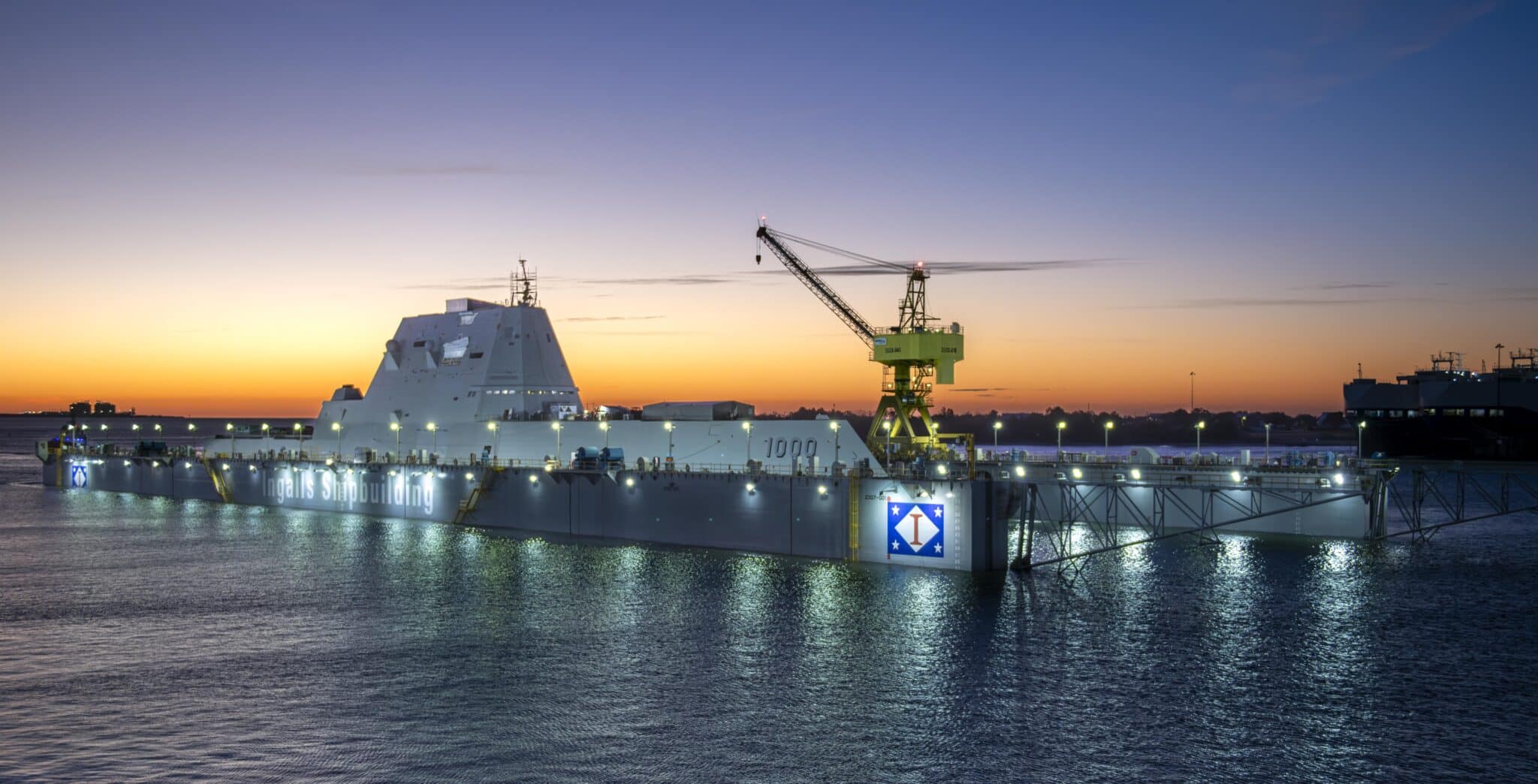
USS Zumwalt to put to Sea in 2026 without main gun systems - Naval News
The Program manager for the Zumwalt / DDG-1000 class vessels revealed new details regarding the overhaul meant to fit Conventional Prompt Strike (CPS) hypersonic weapons to the 3 ships.
www.navalnews.com
Upon the Zumwalt‘s return, she will be the first vessel armed with hypersonic missiles in United States Navy inventory, sporting 12 of the CPS missiles in the forward housing.

US Navy Seeks to Proliferate Hypersonic Missiles Across the Fleet - Naval News
The U.S Navy is looking to spread the hypersonic Conventional Prompt Strike (CPS) missiles throughout the surface fleet.
www.navalnews.com
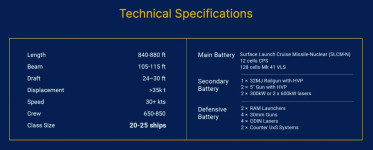
BBG(X)
Official: 45% of Navy's surface force to be unmanned by 2045
Official: 45% of Navy's surface force to be unmanned by 2045 | InsideDefense.com
As the Navy shifts more focus onto robotic and autonomous systems, the service has set a goal for the next two decades: by 2045, 45% of the surface fleet should be unmanned, an official said this week.

Design phase is 6+ years.US Navy Seeks to Proliferate Hypersonic Missiles Across the Fleet - Naval News
The U.S Navy is looking to spread the hypersonic Conventional Prompt Strike (CPS) missiles throughout the surface fleet.
BBG(X)
View attachment 49027
Its not a serious project
no its just trump . having so few VLS with such a huge ship is not how the americans work unless they have suddenly flipped over their heads. But maybe its real. who knows
Its not a serious project
The design of the ship is not even initiated yet.no its just trump . having so few VLS with such a huge ship is not how the americans work unless they have suddenly flipped over their heads. But maybe its real. who knows
From judge is arnaments from conceptual model.