
Turkish Missiles
- Thread starter Tatvamasi
- Start date
You are using an out of date browser. It may not display this or other websites correctly.
You should upgrade or use an alternative browser.
You should upgrade or use an alternative browser.



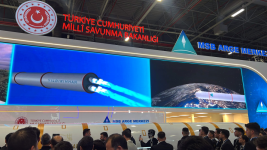
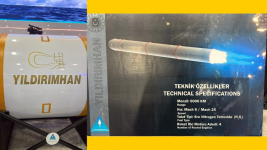
Feels like BS model for propaganda use.

A liquid-fueled ICBM? In the 2020s?
Without nukes, it's pointless. A 3 ton conventional payload isn't enough for any tactical target that can be realistically prosecuted over that range with a very expensive vector like this.
3 tons is not enough for bunker busting either, even accounting for kinetic energy.
South Korea's Hyunmoo-5 has a 8-9 ton payload for that job. That's similar to the planned capacity of the tactical penetrator (non-nuclear) version of India's Agni-5.
Just seems like a weird program assuming they're serious about it.
Feels like BS model for propaganda use.
From what I'm gathering, seems that way. But it's political messaging for sure.

If i have to rationalize, They could be experimenting with Oreshnik like capability,to target high value sites far away using multiple submunitions, with this concept of small ICBM.A liquid-fueled ICBM? In the 2020s?
Without nukes, it's pointless. A 3 ton conventional payload isn't enough for any tactical target that can be realistically prosecuted over that range with a very expensive vector like this.
3 tons is not enough for bunker busting either, even accounting for kinetic energy.
South Korea's Hyunmoo-5 has a 8-9 ton payload for that job. That's similar to the planned capacity of the tactical penetrator (non-nuclear) version of India's Agni-5.
Just seems like a weird program assuming they're serious about it.
From what I'm gathering, seems that way. But it's political messaging for sure.
Tho ukraine is doing that with cheaper cruise missiles.
Still, will be Intresting to see how it progresses.
From what I'm gathering, seems that way. But it's political messaging for sure.
Doing the same with engines!.
What do you think the RS-28 is? Or R-29RMU2?A liquid-fueled ICBM? In the 2020s?

If i have to rationalize, They could be experimenting with Oreshnik like capability,to target high value sites far away using multiple submunitions, with this concept of small ICBM.
Tho ukraine is doing that with cheaper cruise missiles.
Still, will be Intresting to see how it progresses.
Except that capability requires rapid launch on demand, which by extension necessitates solid fuel.
What do you think the RS-28 is? Or R-29RMU2?
The Sarmat is designed to fill a very R36-shaped hole in Russia's silo-based launch requirement, a holdover from the time they were competing with the Titan-II.
A solid-fueled missile is significantly better & easier to work with, as the US with their Minuteman (and upcoming Sentinel replacement) would tell you.
The Sineva is similarly a descendent of the liquid fueled R29 from the 70s. The Russians' problem is that they seem to think it's too expensive or risky to switch over to solid fuel entirely. This can be true especially when you've built out a significant knowledge base & infrastructure surrounding liquid propulsion like the Soviets/Russians have, it can be quite economical to just carry that forward.
But when you're building out a new capability for the first time like the Turks are apparently attempting, I can't seem to think of a good reason as to why you'd want to go with hypergolic fluids. Especially if they want it to be capable of tactical use cases.
The only explanation I can think of is that they originally started off trying to make a light/medium-class orbital rocket and are using the same baseline configuration for an ICBM (kinda like Titan-II's story).
I'll believe it when I see it though. A lot of people I'm talking to on Turkish defence forums seem to think this missile (and the agency behind it) are a bit of a sham, with no background or pedigree in defence R&D.
There are Yars missiles in a lot of holes previously filled by liquid-fuel ICBMs. There were RT-23s in them before that too.The Sarmat is designed to fill a very R36-shaped hole in Russia's silo-based launch requirement, a holdover from the time they were competing with the Titan-II.
Bulavas use SFRs.The Sineva is similarly a descendent of the liquid fueled R29 from the 70s. The Russians' problem is that they seem to think it's too expensive or risky to switch over to solid fuel entirely. This can be true especially when you've built out a significant knowledge base & infrastructure surrounding liquid propulsion like the Soviets/Russians have, it can be quite economical to just carry that forward.
We will know if its a real project within the next 3 or so years. turkey has no requirement for an ICBM unless they want to go nuclear. a bunker buster at that scale is still highly inefficient. Turkey also has quite literally n experience with missiles of this class so this is at minimum a 10year + project.There are Yars missiles in a lot of holes previously filled by liquid-fuel ICBMs. There were RT-23s in them before that too.
Bulavas use SFRs.
There are Yars missiles in a lot of holes previously filled by liquid-fuel ICBMs. There were RT-23s in them before that too.
Bulavas use SFRs.
As I said:
"The Russians' problem is that they seem to think it's too expensive or risky to switch over to solid fuel entirely."
The Russians are carrying forward the dual-alignment strategy that was in place since Soviet times. For the most part, solid replaces solid and liquid replaces liquid. Bulava came in as replacement for solid-fueled R-39. Sineva (and now Layner) are replacements for older liquid fueled R-29s.
I would say the opposite. Last 3 RS-28 launches - fail. Last UR-100N launch - fail. Last 2 Yars launches - success.As I said:
"The Russians' problem is that they seem to think it's too expensive or risky to switch over to solid fuel entirely."
Well on the other hand there has never been a failed AGNI V test to date. It looks like russia finds liquid fuel rockets easier for their operations but that may not apply to everyone.
I would say the opposite. Last 3 RS-28 launches - fail. Last UR-100N launch - fail. Last 2 Yars launches - success.


Whats cost of akinci drone ? How it compares with MQ-9B india purchased from USA ?
and whats the IWB configuration for Kizlema, Anka-3 and Kaan for a2a combat ?