Transport Aircraft of IAF - C-130J, C-17 Globemaster, C295: Updates & Discussions

GxSGwrAWgAA3S1C


16th and last C-295 from Spain.

GxTl7LVXQAAfa3A
Very timely delivery. Airbus just got +5 in IAF/GOI books. Given Boeing bad health and delays... are there products other than C295 that can come very handy for Indian Aerospace Industry development and IAF operations?

Or does Airbus too have bad records? Asking for a friend.
 
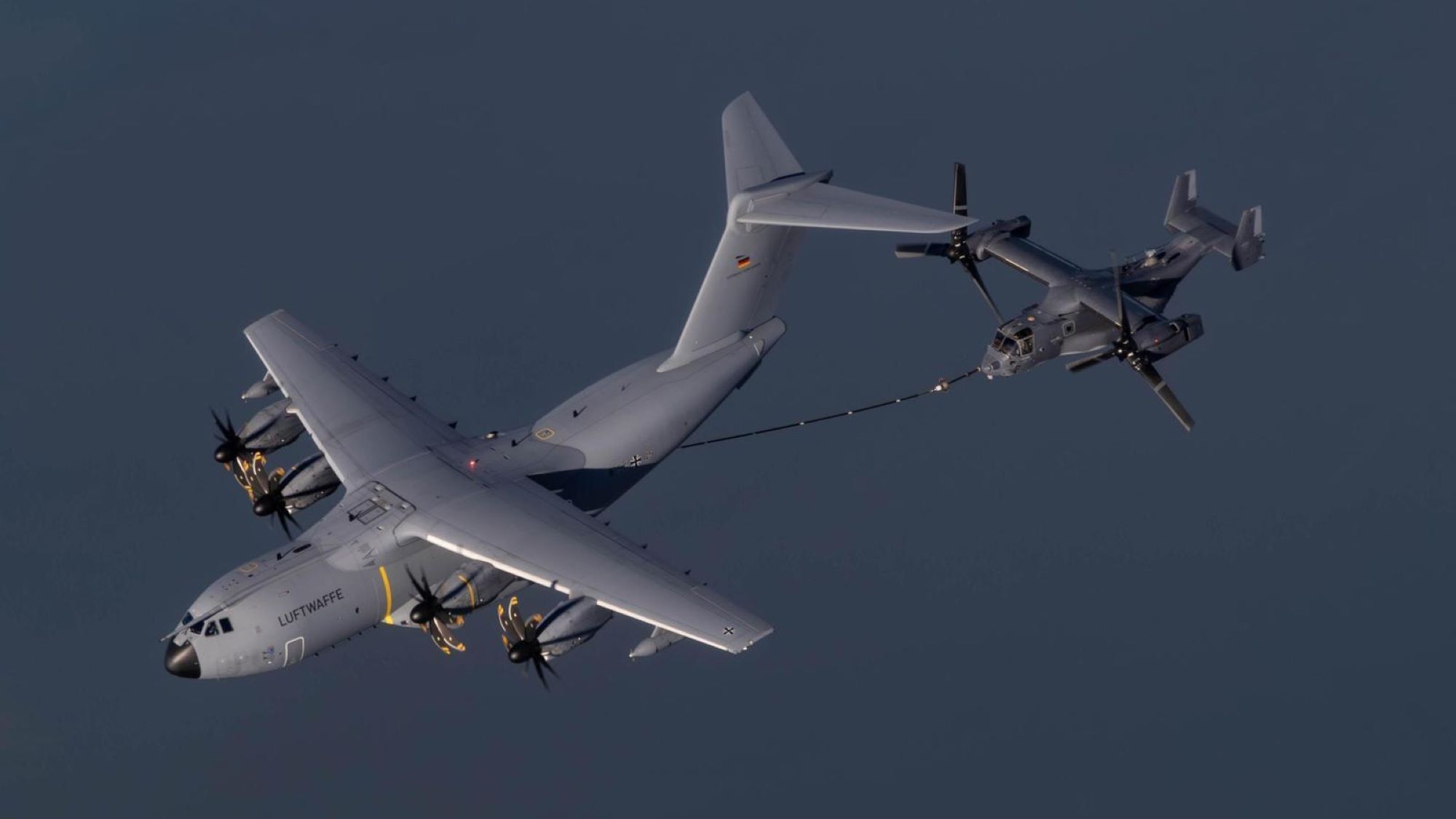
The A400M is a good choice - especially since the aircraft can be additionally configured for Aerial Refuelling too

A400M refueling capability


The A400M uses an additional centerline HDU (Hose and Drum Unit) system, which includes a protrusion under the rear cargo ramp doors and tanks inside the cargo hold, along with underwing pods. This enables the A400M to refuel a large variety of aircraft, including other A400Ms and even C-130s. Its basic fuel capacity of 63,500 litres increases with the two extra cargo hold tanks of the HDU, which carry 7,200 litres each and can transfer fuel at a rate of 2,000 litres (600 US gallons) per minute.


The HDU is an additional kit that can be rapidly installed, transforming the A400M into a dedicated tanker with the three-point refueling system. The U.S. Navy and the USAF Ospreys, as seen in the images, were refueled using the centerline HDU unit.

 
Last edited:
Fu*ing Iran is building indegenious light transport aircraft and here we are screwdriving foreign maal.


I wonder what should be our next step. There's a lot of points already said that" invest in R&D". Push Pvt sector for R&D led product etc.. increase academia coordination etc.

But these are "someday" broad goals with many small small steps.
Does anyone know about any such steps taken in recent times which points out if industry is moving towards it. Both in small policy changes , ground infra, labs etc and academic exchanges between workers of factories and students.

Like, i remember in my school times , we used to have a trip to our local Parle factory or some other once or twice every year. It was really eye opening for us.

Maybe, time that such facilities are opened to school and college tours rather than limited to "reporters", followed by an interactive session between Factory workforce and students and budding scientists?

I will look for if it can find actual work which demonstrates increase in our research foundation beyond MoU headlines or policies from GOI. Focusing on market dynamics.
 
Last edited:
I wonder what should be our next step. There's a lot of points already said that" invest in R&D". Push Pvt sector for R&D led product etc.. increase academia coordination etc.

But these are "someday" broad goals with many small small steps.
Does anyone know about any such steps taken in recent times which points out if industry is moving towards it. Both in small policy changes , ground infra, labs etc and academic exchanges between workers of factories and students.

Like, i remember in my school times , we used to have a trip to our local Parle factory or some other once or twice every year. It was really eye opening for us.

Maybe, time that such facilities are opened to school and college tours rather than limited to "reporters", followed by an interactive session between Factory workforce and students and budding scientists?

I will look for if it can find actual work which demonstrates increase in our research foundation beyond MoU headlines or policies from GOI. Focusing on market dynamics.
Similar method gov. Is going for amca.
Gov. Sanctioning budget under Udaan scheme
Special purpose vehicle compromised of multiple private corporation with HAL and DRDO acting as the mentor/tech and industry enabler.

Mid 2030s timeline for development completion of ~100 seating capacity rta, can use higher degree of imported components as its a civil project, including engines.

Can separately work on indegenious to be debuted in 2040s.
 
Similar method gov. Is going for amca.
Gov. Sanctioning budget under Udaan scheme
Special purpose vehicle compromised of multiple private corporation with HAL and DRDO acting as the mentor/tech and industry enabler.

Mid 2030s timeline for development completion of ~100 seating capacity rta, can use higher degree of imported components as its a civil project, including engines.

Can separately work on indegenious to be debuted in 2040s.

There needs to be a distinction between indigineously developed and indigineously manufactured in policy documents. Otherwise the line becomes so blurry and gives space for workaround.. as we're seeing.

Even better if something is conceived in india, developed in india, manufactured in India fully.

That means technology for thermal management, composites etc. This distinction can really help both business, startups, and regulators to manage our defense ecosystem.

* Is there anyone here from premier STEM institutes of India? Wanted to know if the indigineous initiative has led to evolution in study materials, courses and pedagogy. As in, if advanced things are taught and experiments on now. Giving the right kind of exposure.
 
There needs to be a distinction between indigineously developed and indigineously manufactured in policy documents. Otherwise the line becomes so blurry and gives space for workaround.. as we're seeing.

Even better if something is conceived in india, developed in india, manufactured in India fully.

That means technology for thermal management, composites etc. This distinction can really help both business, startups, and regulators to manage our defense ecosystem.
There is.
Different categories of make in India.

Make-I" is a government-funded category within the Indian defence procurement procedure for projects that require indigenous design and development of equipment, systems, or platforms. It involves the government providing financial support, typically up to 70% of the prototype development cost, and requires a minimum of 50% indigenous content. The government funds the development of advanced military platforms, such as a light tank or a new communication system, to foster self-reliance in the defense sector.

Make-II (Industry-Funded): Projects for prototype development of military hardware or upgrades, primarily for import substitution, where no government funding is provided. The industry funds the development based on an assured order once the prototype is successful.

Make-III (Indigenously Manufactured): This category covers military hardware and spares/assemblies that may not be designed in India but can be manufactured domestically as an import substitute. Indian firms may collaborate with foreign partners for production.

Buy (Indian – IDDM): This is the top priority procurement category, for products Indigenously Designed, Developed, and Manufactured with a minimum of 50% Indigenous Content (IC).

Buy (Indian): Procurement from Indian vendors with an indigenous content of 60% (if not indigenously designed) or 50% (if indigenously designed).

Buy (Global – Manufacture in India): Outright purchase from foreign vendors, but with a minimum of 50% IC achieved through manufacturing or MRO (Maintenance, Repair, and Overhaul) in India.

Buy (Global): Outright purchase from foreign vendors, typically when indigenous options are not available, though it has a minimum 30% IC requirement for Indian vendors in DAP 2020.

Leasing: Allows the armed forces to use equipment without owning it, avoiding large upfront capital costs.
Strategic Partnership Model (SPM): A model for private Indian firms to act as system integrators, collaborating with foreign OEMs to build an ecosystem for major platforms like submarines or fighter jets.

 
There is.
Different categories of make in India.

Make-I" is a government-funded category within the Indian defence procurement procedure for projects that require indigenous design and development of equipment, systems, or platforms. It involves the government providing financial support, typically up to 70% of the prototype development cost, and requires a minimum of 50% indigenous content. The government funds the development of advanced military platforms, such as a light tank or a new communication system, to foster self-reliance in the defense sector.

Make-II (Industry-Funded): Projects for prototype development of military hardware or upgrades, primarily for import substitution, where no government funding is provided. The industry funds the development based on an assured order once the prototype is successful.

Make-III (Indigenously Manufactured): This category covers military hardware and spares/assemblies that may not be designed in India but can be manufactured domestically as an import substitute. Indian firms may collaborate with foreign partners for production.

Buy (Indian – IDDM): This is the top priority procurement category, for products Indigenously Designed, Developed, and Manufactured with a minimum of 50% Indigenous Content (IC).

Buy (Indian): Procurement from Indian vendors with an indigenous content of 60% (if not indigenously designed) or 50% (if indigenously designed).

Buy (Global – Manufacture in India): Outright purchase from foreign vendors, but with a minimum of 50% IC achieved through manufacturing or MRO (Maintenance, Repair, and Overhaul) in India.

Buy (Global): Outright purchase from foreign vendors, typically when indigenous options are not available, though it has a minimum 30% IC requirement for Indian vendors in DAP 2020.

Leasing: Allows the armed forces to use equipment without owning it, avoiding large upfront capital costs.
Strategic Partnership Model (SPM): A model for private Indian firms to act as system integrators, collaborating with foreign OEMs to build an ecosystem for major platforms like submarines or fighter jets.

Yup. I am aware of these broad categories. What i am talking about is the definition of indigineous content in these policy documents.

From what I gathered indigineous content is calculated based on the value addition in the Indian industry/economy. That leaves it for a wide interpretation. i.e. If they are manufactured in india under licensing.. then it will be considered as having good indigenous content. As supply chain bills - licensing fees. ( That's where supply chain plays a major role) I see an increase in local supply chain.. but that too is relative increase.
I am not fully aware of how it's applied in the designing phase, as many business today are forming JVs and indigenising e designing too. A makeup basically. Correct me if I am wrong. Most of industry is following correct path of getting into know-how in hope that it leads to know how.. but if past is any indicator, the industry led by HAL has failed to absorb the know how and even worse in absorbing know-why.

The real know-why, different than Know-how is currently limited to DRDO. I know that DRDO-Academic partnership is increasing with govt push. But I wanted to know if there have been visible changes beyond MoU. Like courses, specialised labs, Increase in the scope of PhD work etc.. cause a sustainable know-why supply chain starts with academia, no?
 
EXPRESSION OF INTEREST (EoI) FOR DEVELOPMENT OF 11-TYPES OF FLAT SEALS FOR HS748 AIRCRAFT

In this sub-category of Make-II, no HAL funding is envisaged for the Indigenous Development but there has to be an assurance of Supply
Order to be placed on the lowest bidding Development Agency (DA). On successful development price will be paid pro-rata along with the production
unit price against deliveries after approval from CEMILAC/DGCA.

This Expression of Interest (EoI) invites responses from eligible Indian Companies for “DEVELOPMENT OF 11-TYPES OF FLAT SEALS FOR HS748 AIRCRAFT”. The project is envisaged to engage Indian industries to participate in Make in India initiative and thereby decreasing dependence of HAL TAD Kanpur on foreign firms for major Bought out Items (BOIs)/ LRUs/sub-system/system which will go a long way to enhance self-reliance capabilities of HAL TAD Kanpur.

https://hal-india.co.in/backend/wp-content/uploads/tender/Annexure-B_EoI_e10_1764219946.pdf

 
  • Like
Reactions: Ashwin and redpanda
Fu*ing Iran is building indegenious light transport aircraft and here we are screwdriving foreign maal.

we buggers are frogs in a well.

Iran builds cheap drones that have been exported , some flying aircrafts, missiles that have been battle tested ....etc while we keep dying over requirements. We are not perfecting or building any thing to completion but just stringing along the way. Only thing that is constant is our love for foreign maal.
 
Instead of building capability we are obsessing with requirements.
We should get embraer or the rusian mta to invest and manufacture in India. This stupid idea of relying on airbus and boeing is virtually making our airline sector terribly expensive & non competitive.
Purchasing a large fleets of an aircraft flying with engines from a third party country can be risky. We should stick with either airbus or Boeing or Russians with transport aircraft. Unlike awacs, which is fleet of mere 3 aircraft from brazil here we are planning for 80 aircrafts, its huge.
 
G7oYvOSaMAAFAgT

G7oYy10aQAAxChE


New MRO facility for C-130J Super Hercules to come up in Bengaluru, expects first aircraft in early 2027


A new defence Maintenance, Repair and Overhaul (MRO) facility to support the C-130J Super Hercules aircraft will be established in Bengaluru.

On December 8, Tata Advanced Systems and Lockheed Martin announced the groundbreaking of the new MRO. Construction is expected to be completed in 2026 and the facility expects to receive the first C130 for MRO operations in early 2027.

The MRO facility will join the existing global network of Lockheed Martin Certified Service Centers and will be strategically located to service the C-130J Super Hercules, KC-130J and C-130 B-H legacy aircraft in the future.

The C‑130 MRO facility is located at Bhatramarenahalli near the Kempegowda International Airport (KIA). It will provide depot‑level and heavy maintenance, component repair, overhaul, and structural checks and testing, structural restoration and avionics upgrades, expanded training for Indian engineers and maintainers, and new opportunities for Indian suppliers across the C‑130 supply chain.

Frank St. John, Chief Operating Officer of Lockheed Martin, said, “Today’s groundbreaking reflects how far our collaboration with Tata Advanced Systems and India has come, and where we’re headed together. For more than seven decades, we’ve grown alongside India’s expanding aerospace and defence industrial base. This new C-130 MRO facility strengthens that foundation. It brings world-class sustainment capability into India, improves readiness for the Indian Air Force, and creates opportunities that will support regional and global C-130 operators. We remain committed to building capability for India and from India for decades to come.”

Rod McLean, vice-president and general manager, Lockheed Martin Air Mobility and Maritime Missions, said, “The C-130J Super Hercules is a proven workhorse for India’s military and humanitarian missions.This defence MRO facility will bolster response time and security in the Pacific, ensure world-class sustainment capability within India, aligning with the country’s ambitions while advancing sustainment capability for the C-130J fleet across the globe.”