
Analysis Tracking USA VS China Trade war

Make a deal now, or you may not get one, Donald Trump tells China

Reuters
WASHINGTON,July 30, 2019 22:34 IST
Updated:July 30, 2019 22:34 IST
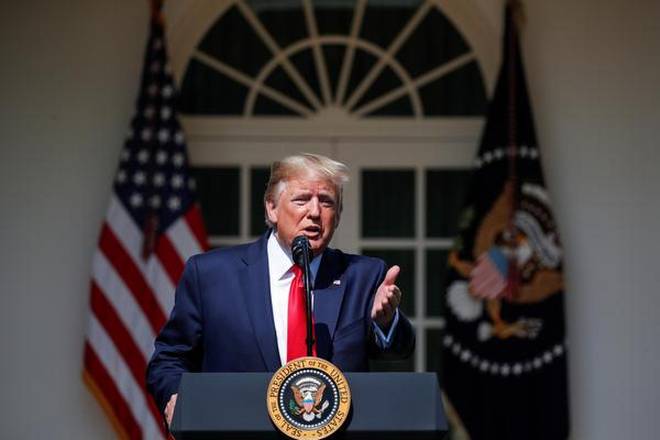
30THTRUMP1

U.S. President Donald Trump speaks at the White House. | Photo Credit: REUTERS

U.S. President warns Beijing against waiting out his first term as trade talks resume in Shanghai

U.S. President Donald Trump on Tuesday warned China against waiting out his first term to finalise any trade deal, saying if he wins re-election in the November 2020 U.S. presidential contest, the outcome could be no agreement or a worse one.

“The problem with them waiting ... is that if & when I win, the deal that they get will be much tougher than what we are negotiating now...or no deal at all,” Mr. Trump said in a post on Twitter, as the latest U.S-China trade talks began in Shanghai.

Mr. Trump said China appeared to be backing off on a pledge to buy U.S. agricultural products, which U.S. officials have said could be a goodwill gesture and part of any final pact.

“China ... was supposed to start buying our agricultural product now — no signs that they are doing so. That is the problem with China, they just don’t come through,” Mr. Trump tweeted.

Expectations low

U.S. and Chinese officials restarted negotiations after talks stalled in May, in a bid to end the year long trade war marked by tit-for-tat tariffs, but must still resolve deep differences, keeping expectations for this week’s two-day meeting low.

The trade war between the world’s two largest economies has rattled global financial markets that have also been pressured by this week’s U.S. Federal Reserve policy meeting and renewed concerns over Britain’s exit from the European Union.

Speaking to reporters at the White House, Mr. Trump said the trade talks were going well with China, but added the United States would “either make a great deal or no deal at all.” ”We’ll see what happens,” he told reporters.

U.S. negotiating team

The U.S. negotiating team arrived for talks in Shanghai on Tuesday afternoon but there was no sighting of U.S. Trade Representative Robert Lighthizer or U.S. Treasury Secretary Steven Mnuchin. The U.S. and Chinese delegations later appeared to have reached Shanghai’s historic Fairmont Peace Hotel where sources say the U.S. delegations are having dinner, but both teams avoided the media and did not make public comments.

Mr. Trump has targeted China as part of his “America First” campaign that helped him win the White House in 2016 and has staked his re-election bid in part on the strength of the U.S. economy. He has sought to negotiate various trade deals with China as well as Europe and other countries as part of his efforts to make good on his campaign promises.

On Tuesday, Mr. Trump also reiterated that Beijing might stall talks in hopes of inking a laxer deal with “somebody like Elizabeth Warren or Sleepy Joe Biden,” singling out two Democratic presidential frontrunners, before reversing course.

“China is dying to make a deal with me. But whether or not I do it, is up to me. It’s no up to them.” he said. “China is willing to give up a lot. But that doesn’t mean I’m willing to accept it.”

Make a deal now, or you may not get one, Donald Trump tells China
 
  • Like
Reactions: BMD
Asia markets sink as the Chinese yuan tumbles

Asia markets sink as the Chinese yuan tumbles


AFPAugust 5, 2019

58a0078b9cd7da3fb5ae4d22216900b86c4bff18.jpg


Multiple rounds of tit-for-tat tariffs between the world's top two economies have already battered trade (AFP Photo/Paul J. RICHARDS, Ed Jones)

More
Asian markets plummeted Monday as the Chinese yuan fell sharply, days after US President Donald Trump's vow to impose fresh tariffs on goods from China sent trade war fears soaring.

Trump's announcement, which came on Thursday, means virtually all of the $660 billion in annual merchandise trade between the world's two biggest economies will be subject to punitive tariffs, with the latest duties due to take effect September 1.

The news saw all three major Wall Street indices slump to their lowest levels since June, with the S&P 500 and Nasdaq recording their worst weekly losses of 2019 on Friday.

In China, the yuan dropped to its lowest level to the dollar since August 2010, fuelling speculation that Beijing was devaluing its currency to support exporters and offset Trump's latest threat to hit $300 billion in Chinese goods with 10 percent tariffs.

The US leader regularly accuses the Chinese central bank of artificially weakening the yuan -- charges long denied by Beijing.

The onshore yuan tumbled to 7.0307 against the dollar -- its lowest level since 2008 -- while the more freely traded offshore yuan tumbled to 7.1085, breaching the 7.0 level which investors see as a key threshold in the currency's value.

Multiple rounds of tit-for-tat tariffs between the world's top two economies have already battered trade, with China's American imports shrinking 30 percent in the first half of the year.

Beijing has vowed to hit back if Washington goes ahead with its latest threat, while news that demand for US exports had weakened underscored concern that trade was becoming a trouble spot for economies worldwide.

- 'A lot messier' -

"China is likely to drag out their response and retaliate in many ways against the US trade measures," warned Edward Moya, senior market analyst at OANDA.

Negotiators from both nations are expected to reconvene in Washington in early September for another round of talks after last week's discussions in Shanghai, but investors remain nervous, Moya said.

"Financial markets are still working on pricing in a complete collapse of trade talks amongst the Chinese and Americans," he said.
 
  • Like
Reactions: Gautam
Yeah, knock-offs.

32 Ridiculous Chinese Knockoffs That Are Hilariously Bad

How are the French w(h)ineries going these days?
There was a fire in the Nimes coastline but it only affected 50 hectares, the vines are starting to suffer from the lack of water in the Languedoc, the harvest will be low in quantity in Alsace wines, in Champagne the vines facing south and west have suffered particularly, it is estimated that the losses will be more than 15%.
 
  • Informative
Reactions: BMD
There was a fire in the Nimes coastline but it only affected 50 hectares, the vines are starting to suffer from the lack of water in the Languedoc, the harvest will be low in quantity in Alsace wines, in Champagne the vines facing south and west have suffered particularly, it is estimated that the losses will be more than 15%.
Has Macron cleared up his delivery of manure yet?
 
US-China trade war: India's gem and jewellery export gets a boost
The US government announcing a 10 per cent tariff covering new commodities imported from China has some good news for India's gem and jewellery industry.

The 10 per cent tariff, starting September 1 if China's government does not give satisfactory reasons against it, will apply to rough and polished diamonds, rough and polished “synthetic gemstones” as well as “jewellery articles of precious or semi-precious stones" coming into the US from China.

Paul Zimnisky, a diamond analyst and consultant in New York, said: “The US imports less than 1 per cent of loose polished diamonds from China but 15 per cent of jewellery. If the tariffs persist, this may lead to US retailers buying more fabricated jewellery from India.” If the tariff is actually implemented, China’s gold jewellery export to US will not be viable and Indian exporters will get an opportunity to fill that gap.
US-China trade war: India's gem and jewellery export gets a boost
 
  • Like
Reactions: BMD
Business group issues wake-up call on China's corporate 'social credit' plan

Business group issues wake-up call on China's corporate 'social credit' plan


By Michael Martina

ReutersAugust 28, 2019

eeb75c7a75ce0a0e70bcae8fea7f2539


A Chinese national flag flaps in the wind outside the Great Hall of the People in Beijing

More
By Michael Martina

BEIJING (Reuters) - The rollout of China's controversial corporate "social credit system" is well under way and accelerating, a European business lobby in the country said on Wednesday, warning that foreign governments need to wake up to the plan's potential risks.

Beijing has been developing a globally unprecedented plan to give companies and individual people "social credit" scores, a goal that has drawn international concerns that it could heighten to Orwellian levels the already strict control that the ruling Communist Party has over society and the economy.

In a roadmap plan released in 2014, China said it would by 2020 create the system to reward or punish individuals and corporations using technology to record various measures of financial credit, personal behavior and corporate misdeeds.

Some experts say that the system remains nascent and could help tackle social problems like fraud or food security, while reducing government discretion in regulating companies.

But one of the authors of a new European Union Chamber of Commerce in China report on the system's implications for companies said that it could become a "surgical instrument" for compelling companies to meet China's political aims.

"It is a very, very potent instrument of regulating, controlling and steering companies in a targeted way," Bjoern Conrad, chief executive officer of Sinolytics, a consulting firm that helped draft the report, told reporters.

Companies "cannot decide between legal and illegal anymore. You have to decide where you want to be on the good and bad scale," Conrad said.


"MAJOR SHIFT"

Foreign companies operating in China have long griped about restricted access to its massive market, and more recently have begun sounding alarms about the growing state role in the economy under President Xi Jinping.

Those complaints are at the core of the United States' criticisms of China's trade practices that have plunged the two countries into a bitter trade war.

The chamber said the corporate social credit system is part of a "major shift" in China's market access limits for foreign companies as the government enhances its ability to control firms' behavior even as it pledges to scale back on traditional constraints, such as joint venture requirements and restricted sectors for investment.

According to the chamber, China will assess all companies using about 30 ratings, many of which have already been implemented, on nearly all aspects of their businesses, including tax and customs records, environmental protection, product quality, data transfers, pricing, licenses, and regulatory compliance.

Negative ratings on a forthcoming punishment mechanism could mean penalties ranging from potentially small fees and exclusion from subsidies and tax rebates, to blacklisting.

"Being a legal representative of a company in China means that your individual rating of the social credit system is directly related to the company and vice versa," Conrad said.

A company could also be rated, and punished or rewarded, based on the record of its suppliers and partners, the report said.

There is no guarantee that the ratings cannot be applied in a "biased way", and foreign firms might be caught between Beijing's prerogative and requirements back home, it said.

Chamber President Joerg Wuttke said it appeared the Chinese government was currently focused on enforcement in its own market and not yet on shaping the behavior of companies in international markets, but that it was a concern.

"It is definitely a wake-up call to western governments, and OECD governments to take this up with China," Wuttke said of the report.
 
  • Informative
Reactions: _Anonymous_
Vexed Canada takes China to WTO over canola ban

Vexed Canada takes China to WTO over canola ban


AFPSeptember 6, 2019

784e8e21d73069be75fae2e98f8b79dba7e96987.jpg


China was the largest market for Canadian canola last year (AFP Photo/RODGER BOSCH)

More
Ottawa (AFP) - Canada has requested a meeting with Beijing at the World Trade Organization to try to bring an end to China's ban on its canola, Trade Minister Jim Carr announced Friday.

In a news release, Carr said Canada raised concerns at the WTO General Council in May about the ban that has compounded already strained relations.

Now Canada is seeking formal bilateral consultations at the WTO as direct engagement with China has not lead to a resolution of the trade spat, he said.

China was the largest market for Canadian canola last year, but in March it blocked sales worth billions of dollars of the oil seed crop, which is used to make cooking oil, animal feed and biodiesel fuel, saying harmful organisms had been detected in recent shipments -- which Canada disputes.

"We stand by our robust food inspection system," Carr said on Friday.

Relations between Ottawa and Beijing have been frosty since the December 2018 arrest in Vancouver of Huawei executive Meng Wanzhou on a US extradition request related to Iran sanctions violations.

In a move seen as retaliation, Chinese authorities detained two Canadians -- a former diplomat and a businessman -- and accused them of espionage.