

The Chronicles of 5G deployment in India : News and Updates
- Thread starter _Anonymous_
- Start date
You are using an out of date browser. It may not display this or other websites correctly.
You should upgrade or use an alternative browser.
You should upgrade or use an alternative browser.


Ericsson scaling up Pune manufacturing facility to meet India 5G gear requirement: India head
Ericsson 5G: "We are scaling up production capability in Pune with Jabil. We would like to hit the target of meeting close to 100% requirement in India from India," Nitin Bansal, head of Ericsson India and head of Network Solutions, Southeast Asia, Oceania and India, told ET. “We have done that...

They have decided to do enterprise/industrial 5G on their own O-RAN tech & use Samsung's tech for civil end users like you & me.what happend to the reliance own 5G development? they were supposed to create their own using ORAN and no news about that these days ?
It seems they will eventually switch to a completely in-house developed O-RAN based 5G, but they aren't willing to sit around until their tech is fully ready. The telecom sector does provide for early mover advantage & given the fierce competition in the Indian market one can understand why they are doing this. It is estimated that the civil users in India will adopt 5G far quicker than industries. But the industries are where the value is.
Jio seems to have gathered up some semi-conductor expertise too by virtue of their recent acquisitions of some American & European companies. These companies are semi-conductor design firms with expertise in RF/Analogue signal chips & some low powered digital chips. Jio is also poaching up Indian semi-conductor design engineers from the likes of INTEL, NVIDIA etc. in cities like Bangalore & Hyderabad.
Jio plans on getting their customized chips from Qualcomm & COTS chips from INTEL. Samsung is lobbying hard to sell their customized chips to Jio. Jio have also held some exploratory talks with the Indian companies (Vedanta Group, if I recall correctly) that are getting into semi-conductor fabs. Recently the CEO if Qualcomm announced that they have no issues sourcing chips from India when these upcoming fabs start production.
Meanwhile the govt. is pushing the big business houses to get into semi-conductor & display fabs. Ambani is obviously in that "big business houses" list. On the other hand, some analysts are saying that Jio has burned quite a bit of cash on 5G spectrum allocation bidding and thus won't be getting into another cash guzzling business like fabs. The parent company also has some big plans in the green hydrogen, energy storage etc. sectors. All of this will require huge amounts of money. So Jio will continue importing semi-conductors. At best they will buy up shares of some upcoming fab & be a minority stakeholder.
It's all hazy at the moment. Hopefully some clarity will emerge soon. I haven't been able to closely follow this topic for some time now. Maybe I have missed a few things.

Jio Platforms, the digital arm of Reliance Industries Ltd, will buy communications equipment maker Mimosa Networks for USD 60 million as it looks to bolster its 5G telecom and broadband services.

 www.thehindu.com
Jio buys U.S.-based Mimosa Networks for $60 mn
The deal comes at a time when countries across the world are looking to move away from Chinese technology

Ericsson has increased India investments to manufacture 5G gear: MD
The Swedish giant has increased investments in India to manufacture 5G radio equipment as it looks to help Indian telcos deploy networks.

Neighbouring countries, allies to get access to India's 5G testbed
"More discussions on the proposal will be soon held. Other nations will be asked to apply for the same," an official said



Tejas Networks gets key 5G tech from IIT-Madras
Tejas Networks getting into the manufacture of RAN is a significant step in the indigenisation of telecommunications equipment
Tejas Networks has acquired the technology for producing Radio Access Network (RAN) – the heart of 5G communications – from the Indian Institute of Technology, Madras, for ₹12 crore. This is a non-exclusive technology transfer. The Tata Group company is expected to be able to sell RAN to telecom companies in a year.
RAN is a piece of equipment that every 5G telecom tower will need to have. There are over 200,000 5G sites in India. (The 2,00,000th site was launched at Gangotri in May 2023.)
Though the technology arose out of the 5G test bed housed in IIT Madras, it was developed by the IITs of Madras and Kanpur and the Society for Applied Microwave Electronics Engineering and Research (SAMEER), a research institution under the Ministry of Electronics and IT.
Tejas Networks getting into the manufacture of RAN is a significant step in the indigenisation of telecommunications equipment, of which there are just a handful in the world—the likes of Huawei, ZTE, and Ericsson. In recent years, buying equipment from abroad has been seen as something fraught with security risk. With RAN under its belt, Tejas joins the elite club of 5G telecom equipment manufacturers.
At a press conference at IIT Madras today, it was said that the technology transferred was at a ‘technology readiness level (TRL)’ 8. From here to TRL-10 – full commercialisation – Tejas would have to do a lot of work including testing.
5G test bed
On May 17, 2022, Prime Minister Modi dedicated the ‘5G test bed’ to the nation. The test bed is distributed over five locations – IITs of Madras, Kanpur, Delhi, and Hyderabad, and the Indian Institute of Science, Bengaluru. A government press release described the test bed as “a crucial step towards 5G Aatmanirbhar Bharat’ and said that Indian academia and industry could use the Indigenous 5G Test Bed “to validate products, prototypes, algorithms, and services.”Though the test bed itself is a year old, work on 5G technologies had started earlier. Dr Radhakrishna Ganti of the Department of Electrical Engineering, IIT Madras, and the Principal Investigator from IIT Madras told businessline that RAN was a product of five years of work of 200 scientists.
Dr Kamakoti Veezhinathan, Director, IIT Madras, disagreed that the technology may have been undersold, noting that Tejas would have further work to do, and the idea was also to help develop an Indian telecom equipment manufacturing industry.
For the quarter ended September 2023, Tejas Networks reported a turnover of ₹377 crore and a net loss of ₹12 crore.

What're the security implications of such a move ? Arguably not everyone is looking out for high speed internet for they come at a high cost but the undesirable elements certainly find a way to come up with funds to abuse this facility ?
Does merely storing data within servers in India solve the problem or is there much more to it ?
Finally what would it take for an Indian company viz the Mittals or our very own Mukesbhai to take Musk on at least in our geography ?
From the little I understand only the Chinese seem in a position to counter Starlink & should have their entire network ready in a few years & to a certain extent the British venture in which Airtel has some stake .
What're the security implications of the Chinese venture on India for I understand that you don't need any ground based receivers to be based in the home country in order to receive signals especially since we've also no good western neighbour not that China's any less of a threat nowadays ?
@Gautam ; @Milspec et al who've some insight into this
From Zero To 394 million in Two Years: India's 5G Takeover Is Bigger Than Anyone Expected
Open Bureau and Agencies
December 19, 2025, 13:36 IST
India’s 5G rollout has been one of the fastest in telecom history. Within two years, mid-band 5G population coverage has crossed 90 percent, placing India alongside the US and China and well ahead of most emerging markets, according to the latest Ericsson Mobility Report
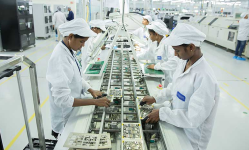
Mobile phones being assembled at a Dixon Technologies factory in Noida, January 28 (Photo: Getty Images)
India has quietly become one of the world's largest 5G markets, with nearly 394 million users by end-2025, a figure that will cross one billion by 2031. According to the latest Ericsson Mobility Report, India now leads the world in Fixed Wireless Access (FWA) connections and has achieved over 90% population coverage in just two years. And we’re not talking simply faster smartphones here. We’re describing a redefined access to broadband, one that drives enterprise digitisation, and positions India as a global 5G powerhouse. The next phase will determine whether this scale translates into sustainable revenue and innovation.
How large is India's 5G subscriber base?
According to the Ericsson Mobility Report, India is expected to have approximately 394 million 5G subscriptions by the end of 2025. Projections indicate this number will exceed one billion by 2031, representing nearly 80% penetration. This places India second only to China in absolute 5G scale globally.
What enabled such rapid 5G deployment?
India's rollout has been driven by aggressive private sector investment, rapid mid-band spectrum deployment, and comprehensive network modernization.
Reportedly, over 90% of India's population is now covered by mid-band 5G within two years of launch - a pace that matches the United States and China while surpassing most emerging markets.
Why is mid-band spectrum critical for India's 5G strategy?
Mid-band spectrum delivers the optimal balance between coverage range and network capacity. It enables high-speed data transmission, video streaming, cloud services, and enterprise applications at scale. India's extensive mid-band coverage has transformed 5G from a premium niche service into infrastructure supporting mass data consumption.
What makes Fixed Wireless Access (FWA) transformative for India?
According to the Ericsson report, India has emerged as the world's largest FWA market with over 12 million connections, led primarily by Reliance Jio.
FWA allows operators to deliver broadband-quality internet without laying physical fibre infrastructure - particularly crucial in semi-urban and rural areas where traditional fiber deployment is slow and economically challenging. This has effectively turned 5G into a broadband substitute rather than merely a mobile upgrade.
How much data are Indians consuming on 5G networks?
India ranks among the world's highest data-consuming markets. Reportedly, average smartphone data usage is projected to increase from approximately 30 GB per month in 2025 to over 50 GB by 2030. This surge is driven primarily by video streaming, short-form content platforms, and aggressively priced data plans that make consumption affordable at scale.
Has the 5G narrative in India shifted beyond speed?
The focus is evolving significantly. While coverage and speed drove initial adoption, the emphasis is now shifting toward value creation. This includes enterprise connectivity solutions, guaranteed performance services, private networks, and industry-specific applications - capabilities that require 5G Standalone (SA) architecture rather than the current Non-Standalone deployments.
Why is 5G Standalone architecture crucial for India's next phase?
According to Ericsson, 5G SA is essential for unlocking advanced features like network slicing, ultra-low latency, and high reliability. These capabilities are fundamental for enterprise use cases including smart manufacturing, logistics optimization, healthcare applications, and public safety systems. Markets adopting SA architecture earlier are reportedly better positioned to monetise 5G beyond consumer data plans.
What does the enterprise opportunity look like for 5G in India?
India's enterprise digitization push creates extensive opportunities for 5G deployment. Potential applications span smart manufacturing facilities, connected ports, energy grids, utility management, and government service delivery. Given India's massive scale, even limited enterprise adoption rates could generate substantial revenue streams for operators.
What are the primary challenges facing India's 5G expansion?
Sustainability concerns are emerging as a critical challenge. Rising energy consumption from expanding data centres and AI workloads poses environmental pressures. While India is reportedly increasing renewable energy use in telecom infrastructure, the Ericsson report cautions that efficiency improvements must keep pace with traffic growth to prevent higher carbon intensity.
How does India's 5G trajectory differ from other major markets?
Unlike mature markets where 5G represents a premium upgrade, India's deployment centers on mass adoption and broadband substitution. Affordable pricing structures, FWA-led growth, and integration with digital public infrastructure have positioned 5G as foundational infrastructure rather than a luxury offering. This fundamentally different approach creates unique opportunities and challenges.
What determines success in India's 5G future?
According to Ericsson's analysis, India has already achieved leadership in scale. The critical test now is whether operators can convert this massive subscriber base into sustainable revenue - particularly through enterprise services, standalone 5G deployments, and differentiated connectivity offerings. Success will require moving beyond reliance on rising data consumption alone and developing new revenue models around guaranteed performance, network slicing, and industry-specific solutions.
What role will network slicing play in monetization?
Network slicing - enabled by 5G SA - allows operators to create virtual networks tailored to specific enterprise needs with guaranteed performance parameters. This capability is reportedly essential for applications requiring ultra-reliable low-latency communication, such as autonomous systems, remote surgery, or critical infrastructure management. It represents a shift from selling data capacity to selling assured performance.
What happens if operators fail to monetise beyond consumer data?
If operators remain dependent solely on consumer data revenue, they risk a profitability squeeze despite massive scale. The infrastructure investments required for maintaining and expanding 5G networks demand revenue diversification. Enterprise services, private networks, and differentiated connectivity offerings represent the pathway to sustainable returns on these investments.
India's 5G journey has transitioned from deployment to differentiation. The infrastructure is largely in place; the question now is whether the ecosystem can deliver the enterprise applications, standalone architecture, and innovative services needed to transform scale into value.
From Zero To 394 million in Two Years: India's 5G Takeover Is Bigger Than Anyone Expected
Open Bureau and Agencies
December 19, 2025, 13:36 IST
India’s 5G rollout has been one of the fastest in telecom history. Within two years, mid-band 5G population coverage has crossed 90 percent, placing India alongside the US and China and well ahead of most emerging markets, according to the latest Ericsson Mobility Report
Mobile phones being assembled at a Dixon Technologies factory in Noida, January 28 (Photo: Getty Images)
India has quietly become one of the world's largest 5G markets, with nearly 394 million users by end-2025, a figure that will cross one billion by 2031. According to the latest Ericsson Mobility Report, India now leads the world in Fixed Wireless Access (FWA) connections and has achieved over 90% population coverage in just two years. And we’re not talking simply faster smartphones here. We’re describing a redefined access to broadband, one that drives enterprise digitisation, and positions India as a global 5G powerhouse. The next phase will determine whether this scale translates into sustainable revenue and innovation.
How large is India's 5G subscriber base?
According to the Ericsson Mobility Report, India is expected to have approximately 394 million 5G subscriptions by the end of 2025. Projections indicate this number will exceed one billion by 2031, representing nearly 80% penetration. This places India second only to China in absolute 5G scale globally.
What enabled such rapid 5G deployment?
India's rollout has been driven by aggressive private sector investment, rapid mid-band spectrum deployment, and comprehensive network modernization.
Reportedly, over 90% of India's population is now covered by mid-band 5G within two years of launch - a pace that matches the United States and China while surpassing most emerging markets.
Why is mid-band spectrum critical for India's 5G strategy?
Mid-band spectrum delivers the optimal balance between coverage range and network capacity. It enables high-speed data transmission, video streaming, cloud services, and enterprise applications at scale. India's extensive mid-band coverage has transformed 5G from a premium niche service into infrastructure supporting mass data consumption.
What makes Fixed Wireless Access (FWA) transformative for India?
According to the Ericsson report, India has emerged as the world's largest FWA market with over 12 million connections, led primarily by Reliance Jio.
FWA allows operators to deliver broadband-quality internet without laying physical fibre infrastructure - particularly crucial in semi-urban and rural areas where traditional fiber deployment is slow and economically challenging. This has effectively turned 5G into a broadband substitute rather than merely a mobile upgrade.
How much data are Indians consuming on 5G networks?
India ranks among the world's highest data-consuming markets. Reportedly, average smartphone data usage is projected to increase from approximately 30 GB per month in 2025 to over 50 GB by 2030. This surge is driven primarily by video streaming, short-form content platforms, and aggressively priced data plans that make consumption affordable at scale.
Has the 5G narrative in India shifted beyond speed?
The focus is evolving significantly. While coverage and speed drove initial adoption, the emphasis is now shifting toward value creation. This includes enterprise connectivity solutions, guaranteed performance services, private networks, and industry-specific applications - capabilities that require 5G Standalone (SA) architecture rather than the current Non-Standalone deployments.
Why is 5G Standalone architecture crucial for India's next phase?
According to Ericsson, 5G SA is essential for unlocking advanced features like network slicing, ultra-low latency, and high reliability. These capabilities are fundamental for enterprise use cases including smart manufacturing, logistics optimization, healthcare applications, and public safety systems. Markets adopting SA architecture earlier are reportedly better positioned to monetise 5G beyond consumer data plans.
What does the enterprise opportunity look like for 5G in India?
India's enterprise digitization push creates extensive opportunities for 5G deployment. Potential applications span smart manufacturing facilities, connected ports, energy grids, utility management, and government service delivery. Given India's massive scale, even limited enterprise adoption rates could generate substantial revenue streams for operators.
What are the primary challenges facing India's 5G expansion?
Sustainability concerns are emerging as a critical challenge. Rising energy consumption from expanding data centres and AI workloads poses environmental pressures. While India is reportedly increasing renewable energy use in telecom infrastructure, the Ericsson report cautions that efficiency improvements must keep pace with traffic growth to prevent higher carbon intensity.
How does India's 5G trajectory differ from other major markets?
Unlike mature markets where 5G represents a premium upgrade, India's deployment centers on mass adoption and broadband substitution. Affordable pricing structures, FWA-led growth, and integration with digital public infrastructure have positioned 5G as foundational infrastructure rather than a luxury offering. This fundamentally different approach creates unique opportunities and challenges.
What determines success in India's 5G future?
According to Ericsson's analysis, India has already achieved leadership in scale. The critical test now is whether operators can convert this massive subscriber base into sustainable revenue - particularly through enterprise services, standalone 5G deployments, and differentiated connectivity offerings. Success will require moving beyond reliance on rising data consumption alone and developing new revenue models around guaranteed performance, network slicing, and industry-specific solutions.
What role will network slicing play in monetization?
Network slicing - enabled by 5G SA - allows operators to create virtual networks tailored to specific enterprise needs with guaranteed performance parameters. This capability is reportedly essential for applications requiring ultra-reliable low-latency communication, such as autonomous systems, remote surgery, or critical infrastructure management. It represents a shift from selling data capacity to selling assured performance.
What happens if operators fail to monetise beyond consumer data?
If operators remain dependent solely on consumer data revenue, they risk a profitability squeeze despite massive scale. The infrastructure investments required for maintaining and expanding 5G networks demand revenue diversification. Enterprise services, private networks, and differentiated connectivity offerings represent the pathway to sustainable returns on these investments.
India's 5G journey has transitioned from deployment to differentiation. The infrastructure is largely in place; the question now is whether the ecosystem can deliver the enterprise applications, standalone architecture, and innovative services needed to transform scale into value.
From Zero To 394 million in Two Years: India's 5G Takeover Is Bigger Than Anyone Expected
Jio Platforms Limited leads India’s global IP creation by a wide margin
CXOtoday News Desk
The Indian Government has recognized Jio Platforms as India’s single largest global IP creator, ahead of all Indian companies and research institutions, in the Annual Report published by the Office of the Controller General of Patents, Designs & Trademarks for 2024-25.
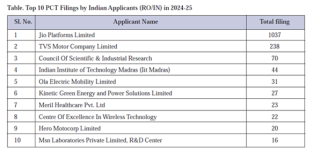
Jio Platforms, which filed 1,037 international patents in 2024-25, stands miles ahead of TVS Motor Co (238), CSIR (70), IIT Madras (44), Ola Electric Mobility (31) and others.
The number of international patents filed by Jio Platforms in 2024-25 at 1,037 is more than double the aggregate of such patent filings by entities ranked from #2 to #10 in the rankings.
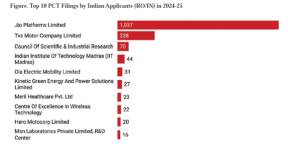
Including the Indian patents, the total patents filed by Jio Platforms during 2024-25 stood at 1,654. As of March 31, 2025, Jio held 485 patents, establishing itself as one of India’s largest patent holders, particularly in 5G and 6G technologies.
This underlines the vision of Mr Mukesh Ambani, Chairman & MD, Reliance Industries to transform into a deep-tech company. “We are resolutely transforming our operating model to become a Deep-Tech company with advanced manufacturing capabilities. We are making every one of our businesses AI-native, positioning them for hyper-growth,” he mentioned during AGM 2025.
“Jio’s transformation into a Deep-Tech company is now unmistakable. And we have done it on a technology stack that is designed, developed, and deployed entirely in India, by Jio’s own engineers. From developing our very own 5G Core, to rolling out the fastest 5G services, and now deploying our global-first home connect technology, we have cemented our place as a Deep-Tech company,” mentioned Mr Akash Ambani, Director, Reliance Industries during his speech at RIL’s 2025 AGM.
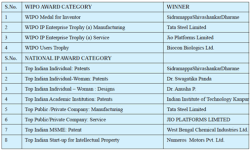
Jio Platforms was recognised for its R&D and creation of new IP on multiple occasions over last year. It won the WIPO IP Enterprise Trophy / Gold Medal for Service industry highlighting achievements in patent filing, grants, and commercialization.
Jio Platforms also won the National IP Award in ‘Top Indian Company in Services’ category in March 2025. This recognizes the company’s strong patent portfolio, including over 4,000 global applications filed in the last three years across telecom, AI, and digital technologies.
Jio Platforms Limited (JPL) was recognized among the Asia IP Elite by IAM at the IPBC Asia Awards 2025 held in Tokyo, Japan. This prestigious recognition celebrates Jio’s continued commitment to excellence in the strategic use and development of intellectual property. The Asia IP Elite honour acknowledges leading organizations across the Asia-Pacific region for their outstanding innovation, leadership, and value creation through IP.
Jio Platforms Limited received the Clarivate South Asia Innovation Award in the Telecommunications category for 2025, recognizing its leadership in technology research and innovation.
Jio Platforms Limited received CII IP runner up award for best Patent portfolio in large ICT category and recognized as one of the top 30 IP driven organization.
Reliance has a comprehensive IP governance framework to strengthen and manage its patent portfolio, ensuring alignment with the Company’s strategic business objectives.
Reliance spent over Rs 4,185 crore in FY25 towards R&D. This was 14.9% higher than Rs 3,643 crore in FY24. In just three years, RIL’s annual R&D spend has increased by over Rs 1,500 crore (from Rs 2,608 crore in FY22).
Jio Platforms Limited leads India’s global IP creation by a wide margin
CXOtoday News Desk
The Indian Government has recognized Jio Platforms as India’s single largest global IP creator, ahead of all Indian companies and research institutions, in the Annual Report published by the Office of the Controller General of Patents, Designs & Trademarks for 2024-25.
Jio Platforms, which filed 1,037 international patents in 2024-25, stands miles ahead of TVS Motor Co (238), CSIR (70), IIT Madras (44), Ola Electric Mobility (31) and others.
The number of international patents filed by Jio Platforms in 2024-25 at 1,037 is more than double the aggregate of such patent filings by entities ranked from #2 to #10 in the rankings.
Including the Indian patents, the total patents filed by Jio Platforms during 2024-25 stood at 1,654. As of March 31, 2025, Jio held 485 patents, establishing itself as one of India’s largest patent holders, particularly in 5G and 6G technologies.
This underlines the vision of Mr Mukesh Ambani, Chairman & MD, Reliance Industries to transform into a deep-tech company. “We are resolutely transforming our operating model to become a Deep-Tech company with advanced manufacturing capabilities. We are making every one of our businesses AI-native, positioning them for hyper-growth,” he mentioned during AGM 2025.
“Jio’s transformation into a Deep-Tech company is now unmistakable. And we have done it on a technology stack that is designed, developed, and deployed entirely in India, by Jio’s own engineers. From developing our very own 5G Core, to rolling out the fastest 5G services, and now deploying our global-first home connect technology, we have cemented our place as a Deep-Tech company,” mentioned Mr Akash Ambani, Director, Reliance Industries during his speech at RIL’s 2025 AGM.
Jio Platforms was recognised for its R&D and creation of new IP on multiple occasions over last year. It won the WIPO IP Enterprise Trophy / Gold Medal for Service industry highlighting achievements in patent filing, grants, and commercialization.
Jio Platforms also won the National IP Award in ‘Top Indian Company in Services’ category in March 2025. This recognizes the company’s strong patent portfolio, including over 4,000 global applications filed in the last three years across telecom, AI, and digital technologies.
Jio Platforms Limited (JPL) was recognized among the Asia IP Elite by IAM at the IPBC Asia Awards 2025 held in Tokyo, Japan. This prestigious recognition celebrates Jio’s continued commitment to excellence in the strategic use and development of intellectual property. The Asia IP Elite honour acknowledges leading organizations across the Asia-Pacific region for their outstanding innovation, leadership, and value creation through IP.
Jio Platforms Limited received the Clarivate South Asia Innovation Award in the Telecommunications category for 2025, recognizing its leadership in technology research and innovation.
Jio Platforms Limited received CII IP runner up award for best Patent portfolio in large ICT category and recognized as one of the top 30 IP driven organization.
Reliance has a comprehensive IP governance framework to strengthen and manage its patent portfolio, ensuring alignment with the Company’s strategic business objectives.
Reliance spent over Rs 4,185 crore in FY25 towards R&D. This was 14.9% higher than Rs 3,643 crore in FY24. In just three years, RIL’s annual R&D spend has increased by over Rs 1,500 crore (from Rs 2,608 crore in FY22).
Jio Platforms Limited leads India’s global IP creation by a wide margin
5G, electric scooters, solar power generation, and carbon emissions trading
Classic scams and exercises in futility.
Classic scams and exercises in futility.