India’s new Raptor .300 Blackout rifle makes international debut at Milipol 2025
Written by Jérôme Brahy
20 Nov, 2025 - 11:07
Defense News Army 2025
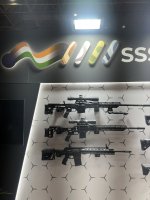
India’s SSS Defence introduced the Raptor .300 Blackout carbine at Milipol 2025 in Paris as part of its first full international presentation of new small arms.
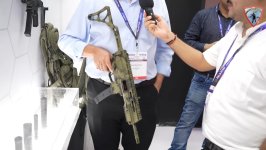
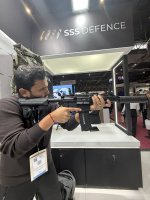
India’s SSS Defence introduced the Raptor .300 Blackout carbine at Milipol 2025 in Paris, as part of its first full international presentation of indigenous infantry weapons. The Raptor was developed as part of India’s intent to compete in the global tactical weapons market, while expanding its domestic production capacity and gauging the export potential for compact suppressed weapons in the .300 Blackout caliber.
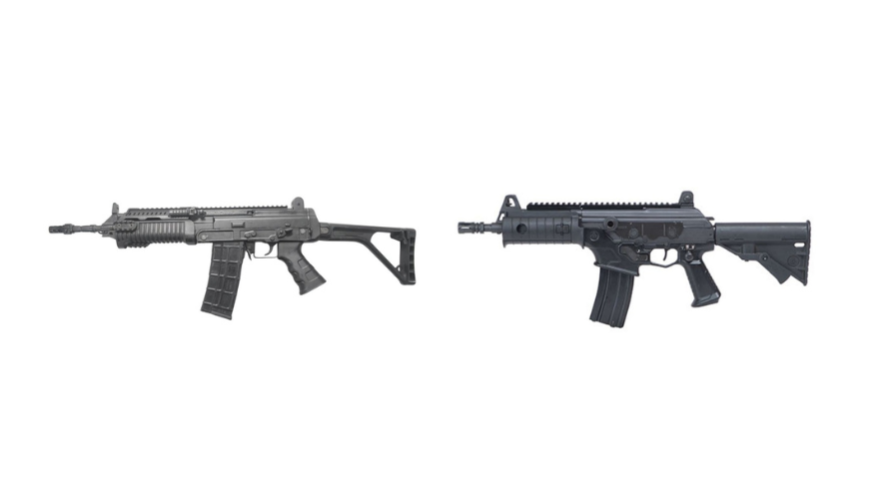
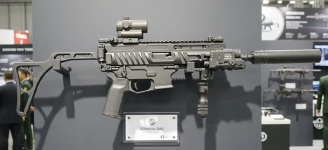
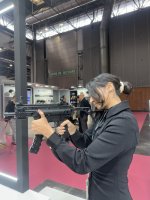
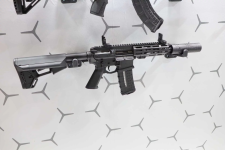 The Raptor is a compact, integrally suppressed .300 Blackout carbine built around a short stroke piston system with an adjustable gas regulator, modular Picatinny interfaces, ambidextrous controls, and barrel options optimised for both subsonic and supersonic ammunition. (Picture source: Army Recognition)
India’s private small arms manufacturer SSS Defence showcased its brand new Raptor .300 Blackout carbine at Milipol 2025 in Paris, presenting the rifle chambered in 7.62 x 35 mm as part of its first full display of indigenous infantry weapons at a major international military and law enforcement exhibition. The company describes the Raptor as entirely designed, developed, and manufactured in Bharat for special forces, SWAT units, and law enforcement customers, aligning the project with the Make in India and Atmanirbhar Bharat initiatives aimed at demonstrating India’s ability to produce modern small arms. The Raptor was shown with its compact, integrally suppressed design, short-stroke piston operating system, monolithic upper receiver, aluminium handguard, and adjustable gas regulator configured for both supersonic and subsonic ammunition types.
Its appearance at Milipol follows a series of domestic unveilings and social media announcements during 2025, including its presentation at the International Police Expo in New Delhi and earlier promotional material emphasising that the 300 BLK caliber is used by international units such as the US Special Operations Command and Germany’s KSK and KSM. SSS Defence links the Raptor to a broader effort to introduce Indian-made small arms to foreign customers, noting that early development interest came from users outside India, with Armenia mentioned as a likely initial requester. The firm also highlights the weapon as part of its strategy to expand production through a new facility planned to become fully operational by late 2025, supporting potential demand from Indian special forces and export markets.
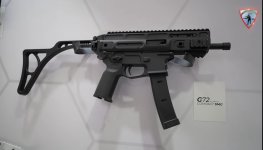
The Raptor’s introduction at Milipol 2025 builds upon SSS Defence’s domestic announcements from August and September 2025, which described the rifle as a fully indigenous .300 Blackout tactical rifle tailored for modern special forces, designed to function as a natural extension of the operator through ergonomics, modularity, and signature reduction. SSS Defence states that the Raptor was engineered over a six-month period and incorporates patented Indian technology, particularly in its integrated suppressor design, which forms part of the barrel rather than being attached externally. The company also links the weapon to its wider portfolio, which includes the M72 carbine that won a 2,000-unit order from the Uttar Pradesh Police, and other weapons shown at events such as the International Police Expo 2025 in New Delhi.
Company statements underline that the Raptor challenges the long-held perception that advanced small arms originate only from the United States, Russia, Germany, Israel, or Arab producers, instead presenting India as a country capable of designing and manufacturing complete weapon systems. SSS Defence emphasises that interest from outside India, including references to Armenia as a probable early requester, influenced the Raptor’s development path and showed that the demand for an Indian .300 Blackout rifle extended beyond Indian agencies. The firm uses the Raptor’s introduction at Milipol 2025 to signal India’s intent to become a supplier of small arms to both domestic elite units, such as Para SF, MARCOS, and Garud Commandos, and to global partners. The company’s messaging repeatedly ties the rifle to the Atmanirbhar Bharat initiative, presenting it as an example of India’s transition from a major importer to a designer and manufacturer of complete defence products.
The Raptor is presented by SSS Defence as a compact, integrally suppressed rifle chambered in .300 AAC Blackout (7.62 x 35 mm), operating through a rotating bolt and short stroke piston system, which is comparable in concept to weapons such as the HK416. The rifle features a monolithic upper receiver and aluminium handguard for rigidity and weight reduction, and uses barrel options of 8.5 inches (216 mm) or 10.5 inches (267 mm), with a rifling twist of one turn in seven inches, right-hand, optimised for heavy .30 calibre projectiles used in subsonic ammunition. The weapon weighs around 3.2 kg without a suppressor and approximately 3.5 kg with a suppressor, and includes an adjustable retractable buttstock and Picatinny rail interfaces for optics, laser designators, and tactical lights. The standard firing modes include safe, semi, and automatic, and the integrated suppressor is intended to reduce acoustic and visual signature more effectively than detachable suppressors when paired with subsonic loads.
The adjustable gas regulator is intended to ensure reliable cycling with both supersonic and subsonic ammunition, which is central to the .300 Blackout concept. The design aims to reduce operator fatigue and improve handling in confined spaces common to close-quarters battle, law enforcement operations, and urban engagements. The weapon’s modular configuration is highlighted as a way to accommodate different mission requirements while maintaining compatibility with widely used accessories familiar to special forces units. SSS Defence notes that specific measurements, such as barrel weight or additional suppressor details, remain confidential for security reasons while confirming that patented Indian components are used in the suppressor assembly.
The Raptor .300 Blackout is intended for scenarios requiring reduced sound signature, short barrel performance, and control of recoil and muzzle flash in environments such as aircraft, maritime platforms, dense urban areas, and transport hubs. The integrally suppressed design seeks to limit detection risk and reduce ricochet or collateral damage during close-range engagements, particularly when using heavy subsonic ammunition. The company cites applications including urban combat, counter terror missions, covert operations, aircraft hijack response, shipping and port security, and situations where traditional calibres such as 5.56 x 45 mm NATO or 9 x 19 mm may not provide the desired balance of energy and suppression. SSS Defence also indicates that the Raptor offers dual mission capability, with subsonic rounds for quiet operation and supersonic loads for engagements at longer distances within the .300 Blackout’s typical effective range.
The modular Picatinny rail system allows operators to tailor the weapon to specific missions by adding optical sights, aiming devices, and other accessories, while ambidextrous controls support ease of use under pressure. The company characterises the design as suitable for roles requiring quiet, compact, and controllable fire rather than general infantry functions, aligning it with suppressed carbines used by specialised units worldwide. The Raptor is also described as engineered to handle extreme weather and varied operational conditions, with features intended to maintain reliability during prolonged use in demanding environments. Across these roles, SSS Defence positions the weapon as a system built to reflect international usage patterns observed within units that have adopted .300 Blackout weapons.
The .300 AAC Blackout cartridge (also abbreviated as 300 BLK), central to the Raptor’s design, was developed in the United States around 2009 by Advanced Armament Corporation with Remington Defense and entered production from roughly 2010 onward, aiming to improve short-barrel performance and suppressed capability within AR-type rifles. The cartridge uses a bullet diameter of approximately 0.308 inches (7.82 mm), a case length close to 1.368 inches, and a maximum overall length of around 2.260 inches, with a maximum average pressure of about 55,000 psi under SAAMI standards. Its parent case is derived from the .223 Remington and 5.56 x 45 mm NATO family, which permits use of standard AR magazines, bolt faces, and other components, allowing conversion from 5.56 to 300 BLK through a simple barrel change and optional gas system adjustments.
This compatibility was intended to avoid the feeding and magazine problems associated with earlier attempts to introduce larger calibres like 7.62 x 39 mm or 6.8 SPC into AR platforms. The cartridge was designed to “negate perceived drawbacks” of these alternatives by maintaining compatibility while offering better performance in short barrels. The 300 BLK is described as effective with both supersonic and subsonic ammunition, the latter allowing a reduced sound signature when combined with a suppressor. The design intent included use in roles requiring flexibility between quiet operations and higher energy fire within the same platform. This dual role is a key factor in why SSS Defence selected the calibre for the Raptor.
The performance characteristics of the .300 Blackout include supersonic loads in the 110 to 125 grain range that can reach approximately 2,200 feet per second from a 16 inch barrel, producing energy levels comparable to or exceeding 7.62 x 39 mm in similar barrel lengths. Subsonic loads around 220 grains operate at roughly 1,000 feet per second or less, allowing quieter firing when suppressed and reducing the likelihood of overpenetration in close quarters engagements. The cartridge retains usable energy from barrels as short as nine inches and offers effective ranges typically cited between 300 and 460 metres depending on ammunition and barrel length. Compared with the 5.56 x 45 mm NATO round, the 300 BLK trades some trajectory flatness for larger projectile mass, greater frontal area, increased penetration potential at short and medium ranges, and superior suppression characteristics.
Conversion between the two calibres is facilitated by the identical case head dimensions, enabling the use of standard bolts and magazines, which is relevant for operators wanting to introduce 300 BLK without restructuring existing inventories. The cartridge’s dual role capability and ease of integration have contributed to its adoption by units such as US SOCOM and Germany’s KSK and KSM. These international usage patterns are referenced directly by SSS Defence to contextualise the Raptor within established global trends. The cartridge’s compatibility with suppressors and effectiveness in short barrel weapons supports the Raptor’s operational focus on compactness and reduced sound signature.
India’s new Raptor .300 Blackout rifle makes international debut at Milipol 2025



 :
:

 chakranewz.com