

We should question why established conglomerates like TATA, Adani, Mahindra, or L&T did not participate. It doesn't make sense. They have a clear objective to move up in the aerospace value chain, so why not start from something small like this?
Saras and NAL Projects : Updates & Discussions
- Thread starter Ashwin
- Start date
You are using an out of date browser. It may not display this or other websites correctly.
You should upgrade or use an alternative browser.
You should upgrade or use an alternative browser.

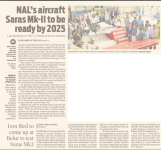
First test flight of Saras Mk2 plane expected in December 2027: official
Saras Mk2, India's civilian aircraft, set to test-fly in December 2027, aiming for passenger transport and air ambulance services.



NAL as a lab should not be allowed to exist alone.View attachment 44994
MY BLOOD BOILS ,
WHEN I SEE THESE RESERVATION BABUS MEETING NOT EVEN SINGLE DEADLINE.
Its better to merge it with ADE of DRDO. Then bring this new entity under MoD.

I never understood why do we even have multiple labs for basically same thing? NAL barely gets any funding and they are keeping that project alive mostly on internal funding.NAL as a lab should not be allowed to exist alone.
Its better to merge it with ADE of DRDO. Then bring this new entity under MoD.
I never understood why do we even have multiple labs for basically same thing? NAL barely gets any funding and they are keeping that project alive mostly on internal funding.
I will do you one better.
GE414 ToT will go to HAL. And there exists no MoU between GTRE and HAL.
Meaning the Kaveri we developed had zero inputs from all the tot of all the engines HAL ever had.
And before anyone says that ToT for assembly of manufacturing is different, I know that. But even that knowledge is immensely valuable.
What is stopping HAL from sharing that to GTRE? DRDO have shared many things to them, why HAL doesn't share their own experience then?I will do you one better.
GE414 ToT will go to HAL. And there exists no MoU between GTRE and HAL.
Meaning the Kaveri we developed had zero inputs from all the tot of all the engines HAL ever had.
And before anyone says that ToT for assembly of manufacturing is different, I know that. But even that knowledge is immensely valuable.
GTRE has developed Kaveri and actually flown it. And HAL is reinventing the wheel with HTFE25. No sharing of expertise.What is stopping HAL from sharing that to GTRE? DRDO have shared many things to them, why HAL doesn't share their own experience then?
Just imagine if HAL engine division and GTRE were a single organisation.
We would have had Mig29s flying with Kaveri by now and Jaguars with HTFE25.
At Bengaluru, Dr Jitendra Singh launches first indigenous Pilot trainer Aircraft 'Hansa-3 NG", reviews plan for 19-seater Aircraft
India’s Indigenous Aircraft Ecosystem Entering a New Era of Growth and Self-Reliance: Dr. Jitendra Singh at CSIR– NAL in Bengaluru
India Eyes Top 3 Global Aviation Ranking; Dr. Jitendra Singh Says Indigenous Aircraft Will Power Next Phase of Growth
Minister Launches SARAS Mk-2 Iron Bird Facility, Boosting India’s Short-Haul Regional Connectivity Programme
CSIR-NAL’s 19-Seater SARAS Mk-2 to Power UDAN Expansion and Reduce Dependence on Imported Aircraft
Dr. Jitendra Singh Flags NAviMet System at HAL, Says India’s Indigenous Weather Tech Now Guards Skies Nationwide

At Bengaluru, Dr Jitendra Singh launches first indigenous Pilot trainer Aircraft 'Hansa-3 NG", reviews plan for 19-seater Aircraft
India’s Indigenous Aircraft Ecosystem Entering a New Era of Growth and Self-Reliance: Dr. Jitendra Singh at CSIR– NAL in Bengaluru
India Eyes Top 3 Global Aviation Ranking; Dr. Jitendra Singh Says Indigenous Aircraft Will Power Next Phase of Growth
Minister Launches SARAS Mk-2 Iron Bird Facility, Boosting India’s Short-Haul Regional Connectivity Programme
CSIR-NAL’s 19-Seater SARAS Mk-2 to Power UDAN Expansion and Reduce Dependence on Imported Aircraft
Dr. Jitendra Singh Flags NAviMet System at HAL, Says India’s Indigenous Weather Tech Now Guards Skies Nationwide
Is it really indigineous? What happens to the recently signed MoU by HAL for Russian CJ something aircraft.

Saras Mk2 has capacity of 19 passengers + 3 crew members. While Sukhoi Superjet 100 has a capacity of 87-108 passengers + 2 cockpit crew. Two very different aircrafts. You probably got confused between saras and HAL/NAL RTA which also has capacity of 90.Is it really indigineous? What happens to the recently signed MoU by HAL for Russian CJ something aircraft.
Last edited:
Govt likely to allocate Rs 12,511-crore to SPV for home-grown transport aircraft
Biggest outlay is for certification, testing and infrastructure. The proposal includes international partner for design and flight testing.The government is likely to commit around Rs 12,511 crore to set up a special purpose vehicle (SPV) for developing a regional transport aircraft, with the bulk of the money earmarked for certification, testing and infrastructure rather than just design, government sources have told Moneycontrol.
The cost structure shows that regulatory approvals and technical validation will take a major share of the total spending, reflecting the complexity of building a civil aircraft, they said. Moneycontrol has reviewed a copy of the proposal documents.
“The SPV proposal is now being examined in detail and the broad financial contours are in place,” one of the sources cited above told Moneycontrol. “The idea is to create a dedicated vehicle that can take the aircraft from design to certification and eventually production.”
A regional transport aircraft is a short- to medium-range passenger plane typically used on domestic and regional routes.
What will SPV do?
The SPV is proposed as a dedicated company or entity that will bring together government support, technical partners and industry participants to take the regional transport aircraft project forward. While the government has publicly said it is “in the process” of setting up the SPV, it has not yet been formally launched.“The SPV will be the platform through which funding, partnerships and execution will be coordinated,” the source said. “The idea is to avoid scattering responsibility across multiple agencies.”
The proposed Rs 12,511-crore outlay and the plan to involve an international partner together offer the clearest picture of how the government intends to structure the regional transport aircraft programme and the scale of financial and technical effort it is willing to commit, the source said.
Role of foreign expertise
A key part of the proposal is to bring in an international knowledge partner for design, certification and flight testing consultancy. About Rs 750 crore has been earmarked for this purpose. This component of the plan indicates that the government is looking to combine domestic development with external technical support related to safety approvals and testing.“The project will need specialised expertise, especially for certification under global standards. That is why a provision has been made for an international knowledge partner,” the source said. The consultancy is expected to cover areas such as FAR-25 design support and flight testing, which are required for commercial aircraft certification.
FAR-25 refers to US Federal Aviation Regulations that lay down safety standards for large transport aircraft. Meeting these standards is essential if an aircraft is to be accepted by regulators and airlines internationally.
Why is certification so expensive?
Certification alone accounts for more than Rs 2,500 crore, making it the single largest cost. Certification involves proving to aviation regulators that the aircraft is safe to fly under a range of conditions, which requires thousands of hours of testing, detailed documentation simulations and real-world trials.Ground testing includes structural tests, fatigue tests and system integration checks, while flight testing involves taking prototypes into the air to test performance, safety and reliability. Together, these stages explain why testing and certification absorb such a large part of the budget, the source said.
How the money will be spent
According to the cost break-up in the proposal, some of the largest allocations are planned for certification of the aircraft at Rs 2,507 crore and infrastructure facilities at Rs 1,981 crore. Ground testing prototypes account for another Rs 1,873 crore, while flight testing of prototypes is estimated at Rs 291 crore, the source said.Spending on materials, bought-out items (BOIs), line-replaceable units (LRUs) and systems is pegged at Rs 240 crore. Prototype tooling and assembly jigs will cost about Rs 133 crore, while documentation and publication are estimated at Rs 465 crore, the source said.
BOIs, or bought-out items, are parts sourced from outside suppliers rather than made in-house. LRUs, or line-replaceable units, are components that can be quickly swapped on an aircraft during maintenance.
The proposal also sets aside Rs 1,000 crore for indigenisation of systems, signalling a push to build domestic capability in aircraft components. A contingency of about Rs 480 crore, or around 5 percent of the project cost, has also been built into the plan, the source added.
Administrative and establishment expenditure is estimated at Rs 680 crore, calculated at around 6 percent of costs excluding contingency and certain consultancy heads.
Last edited:
19 seater ka ata pata nahi. Air India is buying European basic trainers over NALs and sapne ye RTA ke dekh rahe.
Delusionals.

I thought the RTA project was as good as dead.
Why? It is more relevant because there will be private companies with production experience that can run the show. NAL will do the DRDO role.I thought the RTA project was as good as dead.
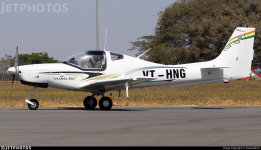
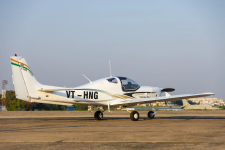
| Feature | **Diamond Aircraft DA40** | **National Aerospace Laboratories Hansa-3 NG** | **Pipistrel Virus (IAF)** | **Pakistan Aeronautical Complex Super Mushak** |
| ------------------ | ------------------------- | ---------------------------------------------- | ------------------------- | ---------------------------------------------- |
| Category | Primary civil / ab-initio | Indigenous basic trainer | Microlight / ab-initio | Military basic trainer |
| Engine | Lycoming 180 hp | Rotax 912 (~100 hp) | Rotax 912 (~100 hp) | Lycoming 260 hp |
| Crew | 2–4 | 2 | 2 | 2 |
| Structure | Composite | Composite | Composite | Metal |
| Max Takeoff Weight | ~1280 kg | ~750 kg | ~600 kg | ~1050 kg |
| Cruise Speed | ~145–150 kt | ~110 kt | ~130 kt | ~140 kt |
| Range | ~1300 km | ~700–800 km | ~1100 km | ~800 km |
| Service Ceiling | ~16,000 ft | ~13,000 ft | ~18,000 ft | ~20,000 ft |
| Stall Speed | ~49 kt | ~45 kt | ~47 kt | ~55 kt |
| Avionics | Full glass | Full glass (NG) | Glass cockpit | Basic (modernized in newer versions) |
| Spin Training | Yes | Yes | Limited | Yes |
| Aerobatics | Limited | Limited | Limited | Yes |
| Training Stage | Civil + military Stage-1 | Ab-initio / basic | Pre-ab-initio | Military basic |
| Operating Cost | High | Low | Very low | High |
| Certification | EASA/FAA | DGCA | Microlight | Military |
---
## **Can Hansa-3 NG replace the Virus in the IAF?**
The new Hansa-3 NG is a **much more capable aircraft than the Virus in many respects**. It has been redesigned with:
* Modern avionics and glass cockpit
* Composite airframe
* Improved spin recovery and training characteristics
* Better suitability for full ab-initio flying
Because of this, the Hansa NG could technically perform *both* screening and basic training roles.
However, replacing the Virus is **not just about capability**, but about training economics and doctrine.
### ✔ Where Hansa NG is better
The Hansa NG is stronger in:
* Full basic flying syllabus
* Spin training and early aerobatics exposure
* Training for CPL and military Stage-1 readiness
* Indigenous production and long-term support
This means it is actually closer to a *basic trainer* than a microlight.
### ✔ Where the Virus still has an edge
The Virus is still superior in:
* Fuel efficiency and operating cost
* Simpler maintenance
* Faster sortie generation
* Lower lifecycle costs
The IAF uses it primarily because **screening needs the cheapest possible aircraft**, not the most capable.
### ✔ Strategic conclusion for IAF
Hansa NG *can replace the Virus*, but only if:
* India wants to shift from a **two-tier screening + basic model** to a **single aircraft pipeline**
* The Hansa NG proves significantly cheaper than turboprop training stages
* Logistics, spares, and fleet reliability are validated
More realistically, the Hansa NG may replace *future imported basic trainers*, not the Virus. The Virus may continue for ultra-cheap screening, while Hansa NG fills the next stage.
---
## **Is Hansa-3 NG good enough for Air India’s basic trainer?**
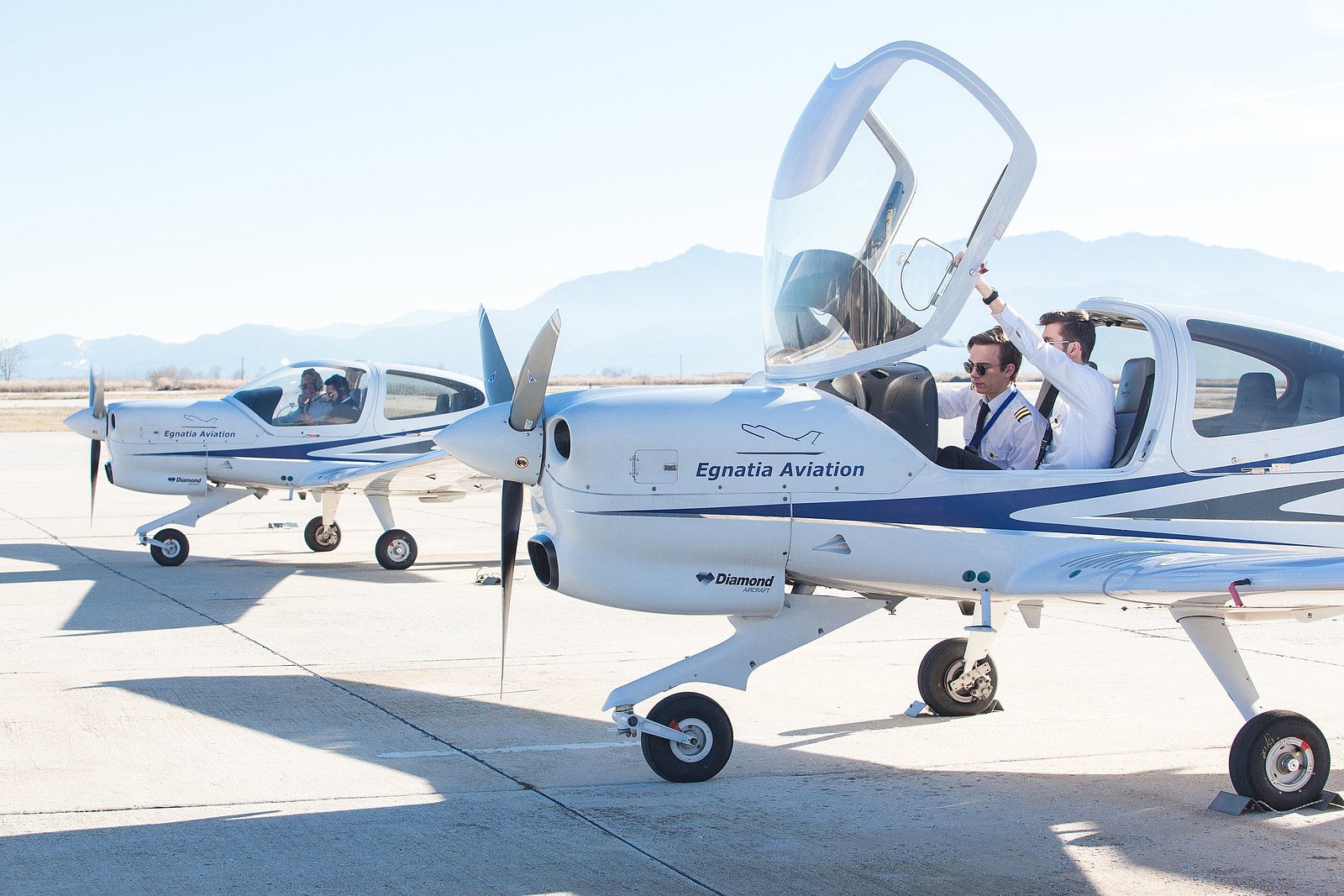
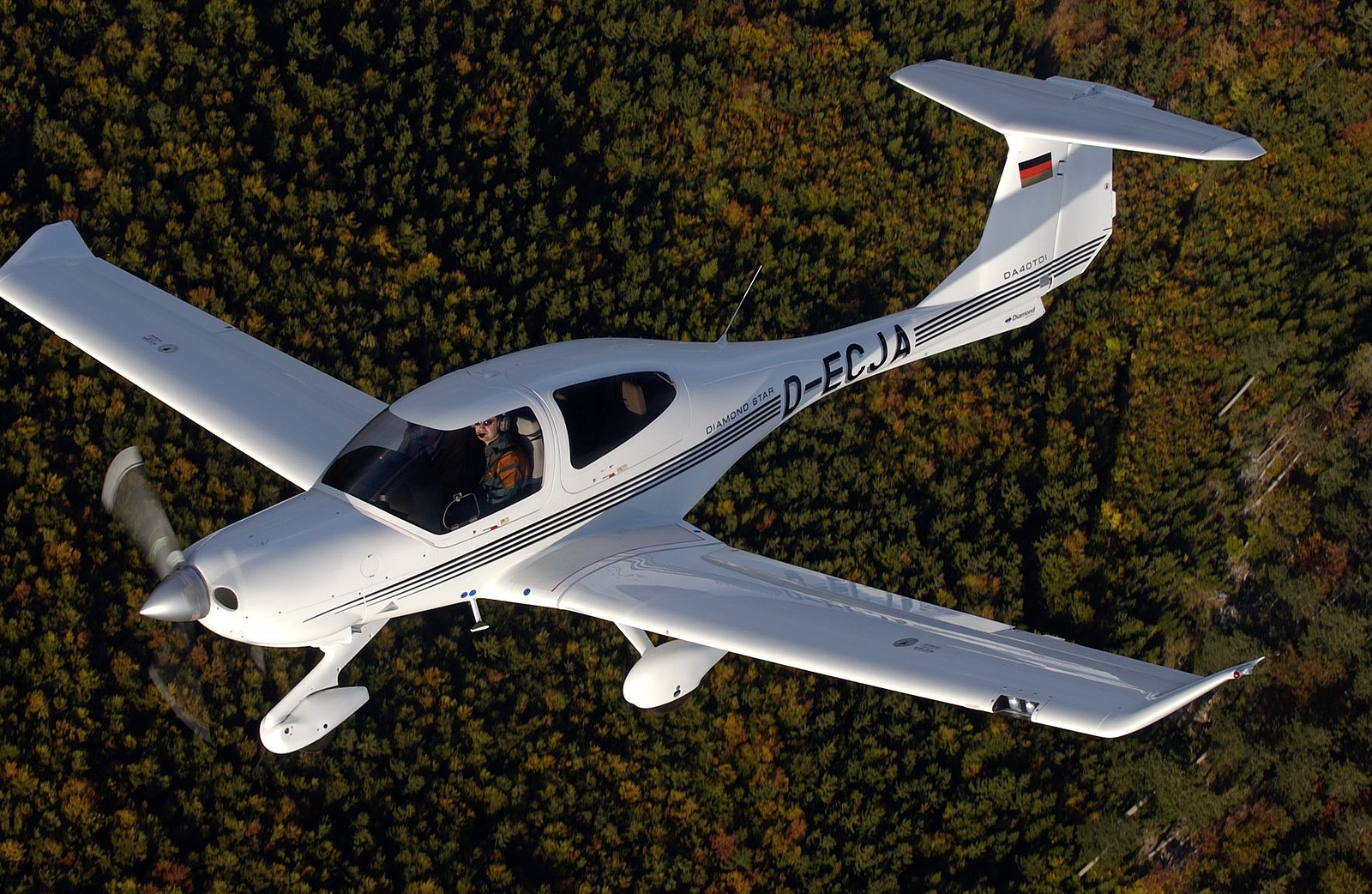

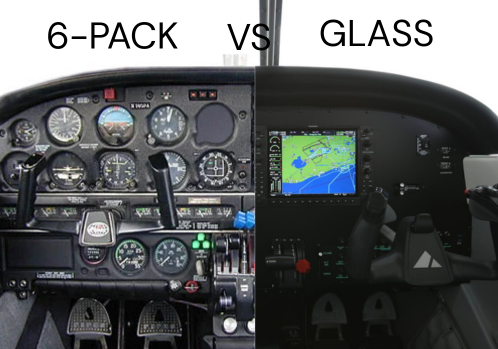
The question becomes very different when we shift from military to civil airline training. Airlines like Air India use aircraft such as the Diamond DA40 because their goal is to prepare cadets for Airbus or Boeing cockpits.
### ✔ What airlines need in a basic trainer
Airline training prioritises:
* Glass cockpit familiarisation
* IFR training capability
* Multi-crew and automation awareness
* Stability and cross-country performance
* Safety and global certification
This is why the DA40 is globally preferred.
### ✔ Strengths of Hansa NG for Air India
The Hansa NG offers:
* Lower cost per flying hour
* Indigenous support and reduced imports
* Modern cockpit and safety
* Good for initial ab-initio flying
This makes it attractive for the *first phase* of cadet training.
### ✔ Limitations compared to DA40
However, it still lacks:
* Global operational experience
* Strong IFR training ecosystem
* Extensive airline-aligned curriculum
* High cruise performance and range
Airlines typically prefer aircraft that are already integrated with international training standards.
### ✔ Practical reality
The most realistic model is:
* Hansa NG for **initial flying hours (PPL phase)**
* DA40 or equivalent for advanced CPL and IFR training
This hybrid model could reduce costs significantly while maintaining airline readiness.
---
## **Final strategic conclusion**
1. The Hansa-3 NG is capable enough to replace the Virus technically, but the IAF may continue using the Virus for cost-efficient screening unless the training doctrine changes.
2. The Hansa NG is better suited as a *basic trainer*, sitting between the Virus and turboprop trainers in the military pipeline.
3. For Air India, the Hansa NG can be a cost-effective entry-level trainer but cannot fully replace the DA40 unless it builds global certification, reliability, and IFR capability.
4. The biggest opportunity is not direct replacement, but **integration into a layered training system** that reduces cost while retaining quality.
---
| ------------------ | ------------------------- | ---------------------------------------------- | ------------------------- | ---------------------------------------------- |
| Category | Primary civil / ab-initio | Indigenous basic trainer | Microlight / ab-initio | Military basic trainer |
| Engine | Lycoming 180 hp | Rotax 912 (~100 hp) | Rotax 912 (~100 hp) | Lycoming 260 hp |
| Crew | 2–4 | 2 | 2 | 2 |
| Structure | Composite | Composite | Composite | Metal |
| Max Takeoff Weight | ~1280 kg | ~750 kg | ~600 kg | ~1050 kg |
| Cruise Speed | ~145–150 kt | ~110 kt | ~130 kt | ~140 kt |
| Range | ~1300 km | ~700–800 km | ~1100 km | ~800 km |
| Service Ceiling | ~16,000 ft | ~13,000 ft | ~18,000 ft | ~20,000 ft |
| Stall Speed | ~49 kt | ~45 kt | ~47 kt | ~55 kt |
| Avionics | Full glass | Full glass (NG) | Glass cockpit | Basic (modernized in newer versions) |
| Spin Training | Yes | Yes | Limited | Yes |
| Aerobatics | Limited | Limited | Limited | Yes |
| Training Stage | Civil + military Stage-1 | Ab-initio / basic | Pre-ab-initio | Military basic |
| Operating Cost | High | Low | Very low | High |
| Certification | EASA/FAA | DGCA | Microlight | Military |
---
##
**Can Hansa-3 NG replace the Virus in the IAF?**The new Hansa-3 NG is a **much more capable aircraft than the Virus in many respects**. It has been redesigned with:
* Modern avionics and glass cockpit
* Composite airframe
* Improved spin recovery and training characteristics
* Better suitability for full ab-initio flying
Because of this, the Hansa NG could technically perform *both* screening and basic training roles.
However, replacing the Virus is **not just about capability**, but about training economics and doctrine.
### ✔ Where Hansa NG is better
The Hansa NG is stronger in:
* Full basic flying syllabus
* Spin training and early aerobatics exposure
* Training for CPL and military Stage-1 readiness
* Indigenous production and long-term support
This means it is actually closer to a *basic trainer* than a microlight.
### ✔ Where the Virus still has an edge
The Virus is still superior in:
* Fuel efficiency and operating cost
* Simpler maintenance
* Faster sortie generation
* Lower lifecycle costs
The IAF uses it primarily because **screening needs the cheapest possible aircraft**, not the most capable.
### ✔ Strategic conclusion for IAF
Hansa NG *can replace the Virus*, but only if:
* India wants to shift from a **two-tier screening + basic model** to a **single aircraft pipeline**
* The Hansa NG proves significantly cheaper than turboprop training stages
* Logistics, spares, and fleet reliability are validated
More realistically, the Hansa NG may replace *future imported basic trainers*, not the Virus. The Virus may continue for ultra-cheap screening, while Hansa NG fills the next stage.
---
##
**Is Hansa-3 NG good enough for Air India’s basic trainer?**



The question becomes very different when we shift from military to civil airline training. Airlines like Air India use aircraft such as the Diamond DA40 because their goal is to prepare cadets for Airbus or Boeing cockpits.
### ✔ What airlines need in a basic trainer
Airline training prioritises:
* Glass cockpit familiarisation
* IFR training capability
* Multi-crew and automation awareness
* Stability and cross-country performance
* Safety and global certification
This is why the DA40 is globally preferred.
### ✔ Strengths of Hansa NG for Air India
The Hansa NG offers:
* Lower cost per flying hour
* Indigenous support and reduced imports
* Modern cockpit and safety
* Good for initial ab-initio flying
This makes it attractive for the *first phase* of cadet training.
### ✔ Limitations compared to DA40
However, it still lacks:
* Global operational experience
* Strong IFR training ecosystem
* Extensive airline-aligned curriculum
* High cruise performance and range
Airlines typically prefer aircraft that are already integrated with international training standards.
### ✔ Practical reality
The most realistic model is:
* Hansa NG for **initial flying hours (PPL phase)**
* DA40 or equivalent for advanced CPL and IFR training
This hybrid model could reduce costs significantly while maintaining airline readiness.
---
##
**Final strategic conclusion**1. The Hansa-3 NG is capable enough to replace the Virus technically, but the IAF may continue using the Virus for cost-efficient screening unless the training doctrine changes.
2. The Hansa NG is better suited as a *basic trainer*, sitting between the Virus and turboprop trainers in the military pipeline.
3. For Air India, the Hansa NG can be a cost-effective entry-level trainer but cannot fully replace the DA40 unless it builds global certification, reliability, and IFR capability.
4. The biggest opportunity is not direct replacement, but **integration into a layered training system** that reduces cost while retaining quality.
---
https://parasdefence.com/uploads/pr..._paras-defence-investor-presentation-2026.pdf Page 20
- Complete Glass Cockpit / Avionic Suite for Saras MK- II Aircraft Platform.
- Delivered 2 Shipsets and working with Customer Closely for Project Completion.
- Aim to increase indigenous content in - line with Make In India, for future requirements.
- Potential Business for Saras - MK- II estimated to be 1+15+115 Nos in the next 5 to 7 Years.
- High Business Potential extending beyond Saras - MK- II for various similar platforms.