

Renewable energy in India : News & Updates
- Thread starter RISING SUN
- Start date
You are using an out of date browser. It may not display this or other websites correctly.
You should upgrade or use an alternative browser.
You should upgrade or use an alternative browser.
India power sector review 2025: Record clean energy deployment drives historic decline in coal generation
7 January 2026
Author(s): Manojkumar N; Medha Mary Mathew; Lauri Myllyvirta
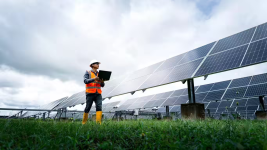
India’s power sector is experiencing rapid change as renewable energy deployment accelerates year after year. India added 41 GW of renewable energy in the first eleven months of 2025, already making a record for capacity additions during a full year, and raising the share of renewables to 40% of the country’s installed capacity. At the same time, rising electricity demand is increasingly being met by renewable generation, particularly during daytime hours when solar power is available. This further eases the replacement of coal power with renewables.
Despite the rapid acceleration of renewable energy, the government intends to add 100 GW of new coal-based capacity over the next seven years. However, India’s existing and under-construction coal fleet is already exceeding the coal capacity requirement projected by multiple resource adequacy assessments for 2030.
The challenge is not capacity adequacy but system flexibility. Most coal plants in India operate at minimum technical loads of around 55%, which forces them to run even during periods when low-cost renewable electricity is available. Long-term coal power purchase agreements continue to bind utilities to higher-cost thermal generation even when lower-cost renewable electricity is available.
This operational rigidity results in avoidable curtailment of solar and wind generation. Enabling higher renewable penetration will therefore require structural reforms that reduce flexibility constraints in the coal fleet, accelerate deployment of battery energy storage, and grid upgradation.
This annual power brief evaluates these shifting dynamics through reviewing India’s generation capacity, ongoing thermal capacity construction, electricity demand trends, source-wise generation patterns, and plant utilisation levels. It also examines the structural reforms required to effectively integrate high renewable penetration, including coal flexibilization, storage expansion, and grid strengthening, as well as outlines what must be done to prioritize renewable energy over new coal additions.
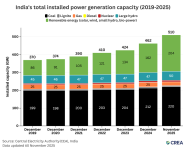
Figure: India’s total installed power capacity (2019-2025)
Key findings:
7 January 2026
Author(s): Manojkumar N; Medha Mary Mathew; Lauri Myllyvirta
India’s power sector is experiencing rapid change as renewable energy deployment accelerates year after year. India added 41 GW of renewable energy in the first eleven months of 2025, already making a record for capacity additions during a full year, and raising the share of renewables to 40% of the country’s installed capacity. At the same time, rising electricity demand is increasingly being met by renewable generation, particularly during daytime hours when solar power is available. This further eases the replacement of coal power with renewables.
Despite the rapid acceleration of renewable energy, the government intends to add 100 GW of new coal-based capacity over the next seven years. However, India’s existing and under-construction coal fleet is already exceeding the coal capacity requirement projected by multiple resource adequacy assessments for 2030.
The challenge is not capacity adequacy but system flexibility. Most coal plants in India operate at minimum technical loads of around 55%, which forces them to run even during periods when low-cost renewable electricity is available. Long-term coal power purchase agreements continue to bind utilities to higher-cost thermal generation even when lower-cost renewable electricity is available.
This operational rigidity results in avoidable curtailment of solar and wind generation. Enabling higher renewable penetration will therefore require structural reforms that reduce flexibility constraints in the coal fleet, accelerate deployment of battery energy storage, and grid upgradation.
This annual power brief evaluates these shifting dynamics through reviewing India’s generation capacity, ongoing thermal capacity construction, electricity demand trends, source-wise generation patterns, and plant utilisation levels. It also examines the structural reforms required to effectively integrate high renewable penetration, including coal flexibilization, storage expansion, and grid strengthening, as well as outlines what must be done to prioritize renewable energy over new coal additions.
Figure: India’s total installed power capacity (2019-2025)
Key findings:
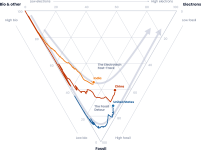
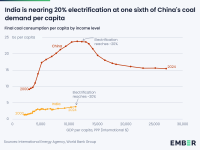
- India’s coal-fired power generation fell in 2025 by 3%, only the second drop for a full calendar year in at least half a century, with the first one being associated with the Covid-19 pandemic.
- The drop in coal and gas-fired power generation was caused by record growth in clean power generation, which contributed to 44% of the drop, less demand for air conditioning due to milder weather (36%), and a longer-term slowdown in power demand growth for other reasons (20%), compared to the trend in 2019-24.
- Meeting India’s 500 GW non-fossil capacity target means that there is no headroom for coal-based power generation to grow between now and 2030, even if power demand growth picks up in the coming years.
- Clean electricity sources are also increasingly covering demand peaks, making coal power capacity additions redundant.
- If under-construction coal power projects (36 GW) are completed, capacity utilization could fall to unprecedented lows, causing financial distress for generators and excessive cost burden on power users.




Thread:
India is smashing it: 42.5GW of new solar in 2026 ALONE. Think about that scale - it’s more than the entire installed capacity of most developed nations. At this exponential rate, solar capacity is on track to CRUSH coal in India by 2028
THREAD
India’s installed coal capacity is 219GW, while solar capacity hit 135GW. India is now adding solar at a rate of 40-45 GW/year. At this pace, solar is on track to reach 260GW by 2028, effectively overtaking the total installed capacity of the coal fleet. 2/6
It's not just capacity: In India, the LCOE for solar is now significantly lower than that of new coal. By 2028, the declining costs of solar will reach a tipping point where building new solar-plus-storage becomes cheaper than simply running existing, older coal plants. 3/6
A primary defense for coal has been its role as "baseload" power. However, India is rapidly scaling BESS, with projections of 25-30GW of storage by 2028. Solar will provide firm, dispatchable power during peak evening hours, directly displacing coal’s traditional utility. 4/6
India is also installing more solar in a single year than the entire cumulative solar capacity built over decades by many of the world's most advanced economies:
> UK total solar capacity: 22GW
> Australia total solar capacity: 40GW
> France: 28GW
> Italy: 37 GW
5/6
We’re witnessing the total eclipse of legacy fossil fuels in real-time. Solar isn't just competing, it's dominating. The "experts" who said this would take decades were wrong. The dinosaurs are losing and the economics are now unstoppable. More reading: India expected to install about 42.5 GW of new solar capacity in 2026
India is smashing it: 42.5GW of new solar in 2026 ALONE. Think about that scale - it’s more than the entire installed capacity of most developed nations. At this exponential rate, solar capacity is on track to CRUSH coal in India by 2028
THREAD
India’s installed coal capacity is 219GW, while solar capacity hit 135GW. India is now adding solar at a rate of 40-45 GW/year. At this pace, solar is on track to reach 260GW by 2028, effectively overtaking the total installed capacity of the coal fleet. 2/6
It's not just capacity: In India, the LCOE for solar is now significantly lower than that of new coal. By 2028, the declining costs of solar will reach a tipping point where building new solar-plus-storage becomes cheaper than simply running existing, older coal plants. 3/6
A primary defense for coal has been its role as "baseload" power. However, India is rapidly scaling BESS, with projections of 25-30GW of storage by 2028. Solar will provide firm, dispatchable power during peak evening hours, directly displacing coal’s traditional utility. 4/6
India is also installing more solar in a single year than the entire cumulative solar capacity built over decades by many of the world's most advanced economies:
> UK total solar capacity: 22GW
> Australia total solar capacity: 40GW
> France: 28GW
> Italy: 37 GW
5/6
We’re witnessing the total eclipse of legacy fossil fuels in real-time. Solar isn't just competing, it's dominating. The "experts" who said this would take decades were wrong. The dinosaurs are losing and the economics are now unstoppable. More reading: India expected to install about 42.5 GW of new solar capacity in 2026
Adani Arm to manufacture India’s longest 91.2-metre wind turbine blades at Mundra
Atul Mathur / TNN / Feb 27, 2026, 23:31 IST

NEW DELHI: Adani New Industries Limited (ANIL), which houses the Adani Group’s renewable manufacturing businesses, is preparing to manufacture 91.2-metre onshore wind turbine blades - the longest to be produced in the country - at its Mundra facility in Gujarat. The blades will be deployed on next-generation turbines designed to improve energy output, particularly at low- and medium-wind sites.
The Mundra plant currently manufactures blades measuring 78.6 meters and 80.5 meters. The new 91.2-metre blade marks a significant leap in design complexity, materials engineering and manufacturing capability. Officials said the initial set of 91.2-metre blades has already been erected on a new turbine model, with serial production expected to begin within the current calendar year.
Blade length, combined with higher rated capacity, is a critical determinant of wind energy output. A 91.2-metre blade - comparable to the length of a football field and taller than a 30-storey building - enables a rotor diameter of nearly 185 meters, sweeping an area of about 26,600 square meters. Each rotation covers an area larger than three football fields combined. A larger swept area, along with higher-rated capacity turbines, allows the turbine to capture more kinetic energy from the wind, improving capacity utilization and increasing power output.
“This is particularly relevant for India, where a large share of potential wind sites falls in low- to medium-wind regimes. Larger rotors and higher hub heights make these locations commercially viable, expanding wind deployment beyond traditional high-wind corridors. The shift towards turbines rated above 5 megawatts (MW) is therefore as much about geography as it is about technology,” an official said.
ANIL’s blade manufacturing facility at Mundra has a current capacity of 2.25 gigawatts (GW) per annum, equivalent to about 450 blade sets annually. The company plans to scale this up to 5 GW in phases, with a longer-term ambition of reaching 10 GW.
Mundra is evolving into a multi-technology renewable manufacturing hub, housing wind turbines, solar modules and supporting component facilities within a single ecosystem. Investments in wind manufacturing so far are estimated at up to ₹3,000 crore, with future capital expenditure focused on automation, advanced tooling and materials research, including recyclable blade materials and larger rotor designs.
India ranks fourth globally in cumulative installed wind capacity, with around 55 GW operational. It is also the world’s third-largest wind manufacturing base, with a domestic manufacturing capacity of approximately 20 GW - sufficient to meet about 10% of global demand. Localisation levels across the wind value chain are estimated at 70–80%, covering towers, nacelles, blades and key components. Blade manufacturing alone accounts for nearly 16 GW of capacity, giving India close to a 10% share of global blade manufacturing.
Adani Arm to manufacture India’s longest 91.2-metre wind turbine blades at Mundra - The Times of India
Atul Mathur / TNN / Feb 27, 2026, 23:31 IST
NEW DELHI: Adani New Industries Limited (ANIL), which houses the Adani Group’s renewable manufacturing businesses, is preparing to manufacture 91.2-metre onshore wind turbine blades - the longest to be produced in the country - at its Mundra facility in Gujarat. The blades will be deployed on next-generation turbines designed to improve energy output, particularly at low- and medium-wind sites.
The Mundra plant currently manufactures blades measuring 78.6 meters and 80.5 meters. The new 91.2-metre blade marks a significant leap in design complexity, materials engineering and manufacturing capability. Officials said the initial set of 91.2-metre blades has already been erected on a new turbine model, with serial production expected to begin within the current calendar year.
Blade length, combined with higher rated capacity, is a critical determinant of wind energy output. A 91.2-metre blade - comparable to the length of a football field and taller than a 30-storey building - enables a rotor diameter of nearly 185 meters, sweeping an area of about 26,600 square meters. Each rotation covers an area larger than three football fields combined. A larger swept area, along with higher-rated capacity turbines, allows the turbine to capture more kinetic energy from the wind, improving capacity utilization and increasing power output.
“This is particularly relevant for India, where a large share of potential wind sites falls in low- to medium-wind regimes. Larger rotors and higher hub heights make these locations commercially viable, expanding wind deployment beyond traditional high-wind corridors. The shift towards turbines rated above 5 megawatts (MW) is therefore as much about geography as it is about technology,” an official said.
ANIL’s blade manufacturing facility at Mundra has a current capacity of 2.25 gigawatts (GW) per annum, equivalent to about 450 blade sets annually. The company plans to scale this up to 5 GW in phases, with a longer-term ambition of reaching 10 GW.
Mundra is evolving into a multi-technology renewable manufacturing hub, housing wind turbines, solar modules and supporting component facilities within a single ecosystem. Investments in wind manufacturing so far are estimated at up to ₹3,000 crore, with future capital expenditure focused on automation, advanced tooling and materials research, including recyclable blade materials and larger rotor designs.
India ranks fourth globally in cumulative installed wind capacity, with around 55 GW operational. It is also the world’s third-largest wind manufacturing base, with a domestic manufacturing capacity of approximately 20 GW - sufficient to meet about 10% of global demand. Localisation levels across the wind value chain are estimated at 70–80%, covering towers, nacelles, blades and key components. Blade manufacturing alone accounts for nearly 16 GW of capacity, giving India close to a 10% share of global blade manufacturing.
Adani Arm to manufacture India’s longest 91.2-metre wind turbine blades at Mundra - The Times of India

100 Anand villages step on gas to ease LPG crisis, with a cheaper option | Vadodara News - The Times of India
Vadodara: Amid the acute LPG crisis and black marketing that have left lakhs scrambling for cylinders, a ray of hope is emerging from the villages of .
 timesofindia.indiatimes.com
Amid the acute LPG crisis and black marketing that have left lakhs scrambling for cylinders, a ray of hope is emerging from the villages of Anand district.
A large-scale bio-CNG cluster of 10 plants spread across 100 villages in the region promises not only a cheaper and more reliable alternative to LPG but also a step towards reducing India's dependence on imported energy.
Once operational, the cluster will produce 10 metric tonnes of bio-CNG daily — equivalent to 521 commercial LPG cylinders or 715 domestic cylinders — ensuring uninterrupted supply for schools, hostels, temples, hotels and highway eateries where menus have been slashed and some have shut down for want of cylinders.
The project will be rolled out from Davol village in Borsad taluka and extend up to Pandoli in Petlad over a 31-km stretch.
"This clean fuel will be 20% cheaper than LPG," said project developer Sanjay Patel, CEO of S P Ecofuel, which promotes innovative and low-cost renewable energy solutions. The entire cluster, including refining and distribution infrastructure, will involve an investment of around Rs 60 crore.
The project will convert cattle dung, food waste and agricultural biomass into clean fuel, helping tackle rural waste and create an extra income stream for farmers.
The initiative will source raw material from nearly 100 villages through women-led farmer producer organisations (FPOs), processing around 500 metric tonnes of cattle dung, food waste, poultry waste and agricultural biomass daily.
"At BAPS Gaushala in Dakor, we are generating around 100 kg of bio-CNG daily. This is transported through nano tankers to Premvati Bhojnalaya, where it is used to prepare meals for more than 1,000 devotees daily,"Patel said.
The cluster will generate around 20,000 cubic metres of raw biogas daily, which will be refined into 10MT of bio-CNG. Waste from 100 villages will be scientifically processed, eliminating dumping and emissions, said Patel.
Napier grass, a high-yield crop, will also be used as feedstock, opening up a new income stream for farmers.
The Davol plant, estimated at Rs 4 crore, is expected to be commissioned by May. Around 400 households in villages like Davol, Pamol, Bodal, Nsiraya, Asodar and Mujkuva are already powered with biogas that has come up through various schemes of the National Dairy Development Board, Gujarat govt's Gobardhan scheme and Swachh Bharat Mission."More than 1,000 farmers, most of them women, have already shown interest in joining FPOs," said Patel.
Apart from fuel, the project will produce organic fertilisers. The processed slurry will be converted into liquid and solid organic manure, which can further be enriched into phosphate-rich fertiliser — offering an alternative to chemical inputs like urea and DAP.
A govt official said the model provides a practical solution to enforce norms against open dumping of waste in villages, while creating additional income streams for farmers and panchayats.
The environmental gains are significant. The cluster is expected to reduce over one lakh metric tonnes of carbon dioxide emissions annually, generating carbon credits while improving sanitation and public health in rural areas.
Currently, Gujarat has around 20 metric tonnes of bio-CNG capacity, almost entirely used for automobiles under the Centre's SATAT scheme.


India is building one of the world’s largest batteries inside a solar farm five times the size of Paris
By Pia Gray
April 4, 2026
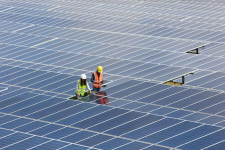
In India, a solar farm five times the size of Paris is about to get the world's largest battery © Onuma Inthapong
Construction is underway in western India on what billionaire-led Adani Group says will be India's largest battery energy storage system. Located inside the Khavda Renewable Energy Park in Gujarat, the project is designed to store 3,530 megawatt-hours of power. Full completion was targeted by March 2026. However, as of April 2026, only 39% of capacity is operational and the battery remains unfinished despite the deadline.
3,530 megawatt-hours across 700 containers
The battery system uses lithium-ion technology across more than 700 containers. Its power capacity is 1,126 megawatts, with an energy capacity of 3,530 megawatt-hours, enough to sustain that output for roughly three hours. The Adani Group announced the project on November 11, 2025, the company has not disclosed the total investment amount. As of April 1, 2026, Adani had brought 1,376 megawatt-hours of capacity online at Khavda. But no updated completion date for the remaining capacity has been publicly stated.
What it solves on the grid
Solar and wind fluctuate with weather and time of day. India’s grid needs power when the sun goes down and demand peaks.This battery absorbs excess daytime generation and discharges it in the evening, reducing reliance on fossil fuel plants. Adani says it will also ease transmission congestion and reduce curtailment when grids waste renewable power they can’t handle.
“Energy storage is the cornerstone of a renewable-powered future,” Adani Group chairman Gautam Adani said in the November announcement. “With this historic project, we are not only setting global benchmarks but also reinforcing our commitment to India’s energy independence and sustainability.”
The roadmap beyond Khavda
Adani’s roadmap extends beyond this installation. The group plans to deploy an additional 15 gigawatt-hours of storage by March 2027. Its five-year target is 50 gigawatt-hours total. For context, India’s Central Electricity Authority projects the country will need roughly 34 gigawatt-hours of battery storage capacity by 2026-27, rising to 236 gigawatt-hours by 2031-32. As of April 2025, only around 0.5 gigawatt-hours of battery storage had been commissioned across India, according to the India Energy Storage Alliance.
The park behind the battery
The Khavda park is already operating at scale. Adani Green Energy added more than 5 gigawatts of new renewable capacity in fiscal year 2025-26, the highest greenfield annual expansion by any company outside China. This brings its total operational portfolio to 19.3 gigawatts. Cumulative installed capacity at Khavda has reached 9.4 gigawatts of the 30-gigawatt target planned for 2029. The park spans 538 square kilometers, an area five times the size of Paris.
India’s larger bet
India has committed to reaching 500 gigawatts of non-fossil energy capacity by 2030 and net-zero emissions by 2070. Storage determines whether intermittent generation can function as baseload power. The Khavda battery doesn’t just store electricity; it tests whether a project of this ambition can be built and operated at the pace India’s energy transition requires.
India is building one of the world's largest batteries inside a solar farm five times the size of Paris - Futura-Sciences
By Pia Gray
April 4, 2026
In India, a solar farm five times the size of Paris is about to get the world's largest battery © Onuma Inthapong
Construction is underway in western India on what billionaire-led Adani Group says will be India's largest battery energy storage system. Located inside the Khavda Renewable Energy Park in Gujarat, the project is designed to store 3,530 megawatt-hours of power. Full completion was targeted by March 2026. However, as of April 2026, only 39% of capacity is operational and the battery remains unfinished despite the deadline.
3,530 megawatt-hours across 700 containers
The battery system uses lithium-ion technology across more than 700 containers. Its power capacity is 1,126 megawatts, with an energy capacity of 3,530 megawatt-hours, enough to sustain that output for roughly three hours. The Adani Group announced the project on November 11, 2025, the company has not disclosed the total investment amount. As of April 1, 2026, Adani had brought 1,376 megawatt-hours of capacity online at Khavda. But no updated completion date for the remaining capacity has been publicly stated.
What it solves on the grid
Solar and wind fluctuate with weather and time of day. India’s grid needs power when the sun goes down and demand peaks.This battery absorbs excess daytime generation and discharges it in the evening, reducing reliance on fossil fuel plants. Adani says it will also ease transmission congestion and reduce curtailment when grids waste renewable power they can’t handle.
“Energy storage is the cornerstone of a renewable-powered future,” Adani Group chairman Gautam Adani said in the November announcement. “With this historic project, we are not only setting global benchmarks but also reinforcing our commitment to India’s energy independence and sustainability.”
The roadmap beyond Khavda
Adani’s roadmap extends beyond this installation. The group plans to deploy an additional 15 gigawatt-hours of storage by March 2027. Its five-year target is 50 gigawatt-hours total. For context, India’s Central Electricity Authority projects the country will need roughly 34 gigawatt-hours of battery storage capacity by 2026-27, rising to 236 gigawatt-hours by 2031-32. As of April 2025, only around 0.5 gigawatt-hours of battery storage had been commissioned across India, according to the India Energy Storage Alliance.
The park behind the battery
The Khavda park is already operating at scale. Adani Green Energy added more than 5 gigawatts of new renewable capacity in fiscal year 2025-26, the highest greenfield annual expansion by any company outside China. This brings its total operational portfolio to 19.3 gigawatts. Cumulative installed capacity at Khavda has reached 9.4 gigawatts of the 30-gigawatt target planned for 2029. The park spans 538 square kilometers, an area five times the size of Paris.
India’s larger bet
India has committed to reaching 500 gigawatts of non-fossil energy capacity by 2030 and net-zero emissions by 2070. Storage determines whether intermittent generation can function as baseload power. The Khavda battery doesn’t just store electricity; it tests whether a project of this ambition can be built and operated at the pace India’s energy transition requires.
India is building one of the world's largest batteries inside a solar farm five times the size of Paris - Futura-Sciences


RIL Sets Sights on 120 GWh Capacity Expansion Beyond Initial 40 GWh
Conglomerate targets tripling of battery factory capacity at 49th AGM, citing national self-reliance
By Shahkar Abidi
19 Jun 2026

"The first phase of our 40 GWh annual BESS and Cell Giga Factory is on track to be commissioned this year, with plans to enhance this up to 120 GWh of annual
capacity", Mukesh Ambani, Chairman and Managing Director of Reliance India Ltd stated in his address during company's 49th annual general meeting held on Friday.
"All the equipment has already been delivered at the site" Ambani noted. "And we have now committed to scale this up to 120 GWh of annual capacity" he added
before continuing that when commissioned, this will make Reliance one of the world's largest manufacturers of lithium iron phosphate batteries.
To put things into perspective, Ambani highlighted that in a world where supply chains are being contested and access to technology is being weaponised, building world-scale battery manufacturing capacity in India is not merely a business decision, but is a strategic imperative for national resilience.
The project is expected to create 200,000 jobs through the Giga Complex and the Kutch Solar Farm combined. "Two hundred thousand Indians – engineers, technicians, operators, construction workers, farmers, and entrepreneurs – whose livelihoods will be built on clean energy" Ambani said in this address.
RIL Sets Sights on 120 GWh Capacity Expansion Beyond Initial 40 GWh | Autocar Professional
Conglomerate targets tripling of battery factory capacity at 49th AGM, citing national self-reliance
By Shahkar Abidi
19 Jun 2026
"The first phase of our 40 GWh annual BESS and Cell Giga Factory is on track to be commissioned this year, with plans to enhance this up to 120 GWh of annual
capacity", Mukesh Ambani, Chairman and Managing Director of Reliance India Ltd stated in his address during company's 49th annual general meeting held on Friday.
"All the equipment has already been delivered at the site" Ambani noted. "And we have now committed to scale this up to 120 GWh of annual capacity" he added
before continuing that when commissioned, this will make Reliance one of the world's largest manufacturers of lithium iron phosphate batteries.
To put things into perspective, Ambani highlighted that in a world where supply chains are being contested and access to technology is being weaponised, building world-scale battery manufacturing capacity in India is not merely a business decision, but is a strategic imperative for national resilience.
The project is expected to create 200,000 jobs through the Giga Complex and the Kutch Solar Farm combined. "Two hundred thousand Indians – engineers, technicians, operators, construction workers, farmers, and entrepreneurs – whose livelihoods will be built on clean energy" Ambani said in this address.
RIL Sets Sights on 120 GWh Capacity Expansion Beyond Initial 40 GWh | Autocar Professional


BHEL builds India's first homegrown 1200 kV ultra-high voltage transformer - CNBC TV18
The equipment was manufactured under a controlled environment at BHEL's newly built transformer facility in Bhopal, using advanced manufacturing and testing infrastructure to meet stringent quality standards.

India must mandate that if at all any coal powered plant is being constructed, it meets nuclear safety standards for future coal-to-nuclear C2N transitions.

Superhydrophobic nanocomposite coating boosts PV power output by 16%, outperforms manual cleaning - pv magazine India
An Indian research team developed a transparent, nanocomposite coating that makes solar panels superhydrophobic, enabling self-cleaning and reducing dust-related performance losses. Six months of outdoor testing showed coated panels produced 16% more power than dusty panels and 7% more than...
 www.pv-magazine-india.com
