Project 75 India Diesel-electric Submarine Programs (SSK) : Updates and Discussions

Who will win the P75I program?

  • L&T and Navantia

    Votes: 16 36.4%
  • MDL and TKMS

    Votes: 11 25.0%
  • It will get canceled eventually

    Votes: 17 38.6%

  • Total voters
    44
  • Poll closed .
India hopes to seal submarine contract with Germany this fiscal, MDL pares down cost ‘significantly’

First submarine, according to RFP, must be delivered 7 yrs after contract signing with 45% indigenous content, followed by one each year until programme reaches 60% localisation.

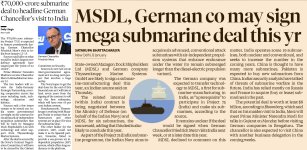
New Delhi: The Indian Navy is hoping to conclude contract negotiations and sign the mega deal for six new conventional diesel-electric submarines with better stealth features this fiscal, in what will be a culmination of a nearly 30-year journey, ThePrint has learnt.

Sources in the defence and security establishment told ThePrint that Navy is catering for signing of the Project 75 India (P75I) contract by end of March next year and is looking at even making the first tranche of payment.

Regarding the cost factor, the sources said that negotiations are still on and the state-run Mazagon Dockyard Limited (MDL), which has tied up with German firm ThyssenKrupp Marine Systems (TKMS), has “significantly” brought down the cost.
It is learnt that this would be the most expensive conventional submarine contract to be signed in the world even though cost has been brought down.

As reported by ThePrint earlier, when the project received a fresh Acceptance of Necessity (AoN) in 2018, it was benchmarked at Rs 43,000 crore. However, MDL and TKMS’s bid crossed Rs 1.2 lakh crore, with GST pushing it even higher.

When the MDL-TKMS bid was chosen earlier this year, the Germans were sounded to pare the costs down, with the Navy hoping to finalise the deal in the Rs 60,000 crore–70,000 crore range.

However, it is learnt that despite the cost being brought down by the MDL, the primary contractor, the deal may cost around Rs 90,000 crore, almost double of what was earmarked in 2019.

The sources said that since the initial bid, there has been a new management at MDL, which negotiated with the Germans and brought the cost down.

According to the request for proposal (RFP), the first submarine must be delivered seven years after contract signing with 45 percent indigenous content, followed by one each year until the programme reaches 60 percent localisation.

This means that even if a contract is signed tomorrow, the first submarine will be delivered only in 2032, and that too, if there is no delay.


The sources are apprehensive that technical consultations and design verification could take time. While TKMS is seen as a reliable partner, the sources remained sceptical of the MDL claim of delivering the first submarine within 7 years of signing the contract.

The Strategic Partnership model, under which the project is being executed, was meant to break the monopoly of state-run yards by bringing private players into submarine building.

But with only L&T qualifying in the private sector, the Navy roped in MDL as well for the P75I. TKMS, initially in talks with L&T, ultimately switched sides to MDL, sensing a possible single vendor situation.

L&T later tied up with Spanish firm Navantia and bid for the project. However, their bid was disqualified on the ground that the Air Independent Propulsion (AIP) system that allows the submarine to remain under water for longer durations has still not been integrated with a sea sailing boat.

Because of this, the sources said, there was no price discovery made and the German bid was accepted.

The new TKMS submarines will be built on an entirely new design, not based on its proven Type 212/214 platforms. Unlike the conventional rounded hulls, the new design will feature angular lines for reduced sonar signature, TKMS CEO Khalil Rahman had told ThePrint in July last year.

This meant that the submarine design would not be as mature as those already built by the TKMS even if inspired from the existing design. However, it is now learnt that the new design will be based on Type 214 and will be larger than it is. The new design is in the last stages of being finalised, the sources said.

The ONLY way I find this expense justifiable is if this was somehow a precondition for having an FTA with the EU.
 
Well you consider the expected delays, some items are delayed by 12-24 months when foreign sourced deal like scorpene. On top they argue about to whom the delay is attributed so LD can be charged. More delay = more upkeep cost in the yard which the shipbuilder will factor in when quoting. German sourced items are always high expensive. Then the LD provision is increased by Navy in anticipation of those delay so there again higher provision built into the quote. If it really touches max 15% in fiscal and you consider provisioning for 24 months delay due to supply chain issues + recent Red Sea disruption so alternative route or air traffic which cost more, obviously higher estimates went into that. So in CNC negotiation they will drop the quote amount to what, like at best 4-8% max, can not be more?
 
  • Like
Reactions: Speedster1
The IN understandably wants a qualitative edge in the neighborhood. Most Western analysts say that the Yuan/Hangor SSK is a credible threat (with its clear Kilo/Lada design influence).

But the decision to go with a new Type 214/216 variant is risky to say the least.

Everyone knows that brochure specs are highly inflated. Though TKMS design and engineering skills are nothing to scoff at, the Greeks had a ton of problems with their new Type 214s in the early 2000s.


I'd say we should have settled on the proven design template of the RSN Invincible class or the Israeli Dakar class template which are now entering service.
 
The IN understandably wants a qualitative edge in the neighborhood. Most Western analysts say that the Yuan/Hangor SSK is a credible threat (with its clear Kilo/Lada design influence).

But the decision to go with a new Type 214/216 variant is risky to say the least.

Everyone knows that brochure specs are highly inflated. Though TKMS design and engineering skills are nothing to scoff at, the Greeks had a ton of problems with their new Type 214s in the early 2000s.


I'd say we should have settled on the proven design template of the RSN Invincible class or the Israeli Dakar class template which are now entering service.
All new design are untested before there induction......... Things have changed since Greek fiasco...... TKMS is offering us something unparalleled & technological superior product...... Nothing like which will ever be available to our enemies for multiple decades to come....... As far as Yuan/Hangor SSK goes, that sub is a relic by modern technological standards....... Worse than Russian improved kilo & far far noiser than kalvari class.
 
All new design are untested before there induction......... Things have changed since Greek fiasco...... TKMS is offering us something unparalleled & technological superior product...... Nothing like which will ever be available to our enemies for multiple decades to come....... As far as Yuan/Hangor SSK goes, that sub is a relic by modern technological standards....... Worse than Russian improved kilo & far far noiser than kalvari class.


Since India is supposed to get the IPR to this new TKMS design, any cost escalations and technical risks will have to borne by us. That's the problem. We should've insisted on a proven in-service hull design rather than just a proven at-sea AIP.

In any case, Dakar/Invincible are brand new boats and have very advanced sensors and stealth.
 
  • Like
Reactions: redpanda
German Chancellor Friedrich Merz is scheduled to visit India for two days on January 12 and 13. His visit could see forward movement on India’s plans to buy and build the German Type 214 conventional submarine with air-independent propulsion.

The plans involve Germany company ThyssenKrupp Marine Systems partnering with Mazgaon Dock Shipbuilders Limited (MDL) to build six vessels at a cost of around $8 billion.

In June last year, the two companies had signed a MoU to collaborate on making six stealth submarines. The pact aims to utilise the latest technology from Germany and the manufacturing abilities of the MDL for six conventional submarines under the Project-75 of the Indian Navy.

 
For once, I hope they clarify the exact model we're getting - Type 214, Type 212C/D or a hybrid. Press reports so far have been all over the place.

Personally, I'm skeptical about us getting U212C/D because the original U212 variant was restricted for sale outside Europe.

It has sensitive acoustic silencing tech that Germany might not want to part with. Plus very expensive at over $1B per unit. That's in the same ballpark as a P-15A/B DDG mind you.

I'd be glad to be wrong though.
 
  • Like
Reactions: Shan

With the cost negotiating committee (CNC) successfully completing its work, the defence ministry will soon approach the Cabinet Committee on Security (CCS) for approval to construct six air-independent propulsion (AIP) submarines at Mazagon Dock Shipbuilders Limited (MDL). The project, to be executed with the support of Germany’s ThyssenKrupp Marine Systems (TKMS) under Project 75 India, is estimated at $8 billion ( ₹66,000 crore), with the submarines expected to be commissioned by the end of this decade.

HT learns that the Indian Navy expects the CCS to give the green light within the current fiscal year, following approvals from the finance department. People familiar with the matter said the CNC has negotiated the construction price of each submarine within the projected cost band.

India’s sea-based capabilities will get a huge boost with the acquisition of an Akula-class nuclear-powered conventionally armed submarine from Russia in 2027-2028, and the commissioning of two more SSBNs (INS Aridhaman and INS AriSudan). The Narendra Modi government has approved the construction of two SSNs for the Strategic Forces Command in 2025 and work has begun on Project 77.
 

India is set to sign a multi-billion dollar deal to construct next-generation conventional submarines by the end of March, with an Intergovernmental Agreement (IGA) finalised with Germany for long-term support and export clearances and cost negotiations with Mazagaon Dockyards Limited (MDL) completed.

Sources said the IGA was finalised recently and the German defence minister is expected to visit India by end of March for the final signing. While the main contract will be signed between MDL and the defence ministry, the IGA will give a larger umbrella of assurances for technology transfer, training of personnel and administrative clearances.

The high value contract can also place India as a warship building hub for the German company that is seeking new markets and estimates that Indian shipbuilders can bring down costs significantly, enabling joint exports in the region.

The navy is keen to sign the contract in the current financial year, given that it is facing a severe shortage in underwater platforms. The mainstay Kilo class submarines are being retired as they have reached end of service life and the only additions in the past two decades have been six of the Kalvari class submarines, also manufactured by MDL. The navy also has financial provisions in the current year that need to be utilised and would be used for the first payments to MDL for the mega contract.
 

India is set to sign a multi-billion dollar deal to construct next-generation conventional submarines by the end of March, with an Intergovernmental Agreement (IGA) finalised with Germany for long-term support and export clearances and cost negotiations with Mazagaon Dockyards Limited (MDL) completed.

Sources said the IGA was finalised recently and the German defence minister is expected to visit India by end of March for the final signing. While the main contract will be signed between MDL and the defence ministry, the IGA will give a larger umbrella of assurances for technology transfer, training of personnel and administrative clearances.

The high value contract can also place India as a warship building hub for the German company that is seeking new markets and estimates that Indian shipbuilders can bring down costs significantly, enabling joint exports in the region.

The navy is keen to sign the contract in the current financial year, given that it is facing a severe shortage in underwater platforms. The mainstay Kilo class submarines are being retired as they have reached end of service life and the only additions in the past two decades have been six of the Kalvari class submarines, also manufactured by MDL. The navy also has financial provisions in the current year that need to be utilised and would be used for the first payments to MDL for the mega contract.
G_4NULObgAASRQV
 
It'd be interesting to know whether the IN got the Germans to part with sensitive tech like sub torpedo tube/ non-magnetic hull fabrication tech for this kind of money. HDW was generous with ToT for the Type 209 back in the 1980s.
 
  • Like
Reactions: Aniruddha and Shan
It'd be interesting to know whether the IN got the Germans to part with sensitive tech like sub torpedo tube/ non-magnetic hull fabrication tech for this kind of money. HDW was generous with ToT for the Type 209 back in the 1980s.

Untill and unless that expertise (ToT of whatever level it might be), is accessible by those actually designing the sub in India, it's useless.


For example HAL has the expertise for Adour, RD33 and AL31s while GTRE is struggling to develop everything from scratch. In this case the ToT is useless.
 
  • Like
Reactions: aditya g