PAK-FA / Sukhoi Su-57 - Updates and Discussions

Cleaning up this thread for now. Please do not spam with useless name-calling.

It wasn't the Su57 but Pak FA which was rejected, I don't know why people in 2026 still don't understand this simple difference and the deal was rejected for various reasons related to ToT, workshare, politics etc it didn't have much to do with the capabilities of the older design as far as I remember.
Its just a rename of the old design. Its rejected on capability also. IAF didnt think its good enough with the older engine.
 
Literally, no one has been talking about the Su-57 in the IAF for the past 5 years. Fanboys talking past each other thats all.

And for the nth time, air forces are designed to be balanced according to their threat perception. Just because you have a shortage of numbers in the overall squadron, you can't just buy whatever aircraft is available. Sukhoi 30, is a large, heavy fighter, hard to maintain and operate. It cant fill the gap of a Mig-21 with MKI on a one to one basis.

Indian Air Force is already overly dependent on the Su-30. What they need now are light and medium fighters. There are 180 LCAs on order and 150 Rafales planned. Their immediate focus is on executing them. In the medium term they want to replace Mig, Mirage and Jaguars which is entirely depended on LCA mk2 development maturity in the next 5 years. After that comes AMCA. The path has never been more clearer in recent years.
Who told you that Su-57 is not coming? UAC team had visited Nashik plant for chai-biscuit session then, lol.
 
  • Like
Reactions: batman
It's HAL talking with UAC. Two companies are trying to establish a business, not an Airforce. Learn the distinction.
Not without GOI's & IAF's permission. Neither HAL or UAC are private entities that could engage each other based upon their whims. It is you naysayers of Su-57's imminent acquisition that should learn the distinction between hot-air and serious discussions.
Airforce stopped talking about PAK FA a long time ago.
That changed after Parliamentary Committe's recommendation in 2023 and especially after last year's skirmish. You were the one saying that we won't order any extra S-400s or should max order 2 when I said we'll procure 5 more. We all know how that turned out. You 'Su-57 in IAF naysayers' are in for a rude surprise in due time. Mark it.
 
Not without GOI's & IAF's permission. Neither HAL or UAC are private entities that could engage each other based upon their whims. It is you naysayers of Su-57's imminent acquisition that should learn the distinction between hot-air and serious discussions.
They don't need permission for such small things; it is a corporate entity with professional management. Its logical progression to assemble another Sukhoi product after MKI in Nasik plant.

That changed after Parliamentary Committe's recommendation in 2023 and especially after last year's skirmish. You were the one saying that we won't order any extra S-400s or should max order 2 when I said we'll procure 5 more. We all know how that turned out. You 'Su-57 in IAF naysayers' are in for a rude surprise in due time. Mark it.
The Parliamentary Committee does not have any say in procurement decisions. If that were the case, we would have MMRCA, a tri-service command, and a reformed DRDO and what not. Those are recommendations. My statement was about airforce comments which you dont have any answer. You are trying to cling to wild hope while all of our planned budget is allocated to Rafale, and the Russian industry is decimated with sanctions.

In the case of S400, I said it makes logical sense to only buy only 2 follow on because more it will affect Kusha. With your eternal love for Russia, you won't think logically in this subject.
 
  • Like
Reactions: screambowl
They don't need permission for such small things; it is a corporate entity with professional management. Its logical progression to assemble another Sukhoi product after MKI in Nasik plant.
On the contrary, they most definitely need permission before allowing Russian UAC delegation to conduct an audit of their facility. They did so because we are looking to license manufacture 100+ Su-57s. There is just no other explanation.
The Parliamentary Committee does not have any say in procurement decisions. If that were the case, we would have MMRCA, a tri-service command, and a reformed DRDO and what not. Those are recommendations.
Oh come on, PC just recommended Indian participation in a futuristic 6th gen jet and here we are looking for either joining FCAS or GCAP.
My statement was about airforce comments which you dont have any answer. You are trying to cling to wild hope while all of our planned budget is allocated to Rafale, and the Russian industry is decimated with sanctions.
IAF chief has made it clear multiple times along with DefSec that we do need a stop-gap 5th gen fighter. It is you guys who refuse to see the obvious, not me.
In the case of S400, I said it makes logical sense to only buy only 2 follow on because more it will affect Kusha
And I said we need 5 more and look who was proven to be correct. And it won't affect Kusha btw.
With your eternal love for Russia, you won't think logically in this subject.
I am not supporting every single import from Russia over Indian systems. But Su-57/60 is imperative and only a matter of time. Since both our viewpoints won't change, let's wait for sometime for truth to come out then we shall see which between us proves to be right in this matter.
 
  • Like
Reactions: screambowl
On the contrary, they most definitely need permission before allowing Russian UAC delegation to conduct an audit of their facility. They did so because we are looking to license manufacture 100+ Su-57s. There is just no other explanation.
Yes, thats the explanation but not "we" as in airforce but just HAL.

IAF chief has made it clear multiple times along with DefSec that we do need a stop-gap 5th gen fighter. It is you guys who refuse to see the obvious, not me.
Nope, DefSec made a general statement about F-35/Su-57 and specifically said there is no formal consultation going on.


Air Chief AP singh actually said they prefer Rafale while mentioning Su-57. Airforce didnt show interest in Su-57 since they went full ahead with the 114 Rafale tender.


The problem with obsessing over a system like this is having tunnel vision. You believe in your own narrative.

And I said we need 5 more and look who was proven to be correct. And it won't affect Kusha btw.
I am not supporting every single import from Russia over Indian systems. But Su-57/60 is imperative and only a matter of time. Since both our viewpoints won't change, let's wait for sometime for truth to come out then we shall see which between us proves to be right in this matter.
You prefer imports from Russia over the Indian system. I also supported the import of these systems a decade ago when the climate was different. It was logical when we had no alternative indigenous solution, and the immediate needs mattered more.

Times have changed. We are committing an unprecedented amount to import Rafale; there will be nothing left for the foreseeable future. A custom version of Su-57 will take the same amount of time to mature as Su-30 UPG and will be very close to our own AMCA timelines. Let's not even talk about the ongoing war led by Putin and its global repercussions towards any critical import from them.
 
We are doing what should be done..

We are lessening the import of Russian weapons .. Increasing from reliable partners like France.
We are indeed increasing US weapons purchase..


Russia won't have much to offer .. only few items hereafter.. Su 57 which was rejected got the interest again because of clauses and restrictions other sellers have..and Pakistan is set to receive J35 sooner that we imagined.
Otherwise it's only AMCA .
Problem is the understanding we had with the Biden admin on gradually reducing Russian mil purchases is no longer there.

The US wants us to buy more stuff from them and is now using (forced labour) tarrifs as leverage. I'd say we are under pressure to buy F-35 as quid pro quo for the interim trade deal. Recall how the Starstreak/LMM deal was signed with the Brits immediately after the FTA.

Since the last 2 decades, the Russians have lost a series of deals in India (Mi-26, Mi-28N, MiG-35/Su-35, Ka-226, etc) and they have not been too happy about it.

They've made their point by restarting sales of defence equipment to Pak - RD-93, Mi-35, Mi-17 and even came close to selling the S-300 once.

Things are at a tipping point right now with both Trump and Putin pitching their respective 5G jets and GoI will have to tread very carefully.
 
Yes, thats the explanation but not "we" as in airforce but just HAL.


Nope, DefSec made a general statement about F-35/Su-57 and specifically said there is no formal consultation going on.


Air Chief AP singh actually said they prefer Rafale while mentioning Su-57. Airforce didnt show interest in Su-57 since they went full ahead with the 114 Rafale tender.


The problem with obsessing over a system like this is having tunnel vision. You believe in your own narrative.


You prefer imports from Russia over the Indian system. I also supported the import of these systems a decade ago when the climate was different. It was logical when we had no alternative indigenous solution, and the immediate needs mattered more.

Times have changed. We are committing an unprecedented amount to import Rafale; there will be nothing left for the foreseeable future. A custom version of Su-57 will take the same amount of time to mature as Su-30 UPG and will be very close to our own AMCA timelines. Let's not even talk about the ongoing war led by Putin and its global repercussions towards any critical import from them.
Ok. We shall see my friend👍
 
Problem is the understanding we had with the Biden admin on gradually reducing Russian mil purchases is no longer there.

The US wants us to buy more stuff from them and is now using (forced labour) tarrifs as leverage. I'd say we are under pressure to buy F-35 as quid pro quo for the interim trade deal. Recall how the Starstreak/LMM deal was signed with the Brits immediately after the FTA.

Since the last 2 decades, the Russians have lost a series of deals in India (Mi-26, Mi-28N, MiG-35/Su-35, Ka-226, etc) and they have not been too happy about it.

They've made their point by restarting sales of defence equipment to Pak - RD-93, Mi-35, Mi-17 and even came close to selling the S-300 once.

Things are at a tipping point right now with both Trump and Putin pitching their respective 5G jets and GoI will have to tread very carefully.
I know no one cares about musings of an internet anonymous nobody but I am telling you that we've already made our decision last year by rejecting F-35 and choosing Su-57. Currently both GOI & Russian side are involved in advance talks regarding the framework of this deal. When and how, time will tell but two things are certain: No F-35s for IAF & we will end up with over 100 Su-57/60s in IAF colours. Period.
 
  • Like
Reactions: Speedster1
Good to see some clean-up, some points got lost in there. So some new + lost points.

> Su-30MKI Vs Su-57 MKI
- IDK if new Su-30MKIs are planned by HAL. If so then instead some Su-57 could be better.​
- We should ask Russia to allow us to use our own RAM, RAS, some S/w.​

> Su-57 suitability to Indian environment. I discussed this on foreign forums also.
- in simple way, if Su-30MKI with Brahmos & many AAMs are manageable then also Su-57, but let me elaborate some tech points.​
- AFAIK all engine dry/wet thrust & A/c MTOW are quoted after testing in a chamber at ISA (International Standard Atmosphere) of 1 atm/1013 HPa & 15C temperature, on a ramp, with bell-mouth. This is "uninstalled baseline thrust"​
- After installing on a jet, there're 3-15% losses depending upon A/c design due to -​
-- Inlet Losses: Airflow distortion, friction, and boundary layer separation in the inlet ducts.​
-- Ram Drag: The penalty incurred by accelerating the incoming air from free-stream velocity to the engine's capture velocity.​
-- Bleed Air & Power Extraction: Energy diverted from the engine core to run the aircraft's air conditioning, electrical systems, and hydraulic pumps.​
-- Exhaust & Nozzle Losses: Pressure and geometric discrepancies between the exhaust nozzle and the surrounding ambient air.​
- Now if engine is moved to ISA+30-35C environment, the air density decreases, AMF (Air Mass Flow) decreases by 20% +/-.​
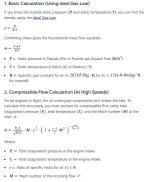
-- AMF can be calculated by Ideal Gas Law Formula or Isentropic Compressible Flow formula.​
-- Then Thrust by F = M.a = M.(V~exit - V~inlet), assuming this acceleration is constant.​
air mass flow.jpg
- let's consider thrust loss due to installation + less density to be 20%.​
- Engines can produce much higher than quoted baseline uninstalled thrust, like 50% more, but flat-rated or limited to prevent damage.​
- Core temp, TET, vibration, etc are metrics to monitor & limit the thrust by FADEC.​
- So if engines are flat-rated to ISA+15C then remaining thrust loss due 15C gap remains uncompensated.​
- When a jet releases brakes & pushes to AB wet thrust for takeoff then -​
-- theoretically dry thrust gets lower by 20% but aux intakes or bigger intake can compensate some loss of thrust, IDK exactly how much.​
-- Su-57 seems to have mesh grills below & side of intakes.​
1782198556665.png
-- extra fuel in AB also compensates the loss of wet thrust needed for t/o, again IDK how much.​
-- if intake + AB fully compensates the thrust loss then ok, otherwise the jet rolls with reduced thrust.​
-- Without aux/bigger intakes or AB compensation, when jet reaches rotation/takeoff velocity, volume/second increases, compensating loss of thrust due to RAM EFFECT.
Mass/sec = volume/sec X density​
= 0.8/0/8 X volume/sec X density​
= (0.8 X density) X (1.25 X volume/sec)​
= (0.8 X density) X (1.25 X Area X length)​
= (0.8 X density) X (1.25 X Area X velocity/sec)​
= (0.8 X density) X Area X (1.25 X velocity/sec)​
-- When takeoff velocity is increased to 1.25x than at ISA, then it fully compensates loss of thrust.
- Lower air density cause loss of lift also but A/c design & 1.25x t/o velocity need to restore the lift by extra control surfaces, larger wing, etc.
- Military runways are 2.5-3 Kms long.​
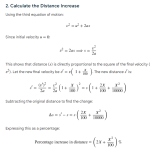
- with 20% decrease in thrust, Takeoff distance increases by 1.5625 times or 56.25%.
1782198820875.png

- Assuming at ISA, Su-57 with Iz-77 would push "installed" wet thrust 0.95 X 157 X 2 = 298.3 KN. Then -​
-- wet T/MTOW = 298.3/9.8 /35 = 0.87,​
-- with 10.3 tons internal fuel + 4x 190 Kg R-77M + 2x 10⁵ Kg R-74M2, AA-STOW (Air-Air Stealth Take Off Weight) = 29.27 tons, wet T/STOW = 298.3/9.8 /29.27 = 1.04​
- Comparing with F-22 at ISA, "installed" thrust of 0.95 X 156 X 2 = 296.4 KN, then -​
-- wet T/MTOW = 296.4/9.8 /38 = 0.79​
-- with 8.2 tons internal fuel + 6x 162 kg AIM-120 + 2x 85 Kg AIM-9X, AA-STOW = 29.04 tons, wet T/STOW = 296.4/9.8 /29.04 = 1.04​

- Both jets config look equal at ISA with AA-STOW. But if Su-57 has higher lift then its T/o distance will be shorter.​
- Google search says that under ideal conditions F-22 with MTOW can t/o in 500m & Su-57 in 350-400m.​
- On YT videos, F-22 with 2 EFTs have been seen to t/o in 8-10 sec, for example at RAF Lakenheath, quite near ISA conditions. So Su-57 with 2 EFTs at identical airfield could do it slightly better if more lift.
Coefficient of friction for rolling tyre & runway = 0.03​
Assumed Drag coefficient Cd = 0.035​
Assumed cross section area = 5m2​
Air density at ISA = 1.225 Kg/m3​
Assumed T/o V=165 knots = 85 m/s, U = 0​
Equation : Thrust - ground friction force - air drag-force = M.a​
T- u.M.g - 1/2 p.v^2.Cd.A = M.a​
312 KN - (0.03*38,000*9.8) - (0.5*1.225*85^2*0.035*5) = 38*a​
38,000.a = 312,000 - 11,172 - 774.43​
a = 7.9 m/s/s in ISA.​
t = V/a = 10.76 seconds in ISA.​
S = 1/2 at^2 = 457.32 m in ISA.​
- So if no thrust loss compensation by intakes, spools RPM, AB then in 20% less dense air -​
-- F-22 could t/o with MTOW in 1.5625*457 = 714.5m​
-- Su-57 with Iz-177 engines could t/o with MTOW within 1.5625*400 = 625m.
- But if loss compensation is there then T/o distance will reduce, probably around ISA distance.​
This is good news for @Rajput Lion & other Su-57 lovers to celebrate & party.🥳😂


> Su-57 has R-100/KS-172 LR-AAM with 300-400 Kms range.
- it has to be carried externally. Even if stealthy Su-57s are kept in front & those with R-100 few 10s of Kms behind, that distance & hence range benefit is deducted & unstealthy pylons & AAMs'll still endanger the jet.​
- R-37M with folding fins also has 300-400 Kms range & better option.​
- Recently tested AIM-260 JATM is expected to have 200-300 Kms range, will be armed to many western jets including its possible export variant.​
- No matter how much AAM range is increased, A/c RCS + radar efficiency will decide detection, locking & breaking the lock.​

> Su-57 data-link with S-400, which F-22 doesn't.
- Link-16 issues have been solved.​
- Option of indirect linking also there via high altitude flying A/c (project Hydra).​

> Inadequately curved intake duct & exposed fan blades in YF-23, X-32, Su-57, dependent totally on RF blocker & YF-23 said to be more stealthy than F-22.
- In 1990s documentaries this point should have been raised & clarified to public.​
But then this means that RAM, RAS, EW, blocker, etc made by different companies & countries obviously have different efficiency.​
- F-22's intake gaping hole leads to S-duct with RAM lining & RF blocker.​
- Ultimately it is the RCS value. In every product domain lagging companies have excuses.​
- Mig-29, Yak-130 can close main intakes due to aux intakes to avoid FOD (Foreign Object Debris) damage at low speeds, but they're 4gen, so no geometry, RAM, RAS.​

> RCS Vs physical CS.
- RCS can be more than physical CS, that's why the new term RCS, otherwise PCS would've sufficed.​
- Curved, bent surfaces, gaps, bumps amplify the RCS.​
- It depends also on wavelength/frequency as per back-scaterring formula 4.pi.A^2/wavelength^2​

> What about previous gen smaller jets with smaller RCS detecting bigger jets 1st with bigger RCS?
- it depends on source radar efficiency + target's RCS return, not just range & size.​
- Radars have power, gain, resolution, noise filtering, etc. Compared to today, early Radars were poor to average. Basically more power means more range.​
- So in every gen's era, RCS was relevant & engineers, pilots talked about it while making radar, planning combat plan - which jet would see & launch 1st.​
- There're countless videos, articles, not all can be covered, we can miss the particular concern. if media doesn't cover some tech aspect doesn't mean it's not a tech concern.​

> Modern/future military avionics Vs best consumer electronics.
- these 2 cannot be compared at all based on just clock frequency, # of cores, cache memory, RAM, memory lanes, etc.​
- There're efficiency difference of code, connection topologies, S/w protocols, etc.​
- 5/6gen avionics are even beyond civilian industrial rack servers.​
- Only technically qualified &/or experienced people understand architectural differences & effect on performance.​
 
  • Informative
Reactions: Photon Vish
Ok. We shall see my friend👍
See that is the fundamental issue im pointing out. Im not here for a bet.

We are outsiders trying to make judgments based on the available information and our intuition of how the system works. I provided you with my reasoning, supported by evidence from the system and the external climate, on why I am saying the Su-57 has no chance. When these things change i will also change my assumptions.
 
  • Like
Reactions: Rajput Lion
See that is the fundamental issue im pointing out. Im not here for a bet.

We are outsiders trying to make judgments based on the available information and our intuition of how the system works. I provided you with my reasoning, supported by evidence from the system and the external climate, on why I am saying the Su-57 has no chance. When these things change i will also change my assumptions.

The way our planners are, one pic of a PAF training pilot inside J35 on a taxiway and we will see things.

But I agree HAL and UAC talking is not a concrete signal. HAL and UAC are talking about Il114 and SSJ. I am sure no Indian airline would order anything which cannot fly over European skies. So they can do all the collaboration they want, but that doesn't mean much unless there is an intent in IAF and MoD. And right now it seems they want to unblock the Mk1A and get a decent deal on Rafale.
 
  • Like
Reactions: Ashwin
-----The Su-57 has an internal fuel capacity of 9,700 kg, greater than every in-service fighter except the Su-35 and MiG-31, and it employs a central lift structure, which yields a superior range. The claim that the Su-57’s range advantage when carrying carried externally“will also be offset” lacks basic common sense—a reduced advantage is still an advantage.​


-----When the F-22 was first designed, its data link had only a receive function and lacked a transmit function. This was because the design originally conceived an "unrealistic" scenario: relying on its stealthy shape, with radar turned off and under radio silence, it would launch a sudden surprise attack. However, reality has proven this concept completely unworkable. Whether over the East China Sea, Syria, or the Bering Strait, modern integrated air defense systems, as well as the L-band radar or infrared detection systems carried by Su-35S fighters, can all detect the supposedly “absolutely silent” F-22.This type of combat relies entirely on friendly forces, especially the support of AWACS in an era filled with R-37 long-range air-to-air missiles., Over its 20 years of service, its stealth “myth” has long been shattered. Therefore, maintaining a one-way data link had become utterly meaningless—it effectively turned the F-22 into a blind man who thinks others cannot see him. Since it had shut down its radar according to its tactical concept and lacked an IRST, it could not even independently perceive that it had already been encircled. So they had no choice but to abandon the full radio-silence strategy and instead install a two-way data link, using it like an ordinary aircraft. This change is, in essence, a complete repudiation of the F-22’s stealth design philosophy and combat methodology. As a pioneer, it is bound to reveal various flaws, making it difficult to capitalize on the “first-mover advantage,” and instead turning that into a weakness for competitors to surpass—an unavoidable reality for any type of industrial product. In particular, the lack of an IRST renders it an absolute blind man when facing opposing fifth-generation fighters that also possess stealth capabilities, not to mention that the Su-57 is additionally equipped with an L-band radar.And the F-22's externally mounted IRST, just as some people say, would "offset its RCS advantage," "increase drag," and "reduce range"—these drawbacks are further magnified by its inefficient aerodynamics resulting from excessive compromises for stealth, its inefficient S-shaped intakes, and its relatively small internal fuel capacity.


-----The greater the intake curvature, the lower the intake efficiency, which further reduces supersonic cruise speed, acceleration capability, and range. Even the so-called YF-23, widely acknowledged by the U.S. military as superior to the F-22, also has visible engine blades. RCS involves strict testing methods and specialized equipment, and is not something that internet users can understand merely through photos and appearance — for example, the YF-23 with exposed engine blades actually has a better RCS than the F-22 without exposed engine blades.​


-----Stealth technology involves subtraction from the physical RCS, not addition. Therefore, masking the intakes on a MiG-29 or Yak-130 will inevitably produce stronger intake reflections than an S-duct obscuration or a radar blocker for the engine face. In reality, because a missile has a streamlined shape, its RCS, even without special design, will already be lower than its frontal cross-sectional projection area. Thus, a 0.51 m diameter (frontal area of 0.2 m²)cannot Externally mounted missiles increase the RCS1~5m² by "certain individuals"—after all, nobody would design a missile to act as a Lüneburg lens. — This is basic dialectical logic.​


-----The frontal RCS of the F-4 is 5 to 7 times that of the MiG-21, yet nobody cares about the MiG-21’s RCS advantage.​
The frontal RCS of the F-16 is significantly smaller than that of the F-15 by a factor of about 3, and nobody cares about the F-16’s RCS advantage.​
Yet everyone obsesses over the so-called gap between 0.5 and 0.3 when comparing the Su-57 to the F-22. That itself reveals the public’s lack of common sense​
—this is also basic dialectical logic. Most people are completely unaware of the fourth-power relationship between RCS and radar detection range, mechanically imagining "huge multiples" and taking the "obvious" advantage for granted. But in the world of mathematics and physics, when it serves as the numerator, the closer the RCS gets to “1 square meter” or even drops below “1 square meter,” the smaller the actual benefit becomes. Ultimately, this comes at the expense of aerodynamic performance and internal fuselage space in the pursuit of overall capability.​


-----Electronic computers, whether used in an aircraft or in a game console, are evaluated by the same metrics: clock frequency, core count, cache, memory, memory channels, and read/write speed. An aviation computer is not something detached from the electronics industry. The development process of a fighter takes up to 20 years, and its service life exceeds 40 years, while electronic products essentially follow Moore’s Law: every 18 months, integrated circuit system performance doubles. Military/aviation computers can never keep up with the pace of mainstream commercial electronic computers. By now, computers capable of running weapon systems present no technical threshold whatsoever and are readily obtainable, while the number of professionals graduating from academies or "retiring" from various companies each year is also growing exponentially. This means that, both in terms of hardware and technical support, for any country, developing avionics no longer poses a technological barrier or challenge compared to manufacturing TNT or ejection seats.For a fighter jet, the model of its onboard computer is nothing more than like the clothes a person wears every day — just spend some money and it can be swapped out.​
 
Last edited:
  • Agree
Reactions: Kiduva21
AMCA needs to be built on the Kaveri Derivative Engine.
Different size, length and diameter both. So its can not fit at all.

Engine is the only issue. May be they have multiple prototypes because they may have thought already if not any western engine then Russian or some other alternative. It's a big project and you can't miss any chance.
While the ge414 gets produced we need atleast two squadrons of AMCA powered by RD-33.

I don't know if RD33 will be eligible for stealth aircraft. Too much acoustics both in dB, and also electronic and thermal. Infact why even go for GE414, I don't understand the concept of installing a 4th gen engine to 5th gen stealth fighter.

A stealth fighter needs a stealth engine.


And France is not as independent as people think, and France as a state and its population as well as EU is very anti-Russia.

Yes there could be some parts which are prone to CAATSA vulnerability
 
  • Like
Reactions: Rajput Lion
-----The Su-57 has an internal fuel capacity of 9,700 kg, greater than every in-service fighter except the Su-35 and MiG-31, and it employs a central lift structure, which yields a superior range. The claim that the Su-57’s range advantage when carrying carried externally“will also be offset” lacks basic common sense—a reduced advantage is still an advantage.​
Not trying to argue, but then why is J20 stated to have greater range?
-----When the F-22 was first designed, its data link had only a receive function and lacked a transmit function. This was because the design originally conceived an "unrealistic" scenario: relying on its stealthy shape, with radar turned off and under radio silence, it would launch a sudden surprise attack. However, reality has proven this concept completely unworkable. Whether over the East China Sea, Syria, or the Bering Strait, modern integrated air defense systems, as well as the L-band radar or infrared detection systems carried by Su-35S fighters, can all detect the supposedly “absolutely silent” F-22.This type of combat relies entirely on friendly forces, especially the support of AWACS in an era filled with R-37 long-range air-to-air missiles., Over its 20 years of service, its stealth “myth” has long been shattered. Therefore, maintaining a one-way data link had become utterly meaningless—it effectively turned the F-22 into a blind man who thinks others cannot see him. Since it had shut down its radar according to its tactical concept and lacked an IRST, it could not even independently perceive that it had already been encircled. So they had no choice but to abandon the full radio-silence strategy and instead install a two-way data link, using it like an ordinary aircraft. This change is, in essence, a complete repudiation of the F-22’s stealth design philosophy and combat methodology. As a pioneer, it is bound to reveal various flaws, making it difficult to capitalize on the “first-mover advantage,” and instead turning that into a weakness for competitors to surpass—an unavoidable reality for any type of industrial product. In particular, the lack of an IRST renders it an absolute blind man when facing opposing fifth-generation fighters that also possess stealth capabilities, not to mention that the Su-57 is additionally equipped with an L-band radar.And the F-22's externally mounted IRST, just as some people say, would "offset its RCS advantage," "increase drag," and "reduce range"—these drawbacks are further magnified by its inefficient aerodynamics resulting from excessive compromises for stealth, its inefficient S-shaped intakes, and its relatively small internal fuel capacity.


-----The greater the intake curvature, the lower the intake efficiency, which further reduces supersonic cruise speed, acceleration capability, and range. Even the so-called YF-23, widely acknowledged by the U.S. military as superior to the F-22, also has visible engine blades. RCS involves strict testing methods and specialized equipment, and is not something that internet users can understand merely through photos and appearance — for example, the YF-23 with exposed engine blades actually has a better RCS than the F-22 without exposed engine blades.​


-----Stealth technology involves subtraction from the physical RCS, not addition. Therefore, masking the intakes on a MiG-29 or Yak-130 will inevitably produce stronger intake reflections than an S-duct obscuration or a radar blocker for the engine face. In reality, because a missile has a streamlined shape, its RCS, even without special design, will already be lower than its frontal cross-sectional projection area. Thus, a 0.51 m diameter (frontal area of 0.2 m²)cannot Externally mounted missiles increase the RCS1~5m² by "certain individuals"—after all, nobody would design a missile to act as a Lüneburg lens. — This is basic dialectical logic.​


-----The frontal RCS of the F-4 is 5 to 7 times that of the MiG-21, yet nobody cares about the MiG-21’s RCS advantage.​
The frontal RCS of the F-16 is significantly smaller than that of the F-15 by a factor of about 3, and nobody cares about the F-16’s RCS advantage.​
Yet everyone obsesses over the so-called gap between 0.5 and 0.3 when comparing the Su-57 to the F-22. That itself reveals the public’s lack of common sense​
—this is also basic dialectical logic. Most people are completely unaware of the fourth-power relationship between RCS and radar detection range, mechanically imagining "huge multiples" and taking the "obvious" advantage for granted. But in the world of mathematics and physics, when it serves as the numerator, the closer the RCS gets to “1 square meter” or even drops below “1 square meter,” the smaller the actual benefit becomes. Ultimately, this comes at the expense of aerodynamic performance and internal fuselage space in the pursuit of overall capability.​


-----Electronic computers, whether used in an aircraft or in a game console, are evaluated by the same metrics: clock frequency, core count, cache, memory, memory channels, and read/write speed. An aviation computer is not something detached from the electronics industry. The development process of a fighter takes up to 20 years, and its service life exceeds 40 years, while electronic products essentially follow Moore’s Law: every 18 months, integrated circuit system performance doubles. Military/aviation computers can never keep up with the pace of mainstream commercial electronic computers. By now, computers capable of running weapon systems present no technical threshold whatsoever and are readily obtainable, while the number of professionals graduating from academies or "retiring" from various companies each year is also growing exponentially. This means that, both in terms of hardware and technical support, for any country, developing avionics no longer poses a technological barrier or challenge compared to manufacturing TNT or ejection seats.For a fighter jet, the model of its onboard computer is nothing more than like the clothes a person wears every day — just spend some money and it can be swapped out.​
very well articulated analysis, just hope more western fanboys could accept this reality instead of the constant Russia bashing and ragebait comments you see online.
 
Nope, DefSec made a general statement about F-35/Su-57 and specifically said there is no formal consultation going on.

Why would he accept anything and invite sanctions threats

-- extra fuel in AB also compensates the loss of wet thrust needed for t/o, again IDK how much.-- if intake + AB fully compensates the thrust loss then ok, otherwise the jet rolls with reduced thrust.-- Without aux/bigger intakes or AB compensation, when jet reaches rotation/takeoff velocity, volume/second increases, compensating loss of thrust due to RAM EFFECT. Mass/sec = volume/sec X density= 0.8/0/8 X volume/sec X density= (0.8 X density) X (1.25 X volume/sec)= (0.8 X density) X (1.25 X Area X length)= (0.8 X density) X (1.25 X Area X velocity/sec)= (0.8 X density) X Area X (1.25 X velocity/sec)-- When takeoff velocity is increased to 1.25x than at ISA, then it fully compensates loss of thrust.- Lower air density cause loss of lift also but A/c design & 1.25x t/o velocity need to restore the lift by extra control surfaces, larger wing, etc.- Military runways are 2.5-3 Kms long.- with 20% decrease in thrust, Takeoff distance increases by 1.5625 times or 56.25%.

In a nut shell Russians use aerodynamics rather than thermodynamics to compensate the thrust.
 
Not trying to argue, but then why is J20 stated to have greater range?
This actually originates from the psychological compensation mechanism. Most people in military enthusiast circles play video games, so they have a tendency to forcibly bundle together aircraft developed in different eras and by different countries, mechanically grouping them into the "same tier." Since video games themselves need to consider various aspects of "balance," the side with inferior maneuverability is compensated with correspondingly stronger performance in another area. As a result, this way of thinking is deeply ingrained.
Specifically, when discussing the J-20, F-22 and Su-57, people cannot help but unconsciously project this mentality onto them, "taking it for granted that the J-20, F-22 and Su-57 belong to the same tier, or at least tiers that are not far apart."

Consequently, given that every visible hard mechanical performance indicator visibly lags behind the F-22 and Su-57, netizens very readily accept the "compensatory mechanism" that "the J-20 carries longer-range missiles."
In fact, in the eyes of many older-generation Chinese military enthusiasts, the J-20’s actual air combat capability falls short of the Su-35S—with an even wider gap in anti-ship and air-to-ground roles—yet these individuals are often branded as spies or heretics within the Chinese online community.


very well articulated analysis, just hope more western fanboys could accept this reality instead of the constant Russia bashing and ragebait comments you see online.
When I was little, I was also a fan of the West and an F-22 enthusiast. Back then, it wasn't called the "Raptor" yet — the books all said it was called the "Super Star."
 
Last edited:
Izd 177 is meant for heavy weight aircrafts like Su57, its like 25% longer, 44% wider, 30% heavier and produced like 70-80% more thrust than GE414, even if we completely redesign the AMCA, I'm not sure about it being able to house the engine,

That means AMCA Mk2 will have bigger engines. So you have a chance there. Mk1 will be just like initial basic stealth aircraft. Real game changer will be the Mk2.
 
That means AMCA Mk2 will have bigger engines. So you have a chance there. Mk1 will be just like initial basic stealth aircraft. Real game changer will be the Mk2.
LMAo what? no the AMCA mk2 wont be able to handle the 117 lol. It would need redesigning the entire aircraft. the AMCA mk2 is just a drastic upgrade over the mk1 to try and get it as close to 6th gen as physically possible in a 5th gen airframe. Its still going to maintain the same performance while being slightly bigger.
 
  • Like
Reactions: Rajput Lion