This gives an overview of block ll, but I know there is other stuff, so that must be classified, The block lll will make you cry
This is one of the reasons, I said the Super Hornet is better than the Rafale
View attachment 49976
A1-F18EA-NFM-000
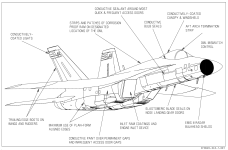
Figure 1-3. Radar Cross Section (RCS) Reduction1.1.4 Radar Cross Section (RCS) Reduction. RCS reduction is a significant feature of the F/A18E/F. While the maintenance community is tasked with maintaining the RCS features of the aircraft,it is in the best interests of the aircrew community to take an active role to ensure the survivabilitycharacteristics of the aircraft are retained.
RCS reduction is accomplished through numerous airframe design features. See figure 1-3. Thebaseline feature is planform alignment of as many surface edges as feasible. The outer moldline of theaircraft is treated to make it a smooth, conductive surface in order to reduce radar scattering.Treatment entails metalizing the navigation lights, canopy, and windshield.
Permanent joints andgaps around infrequently opened panels are filled with a form-in-place (FIP) sealant, which is blendedflush and conductively painted. Gaps around frequently opened panels are filled with a conductive FIP(CFIP) sealant, which allows for easier repair. Conductive tape is applied to a few gaps where there isno substructure to support FIP material, such as along LEX edges. Conductive tape can also be usedto quickly repair damaged FIP joints.
Since CFIP in the gaps around frequently opened panels will experience the most wear and tear, acorrosion-proof radar absorbing material (RAM) is applied in front of many of these gaps. RAM is alsoapplied (1) on the inlet lip and duct, (2) as diamond-shaped patches around drain holes, and (3) invarious locations that tend to highly scatter radar energy such as around pitot tubes, vertical tailopenings, vents and screens, flap hinges and fairings, and portions of the pylons and external tanks. Amulti-layer RAM is used in a few locations, such as around AOA probes and on the top, front surfaceof the pylons.
\Gaps around landing gear doors are treated in two ways. Nose landing gear doors use flexibleconductive blade seals on leading and trailing edges; main landing gear door edges are wrapped withRAM. Scattering from trailing edges (i.e., trailing edge flaps and rudders) is controlled by a radarabsorbing boot which is bonded to the surface.
Scattering from the back edge of the windshield iscontrolled by a gray, laminated material called the aft arch termination strip.The engine inlet ducts incorporate a device to minimize engine front face scattering. The edge of thecanopy incorporates a conductive bulb seal to block radar reflections from that joint. Conductive bulbseals are also used where there is significant structural flexure, such as at the wing-to-LEX interface.
Eleven electro magnetic interference shields (EMIS) III radar shields are permanently installed onthe radar antenna hardware. To allow the aircraft to achieve its full RCS reduction potential, amissionized kit consisting of twelve more EMIS III radar bulkhead shields, are installed for combatmissions only. Additionally, SUU-79 pylons can be fitted with a set of low observable (LO) hardware.



 theaviationgeekclub.com




 & 6gen deal is
 & someone please list point-wise characteristics of UNDEFINED 7gen
 , better open a new thread for it.