
Nuclear Energy in India : Updates
- Thread starter Himanshu
- Start date
You are using an out of date browser. It may not display this or other websites correctly.
You should upgrade or use an alternative browser.
You should upgrade or use an alternative browser.


31 to 33 % efficiency for a Submarine PWR is way to optimistic..... More like 15 to 27 % max.CLWR-B1 is 83 MWth while CLWR-B2 is 190 or 200 MWth.
Using a nominal 31-33% efficiency rate, that translates into 26-27 MWe for B1 and 59-66 MWe for B2 (let's round that off to ~25 MWe & ~60 MWe)
Addressed this article long time ago on the forum:
Indian Nuclear Attack Submarine (Project 77) - Updates & Discussions
This part of @Parthu's recent article stuck with me: So, I made a chart of power to weight ratios of all IN subs (present & future): Figures marked with a Tilda (~) are my guesstimates. Don't take those numbers literally. You are right P77 should enjoy a major advantage, even if we were to...www.strategicfront.org
And on X:
Basically, the writer made a mistake & the paper's editor didn't know any better to check feasibility.

Nowhere in that article he is saying India is abandoning thorium. Clickbait headline. He is just unhappy with the delays in AHWR programme. But, without the second stage going operational why would they go for third stage? Just a hunch but probably he is a bit unhappy cuz ANEEL got rejected by BARC.
Last edited:


People who haven't even read the bill blurting out nonsense as usual.
If you have the guts, go ahead and bid for the tender to build SMRs rather than crying on X.

Modi ko bus phone lagane he ja raha ruko abhi banata SMRPeople who haven't even read the bill blurting out nonsense as usual.
If you have the guts, go ahead and bid for the tender to build SMRs rather than crying on X.
Whats wrong with it? On one hand we cry over the speed of sloth at which govt departments has been functioning since independence while we cry when govt is delegating the task to private players who can make it a timely work for the right price.
Both BSNL and Thorium exploration are very poor examples for anti-privatisation argument.
Even if you dismantle jio today or govt takeovers jio... Jio will be run into ground in a decade. Left battered and tattered by the holier than thou babus and general public would pay for it.
I do not know which alternate dimension these BSNL supporters lived in to be wanting to go back to "BSNL" days. 90% of them would be rendered unemployed due to inability in operating SM efficiently. BSNL has been put to good use as the D-day backup and filling in the gaps where profit centric pvt operators are slow to act. It also gives BSNL and India much needed cover to adopt indigineous approach without affecting the access to services. ( BSNL indigineous tech stack and 30k+ towers for rural areas is one example).
Same for resource exploration.. leave thorium.. there's no dearth of victims, eyewitness, documentary, books, official records of the rampant thugery of mafia, goons, bahubalis and local politicians when it came to exploration and mining. And I have no doubt that despite the modernization, much of the dark underbelly of this sector is still plauged by the worst of humanity.
Lmao! I noticed that too. I bet he just saw the headline and couldn't help but post it to soothe his narrative.Nowhere in that article he is saying India is abandoning thorium. Clickbait headline. He is just unhappy with the delays in AHWR programme. But, without the second stage going operational why would they go for third stage? Just a hunch but probably he is a bit unhappy cuz ANEEL got rejected by BARC.
For once I too was perplexed if GOI really gave up on thorium but then I read the article and found it to be an interview highlighting the importance of thorium which is very much a part of India's nuclear energy policy.

Nuclear Fusion Startup Pranos Fusion Nets $6.8 Mn To Fast Track R&D & Commercialisation
24 Mar'26 | By Palak Sharma
Nuclear energy startup Pranos has raised $6.8 Mn (around ₹63 Cr) in its fresh funding round co-led by pi Ventures and Ankur Capital, along with participation from existing investor Industrial47, Groww cofounder Lalit Keshre, the founders of Razorpay, and Bhukhanwala Industries.
The Bengaluru-based startup is planning to deploy the freshly raised capital to strengthen its R&D, with a major focus on developing high-temperature superconducting (HTS) magnets.
The startup will also fuel the process of commissioning a Tokamak, with first delivery targeted for 2026. Additionally, it will deploy a chunk of the capital to expand its team and build its testing facilities.

For context, a Tokamak is generally a reactor that uses powerful magnetic fields to contain hot plasma, keeping it from touching the walls and enabling atoms to fuse and release energy. In short, it is a device that facilitates the formation of nuclear fusion energy.
Founded in 2024 by JNCASR’s PhD Shaurya Kaushal and ex-REConnect Energy principal engineer Roshan George, Pranos Fusion is a Bengaluru-based deeptech startup developing nuclear fusion technology using magnetic confinement to produce clean, nuclear energy.
The startup was incubated at the Jawaharlal Nehru Centre for Advanced Scientific Research (DST) and the Institute for Plasma Research (DAE). It also claims to have associations with ITER (International Thermonuclear Experimental Reactor).
"The reason we’re raising fresh funds now is that Pranos is at the same starting point as global players. If we delay hardware development, we risk falling behind and entering the market as followers,” Kaushal told Inc42.
Inside Pranos’ Stack
With ambition net-zero targets, increasing climate sensitivity and a growing need for energy, harnessing nuclear fusion energy can perhaps serve as a key step to address a plethora of bottlenecks in the energy sector.In nuclear energy, fusion reaction refers to generating power by combining (fusing) small atomic nuclei together, releasing a huge amount of energy. These light atoms are usually forms of hydrogen. These atoms are heated to millions of degrees, ultimately turning it into hot plasma.
While Tokanak acts as a vessel for this plasma, superconducting magnets are installed outside it to control the plasma inside. In this state of high temperature, the nuclei move at very high speeds, increasing the likelihood of collisions. When the nuclei fuse into a heavier atom, a small amount of mass is converted into a large amount of energy. This energy is known as fusion energy.
This entire process requires a lot of components, out of which three of the following are being taken care of by Pranos via their below mentioned offerings.
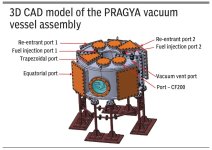
PRAGYA : It is a low-aspect-ratio, medium-scale testing Tokamak, which allows companies to test their technologies. Notably, it is not suitable for actual fusion.
JENGA : It is a software which bridges the gap between Tokamak concept and machine. It manages the design and control aspects of a tokamak.
MAGGA Magnetic Gain : Pranos is also building its own superconducting magnets. Currently, these magnets are in the R&D phase.
“We’re looking at a pilot-stage rollout of JENGA next year once we finish the prototyping. I think Jenga will see pilot level integration the fastest,” Kaushal added.
Pranos, which has partnered with third party manufacturers across Bengaluru, Pune and Chennai for its production, is looking to onboard fusion energy startups as its customers in the future. The startup is collaborating with a few such companies based out of Europe. However, these collaborations are not paid.
Notably, no company is currently generating commercial, usable electricity from fusion reactions. Several reports claim that while fusion reactions have been achieved in labs, there hasn’t been continuous power generation till date.
Startups like Helion Energy (backed by Sam Altman) and Commonwealth Fusion Systems (Backed by Bill Gates) have produced short bursts of fusion reactions, but there is no sign of commercialisation yet. In India, startups like Anubal are working towards nuclear fusion technology.

Pranos Nets $6.8 Mn To Build Tokamak, Superconducting Magnets For Nuclear Fusion
Nuclear energy startup Pranos has raised $6.8 Mn in its fresh funding round co-led by pi Ventures and Ankur Capital
inc42.com
=====
PRAGYA tokamak:


FINALLY. 16 years of delay. phase 2 is now finally active, sincerely hope that now that India has significant amounts of cash for capital expense the AHWR and other phase 3 stuff dont face as much delay

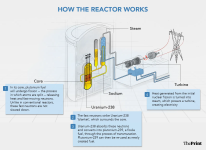
hmm? there should also be a thorium blanket no since this is the reactor where india is going to validate th-u233 conversion capability.
hmm? there should also be a thorium blanket no since this is the reactor where india is going to validate th-u233 conversion capability.
No, Th-232 blanket is for Stage-III AHWR.
Stage-II will use U-238 blanket, as the graphic shows.
"Unlike conventional thermal reactors, the PFBR uses Uranium-Plutonium Mixed Oxide (MOX) fuel. It is surrounded by a blanket of Uranium-238, which, through neutron absorption, is converted into fissile Plutonium-239. This enables the reactor to generate more fuel than it consumes."
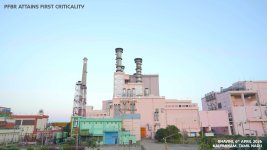
Inside prototype fast breeder reactor

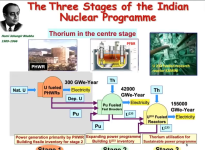
My notes for a refresher:
Three-stage Civilian Program
Stage I (PHWR)
Pressurized Heavy Water Reactor- IPHWR-700 - Indian PHWR 700MWe Reactor
- Generation III+
- Variants: IPHWR-220 and IPHWR-540
- Natural uranium --> 98.2% U-238 + 0.8% U-235
- U-235 is fissile, U-238 is not directly fissile
- INFO: Light Water Reactors (LWR) requires reactor grade fuel
- U-235 enrichment process
- Convert to gaseous state with uranium hexafluoride
- Put in a centrifuge @ 10000s RPM to separate isotopes
- U-235 enrichment levels
- Reactor grade = 3 to 5%
- Weapons grade (HEU) = 90% +
- U-235 enrichment process
- PHWR Nuclear Reaction
- PHWRs can use Natural uranium directly as fuel
- U-235 undergoes fission to produce nuclear energy
- U-238 undergoes neutron capture to produce Pu-239
- Pu-239 is fissile (and can also be used for weapons)
- Takes ~1yr to generate usable quantities
- Outputs
- Nuclear energy from U235
- Pu-239 from U-238
- U-238 (depleted)
Stage II (FBR)
Fast Breeder Reactor
- PFBR - 500MWe Prototype FBR
- CFBR - 600MWe Commercial FBR aka FBR-600
Step A
- Fuel = Byproducts from Stage I = U-238 (depleted) + Pu-239
- Pu-239 undergoes fission to produce nuclear energy
- U-238 (depleted) undergoes neutron capture to produce Pu-239
- Reaction breeds Pu-239
- Doubling time: ~5 yrs (optimistic; likely 10yrs)
- Outputs
- Nuclear energy from Pu-239
- Pu-239 from U238 (depleted)
Step B
- Introduce Th-232 to the reactor
- Th-232 undergoes neutron capture to produce U-233
- U-233 is fissile
- Takes ~1yr to generate usable quantities
- Outputs
- Nuclear energy from Pu-239
- Pu-239 from U-238 (depleted)
- U-233 from Th-232
Stage III (AHWR)
Advanced Heavy Water Reactor- Fuel = Th-232 + U-233 (from Stage II)
- U-233 undergoes fission to produce nuclear energy
- Th-232 undergoes neutron capture to produce U-233
- Reaction breeds U-233
- Doubling time: ~5 yrs (very optimistic; possibly 70yrs)
- Outputs
- Nuclear energy from U-233
- U-233 from Th-232
ye
a step B was what i was talking about. Isnt one of the main reasons why the reactor got delayed for so long precisely because of the fact that they had to engineer the ability for th232-u233 conversion as well?My notes for a refresher:
Three-stage Civilian Program
View attachment 51006
Stage I (PHWR)
Pressurized Heavy Water Reactor
- IPHWR-700 - Indian PHWR 700MWe Reactor
- Generation III+
- Variants: IPHWR-220 and IPHWR-540
- Natural uranium --> 98.2% U-238 + 0.8% U-235
- U-235 is fissile, U-238 is not directly fissile
- INFO: Light Water Reactors (LWR) requires reactor grade fuel
- U-235 enrichment process
- Convert to gaseous state with uranium hexafluoride
- Put in a centrifuge @ 10000s RPM to separate isotopes
- U-235 enrichment levels
- Reactor grade = 3 to 5%
- Weapons grade (HEU) = 90% +
- PHWR Nuclear Reaction
- PHWRs can use Natural uranium directly as fuel
- U-235 undergoes fission to produce nuclear energy
- U-238 undergoes neutron capture to produce Pu-239
- Pu-239 is fissile (and can also be used for weapons)
- Takes ~1yr to generate usable quantities
- Outputs
- Nuclear energy from U235
- Pu-239 from U-238
- U-238 (depleted)
Stage II (FBR)
Fast Breeder Reactor
- PFBR - 500MWe Prototype FBR
- CFBR - 600MWe Commercial FBR aka FBR-600
Step A
- Fuel = Byproducts from Stage I = U-238 (depleted) + Pu-239
- Pu-239 undergoes fission to produce nuclear energy
- U-238 (depleted) undergoes neutron capture to produce Pu-239
- Reaction breeds Pu-239
- Doubling time: ~5 yrs (optimistic; likely 10yrs)
- Outputs
- Nuclear energy from Pu-239
- Pu-239 from U238 (depleted)
Step B
- Introduce Th-232 to the reactor
- Th-232 undergoes neutron capture to produce U-233
- U-233 is fissile
- Takes ~1yr to generate usable quantities
- Outputs
- Nuclear energy from Pu-239
- Pu-239 from U-238 (depleted)
- U-233 from Th-232
Stage III (AHWR)
Advanced Heavy Water Reactor
- Fuel = Th-232 + U-233 (from Stage II)
- U-233 undergoes fission to produce nuclear energy
- Th-232 undergoes neutron capture to produce U-233
- Reaction breeds U-233
- Doubling time: ~5 yrs (very optimistic; possibly 70yrs)
- Outputs
- Nuclear energy from U-233
- U-233 from Th-232
Its a core requirement -- the most important requirement for Phase 2 is to create sufficient U-233 to kickstrat Phase 3 -- only after that Phase 3 can become self sustaining.ye
a step B was what i was talking about. Isnt one of the main reasons why the reactor got delayed for so long precisely because of the fact that they had to engineer the ability for th232-u233 conversion as well?