

The CEO of CCTE that patented ANEEL fuel is of Indian origin - Mehul Shah. Here he speaks about it:
Nuclear Energy in India : Updates
- Thread starter Himanshu
- Start date
You are using an out of date browser. It may not display this or other websites correctly.
You should upgrade or use an alternative browser.
You should upgrade or use an alternative browser.


It looks like India is collaborating with France on SMR and AMR. India should consider setting up an SMR on Great Nicobar Island alongside the port development.2nd Meeting of India | Akashvani News
www.newsonair.gov.in

Government deliberating on questions of radioactive waste, private sector’s role in proposed nuclear bill
Deliberations on private sector involvement in nuclear plants in India, addressing waste management and core research concerns.Deliberations within the government continue on bringing in new legislation to allow the private sector to operate nuclear plants in India, with questions regarding management of nuclear waste and determining if private players can conduct core research into nuclear technologies still being ironed out.
Drafts of the proposed new bill were still being deliberated upon by an intergovernmental committee of experts as well as the Law Ministry though there was a “good chance” of it being introduced in the forthcoming Winter Session of Parliament, an official privy to the proceedings told The Hindu on condition of anonymity.
Currently, only the Nuclear Power Corporation of India Limited (NPCIL), Bhartiya Nabhikiya Vidyut Nigam Limited (BHAVINI) and NPCIL-NTPC joint venture Anushakti Vidhyut Nigam Limited (ASHVINI) can build and operate nuclear power plants in the country.
In February, however, Finance Minister Nirmala Sitharaman said in her Budget speech that the government intended to amend two Acts — the Atomic Energy Act and the Civil Liability for Nuclear Damage Act — to enable private companies, including foreign companies, to form partnerships, and build and operate nuclear plants in India.
Despite the Indo-U.S. nuclear deal of 2008 formally allowing sale of nuclear technologies to India, though with built-in periodic checks and scrutiny by the International Atomic Energy Agency, clauses in India’s Atomic Energy Act and the Civil Liability for Nuclear Damage Act (2010) have been impediments since they impose practically unlimited liability on foreign suppliers of nuclear equipment in case of an accident.
“The effort is to align India’s laws on liability with that of conventions such as the Convention on Supplementary Compensation for Nuclear Damage (CSC),” the official quoted above noted. “However, we also have to bring clarity on questions such as who will be responsible, whether it is the private sector or the government power plant operators, for safe disposal of nuclear waste as well as the re-processing of spent nuclear fuel. There is also discussion on enabling research and development of core nuclear technologies.”
The government’s thrust to encourage greater private sector participation is with the larger objective of installing 100 GW of nuclear capacity by 2047. This is premised not only on importing foreign reactors but also developing Bharat Small Reactors (BSRs) and exploring partnerships with the private sector. BSRs are 220 MW Pressurized Heavy Water Reactors (PHWRs). These reactors are being upgraded to reduce land requirements, making them suitable for deployment near industries such as steel, aluminium, and metals units, serving as captive power plants to aid in decarbonisation efforts.
The plan involves private entities providing land, cooling water, and capital, while the NPCIL handles design, quality assurance, and operation and maintenance. This initiative aligns with India’s commitment to achieving 500 GW of non-fossil fuel-based energy generation by 2030 and meeting 50% of its energy requirements from renewable energy by 2030.
In addition to BSRs, the Bhabha Atomic Research Centre (BARC) is developing Small Modular Reactors (SMRs) for repurposing retiring coal-based power plants and meeting power needs in remote locations. The Department of Atomic Energy (DAE) also plans to introduce new nuclear reactors, including high-temperature gas-cooled reactors for hydrogen co-generation and molten salt reactors aimed at utilising India’s abundant thorium resources.
Published - October 06, 2025 08:03 pm IST
Fuel loading at India's first fast-breeder reactor to begin next week
Fuel loading at India's first prototype fast-breeder reactor in Kalpakkam is expected to start next week, marking a significant step in the country's nuclear program.


India is building a 500 MWe reactor that’ll ‘breed’ more nuclear fuel that it’ll consume. How it works
Fuel-loading for Prototype Fast Breeder Reactor in TN's Kalpakkam began on 18 October. Officials expect it to achieve 1st criticality in 6 months, a step towards self-reliance in energy.
By Soumya Pillai
25 October 2025 04:31 pm IST
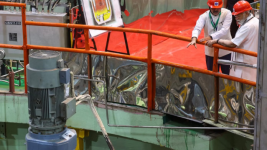
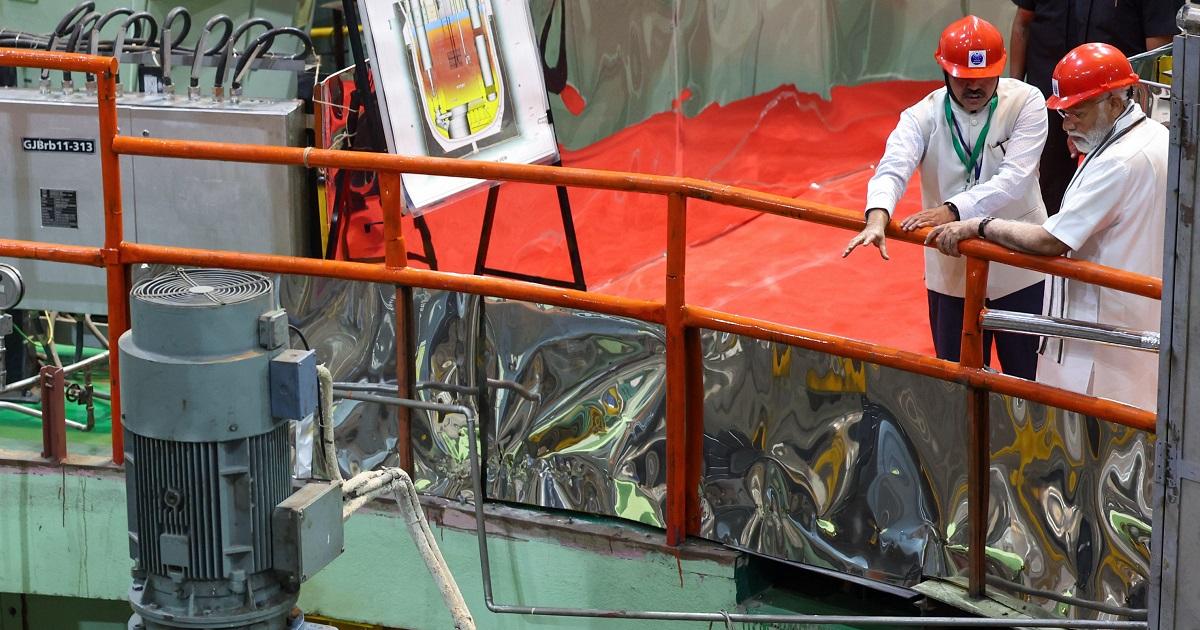
File photo of Prime Minister Modi visiting Kalpakkam in Tamil Nadu, where the nuclear reactor is being developed.
New Delhi: The 500 Mwe-Prototype Fast Breeder Reactor (PFBR) in Tamil Nadu’s Kalpakkam is expected to achieve first criticality within six months, marking a key step towards India’s energy independence.
With fuel-loading nearly complete, India is on track to become the second country after Russia to operate a fast breeder reactor.
The PFBR in Kalpakkam began receiving fuel on 18 October after the Atomic Energy Regulatory Board (AERB) granted permission this month.
Senior officials of the Department of Atomic Energy (DAE) told ThePrint the reactor will reach its first stage of criticality—a self-sustaining fission chain reaction at a controlled and constant rate—within six months. It is expected to be completed by 2026-end, nearly two decades after work on the nearly Rs 7,600-crore project began in 2004.
“This is a historic moment for India’s clean energy future. It is a leap in AI-powered, self-reliant nuclear tech,” said R.K. Singh, former scientist at DAE.
How is this technology different?
A fast breeder reactor generates or ‘breeds’ more nuclear fuel than it consumes, making the process highly energy efficient and substantially reducing radioactive waste.
In PFBR, plutonium, fast neutrons and liquid sodium facilitate conversion of Uranium-238 into fissile material. This fissile material—elements that can be used as fuel for nuclear reactions—can then be utilised again.
Unlike conventional nuclear reactors that use water, PFBR uses liquid sodium as a coolant because it doesn’t slow down ‘fast neutrons’ and can efficiently transfer heat generated.
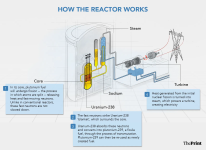
Infographic: Shruti Naithani | ThePrint
The thorium advantage
What also sets India’s PFBR apart will be its capability to eventually utilise thorium, a radioactive element abundantly available in the country.
The central government had said in a statement last year it aims to use thorium-232 as a ‘blanket’ around the core instead of uranium, reserves of which are limited.
The rest of the process to generate electricity will be similar, with thorium being used to create more fissile material, which can then be directed towards other nuclear reactors. In this manner, India will be able to re-use already spent nuclear fuel.
“By transmutation, thorium will create fissile uranium-233, which will be used as fuel in the third stage (of India’s nuclear programme). FBR (Fast breeding reactor) is thus a stepping stone… paving the way for the eventual full utilisation of India’s abundant thorium reserves,” the statement had said.
Earlier this year, Centre had launched the Nuclear Energy Mission for Viksit Bharat, which aims to scale India’s nuclear power capacity to 100GW by 2047. Currently, India’s capacity is just about 8.18 GW.
Development
Construction of PFBR began in 2004, but missed several operational deadlines.
DAE officials told ThePrint that unique challenges during the commissioning stage caused setbacks in the initial stages, including technical issues with using the sodium coolant, technology procurement problems and delays in budget sanctions.
“The problems were resolved, and now, work is advancing at a satisfactory pace,” an official said.
Safety and waste management
Officials said safety is paramount. PFBR incorporates passive safety features such as prompt and safe shutdown in case of an emergency and protection against sodium leak.
A major advantage of this reactor is its use of spent fuel, which would reduce the amount of waste generated and eliminate the need for separate land to dispose of radioactive material.
“Nuclear energy is the way forward and the world is working towards that direction. This reactor will be a major push towards self-reliance in India’s nuclear energy programme,” a DAE official said.
(Edited by Prerna Madan)
India is building a 500 MWe reactor that'll 'breed' more nuclear fuel that it'll consume. How it works
Fuel-loading for Prototype Fast Breeder Reactor in TN's Kalpakkam began on 18 October. Officials expect it to achieve 1st criticality in 6 months, a step towards self-reliance in energy.
By Soumya Pillai
25 October 2025 04:31 pm IST
File photo of Prime Minister Modi visiting Kalpakkam in Tamil Nadu, where the nuclear reactor is being developed.
New Delhi: The 500 Mwe-Prototype Fast Breeder Reactor (PFBR) in Tamil Nadu’s Kalpakkam is expected to achieve first criticality within six months, marking a key step towards India’s energy independence.
With fuel-loading nearly complete, India is on track to become the second country after Russia to operate a fast breeder reactor.
The PFBR in Kalpakkam began receiving fuel on 18 October after the Atomic Energy Regulatory Board (AERB) granted permission this month.
Senior officials of the Department of Atomic Energy (DAE) told ThePrint the reactor will reach its first stage of criticality—a self-sustaining fission chain reaction at a controlled and constant rate—within six months. It is expected to be completed by 2026-end, nearly two decades after work on the nearly Rs 7,600-crore project began in 2004.
“This is a historic moment for India’s clean energy future. It is a leap in AI-powered, self-reliant nuclear tech,” said R.K. Singh, former scientist at DAE.
How is this technology different?
A fast breeder reactor generates or ‘breeds’ more nuclear fuel than it consumes, making the process highly energy efficient and substantially reducing radioactive waste.
In PFBR, plutonium, fast neutrons and liquid sodium facilitate conversion of Uranium-238 into fissile material. This fissile material—elements that can be used as fuel for nuclear reactions—can then be utilised again.
Unlike conventional nuclear reactors that use water, PFBR uses liquid sodium as a coolant because it doesn’t slow down ‘fast neutrons’ and can efficiently transfer heat generated.
Infographic: Shruti Naithani | ThePrint
The thorium advantage
What also sets India’s PFBR apart will be its capability to eventually utilise thorium, a radioactive element abundantly available in the country.
The central government had said in a statement last year it aims to use thorium-232 as a ‘blanket’ around the core instead of uranium, reserves of which are limited.
The rest of the process to generate electricity will be similar, with thorium being used to create more fissile material, which can then be directed towards other nuclear reactors. In this manner, India will be able to re-use already spent nuclear fuel.
“By transmutation, thorium will create fissile uranium-233, which will be used as fuel in the third stage (of India’s nuclear programme). FBR (Fast breeding reactor) is thus a stepping stone… paving the way for the eventual full utilisation of India’s abundant thorium reserves,” the statement had said.
Earlier this year, Centre had launched the Nuclear Energy Mission for Viksit Bharat, which aims to scale India’s nuclear power capacity to 100GW by 2047. Currently, India’s capacity is just about 8.18 GW.
Development
Construction of PFBR began in 2004, but missed several operational deadlines.
DAE officials told ThePrint that unique challenges during the commissioning stage caused setbacks in the initial stages, including technical issues with using the sodium coolant, technology procurement problems and delays in budget sanctions.
“The problems were resolved, and now, work is advancing at a satisfactory pace,” an official said.
Safety and waste management
Officials said safety is paramount. PFBR incorporates passive safety features such as prompt and safe shutdown in case of an emergency and protection against sodium leak.
A major advantage of this reactor is its use of spent fuel, which would reduce the amount of waste generated and eliminate the need for separate land to dispose of radioactive material.
“Nuclear energy is the way forward and the world is working towards that direction. This reactor will be a major push towards self-reliance in India’s nuclear energy programme,” a DAE official said.
(Edited by Prerna Madan)
India is building a 500 MWe reactor that'll 'breed' more nuclear fuel that it'll consume. How it works
NFC successfully develops tech for production of high Residual Resistivity Ratio Niobium ingots
October 22 2025, 08:27 pm IST
HYDERABAD

AEC Chairman & Secretary, Department of Atomic Energy (DAE), Ajit Kumar Mohanty, inaugurating Átmanirbhar Bharat Gallery of NFC at the B.M. Birla Science Centre, in Hyderabad, on Wednesday.
The Nuclear Fuel Complex (NFC) has announced that it has successfully developed the critical technology for production of high Residual Resistivity Ratio (RRR) Niobium ingots and sheets here on Wednesday. High RRR Niobium is a critical material required for a range of advanced accelerator programs aimed at strengthening India’s capabilities in nuclear energy, materials research and critical applications.
The first high RRR Niobium sheet indigenously produced here at NFC was handed over by Atomic Energy Commission (AEC) chairman A K Mohanty to Director of Raja Ramanna Centre for Advanced Technology (RRCAT) U.D. Malshe in the presence of NFC chief executive Komal Kapoor, Bhabha Atomic Research Centre (BARC) Director Vivek Bhasin and other top scientists here on Wednesday.
Currently, high-RRR Nb is sourced entirely from a few international vendors, resulting in supply-chain vulnerability and dependence for large-scale national accelerator programs. With the NFC developing the indigenous technology, India joins a select group of nations with the capability to produce, process, and qualify high-RRR Nb for cutting-edge accelerator applications.
The NFC is planning for large-scale production of RRR Nb and it marks a major milestone towards achieving technological self-reliance in India’s superconducting accelerator infrastructure, boosting high-tech manufacturing, and produce tangible benefits in energy, healthcare, and industrial applications.
For expansion of fuel and structural requirements of the Pressurized Heavy Water Reactor (PHWR) Program of Nuclear Power Corporation of India Ltd. (NPCIL), NFC had successfully completed 18 capital projects during 2017-2025 and nine capital projects are under execution while many projects are under various stages of formulation and planning. All these projects are expected to be completed progressively by 2031-32 and are aimed towards the objective of realizing 100 GW of nuclear power by 2047 announced by Centre, said a press release.
Atmanirbhar Bharat Gallery
In a related development, AEC Chairman & Secretary, Department of Atomic Energy (DAE), Ajit Kumar Mohanty, inaugurated Átmanirbhar Bharat Gallery of NFC at the B.M. Birla Science Centre, Hyderabad, in the G P Birla Archaeological Astronomical and Scientific Research Institute (GPBAASRI).
The gallery will showcase the achievements of the NFC and its role in establishing India’s independence in the complete nuclear fuel cycle.
Dr. Mohanty also delivered the G P Birla Memorial Lecture titled “The Breakthrough Prize for Fundamental Physics: India at the Frontiers of Basic Science”.
GBPAASRI chairperson Nirmala Birla and institute director K. Mruthyunjaya Reddy were present.
The distinguished gathering also included Mr. Komal Kapoor, ECIL Chairman & Managing Director Anurag Kumar and other top scientists, said a press release.
NFC successfully develops tech for production of high Residual Resistivity Ratio Niobium ingots
October 22 2025, 08:27 pm IST
HYDERABAD
AEC Chairman & Secretary, Department of Atomic Energy (DAE), Ajit Kumar Mohanty, inaugurating Átmanirbhar Bharat Gallery of NFC at the B.M. Birla Science Centre, in Hyderabad, on Wednesday.
The Nuclear Fuel Complex (NFC) has announced that it has successfully developed the critical technology for production of high Residual Resistivity Ratio (RRR) Niobium ingots and sheets here on Wednesday. High RRR Niobium is a critical material required for a range of advanced accelerator programs aimed at strengthening India’s capabilities in nuclear energy, materials research and critical applications.
The first high RRR Niobium sheet indigenously produced here at NFC was handed over by Atomic Energy Commission (AEC) chairman A K Mohanty to Director of Raja Ramanna Centre for Advanced Technology (RRCAT) U.D. Malshe in the presence of NFC chief executive Komal Kapoor, Bhabha Atomic Research Centre (BARC) Director Vivek Bhasin and other top scientists here on Wednesday.
Currently, high-RRR Nb is sourced entirely from a few international vendors, resulting in supply-chain vulnerability and dependence for large-scale national accelerator programs. With the NFC developing the indigenous technology, India joins a select group of nations with the capability to produce, process, and qualify high-RRR Nb for cutting-edge accelerator applications.
The NFC is planning for large-scale production of RRR Nb and it marks a major milestone towards achieving technological self-reliance in India’s superconducting accelerator infrastructure, boosting high-tech manufacturing, and produce tangible benefits in energy, healthcare, and industrial applications.
For expansion of fuel and structural requirements of the Pressurized Heavy Water Reactor (PHWR) Program of Nuclear Power Corporation of India Ltd. (NPCIL), NFC had successfully completed 18 capital projects during 2017-2025 and nine capital projects are under execution while many projects are under various stages of formulation and planning. All these projects are expected to be completed progressively by 2031-32 and are aimed towards the objective of realizing 100 GW of nuclear power by 2047 announced by Centre, said a press release.
Atmanirbhar Bharat Gallery
In a related development, AEC Chairman & Secretary, Department of Atomic Energy (DAE), Ajit Kumar Mohanty, inaugurated Átmanirbhar Bharat Gallery of NFC at the B.M. Birla Science Centre, Hyderabad, in the G P Birla Archaeological Astronomical and Scientific Research Institute (GPBAASRI).
The gallery will showcase the achievements of the NFC and its role in establishing India’s independence in the complete nuclear fuel cycle.
Dr. Mohanty also delivered the G P Birla Memorial Lecture titled “The Breakthrough Prize for Fundamental Physics: India at the Frontiers of Basic Science”.
GBPAASRI chairperson Nirmala Birla and institute director K. Mruthyunjaya Reddy were present.
The distinguished gathering also included Mr. Komal Kapoor, ECIL Chairman & Managing Director Anurag Kumar and other top scientists, said a press release.
NFC successfully develops tech for production of high Residual Resistivity Ratio Niobium ingots
Fuel loading at India's first fast-breeder reactor to begin next week
Fuel loading at India's first prototype fast-breeder reactor in Kalpakkam is expected to start next week, marking a significant step in the country's nuclear program.m.rediff.com
LES GO, this shit has been delayed for tooooo long now. finally the CFBR might start construction within 3 years depending on how all the tests on the PFBR go.
PARLIAMENT QUESTION: CONSTRUCTION OF SMALL MODULAR ATOMIC REACTORS
In Union Budget 2025–26, the Government has allocated ₹20,000 crore for the design, development, and deployment of Small Modular Reactors (SMRs), aiming to operationalise indigenously developed SMRs by 2033.
Under Nuclear Energy Mission funds, have been allocated for R&D of 200 MWe Bharat Small Modular Reactor (BSMR-200) which is in advanced stage of obtaining administrative and financial sanction.
BSMR is based on the proven pressurized water reactor technology. It will use Slightly Enriched Uranium (SEU) as a fuel. It has been provided with passive safety features as well as several engineered safety systems to ensure nuclear safety during off normal conditions.
Under the Nuclear Energy Mission, BARC has initiated design and development works on SMRs namely;
- 200 MWe Bharat Small Modular Reactor (BSMR-200). Lead unit proposed at Tarapur Atomic Power station site, Maharashtra.
- 55 MWe Small Modular Reactor (SMR-55). Lead unit proposed to be constructed at Tarapur.
- Up to 5 MWth high temperature gas cooled reactor meant for hydrogen generation. This reactor is proposed to be constructed at BARC Vizag, Andhra Pradesh
- Repurposing of retiring fossil fuel-based power plants,
- Captive plants for energy intensive industries and
- Off-grid applications for remote locations.
Government has announced to partner with private players for deployment of 220 MW Bharat Small Reactors (BSR). Accordingly, Nuclear Power Corporation of India Limited (NPCIL) has issued a Request for Proposal (RFP) within the existing legal framework, inviting Indian industries to participate in setting up of BSR for captive power generation, to provide a sustainable, low-carbon energy solution for industries, enabling them to decarbonize their operations.
Government of India has set the target of achieving 100 GWe installed nuclear energy capacity by 2047 to contribute significantly in achieving the target of Net Zero by 2070.
Safety including environmental safety is accorded highest priority in setting up of nuclear power projects. The construction of nuclear power plants is commenced only after obtaining environmental clearance from Ministry of Environment, Forest and Climate Change (MoEF&CC) following the due process.
Waste management facilities are an integral part of the design and established along with the plants at the site.
Public awareness activities based on a multipronged approach to spread awareness about nuclear power projects and address any apprehensions in a credible manner are ongoing. DAE regularly organise public awareness programme for educational institutions and villages around the plant sites to spread awareness about nuclear energy and to eradicate myths.



SHANTI Bill spurs private sector to make, run nuclear plants
The SHANTI Bill encourages private sector investment in nuclear energy while limiting operator liability and reforming regulatory frameworks.
New B.A.R.C. coming up in Andhra Pradesh

 www.livemint.com
BARC to establish 3,000-acre R&D hub in Andhra Pradesh’s Anakapalli district: All about the project | Today News
BARC plans to establish a 3,000-acre R&D campus in Anakapalli. The project aims to enhance nuclear research for energy, health, and agriculture. Details here.
www.livemint.com
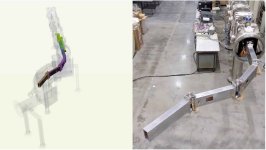

This is the 'TVS-2M' type fuel that Russia's Rosatom has delivered for Unit-3 of India's Kudankulam Nuclear Power plant in Tamil Nadu.. This advanced fuel will last 18months, earlier fuel type used to last 12 months.
US firm & NTPC to team up, fuel India’s thorium ambitions
Comes in the wake of SHANTI Act; NTPC may consider equity infusion
Written by Anil Sasi
New Delhi | Updated: January 1, 2026, 06:10 AM IST
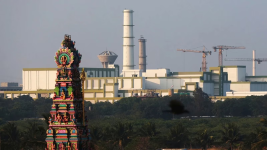
The move also signifies the government’s plan to explore the deployment of a thorium-based fuel for India’s existing fleet of Pressurised Heavy Water Reactors (PHWRs), which could, in turn, help buttress the country’s energy and fuel security. (AP)
Chicago-based Clean Core Thorium Energy (CCTE), only the second American company to have bagged an export license from the US Department of Energy to sell nuclear technology to India in nearly two decades, will partner NPTC Ltd, the country’s largest power utility, in the development of thorium as an alternative to uranium for fueling nuclear reactors.
The board of state-owned NTPC is learnt to have cleared a minority equity investment in CCTE in a strategic early-stage participation effort in this niche area, which could potentially mark another step toward closer cooperation between India and the US on atomic energy at a time when bilateral trade relations are still in a limbo.
The NTPC stake infusion proposal is subject to clearances from the Ministry of Power. The minority investment by NTPC, sources said, is aligned with its objective of setting up 30GWe (giga watt electric) of atomic energy capacity by 2047 and exploring an entry into the nuclear fuel cycle in a way that it aligns with India’s broader strategic objectives in the nuclear sector. Queries sent to NTPC on the issue did not elicit a response.
The move also signifies the government’s plan to explore the deployment of a thorium-based fuel for India’s existing fleet of Pressurized Heavy Water Reactors (PHWRs), which could, in turn, help buttress the country’s energy and fuel security.
Earlier in December, Parliament had passed the Sustainable Harnessing and Advancement of Nuclear Energy for Transforming India (SHANTI) Act, 2025, which marked a major shift in how India’s tightly controlled nuclear power sector will be governed in the coming years.
For the first time, the legislation enables private players to enter the operations side of this critical sector, including the possibility of foreign participation in the future. It also envisages a role for private entities in areas such as fuel management, which had remained under tight public-sector control for decades. The advantage with the thorium fuel produced by the Chicago-based company is that it can be shipped to India and directly loaded on to PHWRs.
Thorium, the radioactive metallic element named after the Norse god, has been a long-standing hope for India’s true energy security. It has been touted as an alternative to uranium since 1954 by India’s policymakers because it’s more abundant, produces lesser amounts of long-lived radioactive waste (that have a long half-life) and potentially lowers the proliferation risk.
For India, which has little uranium reserves but has abundant deposits of thorium, the latter has been part of a long-term strategy for reducing dependence on imported nuclear fuels.
CCTE’s founder and CEO Mehul Shah is of Indian origin. While thorium deployment has been predicated on the idea of new reactors being designed in the last leg of India’s 3-stage nuclear program to run on this fuel, which could entail reconstructing the country’s nuclear power fleet from the ground up, Shah and his company have approached this differently as part of Clean Core’s broader research of advanced nuclear fuel cycles, whereby it has created a new type of fuel that blends thorium with a more concentrated type of uranium named HALEU (high-assay low-enriched uranium). This can then be used in India’s pressurised heavy-water reactors that make up the bulk of the country’s existing fleet.
Clean Core’s new fuel, called ANEEL or Advanced Nuclear Energy for Enriched Life, can be potentially deployed in the country’s PHWRs at scale. The combination of thorium with small amounts of enriched uranium and the promise of its use in existing or new PHWR reactors promises to enhance India’s energy security by using domestically available thorium and improving safety and proliferation resistance. It could also significantly reduce nuclear waste. Additionally, the new fuel promises cost savings by delivering greater energy output within existing safety margins and lowering the operating costs of current reactors.
CCTE is learnt to have figured in assurances extended by the Department of Atomic Energy and the country’s nuclear regulator, the AERB, to the US between March and May 2025, and a license was granted to it in August from the US DOE.
Earlier, on March 26, the DoE had cleared New Jersey-based Holtec International’s application for specific authorization with respect to the restrictive regulation that is referred to as “10CFR810” (Part 810 of Title 10, Code of Federal Regulations of the US Atomic Energy Act of 1954) for transfer of technology to Indian entities.
According to nuclear scientist Anil Kakodkar, given that India is able to build large PHWR capacity with imported uranium as fuel, the country has the possibility of using this reactor capacity for conversion of thorium to fissile uranium through irradiation of thorium along with HALEU uranium fuel combination in the country’s PHWRs at scale.
This enables the launch of the thorium phase (the third phase of India’s three-stage nuclear program) earlier, without having to wait for build-up of required fast breeder reactor capacity in the second phase. PHWRs comprise the first phase of the 3-stage program.
The used fuel from these PHWRs, the mainstay of India’s nuclear power program, can then be recycled to set up additional power generation capacity, including through the new-age molten salt reactors or MSRs (nuclear fission reactor with molten salt as coolant or fuel). This will enable faster energy independence from imported nuclear fuel, Kakodkar told The Indian Express.
A former Chairman of the Atomic Energy Commission, he is now Chancellor of the Homi Bhabha National Institute and Chairman of the Rajiv Gandhi Science & Technology Commission.
Thorium itself is not a ‘fissile’ material like uranium, which means that its atoms are not inherently unstable enough for an extra neutron to easily split the nuclei and release energy. But it is classified as ‘fertile’ and can soak in neutrons and transform into the fissile material uranium-233, which can then be split to release energy.
The Department of Atomic Energy’s 3-stage power program envisages a pathway to utilizing India’s abundant thorium reserves – found in coastal sands on the beaches of Kerala, Tamil Nadu, Odisha, Andhra Pradesh, Maharashtra and Gujarat, and in the inland riverine sands of Jharkhand and West Bengal – to generate electricity. The second stage of the 3-stage plan involves the Fast Breeder Reactors or FBRs, where operational progress has been slow.
Given the impediments being faced in the large-scale deployment of FBRs, Kakodkar said a solution lies in looking at fuel cycle options instead of reactor options and that India needed “to be able to establish, as early as possible, self-sustaining (or near enough) thorium based nuclear power generation capacity sufficient enough… This, in turn, requires reactor capacity large enough to convert the required quantity of fissile uranium from thorium in time.”
Delays in FBR deployment is bad news for India’s nuclear program, given that these reactors envisaged the use of recycled fuel while breeding much more fissile fuel. By irradiating thorium along with HALEU in the country’s pressurised heavy-water reactors (which use heavy water as a coolant and moderator) at scale, one can make up for delays in the second stage, Kakodkar said.
The world over, most leading nuclear players such as the US, Russia, France and South Korea specialize in building light water reactors or LWRs, where normal water is used as coolant and moderator. While the SHANTI Act opens the door for LWR-based imported reactors to be set up, leveraging existing PHWRs does present itself as an important diversification from the import risk.
Pressurized heavy-water reactors are said to be more suited to handling thorium because heavy water – an isotope of water that has an extra neutron on the hydrogen atom – absorbs fewer neutrons during the fission process, increasing the efficiency of the fission reaction by allowing more neutrons to be absorbed by the thorium.
Currently, there are over 45 PHWRs operating worldwide: 19 in India, 17 in Canada, three each in Argentina and South Korea, and two each in China and Romania, according to International Atomic Energy Agency data.
US firm & NTPC to team up, fuel India’s thorium ambitions
Comes in the wake of SHANTI Act; NTPC may consider equity infusion
Written by Anil Sasi
New Delhi | Updated: January 1, 2026, 06:10 AM IST
The move also signifies the government’s plan to explore the deployment of a thorium-based fuel for India’s existing fleet of Pressurised Heavy Water Reactors (PHWRs), which could, in turn, help buttress the country’s energy and fuel security. (AP)
Chicago-based Clean Core Thorium Energy (CCTE), only the second American company to have bagged an export license from the US Department of Energy to sell nuclear technology to India in nearly two decades, will partner NPTC Ltd, the country’s largest power utility, in the development of thorium as an alternative to uranium for fueling nuclear reactors.
The board of state-owned NTPC is learnt to have cleared a minority equity investment in CCTE in a strategic early-stage participation effort in this niche area, which could potentially mark another step toward closer cooperation between India and the US on atomic energy at a time when bilateral trade relations are still in a limbo.
The NTPC stake infusion proposal is subject to clearances from the Ministry of Power. The minority investment by NTPC, sources said, is aligned with its objective of setting up 30GWe (giga watt electric) of atomic energy capacity by 2047 and exploring an entry into the nuclear fuel cycle in a way that it aligns with India’s broader strategic objectives in the nuclear sector. Queries sent to NTPC on the issue did not elicit a response.
The move also signifies the government’s plan to explore the deployment of a thorium-based fuel for India’s existing fleet of Pressurized Heavy Water Reactors (PHWRs), which could, in turn, help buttress the country’s energy and fuel security.
Earlier in December, Parliament had passed the Sustainable Harnessing and Advancement of Nuclear Energy for Transforming India (SHANTI) Act, 2025, which marked a major shift in how India’s tightly controlled nuclear power sector will be governed in the coming years.
For the first time, the legislation enables private players to enter the operations side of this critical sector, including the possibility of foreign participation in the future. It also envisages a role for private entities in areas such as fuel management, which had remained under tight public-sector control for decades. The advantage with the thorium fuel produced by the Chicago-based company is that it can be shipped to India and directly loaded on to PHWRs.
Thorium, the radioactive metallic element named after the Norse god, has been a long-standing hope for India’s true energy security. It has been touted as an alternative to uranium since 1954 by India’s policymakers because it’s more abundant, produces lesser amounts of long-lived radioactive waste (that have a long half-life) and potentially lowers the proliferation risk.
For India, which has little uranium reserves but has abundant deposits of thorium, the latter has been part of a long-term strategy for reducing dependence on imported nuclear fuels.
CCTE’s founder and CEO Mehul Shah is of Indian origin. While thorium deployment has been predicated on the idea of new reactors being designed in the last leg of India’s 3-stage nuclear program to run on this fuel, which could entail reconstructing the country’s nuclear power fleet from the ground up, Shah and his company have approached this differently as part of Clean Core’s broader research of advanced nuclear fuel cycles, whereby it has created a new type of fuel that blends thorium with a more concentrated type of uranium named HALEU (high-assay low-enriched uranium). This can then be used in India’s pressurised heavy-water reactors that make up the bulk of the country’s existing fleet.
Clean Core’s new fuel, called ANEEL or Advanced Nuclear Energy for Enriched Life, can be potentially deployed in the country’s PHWRs at scale. The combination of thorium with small amounts of enriched uranium and the promise of its use in existing or new PHWR reactors promises to enhance India’s energy security by using domestically available thorium and improving safety and proliferation resistance. It could also significantly reduce nuclear waste. Additionally, the new fuel promises cost savings by delivering greater energy output within existing safety margins and lowering the operating costs of current reactors.
CCTE is learnt to have figured in assurances extended by the Department of Atomic Energy and the country’s nuclear regulator, the AERB, to the US between March and May 2025, and a license was granted to it in August from the US DOE.
Earlier, on March 26, the DoE had cleared New Jersey-based Holtec International’s application for specific authorization with respect to the restrictive regulation that is referred to as “10CFR810” (Part 810 of Title 10, Code of Federal Regulations of the US Atomic Energy Act of 1954) for transfer of technology to Indian entities.
According to nuclear scientist Anil Kakodkar, given that India is able to build large PHWR capacity with imported uranium as fuel, the country has the possibility of using this reactor capacity for conversion of thorium to fissile uranium through irradiation of thorium along with HALEU uranium fuel combination in the country’s PHWRs at scale.
This enables the launch of the thorium phase (the third phase of India’s three-stage nuclear program) earlier, without having to wait for build-up of required fast breeder reactor capacity in the second phase. PHWRs comprise the first phase of the 3-stage program.
The used fuel from these PHWRs, the mainstay of India’s nuclear power program, can then be recycled to set up additional power generation capacity, including through the new-age molten salt reactors or MSRs (nuclear fission reactor with molten salt as coolant or fuel). This will enable faster energy independence from imported nuclear fuel, Kakodkar told The Indian Express.
A former Chairman of the Atomic Energy Commission, he is now Chancellor of the Homi Bhabha National Institute and Chairman of the Rajiv Gandhi Science & Technology Commission.
Thorium itself is not a ‘fissile’ material like uranium, which means that its atoms are not inherently unstable enough for an extra neutron to easily split the nuclei and release energy. But it is classified as ‘fertile’ and can soak in neutrons and transform into the fissile material uranium-233, which can then be split to release energy.
The Department of Atomic Energy’s 3-stage power program envisages a pathway to utilizing India’s abundant thorium reserves – found in coastal sands on the beaches of Kerala, Tamil Nadu, Odisha, Andhra Pradesh, Maharashtra and Gujarat, and in the inland riverine sands of Jharkhand and West Bengal – to generate electricity. The second stage of the 3-stage plan involves the Fast Breeder Reactors or FBRs, where operational progress has been slow.
Given the impediments being faced in the large-scale deployment of FBRs, Kakodkar said a solution lies in looking at fuel cycle options instead of reactor options and that India needed “to be able to establish, as early as possible, self-sustaining (or near enough) thorium based nuclear power generation capacity sufficient enough… This, in turn, requires reactor capacity large enough to convert the required quantity of fissile uranium from thorium in time.”
Delays in FBR deployment is bad news for India’s nuclear program, given that these reactors envisaged the use of recycled fuel while breeding much more fissile fuel. By irradiating thorium along with HALEU in the country’s pressurised heavy-water reactors (which use heavy water as a coolant and moderator) at scale, one can make up for delays in the second stage, Kakodkar said.
The world over, most leading nuclear players such as the US, Russia, France and South Korea specialize in building light water reactors or LWRs, where normal water is used as coolant and moderator. While the SHANTI Act opens the door for LWR-based imported reactors to be set up, leveraging existing PHWRs does present itself as an important diversification from the import risk.
Pressurized heavy-water reactors are said to be more suited to handling thorium because heavy water – an isotope of water that has an extra neutron on the hydrogen atom – absorbs fewer neutrons during the fission process, increasing the efficiency of the fission reaction by allowing more neutrons to be absorbed by the thorium.
Currently, there are over 45 PHWRs operating worldwide: 19 in India, 17 in Canada, three each in Argentina and South Korea, and two each in China and Romania, according to International Atomic Energy Agency data.
US firm & NTPC to team up, fuel India’s thorium ambitions
