

Military Technology from Ukraine
- Thread starter AntonKvertus
- Start date
You are using an out of date browser. It may not display this or other websites correctly.
You should upgrade or use an alternative browser.
You should upgrade or use an alternative browser.
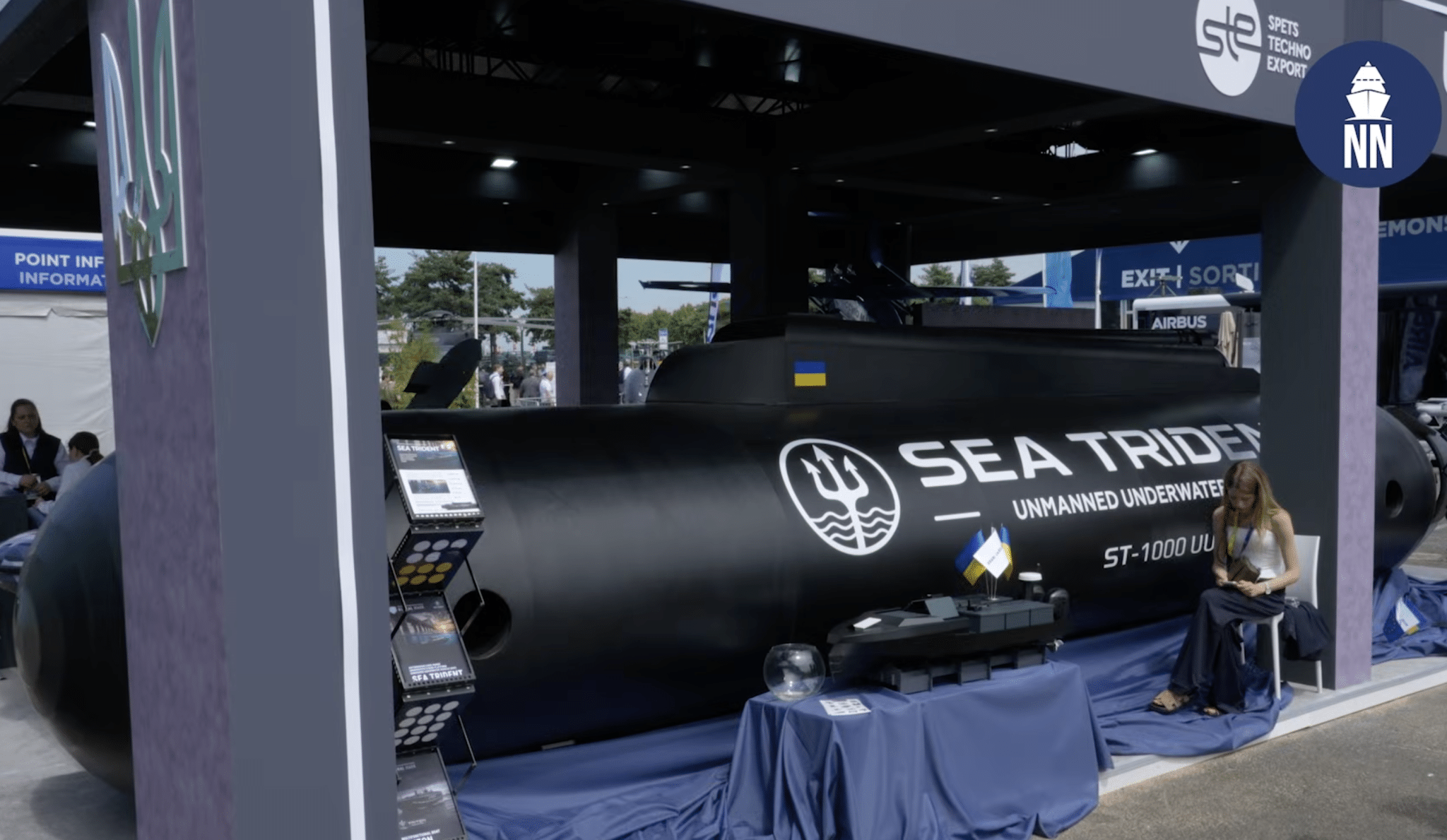
Video: Ukraine’s Massive New Underwater Drone - Sea Trident ST-1000 - Naval News
Ukraine’s Global Mark has just unveiled its first-ever Extra-Large Uncrewed Underwater Vehicle (XLUUV) at the Eurosatory 2026 defense exhibition in Paris: the Sea Trident ST-1000.
 www.navalnews.com
1- Kamikaze / Strike operations
2- Logistics and payload delivery
3- Interception and neutralization of other UUVs
4- FPV drones carrier
- Length: 10 meters
- Beam: 2 meters
- Height: 1.5 meters (excluding mast assembly)
- Weight: 10 tonnes
- Range: 2,000 nautical miles
- Speed: 6 knots cruising / 10 knots max
- Operating Depth: 60 meters
- Payload (Warhead): 1,000 kg
Ukraine’s top strike-drone maker moves into ballistic missile defense
Ukraine’s top strike-drone maker moves into ballistic missile defenseIts new FP-2 drone struck an oil refinery in Russia’s Tyumen region on June 20 — a target 1,286 miles from the Ukrainian border, Zelenskyy said — and the company says its rebuilt FP-1 now flies 1,677 miles up from 1,025 miles, while the FP-2 can carry a 440-pound warhead up to 230 miles away.
“The new modernized FP drones have been tested. Now they can reach targets at a distance of 3,000 kilometers. I am grateful to the Fire Point engineers,” Zelenskyy said in his June 20 evening address.
Zelenskyy said the next Fire Point drones will reach 1,864 miles, far enough to put refineries and arms plants in the Urals and western Siberia within range.
The FP-7.X is designed to hit a ballistic missile at 15 miles altitude for about $700,000 a shot — $300,000 under the original target — against roughly $3.8 million for a Patriot PAC-3. Fire Point aims to mass produce it at three a day starting in August.
Fire Point flight-tested the FP-7.X in early June, a “fully controlled maneuvering flight,” co-founder Iryna Terekh wrote on X alongside a video of the launch.
Ukraine’s newest strike weapon drifts into Russia on the wind
Ukraine’s newest strike weapon drifts into Russia on the windThe balloon-born missile, DART, drops from a balloon at about 7 to 11 miles and runs on satellite guidance until it falls to about 4 miles, where its navigation cuts out and a solid-fuel engine carries it along a fixed course, according to its creators at the Ukrainian company Center of Innovative Technologies Program.
Its roughly 22-pound warhead scatters conductive graphite filaments designed to short out Russian power grids, according to Militarnyi, though it has not yet cleared Ukrainian military codification.
Ukraine’s ballistic missile to hit Moscow is almost ready
https://defence-blog.com/ukraines-ballistic-missile-to-hit-moscow-is-almost-ready/
https://defence-blog.com/ukraines-ballistic-missile-to-hit-moscow-is-almost-ready/
Key Points
- Fire Point chief designer Denys Shtilerman said the FP-9 ballistic missile, with an 855 km range and 800 kg warhead, awaits only engine testing before first flight.
- The FP-9 is designed to reach Moscow and St. Petersburg and is expected to receive Ukrainian Ministry of Defense codification in 2026.
Denys Shtilerman, chief designer and co-founder of Fire Point, said the FP-9 ballistic missile has completed all major development milestones except its solid-fuel engine, which was undergoing ground testing at the time of filming, and that the first test flight to a target in Moscow could follow shortly after a successful engine validation.
“We have everything for the FP-9, which can reach Moscow, except the engine,” Shtilerman told Pressing. “We will test the engine this month and expect to begin test flights soon. As soon as a test flight shows that everything is working properly, the next flight should be launched toward Moscow.”
The FP-9 represents a different category of weapon entirely: a short-range ballistic missile designed to reach targets at 855 km (531 miles) in under three minutes of flight time, delivering an 800 kg (1,764 lb) warhead at speeds exceeding 2,200 meters per second (Mach 7), with a circular error probable of 20 m (66 ft). The missile measures 9.5 m (31 ft) in length and 1.1 m (3.6 ft) in diameter, making it larger than Russia’s Iskander-M ballistic missile, which is 7.2 m (23.6 ft) long and 0.95 m (3.1 ft) in diameter.
9 nations back Ukraine’s Patriot alternative, Freyja — and want it flying in a year
9 nations back Ukraine’s Patriot alternative, Freyja — and want it flying in a yearNATO Secretary General Mark Rutte, European Commission President Ursula von der Leyen and European Council President António Costa also attended Monday’s meeting in Paris, in addition to representatives from several European defense companies, including: Destinus, Diehl Defence, Eurosam, Fire Point, HENSOLDT, Kongsberg Defence & Aerospace, Leonardo, MBDA, Saab, Safran, Thales and Weibel Scientific.
“Europe needs more protection against ballistic threats. Together, we can create such a system,” he said. “It is important to politically confirm that FREYJA is our joint project, serving the interests of all of Europe.”

Ukraine’s Fire Point CEO On How It’s Making Missiles And Drones To “Destroy The Russian Empire”
Iryna Terekh talks Flamingo cruise missiles, weaponizing AI, Ukraine's future interceptors and much more in our wide-ranging interview.

Ukraine's Fire Point CEO On How It's Making Missiles And Drones To "Destroy The Russian Empire"
Iryna Terekh talks Flamingo cruise missiles, weaponizing AI, Ukraine's future interceptors and much more in our wide-ranging interview.
 www.twz.com