Lockheed Martin F-35 Lightning and F-22 'Raptor' : News & Discussion

Current F-35 Configuration Complicates Fielding Of APG-85 Radar

By Frank Wolfe | February 5, 2026
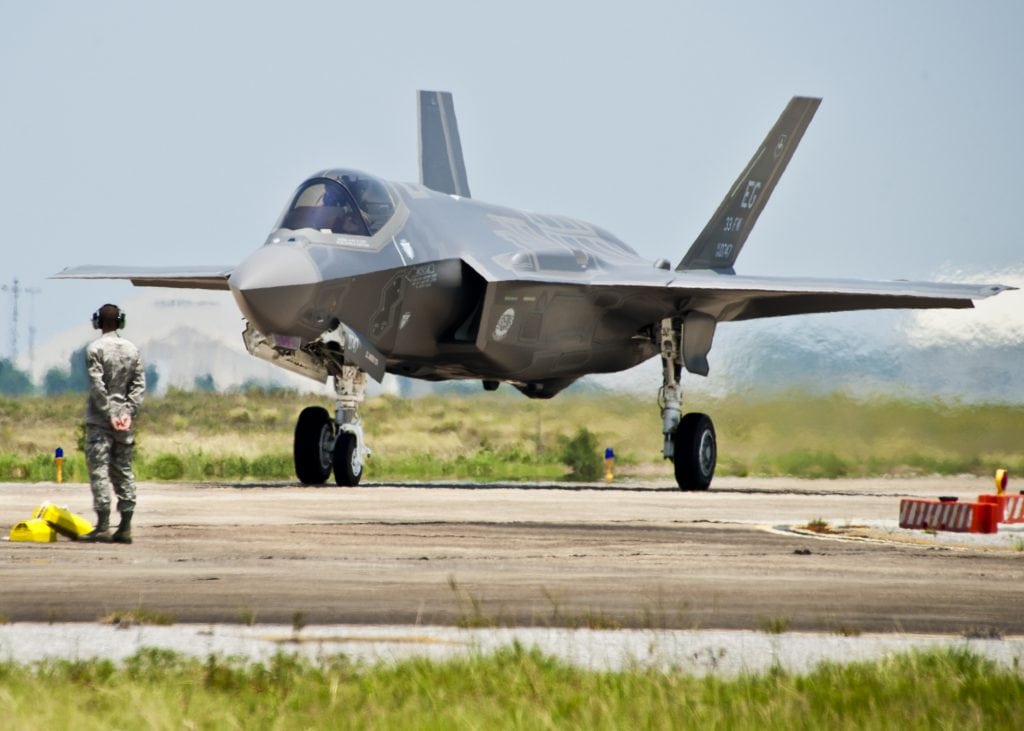
Radar mountings in the nose of the Lockheed Martin F-35 fighter are different for the current AN/APG-81 by Northrop Grumman and the future AN/APG-85 radar, also by Northrop Grumman–a difference which has helped complicate fielding of the new radar which was to deliver with F-35 Lot 17 but may now instead deliver later, possibly in Lot 20 in the next two years.

Radar mountings in the nose of the Lockheed Martin F-35 fighter are different for the current AN/APG-81 by Northrop Grumman and the future AN/APG-85 radar, also by Northrop Grumman–a difference which has helped complicate fielding of the new radar which was to deliver with F-35 Lot 17 but may now instead deliver later, possibly in Lot 20 in the next two years.

“The APG-81 is different than the APG-85, and therefore delivering the aircraft, as currently configured, with an APG-85 radar versus an APG-81 radar is challenging,” Rep. Rob Wittman (R-Va.) said in an interview off the House floor on Feb. 3.

“The bulkhead configuration is key because for both of the radars, they are very different,” he said. “Remember, the bulkhead configuration allows the placement of the radar towards the attitude of the array, and the attitude of the array makes all the difference in the world about how the radar operates.”

A dual mount to accommodate either the APG-85 or the APG-81 would take two years to field, a source told sister publication Defense Daily.

“I know all about it, but the delivery of the aircraft is classified,” Wittman said when asked whether he knew if it were true that Lockheed Martin has been delivering F-35s to the military services since last June without radars, including all F-35As. “I can’t speak to the condition of the aircraft so you’ll have to go to the Air Force, the customer, and ask them about that.”

Wittman, the chair of the House Armed Services Committee’s Tactical Air and Land Forces panel, has been bird-dogging the F-35 program and the contractor team since the fall of 2024 on delays in the delivery of the APG-85, including what he said have been monthly phone calls since then with the head of the F-35 program executive office. Marine Lt. Gen. Gregory Masiello became the F-35 program executive officer in July last year. He succeeded Air Force Lt. Gen. Michael Schmidt, now retired, who served as the head of the F-35 Joint Program Office between July, 2022 and July, 2025.

“I spoke to Lockheed yesterday, and they’re working with Northrop to get APG-85 delivered even faster,” Wittman said on Feb. 3. “They’re doing some things to try and integrate it with Technology Refresh-3 [TR-3] and Block 4.”

Nearly a year and a half ago, Wittman said that he had met with Northrop Grumman to discuss the need to reduce test time for the APG-85, which he said had increased from three days to 78 days—part of a wider set of challenges involved in building a Gallium Nitride-based radar needing upgraded cooling and power in the F-35’s nose.

Wittman said that “they’ve condensed the testing regime” and “have been able to truncate some of those things” to accelerate delivery. “We’ve been on Lockheed, as well as Northrop to continue to compress the schedule,” he said. “I’d like to see them compress it even more. I think they can do that.”

The APG-85 is to deny adversary use of the electromagnetic spectrum and to allow better weapons accuracy and targeting of adversary airborne and surface radars at greater ranges.

“It’s an incredibly advanced radar,” Wittman said of the APG-85. “The arrays on it give it much more power which is why we have to upgrade the engine. I think we need about 82 kilowatts of power versus what it’s producing right now. The APG-85 is key to Block 4, and it’s key to TR-3 software upgrade capabilities and integration with the imaging system, the Distributed Aperture System.”

More than two and a half years ago, now retired Air Force Lt. Gen. Richard Moore, then the service’s deputy chief of staff for plans and programs, said that “we are getting very close to the new radar on the F-35” and that the APG-85 would be “a dramatic increase in our ability” over the APG-81 radar, which Northrop Grumman builds in Linthicum, Md.

“It’s my hope they do it [delivery of APG-85] as fast as humanly possible and have the system perform,” Wittman said on Feb. 3. “I don’t want it delivered, if it’s gonna be operationally deficient because then the aircraft sits on the tarmac.”

F-35 deliveries to U.S. units in the field since last June have had the APG-85 mountings, which do not fit the APG-81. But, the radar-less F-35 deliveries have not affected sales to foreign partner nations which have the APG-81 on their jets, the source said, adding that, without a radar, there had to be additional weight added in the nose for aircraft balance during flight. Radar-less F-35s have been able to fly, as long as they are accompanied by other F-35s, data linked and equipped with the APG-81, the source said.

On Feb. 3, an Air Force spokeswoman said that the Air Force’s, Navy’s, and Marine Corps’ joint development and integration of the advanced APG-85 will help defeat “current and projected adversarial air and surface threats.”

“This advanced radar will be compatible with all variants of the F-35 aircraft,” according to the Air Force. “Due to program security reasons, we are protecting any additional information with enhanced security measures.”

F-35 deliveries restarted in July 2024 after a halt in late 2023 due to software problems with TR-3, which is to allow the integration of dozens of new sensors and weapons for the Block 4 upgrade.

In January 2023, Northrop Grumman disclosed the development of the APG-85 for Block 4 F-35s beginning with Lot 17, but the company and the F-35 program have not revealed funding levels nor contract details for the radar.
 
When I saw A U S, I read it as AUS and thought it was about Red Flag, t
"Altogether, there are 32 units from the USAF and Space Force, US Marine Corps, US Navy, Air National Guard, alongside the RAF, and Royal Australian Air Force (RAAF)."


@pic, A try and fail story about a senator who when asked a Q was told, he doesn't know and told to ask air force, Do you really think they aren't putting in APG81 radars? Given the 85 needs a new bulkhead
 
Last edited:
  • Like
Reactions: BMD
@pic, A try and fail story about a senator who when asked a Q was told, he doesn't know and told to ask air force, Do you really think they aren't putting in APG81 radars? Given the 85 needs a new bulkhead


F-35 deliveries to U.S. units in the field since last June have had the APG-85 mountings, which do not fit the APG-81. But, the radar-less F-35 deliveries have not affected sales to foreign partner nations which have the APG-81 on their jets, the source said, adding that, without a radar, there had to be additional weight added in the nose for aircraft balance during flight. Radar-less F-35s have been able to fly, as long as they are accompanied by other F-35s, data linked and equipped with the APG-81, the source said.
 
It's wrong from what I've read

"Radar mountings in the nose of the Lockheed Martin F-35 fighter are different for the current AN/APG-81 by Northrop Grumman and the future AN/APG-85 radar, also by Northrop Grumman–a difference which has helped complicate fielding of the new radar which was to deliver with F-35 Lot 17 but may now instead deliver later, possibly in Lot 20 in the next two years."

1, only US aircraft initially get the APG-85
2, the dual fitment bulkhead won't be available till lot 20, it's not available for lot 17, They can't fit the APG-85
3, the question could be asked, were APG-81 radars ordered for US lot 17?
 
Last edited:
Appendix J. AUKUS-Related: Projects Characterized as Too Big to Fail

A 2012 review by one observer of a report from Australia's Defence Materiel Organisation (DMO) on major Australian defense acquisition programs stated the following in connection with an Australian program to acquire F-35 Joint Strike Fighters:

Since the inception of this project, [the Australian Department of] Defence has accepted, seemingly without question, the marketing that has been generated by the [F-35] manufacturer and the US Project Office. Despite a series of increasingly critical reports coming from various US Governance authorities, Australia's commitment to the JSF has been unwavering and unquestioning. As the pressures from such reports increased, both US and Australian Defence and Military bureaucrats have retreated to the defence of 'The project is too big to fail', and 'There is no alternative', neither of which is true.

The outcome of the JSF Project will be determined by the laws of physics, not by any political/commercial/bureaucratic imperatives. The A12 Avenger [attack aircraft] Project was also 'too big to fail', but it did, and for much the same reasons that now threaten the JSF Project. Furthermore, both Defence and the DMO have been provided with independent and robust analyses of the JSF Project, but these seem to have all fallen within the Major JSF Project Challenge of "Appropriately manage JSF misinformation in the media". Certainly, all attempts to raise questions about the project have been ignored or rebuffed.

The JSF Project demanded competent and robust project and systems engineering analysis and management from its inception, much along the lines that the Air Member for Technical Services at the time provided for the F-111 Project. His independent evaluation of that project and the critical problems that beset it enabled the early identification and successful management of the risks involved. Because that capability was stripped from the RAAF [Royal Australian Air Force] under the DRP/CSP [Defence Reform Program/Commercial Support Program], the risks associated with the JSF project are now all maturing. https://www.congress.gov/crs-product/RL32418#fn192 (192)


192.E. J. Bushell, Review of Defence Materiel Organisation (DMO) Major Projects Report (MPR) 2010-11, February 2, 2012, p. 52, with cover letter dated February 2, 2012, addressed to Committee Secretary, JCPAA (Joint Committee of Public Accounts and Audit), Department of the House of Representatives, Parliament House, Canberra.
 
2012, That was the prediction, and now the conclusion is: the risks associated with the JSF project are now all maturing. The report is dated 01/26/2026
You have a civilian who works in congress, write a report for congres on open sourse information, I hope you don't mind if I just take it at face value

Then he quotes a public submission sent to our gov , All Australians can submit a submission and have their say

It's a part of our democracy, Any Idiot can put in a submission, It's a free for all
It was a submission from a retired guy, who had an axe to grind, I guess you would like to read the whole thing? He was complaining about how a department works

Why post it here, he wasn't even talking about the F-35


1770620206766.png
1770620280908.png
 
Last edited:
found it, from the retired old man, said on bottom of page 1
The old crank makes a F-35 JSF bitch on page 52, He doesn't have access to anything and only public open source

The US civilian who works for congress, must have found his submission on google, I really don't know why he used him, I guess that is what happens when you get people writing reports who don't have access to what is really going on
It is funny that this submission ends up in a US report, the magic of the internet
 
Last edited:
@ PIC, I understand why you are having a hissy fit, France's big dream of the FCAS is dead
Through frustration you want to attack the F-35, which is the best available fighter in the world


PARIS — The long-troubled Future Combat Air System (FCAS) developed by France, Germany and Spain is on the brink of collapse, four European officials in Paris and Berlin told POLITICO.

"An announcement ending [the project] is more likely than a revival," said an official familiar with French President Emmanuel Macron's thinking on Friday.

A French parliamentarian working on defence issues expressed the same opinion separately.

"The FCAS is dead, everyone knows it, but no one wants to say it," he said.
 
@ PIC, I understand why you are having a hissy fit, France's big dream of the FCAS is dead


PARIS — The long-troubled Future Combat Air System (FCAS) developed by France, Germany and Spain is on the brink of collapse, four European officials in Paris and Berlin told POLITICO.

"An announcement ending [the project] is more likely than a revival," said an official familiar with French President Emmanuel Macron's thinking on Friday.

A French parliamentarian working on defence issues expressed the same opinion separately.

"The FCAS is dead, everyone knows it, but no one wants to say it," he said.
Maybe, India and France could develop 6th gen fighter together:) What do you say, our Aussie mate;)
 
  • Love
Reactions: Hydra
Maybe, India and France could develop 6th gen fighter together:) What do you say, our Aussie mate;)
I suggest codevelopment of ~30ton mtow SCAF, completed in ~2040 ,for Indian navy and French navy/airforce.

By then IN alone will have requirement of ~100 stealth jets to be completed in near future along with existing and expended inventory of rafale Ms .

France will also have combined requirements of ~100 SCAF.

120-140kn joint engine development is already confirmed.
Internal avionics could be separately developed for each nation.
 
  • Like
Reactions: Rajput Lion
Australia paid $144m to be a F-35 partner
"System Development and Demonstration (SDD) Payments: Australia contributed a cash component of US$144 million for the SDD phase, which was completed, with the phase closing in 2017."

Look at what Germany and Spain was expected to pay and what they got, two thirds of the cost $20billion each and France wants most of the workshare, an 80% number was published
 
Australia paid $144m to be a F-35 partner
"System Development and Demonstration (SDD) Payments: Australia contributed a cash component of US$144 million for the SDD phase, which was completed, with the phase closing in 2017."

Look at what Germany and Spain was expected to pay and what they got, two thirds of the cost $20billion each and France wants most of the workshare, an 80% number was published
Partner? Don't think its the right word.

Australia's f35 participation can be described as-:
Early booking fees with some TOT for some components to be license manufactured in Australia.