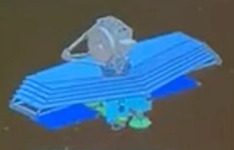

This is an actual prototype being made, not a render.
View attachment 54844View attachment 54845
Deployable Optical Space Telescope (DOST) hardware and poster displayed at the ISRO stall at Bengaluru Space Expo (BSX) 2026 on 7 September 2026. The poster credits the development team as OPMG-MESA-SAC-ISRO and shows a segmented primary mirror assembly with six hexagonal segments labelled SPMMS-1 through SPMMS-6, alongside a deployable boom and actuator assembly.
Displayed hardware includes a hexagonal mirror segment substrate with harness and connectors attached, marked with X and Y axis reference arrows, a gold coloured cradle holding a foil wrapped cylindrical component, an actuator and gear assembly, and coiled copper harness with connectors.
OPMG is the Optical Payloads Mechanics Group, which sits under the Mechanical Engineering Systems Area (MESA) at the Space Applications Centre, Ahmedabad. The group works on opto-mechanical design for space-borne imaging instruments, covering the mechanical frameworks, mounts and flexures that hold optical elements in place, and the precision engineering needed to keep those elements aligned through the thermal swings of orbit. Its remit spans remote sensing, communication and navigation payloads. MESA is one of SAC's top-level areas, alongside the Microwave Remote Sensors Area, the Satcom and Satnav Applications Area, the Earth, Ocean, Atmosphere, Planetary Sciences and Applications Area, and the Human Spaceflight and Advanced Technology Area. As of mid 2026 the Group Director of OPMG was Mr. Neeraj Mathur and the Division Director of MESA was Mr. Naimesh Patel.
Adjacent exhibits visible in frame include a radar altimeter designed for sea surface terrain for Gaganyaan, providing altitude from 0.5 km to 3 km with up to 20 degree attitude tolerance in pitch and roll, flown in the Pad Abort Test and the Gaganyaan Integrated Air Drop Test, shown with an IADT-02 altitude profile chart marking ascent mode, level flight, crew module release and descent mode. Panels for a Ka-band receiver, Ka-band FG, X-band receiver and FG, 1 W power amplifier and SSR are also visible.
Also in frame is a Space TWTA panel under a Make in India banner, listing 10.7 to 11.7 GHz, 210 W output at beginning of life, 50 percent efficiency, around 50 dB gain, IMD of -11 dBc at 3 dB IBO, a radiation cooled TWT, a dual anode gun for control over life and a 4-stage depressed collector, together with the infrastructure required for production and a note that ISRO is seeking a technology partner. The panel states that a typical 24-transponder communication satellite needs around 30 TWTAs and that the technology is available from only a small number of sources globally.
Further exhibits in frame include an IMS-1M MX payload panel on onboard AI and ML computing for cloud detection, forest fire detection and target detection and tracking, with nano-processing electronics called out, a GDB ASIC
Source: Indianspaceflight.in
Source: Indianspaceflight.in
(Click on the link to watch that video)
Presentation by ISRO's Liquid Propulsion Systems Centre (LPSC) shown during Bengaluru Space Expo (BSX) 2026 on 7 September 2026. Covers the SE-2000 semi-cryogenic engine platform and includes a 3D render / animation of the LME-110 LOX-methane engine.
I think this is for ISRO's "ExoWorld" telescope for "Observing Exoplanetary Atmospheres" at Sun-Earth L2 point: