First Joint View by Coronagraphs on India's Aditya-L1 and Europe's Proba-3 Decodes Solar Eruptions Near Their Birthplace
October 15, 2026
For the first time, scientific observations of the same solar eruptions by India's Aditya-L1 mission and Europe's Proba-3 have been jointly analyzed and published. Scientists at the Indian Institute of Astrophysics (IIA), Bengaluru, combined observations from the VELC payload onboard Aditya-L1 and the ASPIICS payload onboard Proba-3 to study coronal mass ejections (CMEs). They measured the mass, density, and energetics of these CMEs in the region very close to the Sun. The study has been published in the prestigious journal
Astronomy & Astrophysics.
Why it matters:
CMEs are large eruptions from the Sun in which huge amounts of magnetized plasma are thrown out into interplanetary space. When such eruptions are directed towards Earth, they can disturb the near-Earth space environment. Measurements of CME parameters near the Sun are very valuable for understanding the physical processes that shape CME properties and subsequent evolution. However, observing CMEs very close to the solar disk is challenging, and earlier space coronagraphs only partially succeeded in observing them and could not track the early evolution of faint CMEs. As a result, how CME energy is shared between kinetic, thermal, and magnetic in the inner corona has remained poorly constrained. Combining Aditya-L1/VELC and Proba-3/ASPIICS shows potential for a better understanding of it.
Aditya-L1, India's first dedicated solar mission, was launched by PSLV-C57 on 2 September 2023. The spacecraft was successfully placed in a halo orbit around the Sun—Earth L1 point on 6 January 2024. This special vantage point facilitates uninterrupted observation of various solar phenomena. The Visible Emission Line Coronagraph (VELC) was developed by IIA, Bengaluru, in close collaboration with ISRO. VELC takes the spectroscopic observations of the solar corona from 1.05 to 1.5 solar radii in the 5303 Angstrom green coronal line.
Proba-3, a mission of the European Space Agency (ESA), was launched by PSLV-XL from Sriharikota on 5 December 2024. It is the world's first precision formation-flying mission. Two spacecraft fly about 150 meters apart, and one casts a shadow on the other. This creates an artificial solar eclipse in space, allowing the ASPIICS coronagraph onboard Proba-3 to image the corona from about 1.1 to 3 solar radii in white light and in the 5303 Angstrom green coronal line.
Working together:
The coronagraph onboard Aditya-L1 (VELC) and Proba-3 (ASPIICS) conducted joint observations of almost the same part of the solar corona in two different types of observations (spectroscopic from VELC and imaging from ASPIICS). These joint observations provide deeper insights into CME evolution than observations from a single spacecraft alone. ASPIICS white-light and green coronal emission line observations provide sharp images that enable accurate estimates of a CME's shape, dynamics, and mass. VELC spectroscopic observations in the green coronal emission line provide information on CME gas at about two million degrees. This gives independent estimates of the CME's density and thermal energy. The two instruments share a common field of view in the low corona. The team found that only two CMEs, on 14 and 16 September, were recorded simultaneously by VELC and ASPIICS from July to December 2025. In both cases, VELC caught the eruptions at an early stage, demonstrating how the two instruments complement each other.
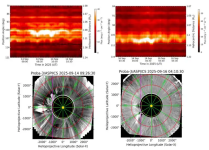 Figure: Coordinated observations of two coronal mass ejections (CMEs) on 14 September 2025 (left) and 16 September 2025 (right). The upper panels show the increase in coronal emission recorded by Aditya-L1/VELC as the CMEs passed through the inner corona. The lower panels show the corresponding CMEs observed in white light by Proba-3/ASPIICS.
Key findings:
- Two CMEs, two behaviors: The 14 September CME was fast (about 645 km/s), while the 16 September CME was much slower (145 km/s). The density of the 16 September CME dropped more steeply with height than that of another CME, indicating its stronger early expansion.
- Independent checks agree: Estimates of mass and thermal energy from ASPIICS and VELC agree well, despite the two instruments using different geometric assumptions, physical considerations, and observation types.
- Different energy partitioning: In the 14 September 2025 CME, thermal energy was only about 1% of the total. In the 16 September 2025 CME, thermal energy grew until it matched kinetic energy. The estimated magnetic energy is comparable to or greater than the kinetic energy.
The results demonstrate the scientific potential of synergetic ASPIICS and VELC observations to constrain the CME mass, density, and energetics in the inner corona, thereby providing new observational constraints on the early evolution of CMEs. The study shows that pairing a coronagraph that images the corona with one that measures its spectrum yields a more complete, cross-checked view of the origin and evolution of CMEs.
This study was led by researchers from the Indian Institute of Astrophysics along with other European and American solar physicists. The work shows the growing scientific impact of Aditya-L1 and the strength of coordinated observations and associated international cooperation in solar astrophysics and space science.
Reference: Agarwal, A., Mishra, W., Ramesh, R., et al. (2026). Coordinated coronagraphic observations from Proba-3 and Aditya-L1: Investigating coronal mass ejection energetics in the inner corona. Astronomy & Astrophysics.
https://doi.org/10.1051/0004-6361/202661733
First Joint View by Coronagraphs on India's Aditya-L1 and Europe's Proba-3 Decodes Solar Eruptions Near Their Birthplace


 timesofindia.indiatimes.com